| PAGE | CREATED BY | F E L O |

|
| The use of nitrous oxide (N20) as a performance enhancement has been traced back to World War II, where it was employed to give Allied aircraft "emergency" boosts in both airspeed and altitude capabilities. However, with the advent of jet propulsion at the end of WWII, the government's interest in piston-powered aircraft waned. And for the most part, nitrous R&D was shelved. There were sporadic attempts at using nitrous oxide in race cars over the next few decades, but since tor the most part it was a clandestine, closely-guarded secret, not too many people were aware of its existence. Finally, in the 1970s, nitrous "came out of the closet" and was the hot topic of conversation. Especially since a number of entrepreneurs brought systems to market that were highly erratic, at best. It was at this point in time when a couple of successful automotive technicians and racers, Mike Thermos and Dale Vaznaian, saw there was a potential for nitrous - done right. In 1978 Mike and Dale formed Nitrous Oxide Systems, Inc., and the rest is history. They didn't invent nitrous oxide - they simply perfected its use and elevated it to a position of prominence. Admittedly, the company's early years were largely spent demonstrating that nitrous oxide was an efficient, safe and reliable form of performance enhancement. NOS has always been known for thoroughly engineering each application, using only the best quality materials, and producing kits that were easy to install and built for long service. And with enthusiast publications like Hot Rod Car Craft and Popular Hot Rodding among many, informing their readerships with in-depth tech features on NOS systems for various applications, the word began to spread. Perhaps the greatest boost to the popularity of nitrous oxide was the advent of drag racing's Pro Mod class. Early pioneers like Charles Carpenter, Bill Kuhlmann and Robby Vandergriff captured the imagination of race fans with their impressive performances with stock-bodied cars. And NOS was there for every performance milestone - the first 200 mph run by a "doorslammer," the first 6-second run, etc. In fact, every single key performance milestone with nitrous has been set by racers using NOS systems. Today, as a Holley brand, and with over twenty years experience building nitrous systems for racing and street applications, NOS remains as the dominant force in the industry. A great deal of the company's success can be attributed to its ongoing pursuit of perfection and extensive R&D efforts. Another key factor is the relationships that NOS has forged with leading racers and professional engine builders. Their input has served to keep the company on the leading edge of technology. As we enter the next millennium, NOS stands ready to serve its customers with the industry's most complete selection of nitrous oxide systems and a technical support team that's often rated as the best in the business. |
 |
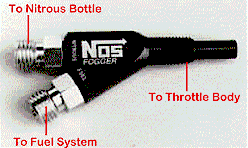
| Adding Nitrous Oxide (N2O) to your car, is one of the most cost effective ways to substantially increase your horsepower and torque. The power increases are phenomenal, it is available on demand, and a "normal system" will cost you thousands less than a turbo- or super-charger. The marvels of modern chemistry! How does Nitrous Oxide accomplish this? 1. Nitrous Oxide is comprised of 36% oxygen as compared to about 21% that is in a normal atmospheric intake charge--that's about 70% more oxygen! More oxygen means more combustion which in turn means more power (assuming that there is sufficient fuel to burn the additional oxygen!) 2. So if greater oxygen and fuel content in the combustion chamber cause the increase in horsepower, why not just inject oxygen? Well, the engine would produce more power than it could handle and simply blow up! Once the N2O is injected into the chamber and the temperature reaches 572�F (on the power stroke), the molecules breakdown and the the nitrogen and oxygen molecules are separated. The oxygen is immediately burned and the remaining nitrogen helps to dampen the combustion so that the above problem does not occur. 3. As the Nitrous Oxide changes from a liquid to a gas, it cools the intake air temperature to the tune of 60�-75�F. As a rule of thumb, for every ten degree reduction in intake air temperature, there is a 1% increase in horsepower. |
 |
 |
 |