
In general, one defines a breeder as being the one that reproduces a species. What differentiates a GOOD breeder is the little things he does or insists be done. How then do we differentiate a good breeder from a bad one?
The best known way, is the game of questions and answers. Certainly questions that you would ask but that you would also know most of the answers. Learn to listen attentively, you will learn a lot, and more quickly than you think. At this stage, with the research you have done, you should know enough about the breed you have chosen. Ask the right questions to the breeder and see if his answers satisfy you. Remember that there are only two kinds of breeders, the good ones and the others.....

 A good breeder will want to know all about you, your family, if someone at home has allergies, if you have children, if you want to have children during the life of the cat, etc.. He will also want to know why you want a cat, what you want to do with him, etc. He will probably ask you more question than you have for him. Don't be upset it's not mistrust but interest.
The others will want to know if you have the money to pay for it, for the remainder, no questions.
 A good breeder won't let you see the kittens at a young age, at least you will not be able to have direct contact with them before the first vaccinations (for health reasons). In doing this, they want to avoid the contamination of the kittens before their immunity system has developed. The immune system is generally complete after the age of 4 months. However you can see the kitten after the age of 8 weeks after the first shots. But at this time you will probably not have direct contact with them.
With the others, you will be able to see and touch the kittens without any precautions.
 A good breeder will provide you with a health certificate for your kitten that will have been seen by the veterinary, vaccinated, wormed if it's necessary, etc. Besides, the vaccination schedule will be up to date, and it will provide you with health guarantees. He will explain to you the how + why for the vaccine he recommends.
They can provide you, in certain cases, with a vaccination certificate. Often, recalls are not done. For guarantees, you will have to go yourself.
 A good breeder will know the main hereditary illnesses of his breed, he will ascertain the absence of these illnesses in his reproductive animals. He will be able to advise you of the future of your kitten if by bad luck something happens. General rules, hereditary illnesses are coverd by a total warranty.
Hereditary illnesses�? These cats don't look sick, do they? Why a warranty for a thing that will probably never happen?
 A responsible breeder will be able to show you the registration certificates of his reproductive animals, as well as those of the kitten if they are old enough or if not, the registration of the litter. He take pleasure in explaining to you the importance of that certificate.
He will insist that these cats are pure breeds but won't be able to show you the papers since he doesn't take care of that. He may offer you papers in return for a monetary surplus, this doesn't look good. Were do these certificates come from, if he doesn't have the parent's�papers?
 A good breeder will be proud to show the parents, at least the mother, if the father comes from elsewhere. He will also show you other cats living with him. However, he will be able to give you all the information on the father's credentials and if you ask, probably a picture.
He may not be able to show you the mother under pretense that she is a little apprehensive. As to the father, his coordinates have probably been misplaced or he used the first one he found or the lest expensive one..
7. THE OBJECTIVES OF REPRODUCTION
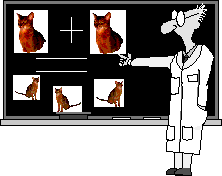 A good breeder will explain with passion his objectives for this reproduction, his aim: to improve the breed, to insure a progeny, etc. He will explain to you why he chose this particular female with this male, what is important to him in the reproduction, either to produce healthy kittens, or the most compliant to the breed.
It may be one of his first litters, or maybe he produces too often. Justifying the litter generally goes from "one wants to make a little money to cover our expenses with the cat", or "one wanted to have a litter to calm her temperament" while passing by the unavoidable "well its fun for the children". If the kittens sell quickly and if he doesn't have any problems he might decide to reproduce again, and again and again.
 A good breeder will have spent a lot for his litter. He may have traveled quite a distance to have his female mated and paid out a considerable sum for this. He will certainly have invested in the detection of congenital illnesses. He will also have taken the trouble to verify that the male also answers to the same standard of quality. He will also have invested in a quality food and will keep up the good health of his reproductive animals.
He probably uses the cupboard for his litter, or the least expensive place, without any other concerns. Health verification is probably limited to the yearly vaccination. He doesn't bother with the parent's temperament, all he cares about is the mating.
 A good breeder will provide you a pedigree with your cat. He will be pleased to tell you about your future kitten's ancestors, of which he knows several, or even some are present in his home, or his immediate setting. If you don't stop him the story can be long.
The others try to explain the uselessness of these small pieces of papers.
 A good breeder will most likely have a waiting list or reservations. Don't get discouraged, it is better to wait a while and get what you really want. The good breeder takes pleasure in your visit's whether he has a kitten for you or not.
You won't hear from him except if there are kittens available, no interviews, discussions, nor reservations.
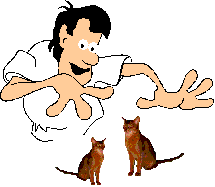 A good breeder, especially if you are unskilled on the subject, may want to choose your kitten himself. At least, he will limit your choice to those kittens that he feels would be right for your lifestyle and your expectations. Trust him, if you don't, go to another breeder.
No help, no selection, for him all are the same.
 A good breeder will give you a lot of information on the feeding, the training, the care and tell you everything you need to know to succeed with your new companion. He will be able to suggest pertinent books or magazines and the specialized places (veterinary, groomer, competent training schools).
To your questions, he'll answer, it's easy, everybody knows what to do�!
 A good breeder will probably be a member in good standing of various feline clubs, relating to his breed. It could be breed clubs, general cat clubs, etc. He will also encourage you to join these clubs, and will be able to, if need be, speak for you to these clubs.
Beware of those that say it doesn't matter, or that they were previously members but that because of disagreement with certain orientations of the club, they didn't renew. Some will tell you they had nothing to learn or take away from these organizations. Rather, ask yourself, who doesn't want who?
 A good breeder will require up-dates on the kitten. He will certainly ask you to advise him of the least problem. He will be there to guide you. Your relationship will often become a friendly and profitable one.
If you are able to find him, he won't know what to say, or he won't return your calls. Anyway, it's no longer his problem.

A good breeder will present you with a written contract. This contract will contain all applicable information to the identification and the description of the animal that you buy. He will include a description of your responsibilities as a new purchaser. There will also be a complete description of the guarantees offered by the breeder. This will allow you to see the conditions clearly and also to refer to them if you need to.
No written contract, but remember that in spite of all the wonderful promises, words take off but the written word remains.
 A good breeder will foresee a clause for the return of the kitten if problems should occur with your new buddy. There is no way he will let his small baby be put on the street or worse yet sent to the pound. If he doesn't take him back, he will be able to foresee a means to re-settle the kitten in a new location, if for some reason you were unable to take care of him.
One would surely answer you to do what you want, the kitten is yours now and so are the problems.
 A good breeder will keep his animals with him in the house. These "babies" are usually born close to him and will be raised in a healthy environment, with the family members. Being in the house their socialization will only be better, and the time that the breeder spends with them will be a plus.
Be on your guard with kittens kept in barns, hangars, or again in the cold and humid cellars. Kittens may not have known anything else but their small unsanitary corner.
18. ARE YOU INTERESTED IN BREEDING?
A good breeder will demand a lot of you, if you want to buy a cat for reproduction.. It will be up to you to prove to him that you have acquired enough knowledge to get good results. You should also demonstrate that your objectives are honorable and that you don't only want a machine to provide kittens. Don't take offense to the fact that a breeder is distrustful towards you, don't take it personally, his goal is to preserve the breed. If he accepts to let you join the select club of breeders, he will always be there to guide you in your progress. He will make sure to provide you with his best kitten to assure your future success. You will need to understand that it is his name that you will represent while showing kittens having their origin from his precious lineage. A bit normal, don't you think.
You buy the kittens and you do what you want with them. We don't care.
 A good breeder will inform you of all the inconveniences of keeping a cat and especially this breed. He will inform you of the kittens specific needs, his disposition to supervise, etc. Don't think that he wants to discourage you, he wants to make sure you know what you are taking on.
If it's him that has the perfect breed, beware.
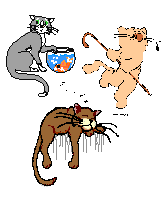 A good breeder will be able to explain and demonstrate the disposition of each of his kittens. His knowledge on the subject is certain. He knows each of them personally. He probably did several temperament tests and since he lives with his pups, he knows them well. For him, every kitten has his own disposition, each is different.
No matter what one tells or doesn't tell you, cats are not all equal, every animal has a different character.