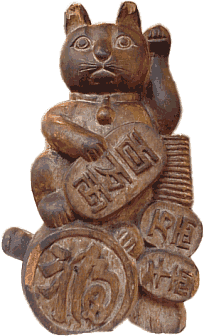
 It is commonly believed that the Maneki Neko became popular in the latter half of the Edo Period (1603 - 1867), although this lucky cat is rarely mentioned by name in era documents. By the Meiji Period (1868 - 1912), however, it begins to appear with great regularity in publications and business establishments. One of the most plausible reasons for its rapid rise to popularity in the Meiji Period involves the sex industry. In the secluded Edo Period, during which Japan closed its doors to the outside world, an indigenous "amusement" culture grew side by side with the expanding power of the merchant class.
Among the various manifestations of the Maneki Neko charm, the most popular is tri-colored. Yet tri-colored male cats are rarely found among the world's cat population. Indeed, genetic studies show conclusively that a tri-color gene in male cats is quite rare. For this reason, perhaps, the tri-colored Maneki Neko is considered most lucky. White versions and black versions of the Maneki Neko are also popular. Some say white represents purity, whereas black cats have traditionally been considered lucky in Japan, able to ward off evil or cure illness in children. Today, the black Maneki Neko is reportedly gaining popularity among ladies to ward off stalkers. Various sites devoted to this lucky charm (see RESOURCES below) claim that the less-prevalent red-colored Maneki Neko is used to exorcise evil spirits and to combat illness, while gold-colored cats invite money and pink ones attract love. Nonetheless, in Japan's not so distant past, red and pink cats were thought to have supernatural powers and were avoided.
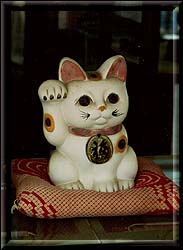 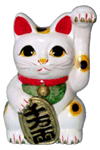
Paw Up (Left or Right)
According to research by the Maneki Neko Club in Japan, about 60% of all Maneki Neko talismans are lifting up their left paw, while the rest hold up their right. South paws are supposedly beckoning customers to enter the store, while right paws are supposedly attracting money and good fortune (e.g., piggy banks in the shape of the Maneki Neko hold up their right paw). The distinction seems somewhat dubious - more customers mean more money. According to the same source, most Maneki Neko in earlier days were lefties, but the growing lust for money in contemporary Japan means that more and more modern-day cat charms beckon with their right paw. Paw height is also of interest. The higher the paw, the more expansive the reach of the cat's lucky magic.
 Background from Japanese Backgrounds |