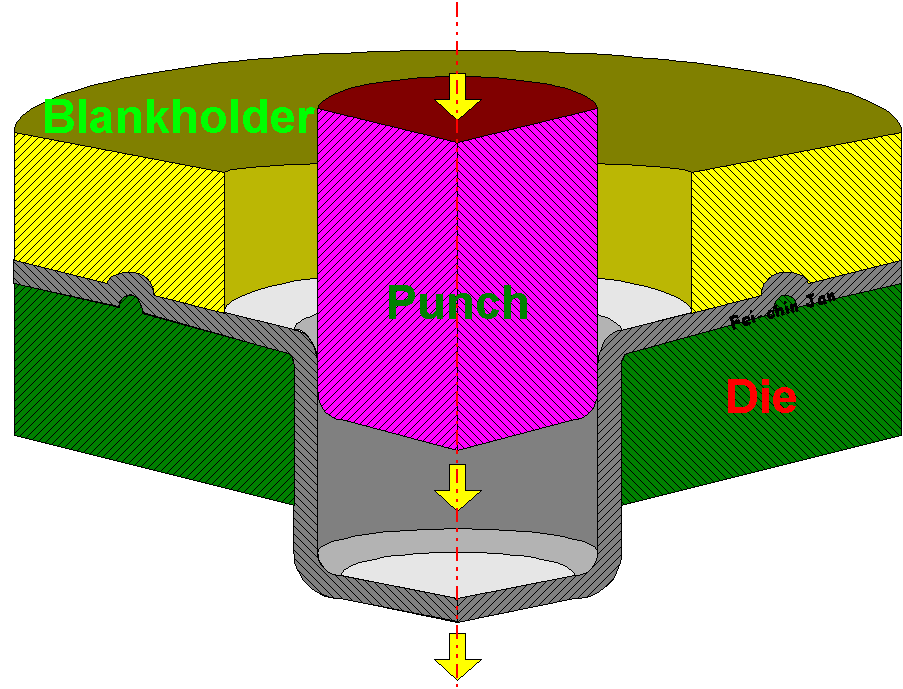
Sheet metal forming is a branch of the metal forming processes, in which the workpiece is usually a sheet or a part fabricated from a sheet. Stretching and drawing are two important deforming operations in sheet metal forming process. In stretching, the sheet metal is clamped around its edges and stretched over a die. In the drawing process, a flat sheet metal blank is formed into a cylindrical or box-shaped part by means of a punch that presses the blank into the die cavity. Sheet stretching and drawing operations are critically affected by material properties such as the strain hardening exponent "n" and the strain rate hardening exponent “m”. Changing these parameters can change the deformation process from stretching to drawing.
In this Lab., the effects of material parameters, such as n, K, friction coefficient m, and bead height on the finished part in the stretching and drawing processes will be investigated by using the FEM code DEFORM. There are two sets of simulation parameters used in this simulation for analyzing their effect on the sheet forming process. One of these sets is the reference set and the other one contains comparing parameters. Conduct your first simulation by using the data in the reference set and, then, change simulation parameters individually by selecting the data in the comparing set.
Simulation Parameters:
The simulation is a isothermal plain strain problem at room temperature. There should be at least 3 layers of elements in the thickness direction. The blank holder moves down first to clamp the blank sheet and, then, stop there and the punch start to move to deform the sheet. The die is assumed to be stationary. The initial setup is shown in the figure and tool geometric data and process parameters, as well as simulation parameters are given in Table 1 and Table 2 respectively.
Geometric data and process parameters(mm)
Punch radius
3.5
Punch width
12
Die radius
3.5
Die width
20
Sheet width
40
Initial sheet thickness 1.0
Max. punch travel 10
Punch velocity
1
Simulation parameters
Parameters Reference Data Comparing Data
E (Young’s modulus)
207000 MPa
n (Strain hardening exponent) 0.15
0.35
Temperature
20
°C
20 °C
K (Strength of material)
490 MPa
690 MPa
m (Coefficient of friction) 0.01
0.1
Drawbead height
0.25
mm 0.5
mm
n (Poisson’s ratio)
0.3
Results:
Case 1: Grid
Deformation Simulation
Effective
Strain Contours
Effective
Strain Rate Contours
Load
Stroke
Case 2: Grid
Deformation Simulation
Effective
Strain Contours
Effective
Strain Rate Contours
Load
Stroke
Back to Main Page.