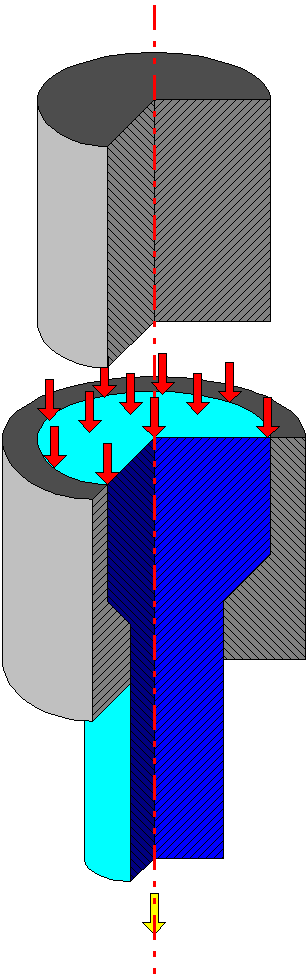
Extrusion is a manufacturing process in which material in a container is forced by a ram though a suitably shaped aperture in a die to yield a product of a smaller but uniform cross-sectional area. Depending upon the relative motion of the workpiece material and the ram, the extrusion can either be forward or backward extrusion. During the initial stages of the process, the workpiece is compressed until the material starts to yield plastically and then it fills the container and the die. With the application of continuous pressure by ram, the material begins to flow through the die aperture. The orifice is shaped such that extrudate takes on the final shape. With proper tool design, quite complex shapes can be produced.
The objective of this lab is to simulate simple, forward extrusion of a billet through different die angles and friction factors. Extrusion involves very severe deformation compared to simple upsetting processes. Hence, the FEM mesh grid will be distorted severely during the process and may require remeshing. DEFORM has an ability to remesh automatically. Remeshing is inevitable to continue the simulations in case the four-node mesh structure collapses into a triangular structure.
Material Behavior:
The process is performed at high temperatures and the same law as a hot upsetting process governs the material behavior. The workpiece material is Ti-6Al-4V. For this lab do not use material properties in DEFORM-PC database. Instead use 140 MPa as strength coefficient (C) and 0.4 the strain-rate-sensitivity exponent (m). The process is assumed to be isothermal.
Geometric Data:
The workpiece is a solid cylinder with the following dimensions:
Initial workpiece diameter: 2.0 in
Initial workpiece height: 2.0 in
Use a user generated mesh with about 300 elements.
Dies are assumed to be rigid bodies. Ram dimensions are as follows:
Diameter 2.002 in
Height 0.3 in
(Although the diameter of the ram should be 2.0 inches, you need to specify 2.002 inches to avoid slipping of the nodes at the edge of the boundary, which can take place due to round off errors in calculations)
Die geometry:
Use the die dimensions as specified with the following die angles,
Case 1 and Case 3: a= 20 degrees
Case 2 and Case 4: a = 45 degrees
All the dimensions are in inches. Assume all corner radii are 0.0 inches unless otherwise stated. Since the dies are rigid, mesh generation is not required for them. There is a 0.01 in clearance between the lower edge of the workpiece and the start of the conical part of the die as shown in Figure A.
Process Conditions:
Billet temperature: 925 °C
Percentage reduction in area: 36%
Friction factor for Case 1 and 2: 0.0
Friction factor for Case 3 and 4: 0.45
Ram velocity: 1.9 in/sec
Number of steps: 50 steps
Specify the stroke: 1.8 in
Specify the appropriate step size increment
Model Properties:
The model is constructed as figure A. There is a 0.1 inch gap between ram and workpiece. So the total stroke would be the specified stroke 1.8 inch plus 0.1 inch. Figure is established, because the part and the loads are axisymmetric. So our model also follows this rule. Along y-axis, the workpiece is of zero displacement and velocity in X direction. All the other parameters of the simulation are set as above.
All the units are in English units.
Results:
Case 1: Grid
Deformation Simulation
Effective
Strain Contours
Effective
Strain Rate Contours
Load
Stroke
Case 2: Grid
Deformation Simulation
Effective
Strain Contours
Effective
Strain Rate Contours
Load
Stroke
Case 3: Grid
Deformation Simulation
Effective
Strain Contours
Effective
Strain Rate Contours
Load
Stroke
Case 4: Grid
Deformation Simulation
Effective
Strain Contours
Effective
Strain Rate Contours
Load
Stroke
Back to Main Page.