|
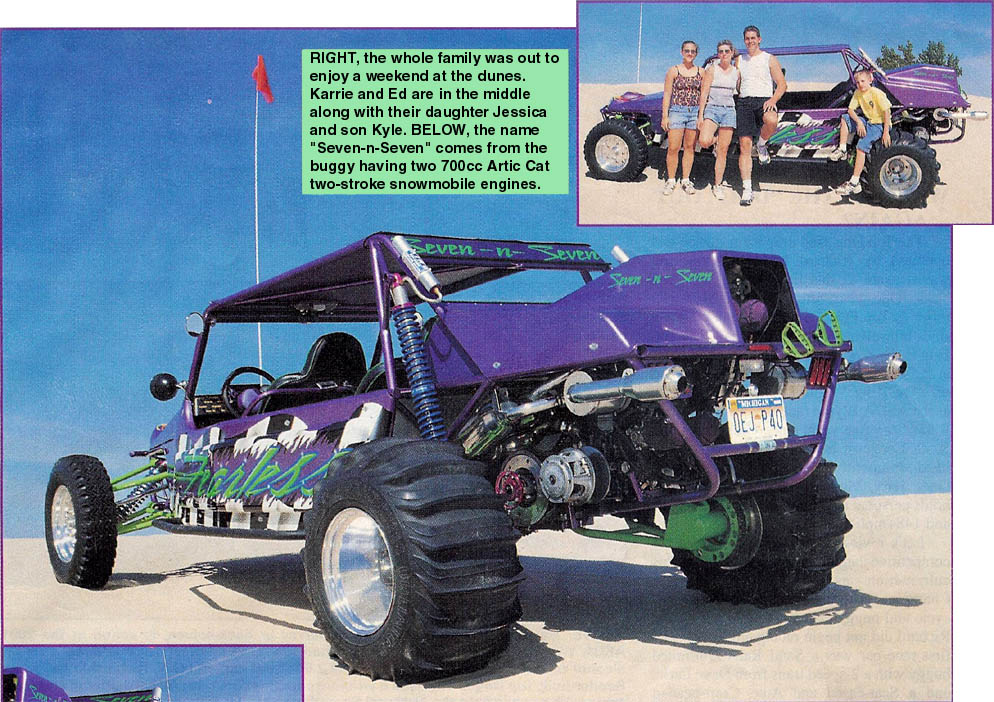
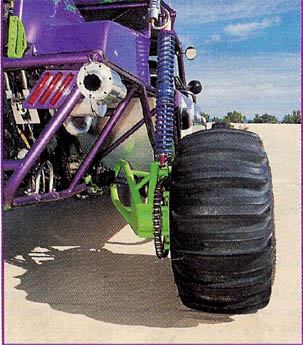
With the axles and CVs connecting to the trailing arms so far forward on the arm, the outer CV only travels six inches during wheel travel, so CV angle is not a factor to worry about. So, to recap, each trailing arm has two stub axles, one in the normal location, and one mounted very near to the pivot point of the arm. Both of these stub axles have sprockets attached to them, and a one-inch chain connects the two, thus sending power to the wheel. Stopping power comes from Ford disc brake calipers which clamp down on the inboard sprockets, essentially making each sprocket also act as a disc brake rotor. A total of 18 inches of rear travel is achieved with King 2-inch coil-over shocks with a 14-inch stroke and dual-rate springs. For sand action Ed mounts S.T.U. 16.50 Padla Traks on CMS 15x14 aluminum wheels. However, the buggy is street legal in Michigan, so for street or trail running the buggy is fitted with 33x14.50 TSL Boggers mounted on 15x10 CMS aluminum wheels.
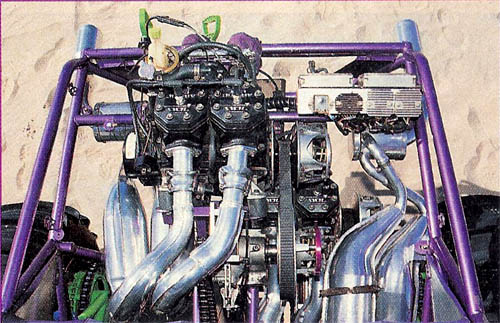
Powering the 1,600-pound buggy are two 1994 Arctic Cat 700cc snowmobile engines (hence the name "Seven 'N Seven"). These twin-cylinder engines are two-stroke power-plants featuring water cooling and electronic fuel injection, and remain in stock form for reliability. The four exhaust pipes (expansion chambers) are factory Arctic Cat units that are routed into two custom mufflers built by Ed. The high-rpm howl emitted from these mufflers is unlike any other buggy we've heard. The end result of the howling is 130 horsepower
produced by each engine. |