

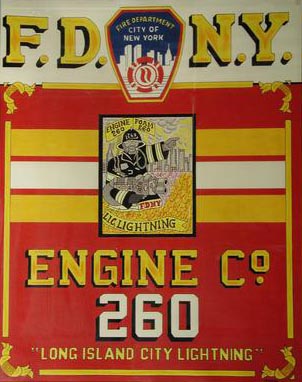
Engine 6 filled the gap between Engine 4 (Engine 262) to the north, Engine 3 (Engine 261) to the east and Engine 1 (Engine 258) to the south. Engine 6 was placed in service at 692 Vernon ave (now Vernon Blvd) in Ladder 3's former quarters. Before Ladder 3 used this house, it was used by Washington Engine 7. This house was built for Engine 7 of the volunteer department in 1889 and replaced the older house that was across the street. Like all other firehouses in Long Island City this building was leased.The Long Island City Fire Department was disbanded on January 28, 1898. on January 1, Manhattan, The Bronx, The city of Brooklyn, Statin Island and Queens Merged into the greater city of New York. Other than Long Island City, The rest of Queens was little villages with a great deal of open space in between. Long Island City had the only paid fire department in the country.
Even though the cities merged on the first, The New York Fire Department would take until the twenty eigth before doing something with the new fire companies in Brooklyn and Long Island City. At the time Brooklyn had 56 engines and 25 ladder companies. These numbers would remain the same and the six engines and three ladder companies of long island city would be renumbered. Engine 1 through 6 were renumbered 58 through 63 and ladder 1, 2 and 4 were renumbered 15, 16 and 17.Engine 6 became engine 60 of the brooklyn and queens fire division of the New York City Fire Department. Even though Brooklyn and Queens companies were part of the city, they were under the command of an assistant chief. It wouldn't be until 1912 that the companies would cross the river into manhattan.
Engine 60 was renumbered on October 1, 1899 to avoid confusuin with Engine 60 in the Bronx. All brooklyn and queens engine companies were given an extra one hundred, thus engine 60 became engine 160. On January 1, 1913, Engine 160 was again renumberedto engine 260. This time it was because the department was growing. The two hundred numbers were allready in Statin Island and it would be only a matter of a few more years before the two hundreds would be in brooklyn and queens. The statin Island units became the 150's.After becoming part of the F.D.N.Y. , Engine 60 recieved a new forth size 1899 American steamer. The one and only hose wagon used by the company was an 1891 Marlborough wagon. The steamer would be replaced on October 21, By an new 1921 American LaFrance 750 GPM pumping engine. The next piece of apparatus was a used 1923 American LaFrance 750 GPM pumper. It was recieved in 1934 from Engine 70 on City Island.
In April of 1939 Engine 260 moved into new quarters at 11-15 37th ave. Also, in 1939 the company recieved a new 1939 Ahrens Fox HT model pumper, which was referred to as the "caddillac" of fire engines. It had an enclosed cab and could pump 1000 GPM. The "Fox" was used until 1957, at which time it was replaced with anouther used 1947 American LaFrance 1000 GPM pumper coming from engine 32.
The LaFrance was used for only three years and it was replaced with a new 1960 Ward LaFrance "Firebrand" model. It was the low end of the Ward LaFrance fire truck line. Most of the "firebrands" went to the busy companies and only lasted several years before going into the reserve fleet. Engine 260's Ward lasted until 1972 when anouther used rig had 260 painted on its sides. This rig was a 1968 Mack 1000 GPM pumper and came from Engine 53.
In 1976, a 1970 Mack replaced the older mack. This rig had been well traveled, coming from Engine 43 and Engine 58 before arriving at engine 260. the last two rigs were purchased new from Mack. One was a 1979 and then a 1988 model. Since moving in 1939, the 37th ave firehouse has been used by other companies and spare rigs. The first to move in on june 1, 1939 was Bridge Chemical 61. This unit was an older American LaFrance pumper with a booster tank installed by "the Shops". This unit would respond the the city's bridges and could operate independently. On may 1, 1944 bridge Chemical 61 was relocated to the quarters of Engine 292 on Queens Blvd. The next unit to move in was the Emergency Utility Unit 1. This was placed in service January 10, 1942 because of the war. It was a 1921 Mack city service truck that was also converted by "The Shops". It carried twelve 250 GPM portable pumps and an assortment of hoses and tools. It was used to pump out subways, cellars and whatever was deemed necessary.
On September 5, 1972, Search Light 21 was relocated here and a Foam pumper was also placed in service. Search light 21 is a 1959 Mack. It was taken out of service on August 15, 1990. This rig is currently on display at the fire department museum. The foam apparatus was renumbered to foam 81 on may 10, 1988 and recently was renumbered to foam 260 and still responds from quarters to this day. it is a 1988 Mack pumper that was retrofitted by "the Shops" and carries 1000 gallons of foam concentrate