INSTANT
CONTINUUM
A philosophical rebuttal on contemporary
scientific
theories concerning forces and energies, light and matter
by Francisco Damián Folch Torres
© Copyright
by Francisco
Damián Folch Torres, 2004, 2006. All Rights Reserved.
TABLE
OF
CONTENTS
CHAPTER
I: Cause...........................................................................
5
CHAPTER II: Reality........................................................................
9
CHAPTER
III: Order.......................................................................
15
CHAPTER
IV: Motion.....................................................................
23
CHAPTER
V: Time...........................................................................
27
CHAPTER
VI: Force.......................................................................
33
CHAPTER
VII: Wave........................................................................
43
CHAPTER VIII: Particle................................................................
60
CHAPTER
IX: Space......................................................................
75
CHAPTER
X: Effect.......................................................................
81
CHAPTER
XI: Theory.....................................................................
91
CHAPTER XII: Imagination............................................................ 97
"Science
advances only by making all possible mistakes; the main thing is to
make the
mistakes as fast as possible -- and recognize them." --John Archibald Wheeler
"One
of the hardest test for scientific mind is to discern the limits of the
legitimate application of the scientific methods." --James Clack Maxwell
I am not a
Columbus but
more so a Vespucci. I am not a discoverer navigating on uncharted
territory but
rather a cartographer, demarking colonized terrain.
I
am not a scientist, presenting a paper on new findings, nor a
theoretical
physicist speculating on possible new findings. There is nothing new
discovered
here, but there is many anew explanations. What I write here is as a
philosopher, a cartographer of logic.
Science
teaches that truth is revealed by observation and that observation is
verified
by repetitiveness and further observations. Philosophy seeks truth
through
contemplation, a rather more subjective appreciation of reality.
Knowledge is
gained
through observation and reasoning, written down for others to learn and
analyze--a distillation of Truth--Humanity's process towards
Understanding.
As we transcend
our
perpetual Age of Darkness, Science should enlighten us towards the way
of
Truth. And so we study the writings of our ancient fathers and the
article of
the next Nobel aspiring scientist from the latest magazine in order to
learn.
But the total acceptance of Science will not come until attitudes and
philosophies do not change to accommodate the ignored truth about our
mind's
imaginary realm. Any explanation of Reality must reflect an accepted
belief in
gods and their spiritual world, which commanded human acceptance of
reality. It
is a bias interpretation of reality by the fancies of the human
intellect,
reflecting emotions and encompassing our abysmal ignorance. For the
European
mind this meant an acceptance that observing and learning the way
things behave
did not take credit away from God's command over the physical world.
Observing
the orbits of planets did not affect God's hand in propelling them.
These old
beliefs persist still today even when God's hand has loosened his power
to
swirl hurricanes and move tectonic plates by the explanations of
Science.
Understandably!
There are
far too many things that still remain unknown for which the infinite
powers of
gods can simply explain. What else can so easily explain the appearance
in
nature of a molecule so complex as the deoxyribonucleic acid? Or, what
can
explain the containment of the seemingly eternal universe? God suffice
for many
as one appeasing answer. My answer is the all-encompassing Universe
itself.
But this is not
a book on
the debate of God versus Science. My position is of a realist, that the
nature
of things is revealed through observation (measurements). We only need
to
understand what we observe, thus we experiment.
Currently,
scientific
observation has peered into Nature like never before, but current
theories lack
from congruency. It has been repeatedly recognized in scientific books
and
magazine articles that current theories on the behavior of light and
its effect
on matter at the atomic scale fall short of being congruous and
consistent with
new observations. The solution has been to modify standing theories in
order to
accommodate new findings, regardless if these are presented as
exceptions or
based on theoretical phenomena.
This book comes
as a
synthesis of many current texts on Relativity, Quantum, and
cosmological
theories. It concerns the definition of a new model that explains
experimental
observations in much simpler terms. But such a proposed model stands
against
formidable convictions supporting the standing mainstream theories,
regardless
how complex and unintelligible these have developed into.
In order for the
proposed
model to be accepted, the reader must first analyze the basic premises
from
which Relativity, Quantum, and cosmological theories are based upon.
This
requires the reevaluation of old experiments from which these premises
were
established. Furthermore, it should then be indicated how these
premises
complicates current models, and how their elimination simplifies things.
The main
difficulty in
accepting the here proposed model is that it parts from the premise
that is
most insipid given current accepted theories: the subjectivity of time.
Time is
a descriptive term that is so innate to our way of thinking; it is
difficult to
conceptualize it as anything else other than objectively real.
Time is not
real, at least not in the sense Albert Einstein prescribes it, as a
fourth
physical dimension of the structure of Nature, but exists more so as an
abstract conceptualization of our mind, a logical term employed in the
understanding of motions and their relationship with other motions and
the
environment. This definition of time is not new, but after Special
Relativity,
such classical argument would seem groundless and few scientists would
risk
adopting such old premise. Time became a dimension of the physical
side,
affected by motion or gravity. However, something very interesting
(logically
speaking) happens when one explains the phenomena of Relativity without
time,
it resolves certain inconsistencies, especially of congruency with
other fields
of Physics.
Without time,
the universe
becomes one continuous three-dimensional field, the limits of which are
determined by the extent of light and matter. Regardless of dimension
or shape,
the universe changes as everything tends towards a balance of
conditions. But
as these changes take effect, the universe remains one. No infinite
parallel
universes or endless chains of past and future realities. We are always
at
present, the past is only recorded or remembered, and the future will
be as a
consequence of current conditions, only for us to speculate upon.
Subjective
time fall upon the domain of Philosophy but is a view Science should
embrace.
It is the
purpose of
Science to define the conditions of existence and determine how changes
occur.
If we understand we can thus explain--somewhat more.
This work
scarcely goes as
far as presenting, with few detail explanations and brief discussions,
the
various experiments by which basic scientific discoveries were made and
from
which fundamental logic were deduced at the beginning of the previous
century
for the construction of Relativity and Quantum physics.
It is desirable for the reader if some
prior knowledge on the fields of Relativity and Quantum is attained,
though the
style and language used is geared to the general audience. Regrettably
the
inherent nature of the topic makes this text a rather dense reading.
A quest to find
a theory
that will unify all forces and integrate Relativity and Quantum physics
has
been on the procession ever since these theories were presented, driven
by a
portent overview--an extension to the unification of magnetism and
electricity
into one force, the electromagnetic. Yet, I am aroused by the current
attempts
at such a unification theory, as have been presented by even the most
respected
scientists in the world. Many of these ideas use such unorthodox
thinking that
they border on the metaphysical, among the most infamous of these,
superstrings
and their ten or twenty-six dimensions of space.
I use my license
as a
philosopher to write a book on science and present some inconsistencies
I
believe exist in the way some experiments have been
interpreted--experiments
which are cornerstones for modern physics. These have been left
unquestioned as
further experimentation revealed no mayor discrepancy to the general
theories;
where only minor adjustments were conceived in order to concur with
each
observation.
I do not claim
to be a scientist.
To be a scientist implies to conduct experiments, a procedure I have
not
employed here. Every argument I lay before the reader is strictly based
on
experimental results that have been published by various scientist.
This is not
a publication of new findings; it merely takes existing experiments and
reinterprets the data accumulated. Like differentiating between a "half
full"
and a "half empty" glass. The purpose of this book is to present an
alternative
model using the same information other scientist have had at hand.
Interested in
the sciences
and as a strong advocate of scientific thinking, I pursue an
understanding of
the world in the most factual and logical manner. But the views given
in this
work are phenomenological, that is to say, they depict Nature not as
scientist
through numbers, but as philosophers through arguments. I believe in a
physical
world of cause and effects, and in our ability as humans to recognize
through
our senses and our minds, both the direct cause and the indirect effect
of
every phenomena in the physical world. That the world in which we exist
is
strictly physical in all its characteristics, but that our cognitive
ability,
our mind, is capable of representing our surrounding as an abstract
conceptualization.
By that same
mechanism by
which we rationalize, the mind is also capable of making relationships
and
associations that although logical, are outside the realm of the
physical world
(i.e. love, beauty, coincidence). This ability to imagine can be so
detailed
and so full of realistic correlation with our complex world, that they
can
become convincingly real. This ability to imagine makes us sometimes
susceptible of conceptualizing erroneously. So science must stand as a
beacon
of light, a lighthouse to indicate the way to the land of truth in a
sea of
confusion. Science screens facts from fantasies, to find out and
distinguish
between what is actually real and what seems to be. Science is the way
towards
Truth, regardless of how hard this process be; for it will take the
genius of
illustrated individuals and the powerful tools employed in scientific
methodology, to formulate the true relationship of things. It is a
process that
will prevail from all ideas, beliefs and opinions, contradictive or
not,
towards the gain of knowledge.
How philosophy
plays into
all this? Concocting a theory is, in a narrow sense, philosophizing. I
use the
word "narrow" to give credit to the specificity and standardization
employed in
scientific theorizing, strictly elaborated from experimental data and
mathematical logic. Philosophy, however, is at liberty to be more
flexible and
encompass the metaphysics. Yet, this flexibility lies solely in the
definitions
of terms; that while proper logic is generally maintained, by accepting
fictitious definitions the whole logical construct becomes
metaphysical. For
this work, however, the employment of sound logic and scientific facts
has been
the primary concern, as an attempt to develop a scientific logical
construct.
In order that a
theoretical model which takes time as a subjective attribute to be
accepted,
regardless of individual convictions, every physical phenomena relating
to the
field must be explained consistently. This requirement stands foremost
in the
development of the model. But the presentation of such a model could
not be a
straightforward act, since some erroneous preconception derived from
the
objectivity of Time, must be clarified first. For example, the Second
Law of
Thermodynamics, which supports the so-called "arrow of time", would
have to be
scrutinized.
Three precepts
have been
adopted along with timelessness: (a) that dynamic systems reduce their
energy state,
following the path of least resistance; (b) that dynamic systems are
intrinsically chaotic and tend towards balance; and (c) that forces and
energies propagate only as fields. None of these ideas are new, though
historically speaking Chaos is the newest aphorism. The older
statements are
rejected by modern, well-established theories. The "path of least
resistance"
seems to be contradicted by chaotic behavior and most potently by the
Second
Law of Thermodynamics, while the quantum physics strongly advocates a
particle/wave (a force/force-carrying-particle) duality, which
contradicts the
last.
Basing the model
under
such propositions create a most precarious position, the likelihood of
not been
accepted by the scientific community, as it concerns the revision of
the major
theories in Physics of the past century. Though it is not an all
encompassing
refute, it does ask for the re-evaluation of many fundamental
interpretations
of experimental data. Thus, it presents itself as heresy to the
established
Science.
My studies in
the field of
Quantum and Relativity started from high school when I became
interested to
know about these two Sciences. So I independently of the school's
curriculum, I
pick up some relevant books and started reading. Right away, the
authors of
these sciences, particularly on Quantum, presented their theories as
the best
alternative, but not quite revealing full understanding on the behavior
of
atomic physics. The authors present Quantum as the most advance of
theories but
not altogether logical or conclusive. Their reasoning is that the
underlying
physics of the atoms is precisely undeterminable. That one cannot know
with
exactitude both the position and the velocity of a particle
simultaneously.
This is called the Heisenberg Uncertainty Principle.
The model I
present here
is an elaboration that has evolved during the past twenty years. I
cannot say
that my work is fully complete, as I am still polishing to a high
luster. As it
is, is shinny enough. It is my hope that the reader finds this model a
new
splendor in the view of the world.
"Reality,
what a concept!" --Robin
Williams,
comedian
"If
you would be a real seeker after truth, it is necessary that at least
once in
your life you doubt, as far as possible, all things." --Rene Descartes
I define "opinion" as: a personal conceptualization of
reality, which
may or may not follow proper logic and non-subjective observations.
Those
opinions that do concur with these specifics I denote as "reason", that is: an idea expressed precisely in a
manner
that properly reflects reality in a logical and objective manner. For
the most
part, individuals will go to great length defending their opinion as
reason.
This is understandable, since opinions are constructed from the
"logical"
associations of acquired knowledge, and form the basis by which the
mind and
the individual will respond towards the environment. The opinion a
person gives
is a reflection of how reality is conceptualized by him or her. Thus,
an
opinion is taken by its author to stand as reason, as it stands outside
the
capability of the individual, to reach other opinion without knowledge
of
alternative or additional information that might exist. And even then,
we have
the free choice of choosing from various opinions, and in a sense
choose what
seems reasonable, whether logical or not.
An opinion
should depend
on three factors to be considered as reason. First, that adequate (and
sufficient) information has been gathered. Second, that correct logic
has been
used in correlating or associating the information. And third, that all
information is factual. Any compromise should disqualify the opinion as
just
that.
Of course, if
information
is altogether lacking, it will be undiscerning as to the required
information
needed to constitute an opinion as reason; and inevitably any opinion
will stand
as reason until conflicted by further studies which will provide new
information. A reason becomes an opinion when confronted by an opposing
idea.
For any conflicting ideas to exist, there must be a discrepancy in
some, if not
all, of the factors comprising "proper" reason. Since each of these
factors
mentioned previously are progressively harder to prove true it becomes
a very
difficult process to scrutinize any opinionated idea as reason.
Through
discussion any
differences can be identified. This process is not always easy and in
some
cases it becomes almost impossible to fulfill. Opinions are generally
based on
a large number of logical relationships, so the first attempt is to
verify that
both sides share equal information. If a discrepancy is found, then it
is just
a matter of agreeing that the information not shared can in fact be
properly
included as part of the set of factual information for use towards the
formation of a logical construct. Agreeing to such terms can sometimes
be
difficult but it is the simplest of the discrepancies to be specified
if not
corrected.
Otherwise, if in
fact both
sides share all corresponding information then the discrepancy may lie
in the
reasoning of logic used. Correcting such problems is achieved by
continued discussion,
and not only requires the resourcefulness to decide on what is correct
logic
but the willingness to accept mistakes and learn from others.
The last factor,
which in
most cases is just an implication of either of the first two factors,
is by far
the hardest to clarify once identified. Since the origin of such
disagreement
is not a "lack of knowledge" or a "wrong interpretation" but the
disagreement
on the validity of a particular information. Upon disagreement on the
validity
of any particular information both the set of knowledge and their
interpretation are consequently affected. It is the grand purpose of
Science to
test claims and scrutinize the information on which they are based
upon.
Science pertains to the physical phenomena, as only the Nature behaves
in. So
this discrepancy is easily enough resolved if it is experimentally
feasible.
Yet for Science as elsewhere, premises exist which are never easily
discernible
experimentally--a premise being particular information that is taken as
truth by
general reasoning and not from experimental findings. The classical
example is
God, whom existence can neither be proven nor disproved experimentally.
Science
dismisses it since the idea lacks of physical expression (a debatable
argument,
since many believers attribute both natural events and mental
inspirations as
influenced by such). Whether a god is included in a theory or not,
either case
a logical and sound opinion can be reached. Metaphysics regrettably
claims
there is more than the physical aspect, which only Science corresponds
to (thus
the name).
Even when much
is yet to
be understood, there is sufficient knowledge of Nature to establish
Science as
veracious. Yet Science will always be faced with conflicting views,
serving
only to discredit it among the believers of Metaphysics. While our
inquiry of
Nature continues, there will be conflicting arguments, many of which
might be
metaphysical. Truly there is little physical support for the
metaphysical, and
most of these have been disproved for that same reason. It is the
respectability and reliability of a robust science that will ultimately
dismiss
the metaphysics as surreal, when no experimental test exists to refute
a claim.
The believers of myth and religion could hardly admit such status. It
is the difficulty
in confirming the objectiveness of certain premises that makes the
third
discrepancy in the reason-defining logic factors almost an unreachable
resolution.
Through our
perceptions we
form an appreciation of reality. Perception of our
environment is inferred through our visual, auditory, olfactory, taste,
and
tactile senses. Logic is, in a
metaphorical way a sixth sense, since it provides an enhanced
appreciation of
the physical world, by conceptualizing relationships--but it is also
capable of
associating various physical effects in ways that have no physical
correlation,
like: simplicity, usefulness, efficiency, rarity, or beauty. Such terms
are not
very scientific but properly emphasize a particular characteristic and
enhance
the description of the world. Through the logical structure we
construct in our
minds, a reflection of reality is projected as our thoughts.
What follows is
an
explanation of a schematic diagram on the relationship between reality,
perception, and appreciation/rationalization.
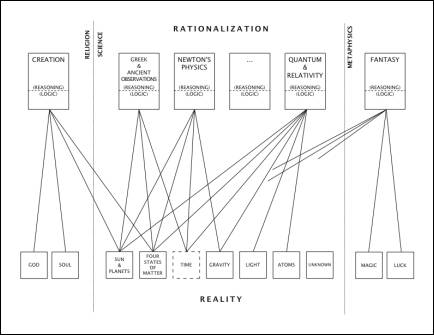
Figure 1: Perceptions.
The row of
squares at the
bottom is comprised of objects, forces, actions or anything that is
either
empirical, hypothetical, believed or conceptualized as real
(information). The
rectangles at the top are mayor theories (thoughts). Each theory is
divided by
a dotted line to denote the idea at the top and the logic underneath.
Intercrossing between the top and bottom elements are perceptions,
regardless
if they are gathered through instrumentation, our senses, or faith. The
dotted
vertical lines separate the domains of Religion, Science, and
Metaphysics.
Obviously, not every possible premise, theory or perception is
presented here,
but an attempt to name most mayor elements, with some economy in
design, has
been made.
It is not my
intention to
either dismiss or enforce any of the "realities", but just keep in
accordance
with the definition put forth, so that every alternative is included.
The
separations between Religion and Science is founded on the basic
premise of the
gods or any other supernatural entity (to include souls), that through
faith
are believed as true and real, but can not be experienced neither
through our
senses (aside from logic) or instrumentation. Since faith is not
accepted as a
scientific perception, as one that can be verified and reproducible,
thus the
division between Religion and Science (Metaphysics holds a similar
distinction
as with Religion). Religion and Metaphysics have been separated and
placed on
opposite ends of Science, not only to symbolize the narrow and specific
criteria of Science, but also give credit to both the gods and souls,
as most
believers would have it, that these are not among the mystical and
magical
superstitions.
For Science,
real is
everything that can be sensed and measured; for Religion, Science lacks
faith,
to sense other things that are real but not palpable by physical means.
Science
and Religion are in principle truth finder and truth provider,
respectively. Stated
only to indicate the extent of their similarities, there is no
intention in
presenting a history of both harmony and conflict between the two.
Religion
provides truth from the wisdom of a conceptualized supreme being,
learned
through faith and guidance of the clergy, and left to be interpreted by
the
believers to the best of their abilities, as the diversity and
ramifications of
religions indicate. Science, on the other hand, searches for truth in
the
wonders of Nature, learned through observation and the scrutiny of
experimentation, to be analyzed by investigators with the best logical
explanation, as the unity of the sciences demonstrates.
In Science, the
distinction in the terminology of opinion and reason does not
necessarily
exist. Hypothesis and theories are generally presented as reason since
they
deal with physical phenomena: a theory being a mathematical and logical
description of observable phenomena, and a hypothesis are assumptions
to be
refuted or supported by experimentation which are based on existing
theories.
However, it is occasionally the case that avant-garde scientist break
the
sequence of steps in an attempt to stipulate additional observations
not yet
made experimentally but reached through imaginary experimentation;
guesswork on
what other secrets Nature keeps. And then build theories from untested
hypothesis. This sort of mental work is not science but more so
philosophy. And
though it is a very powerful tool for the development of Science, it
can also
prove to be all too fantastic.
It is possible
that a
theory be logical in structure and mathematically feasible (which is in
itself
an experimental test) but still is physically impossible. For instance,
in
hypothesis, a magnetic monopole can exists, in reality no such thing is
ever likely
to be found. Or say for instance a particle devised from the
mathematical
possibilities of a theory, in which in itself becomes basis for further
devised
particles--but this will be discuss later on this book.
Science is a
system by which reason is attained, hypothesis merely raised to be
investigated. Both theory and hypothesis are logical constructs
attained by a
process of observation and analysis, that is continually put to test
and
enhanced by the successive findings and rethinking on its
implementation. The
methodology of experimentation is employed as a discreet yet stature
projection
of our cognitive ability. With the utilization of more precise,
sensitive, and
powerful tools we are capable of perceiving, discovering, and
understanding the
world in ways more enhanced than our natural abilities would normally
permit us
to. As perception expands, so does appreciation and rationalization,
guiding
thus forth to the fuller understanding of Nature. Naturally, if the
experiments
are done correctly, then the observations acquired are reliable; and if
the
interpretations are sound and mathematically feasible, then the opinion
set
forth as hypothesis stand as a theory of reason. The experimentation
process of
science of verification through reproduction or reconfirmation, guards
against
misinformation; yet misconceptions can still percolate regardless if
the
information collected is duplicated again and again, when failure to
interpret
the observations correctly continue due to the incorporation of
erroneous
premises. Erroneous in the sense that it is not true to reality,
something
pertaining to Nature, which is what Science upholds. So in addition,
Sciences
employs a mechanism to safeguard against misinterpretation by demanding
that
theories must not only explain in the simplest form all the available
observations, but able to make predictions and stand the scrutiny of
further
test.
Yet Science is
still
hunted by another more sublime monster than metaphysics--ignorance; a
circumstance which hinders the faculties to discern fact from fiction,
on
whether the idea presented is at fault over knowledge, interpretation
or
validity factors. Faced with the problematic that Nature in itself is
an
extremely complex system, there is no much still to be learned. This
gives room
to variations in logical constructs which, for all practical purposes
(for lack
of information), can constitute as theories. What is always at stake is
the
question of a premise factualness, which will exists even when there
are no supporting
experiment or opposing hypothesis. Again, premises are assumptions that
form
the basis to a theory, and are generally unverifiable by scientific
methods,
thus left to our cognitive intuition for scrutiny; an intuition on
perception
and rationalization.
Subjective
relationships
like tendencies or coincidence are useful in explaining the physical
world but
they can become confused as true perceptions and defray our ability to
reason.
Historically, this has been the case, as it was with the observed
motion of
celestial bodies.
The retrograde
motion of
the planets as they appear to move against the background of stars
under the
Aristotelian geocentric model could only be explained with eccentrics
and
epicycles. So was Kepler's model of the universe, in which he made some
connection between the harmony of all celestial motions and the number
of
perfect solids; a connection that had no physical correlation and he
later
dismissed. Modern Science is not exempt from perceptual confusion and
for such
a reason, experiments are continually being developed to verify and
certify any
claim. Science, nevertheless, provides a very aesthetic tool to resolve
conflicting theories. Provided that two or more ideas attempt to
explain a
particular concept or phenomena, Occam's (Ockham's) razor dismisses the
more
complex. This however is not always a simple criteria to apply, nor
necessarily
justifies the least complex as the correct. But while no experimental
information exists to determine a correct choice, it is a liable weapon.
What is being
conveyed
here is that a theory that would seem very logical and certainly
mathematically
feasible is in fact wrong. This, not only gives philosophy a place in
assisting
in the advancement of science but a reason for the work here presented.
Many
inconsistencies have been raised in resent years that jeopardize
contemporary
theories concerning light, atoms and the formation of the Universe. So
I
propose an alternate description, based on the same experiments
published by
scientists.
"In
essence, nature is simple."
--Hideki
Yukawa
"Here
then is this principle, so wise, so worthy of the Supreme Being:
Whenever any
change takes place in Nature, the amount of action expended in this
change is
always the smallest possible."
--Pierre Louis Moreau of Maupertuis, 1732
Many
philosophers and
theorist have seen the tendency of an isolated system towards disorder
as a
support to the irreversibility of the arrow of time (which will be
discuss in a
later chapter). The problem with the Second Law of Thermodynamics, which formulates such a tendency, is that
it is always in need of a
new excuse. In every field of Science, organized structures and systems
form.
From the formation of galaxies, and the evolution of genes, to the
grandest
demonstration of order of all structure (as regarded by some), the
human
brain--the Second Law is confronted with an onslaught of violations to
its
policy. Surely this Second Law should be left only for the study of
motors, for
which this principal was originally deduced, to explain the unavoidable
lost of
energy to friction.
Isolated systems
per se, do not have
inherently this incessant tendency
towards disorder; on the contrary, external influences are the cause of
disruption on most occasions. For instance a building left isolated,
since it
is a static structure, will maintain its composure indefinitely, but it
must
suffer from the weathering due to rain, wind and use, to erode. As for
dynamic
isolated systems, what is intrinsic is an impetus toward a least
energetic
state through the path of least resistance, whichever configuration
such state
leads to, it is a process by which the least amount of energy is
utilized (or
the largest amount of energy liberated). It is also a chaotic process.
From the surface
of least
area of bubbles to the tendency for high pressure to expand
turbulently, Nature
demonstrates an economy in energy expenditure. Dissolution and
homogeneousness
are inevitable process while these are the least resistant route,
otherwise
precipitation or dispersion would occur. Some compounds are soluble in
water
while the polarity of other molecules like oils make them hydrophobic.
It
should be notices that under the terms of least resistance, at no
moment are
order or disorder presented as factors in the dynamics of these
systems. What
drive dynamic system is strictly its energy components and how each
object or
particle within it, relates to one another and it's surrounding.
Reluctantly,
scientist and
philosophers cling to this Second Law of Thermodynamics, the intrinsic
increase
of Entropy, as the inseparable sibling to the First Law of
Thermodynamics, the
Conservation of Energy Law, which truly remains inviolable. This
stubbornness
to maintain the validity of the Second Law, forces philosophers and
theorist to
develop tangent loops of reasoning to accommodate into the process
under
investigation a violating decrease in entropy whenever order is
observed. These
tangent loops of logic go by the names of: Rayleigh-BŽnard hydrodynamic
instability, Turing instability, Hopf instability, etc. The occurrences
of
order in Nature, though very recurrent, are regarded as anomalies for
they
contravene the Second Law. So for instance, Coveney and Highfield
indicated in their
book, The Arrow of Time,
systems
which are far from chaotic must be explained through the
Glansdorff-Prigogine's
minimum entropy production theorem which is an "approximation which
makes
systems far from equilibrium [that is, ordered systems], look and
behave
locally as a good-natured patchwork of equilibrium," and "the
remarkable fact
is that while far from equilibrium systems the global entropy
production
increases at a furious rate, consistent with the Second Law, we can
nevertheless observe exquisitely ordered behavior. Thus we must revise
the
received wisdom of associating the arrow of time [their main theme]
with
uniform degeneration into randomness." But they add "the only reason
why the
criterion is not a universal rule is that there is an enormous range of
possible behaviors available far from equilibrium [referring again to
ordered
systems]."[i]
To further
illustrate the
sort of tangent reasoning that attest in defense of the Second Law,
theorist
have concocted a state of "super-symmetry" to have existed prior to or
at the
origin of formation of the infinite Universe. Such a state of perfect
symmetry
is made necessary in order to allow the primordial cosmos to be much
more
organized than it is presently observed, all the way up to its most
perfect
origin. The logic extension to this proposition is the eventual death
of the
cosmos at maximum disorder [at equilibrium]. Our present state is
somewhere in
between. When it is generally agreed that galaxies and solar systems
[far from
equilibrium] surge from the condensation of giant gas nurseries [at
equilibrium], it seems absurd that Nature must follow such a sinusoidal
evolution. The following graph that illustrates this irrationally
proposed
behavior, which could in fact be extended to continue its sine wave
evolution
back to perfect symmetry if the Big Crunch is taken into consideration.
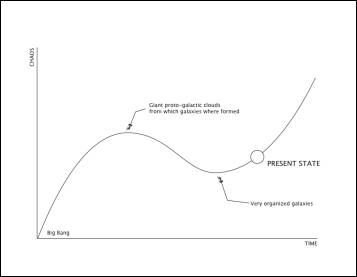
Figure
2:
Apparent Sinusoidal Entropic
Evolution of the Cosmos.
Another example
is genetic
evolution that is generally accepted as primarily driven by chance
mutations.
Yet the continual enhancement observed in the evolutionary process
cannot be
dismiss as merely an increase disorder in the genetic code. On chance
alone,
the rising of a creature as complex as human beings would definitely
seems
impossible; and in fact it has been observed by many religious
advocates that
such improbability supports their rightly belief of life occurrence by
design
of a supernatural creator. Yes! The Universe.
Even for the
atom-splitting realistic philosopher or theorist the process of
evolution down
to the decent of Homo sapience
could be explained by sheer numbers: billions of years of continuous
enhanced
reproduction. Considering the prolong period and extent in volume in
such
evolutionary process as it has taken in our living planet, while at the
same
time recognizing the feasibility by which basic organic constituents
for life,
are formed in the laboratory (Stanley L. Miller and Harold C. Urey), then the opportunity for deoxyribose
nucleitides to
have formed seems likely. And as long as conditions for the existence
of life
is maintained, life will continue to enhance herself.
These continual
elaborations towards complexity could still be perceived as an increase
in
entropy. But chemical reactions between chance encounter of two
molecules does
not constitute an increase in entropy; entropy is not probability,
chemical
reactions follow strict physical laws which are the same regardless of
where
they take place (given, of course, similar conditions). Given an ocean
full of
simple genetic building material, the large volume increases the
chances for
enzymes to link the appropriate proteins into the reproduction of large
ribonucleic chains. This mechanism for reproduction allows for error in
the
process, which is generally due to external influences (e.g.
ultra-violet
light); but by the same token, variety proliferates. This could again
justify
an increase in entropy, but it is a very narrow appreciation. Such
errors and
variations give way to more elaborate configurations as well as some
dead ends.
These last two
examples
might be a little too much for the stomach, so I include a more
palpable
example concerning a recently developed experiment, where precisely the
Second
Law of Thermodynamics is most violated by the ordered formation of
highly
symmetrical molecules. This is regarding buckminsterfullerene's and the
generation of the rest of its consorts. (Harold Kroto from the
University of
Sussex, James Heath, Sean O'Brien, Robert Curl and Richard Smalley,
from Rice
University, discovered C60 and the other fullerenes earning them 1996
Nobel
Price for Chemistry). These magnificent carbon molecules,
created either
by vaporizing carbon films with laser or setting an electric arc
between two
graphite electrodes, either of which take place inside a pressurized
helium
chamber. These most symmetrical molecules emanate in surprising
propensity from
the very disordered state of the free suspended carbon atoms within the
inert
helium. How this is so can be explained by molecular physics alone,
without the
need of including some sort of strange thermodynamic explanation to
support the
compelling state of "least entropy". As it is universally observed,
free carbon
attract with a proficiency to form aromatic links. The geometric
imposition of
an occasional pentagonal arrangement is to curve adjoining hexagons
into
spheroids. Under the prescribed circumstances, the tendency towards a
path of
least resistance is not only manifested by the proficient formation of
aromatic
rings and an instability of adjacent pentagonal rings (thus resisting
malformations), but that these pentagonal rings form in order to reduce
the
surface area of the molecule to a minimum, increasing in turn its
stability.[ii]
I shall make
reference to
one last article in which the authors' main topic is natural order, but
again
in conflict with their conviction that things should inexorably tend
towards
disorder. "Order in nature would appear to be the exception, not the
rule. The
regularity of the solar system the complex organization of living
things and
the lattice of crystal are all transient patterns in a grand
dissolution into
chaos. The prevailing theme of the universe is one of increase
entropy," and
goes on presenting "particular fascinating" order in nature, patterned
ground. Krantz, Gleason, and Caine conclude by
reflecting "the wonder of patterned ground is not so much how it
happens but that it
happens at all. The same can be said of the more familiar regularity of
snowflakes. An element of mystery will always attend phenomena that
unite the
precision of geometry with the vagaries of change."[iii]
Chemistry
demonstrates a
different violation to the Second Law of Thermodynamics with an array
of
endothermic reactions; coldness and freezing is regarded as "far
from
equilibrium". Instead of attributing such reactions with further
exceptions,
all chemical reactions, regardless if they are endothermic or
exothermic, can
be explained without any inconsistencies by the tendency to reach the
least
energetic state along the path of least resistance.
This tendency
for dynamic
systems to change through the path of least resistance can in many
events seem
as an "increase in disorder". For example, adding red dye to water will
ultimately end as a homogeneous coloration of the solution, which is
generally
regarded as an increase in disorder of the system. Since it is taken
that the
dye, when conglomerated in a small drop, is at its most ordered state.
Alternatively,
such argument might be considered true while the dye is isolated, but
once
mixed with the solvent it no longer holds valid. Homogeneousness should
be
regarded as the most ordered state for the solution. After all, it is
at this
stage that the system has reached "equilibrium" --evenly throughout the
entire
volume, the solution is at a normalized equal; I see no reason why this
should
not constitute as uniformity, order or symmetry rather than maximum
entropy.
Le Chatelier's
Principle: When a stress is applied to a system at
equilibrium
the system will adjust to relieve the stress--a clear demonstrations of
Nature
insistence towards balance.
Where some would
see
infinite diversity, others would recognize variations of particular
themes, as
clouds are infinite varied in shape yet categorized by form: cumulus,
cirrus,
cirrostratus, mammatus, etc. Order
and disorder are properties of pure appreciation and their degree or
magnitude
has no physical constituency. That is to say, Nature does not discern
the state
of "order" of a system, which "compels" a change towards an increase in
"disorder".
Disorder has a
direct
relationship with the term entropy, which is, as defined by Rudolf Clausius, the capacity of change. Regrettably,
scientist
interchange these terms indiscriminately, since in the majority of the
examples
used to describe entropy, it's appreciative increase in disorder goes
in
accordance with an entropic increase. Yet one must be careful with such
terms,
that is, entropy as the capacity of change, which is mathematically
described
as a ratio of expelled heat over temperature. When and where there are
no
differences between the ratios at two different states, of the same
system,
then such process of change is considered reversible. Contrariwise, if
a
difference is measured, the process is defined as irreversible and
tending
towards thermodynamic equilibrium. But not necessarily must there exist
a
correlation between the energy transformation of a system and the level
of
disorder. Take for instance the solar system, with Earth slowly being
dragged
towards the Sun as gravitational tug converts Earth's orbital kinetic
to the
Sun's gain in rotational velocity. The system is completely isolated
from
external influences, and loosing energy as the sun radiates. Yet, if
and when
Earth is finally swallowed up by the Sun, entropy need not have change,
even
though the system appears a little more organized without us around. Or, take a box containing a
dismantled jigsaw
puzzle, where disorder is considered at its maximum, which is in turn
shaken,
regardless how long this takes place disorder will remain constant.
Shaking the
jigsaw puzzle would not necessarily constitute a reversible process,
though
certainly some scientist would argue such. Nevertheless, either the box
spontaneously combusts to hell or the person tires to death from
shaking it,
but disorder will be maintained constant.
Nature strives
on
simplicity, even when humans starve at the apparent complexity. The
Universe is
certainly chaotic in that it is a non-linear system, not to imply that
it so
must be mystical and perplexing. The complexity of many systems
overwhelms us,
and figuring its secrets is a challenging process for the endeavor of
Science.
Beneath are unveiled, through observation and logic, fundamental laws
of
Nature. As we progressively expand our knowledge of what interactions
are being
manifested in Nature, the very complicated is simplified. This
knowledge has
been capitalized by the recent discovery that chaos itself is an
intrinsic
characteristic of systems that evolve in orderly fashion. The
mathematics of
chaos reveals
that some orderly factor is responsible for the disordered state of the
function.
These are dynamic systems that depend on their own proper configuration
to
define their consequent state--a constant recursiveness whose immediacy
of
response destroys its history into a flux of causes. It is this
self-reference-cause effect that attributes to chaos. But this is how
Nature
is. It is, in a single word: evolution. Regardless if it involves
astronomic,
atomic, biologic, or social systems, all will be appreciated as
organized since
their formation, however complex, are the continuous results of actions
taking
place in a system through the least resistant path (governed by
specific forces
and invariable laws)--developing into indeterminate variations of
common
patterns. These are historical processes that will hardly be seen as
causal.
It is not
coincidental
that mathematical functions like the Mandelbrot set and Lorentz Strange
Attractor surprisingly echoes systems in Nature. Both, the development
of a
chaotic set of equations and the physical dynamic system involve a
multitude of
variables that change according to the just-prior state of the system.
Again,
it is the development of new states, as determined by its own internal
structure and circumstance, what generates chaos. The state and
circumstance of
every element involved within a system, determines (regionally) how
changes are
to occur, hence minute fluctuations can evolve into grate differences.
Yet this
does not imply that because a butterfly flutters its wings over Florida
a
typhoon in Malaysia could result--the presence of the butterfly alters
slightly
the wind through which it flies, while the typhoon which ruffles the
seas is
generated independently from atmospheric disturbances of thousands or
millions
times more the amount of energy. All the butterfly proves is that we
will never
determine meteorological events exactly.
The fact that
natural
systems can be emulated through mathematics formulations does not in
any way
imply that such natural systems are then to be precisely extrapolated,
as to be
deterministic. Though an approximation for the most likely state is
possible
with computers, simulations must be kept in continual re-calibration if
these
are not to diverge far from the natural system being mimicked. The
intentions
behind a simulation are not to be determinate as to the exact future
state of a
system but more to understand its behavior or the manner in which it
evolves.
Naturally, there is an element of unpredictability in any chaotic
system, but
patterns that reveal some sort of organization are developed. This
provides
some degree of predictability as well as understanding, though
naturally with
some limitations. Pattern reoccurrence in chaotic systems are no
substitute for
determinism but certainly helps to prescribe ranges within which the
system is
most likely to develop into. Regardless of its uncertainty, chaos is a
great
support to the irreversibility of events, an in some way more so than a
deterministic view ever was.
The method of
prescribing
ranges within which a system is most likely to develop was first
postulated by
James Clark Maxwell, by describing the behavior of gases not by
the
individual motion of its constituent particles but as a statistical
mechanic of
all these so as to define the entire gas as a unit. To this, Ludwig
Boltzmann's enhancement in the statistical mechanics
serves to
discredit the Second Law of Thermodynamic. Boltzmann's H-theorem
describes the
dispersion of gases on account of the statistical mechanics of the
internal
collisions of the molecules or atoms in the gas, reflecting the natural
tendency of a system toward a least energetic state--entropy, a term
imported
only as an appreciated term to quantized the energy within a gas which
increases dispersion, the capacity of change.
Understanding
the
underlying laws that govern a system will not render the system as
predictable.
Knowing that molecules in a gas speed and collide will not determine
the
trajectory that a feather will take, when it falls through it. As nor
will
knowing genetics will exactly determine heredity. From sunspots to the
formations of vortices, to predict occurrences Science will only deal
through
probability. Even in chaotic systems, there will be some degree of
predictability through probability. This regards deeply our
understanding of
the system in question. Probability will indicate the size, origin and
trajectory a hurricane should take upon formation, and this knowledge
will
result greatly from the understanding of the atmospheric state that
generate
these systems prior to their formation.
I propose the
adoption of
a theorem (postulated as early as the eighteen century) that will be
more in
accordance with observation, a sort of Economy of Energy Law, in that a
dynamic
isolated system (static isolated systems do not change) will tend to
minimize
its expenditure of energy, through a path of least resistance. This will reflect the overwhelming tendency
for
systems to organize (i.e., stability), yet keeping in mind that
frictional force
reduce that same efficiency. That as a result of the
self-reference-cause
effect, chaos will result in the evolution of these systems. Chaos is
not an
impediment of order.
Must we
stubbornly
continue to support the archaic Second Law of Thermodynamic with its
strange
loops of reasoning or can we finally accept Nature as it is?
Two final notes
on this
tendency towards a path of least resistance: first, it does not violate
the
certain First Law of Thermodynamics, the Conservation of Energy (and
Mass); and
secondly, it is in accordance with Newton's First Law: "every body
continues in
its state of rest, or of uniform motion in a straight line, unless it
is
compelled to change that state by forces impressed on it." It should be
pointed
out that in order for the Second Law of Thermodynamics hold a congruent
relationship with the First Law of Motion then systems isolated from
external
influences will tend toward disorder as the Second Law of
Thermodynamics
declares, and inertia would not need to be maintained but rather loose
energy
to the rest of space.
"[Physics]
shows us the illusion that lies behind reality--and the reality that
lies behind
illusion." --John Archibald
Wheeler
"Henceforth
space by itself, and time by itself, are doomed to fade away into mere
shadows,
and only a kind of union of the two will preserve an independent
reality." --Hermann Minkowski
Motion is a
change in position; a relative property determined from an arbitrary
point of
reference. With such a definition, it can be deduced that as two bodies
approach each other, deprived of any other reference, it will be
indeterminable
as to which among the two is moving, if not both. What can be discerned
is
acceleration, that is, forces exerted upon each object.
The classic
studies of
Galileo Galilei and Isaac
Newton on the
mechanics of motion, demonstrate that velocity was not absolute but
rather
relative to a frame of reference. For instance, a ball placed inside
the cart
of a moving locomotive seems stationary in reference to the cart but
speeds
greatly in relation to the railroad. I do not refute this,
nevertheless, it
must be emphasized that the components of motion, what constitute as
the
inertia of the ball, remains the same regardless of any frame of
reference and
this is true even in the most simple of motions. The fact that some
motions can
be canceled out by adjusting the reference frame does not eliminate the
constituent inertia of that body. The ball will remain motionless
inside the
cart of a moving train, as long as the train maintains a straight
trajectory at
constant speed. Any change in direction or magnitude in velocity of the
train
will cause the ball to continue under its own inertia until otherwise
affected
by opposing forces.
Newton's First
Law of
Motion, which states this tendency for bodies to
remain at
rest, unless acted upon by an external force, implies that Nature has
no
distinction over velocity but does so over acceleration--acceleration
being the
numerical representation of the expression of a force determined by the
change
of velocity over a set duration (time). What is distinct is inertia, which is precisely the intended definition
behind the
First Law. Inertia remains unchanged regardless of reference frame. A
ball,
which remains still to one observer, can appear to move to another, yet
both
are the same object and maintain the same inertia--regardless of
reference
frame.
Imagine for
instance two
children playing pass ball inside a fast moving spaceship--fast in
relation to a
very distant planet they might be approaching. The ball appears to have
a small
inertia, changing direction with easy tosses, yet the same ball, should
it
continue with the same speed towards the distant planes, consequently
colliding, would express a tremendous release of kinetic energy.
Inertia is a
direct result of mass and energy accumulated by the system from
impending
forces and that, which is intrinsic to it. The ball in this case has
indeed
gathered additional energy from the acceleration of the spaceship, yet
the
larger inertia of the ball remains undetectable to the kids, as they
too have
increased their inertia inside the ship. The two kids where only
changing the
balls inertia within the system slightly. Since we need to quantify
inertia for
descriptive necessity, it seems then that an absolute origin is needed
if we
are to maintain the numerical value of the inertia regardless of
reference
frame. This is arbitrary as an origin may be established anywhere for
any
system or trajectory. Maybe a more mundane example will help visualize
the
distinction.
An automobile
traveling at
ninety-one kilometers and hour where it to impact another vehicle
traveling on
the same direction at ninety kilometers an hour, would exert a force
equal to
that of a one kilometer an hour impact. That same vehicle, where it to
collide
against another stationary vehicle, it would cause a disastrous
accident. For
both cases the automobile certainly would have the same inertia. But
the
difference in inertia between the two vehicles is the energy manifested
in the
collision. This is consistent
whether there is or not a ground to reference with. Likewise, for the
collision
with the stationary vehicle, it is irrelevant whether the ground helps
to
reference the motion of either vehicle. Even if the scenario lacked
from any
reference frame (to determine velocity), the energy exerted in the
impact, is
determined by the difference of inertia between the two bodies involved.
Forces exerted
on the
system change the inertia (mass and energy) of the system. This is a
physical
change that manifest independent of reference frame. (True that
acceleration is
also measured against an arbitrary reference frame in order to
quantities the
change in velocity, but an unequivocal difference exists; a person can
distinguish acceleration with eyes closed but not so velocity--and that
is as
sensible as science might get.)
The independence
between
inertia and reference frame generally stands unperceived since
collisions
normally considered for study involve few bodies. When many objects are
involved, as is the case when dealing with molecules in a gas, this
ambiguity
disappears. A gas will always exert the same pressure against "a flask"
regardless of the reference frame chosen for its definition of
velocity. What
is taken into consideration is the kinetic energy of the myriad of
molecules as
they vibrate and collide against one another and "the flask". It is
irrelevant
if "the flask" is perceived by a moving observer, who would
observe--hypothetically speaking--as one might presume, a slight
difference in
pressure (proportional to velocity) between the front and rear of "the
flask".
This could only be true if the "flask" was accelerating. Otherwise, it
would
imply that the motion of the observer affects the pressure the gas
makes
against the container, which is absurd. What is concerns here are the
energy
collisions of molecules exerted upon the container; the reference frame
should
be reduce to a minimum, that is, between molecule and container or
between
molecule and molecule. The general rule is that only the objects
involved in a
collision are relevant in defining the impact force, regardless of
reference
frame; so that the reference frame can always be reduce to include only
those
bodies involved in the collision.
Reducing the
reference
frame to a minimum destroys absolute space and motion, deeming them
inconsequential. This notion goes in accordance with Ernst Mach's belief that the two properties are "pure
mental
constructs". (Space here is defined from a particular arbitrary point
in space
which is common to the observed motion, that is, a point in space or
origin
which does not move, by definition. Such point is absolute only for
that
definition.) Only the sense that this fact is so counter-intuitive
makes it so
disproving.
The fact seems
even less
intuitive when dealing with waves. Given a sounding siren atop a stationary
tower, a
Doppler effect is observed on the wave propagation, if there is a
difference in
velocity between the siren and the listener, which as an example will
be a
pilot aboard a fast airplane. Since frequency is defined as the energy
of a
wave, the observed shift suggest that by choosing a reference frame
this
intrinsic property is affected. This is contrary to the maxim: that,
observation does not denote reality (aside from Quantum physics which
refutes
it). Despite of this, while a frequency shift is perceived, the wave
emanates
at a certain frequency from its source, evenly radiating, regardless.
The
appreciated shift is due to the natural definition of a wave as a field
(a
series of continuous waves that radiates from a source). One must keep
in mind
that it is irrelevant whether the observer or the source is actually
moving,
since the reference frame should be reduced to a minimum to determine
the
energy of the wave. Physically, the wave does not change, but the
motion of the
observer (or source, whatever the case might be) produces a shift in
the rate
of impingement, effectively altering the energy expressed. (This is
analogous
to the collision of an automobile against another moving vehicle
compared to
the energy exerted if colliding against a stationary vehicle.) Those
objects
involved in a collision, in this case the sound waves and the ear, are
relevant
to the definition of the impingement rate, or energy. The apparent
paradox with
the frequency shift of waves occurs as a result of referencing the
speed of the
wave and also of the observer against the environment instead of
minimizing the
reference frame.
Enter light!
The speed of
light is
measured by multiplying wavelength times frequency--wavelength
determine the
distance between each wave crest, frequency determines how many waves
vibrate
as a specific point is space per second, thus velocity. For instance,
x-rays
have a wavelength of about 5 nanometers (5.0x10⁻⁹ m), its
frequency
something like 6,000 terahertz (6.0x10¹⁶ Hz), the product
of course
equals 300,000 kilometers per second, the speed of light in vacuum.
Congruently, shifting the frequency by observation, affects the
appreciated
wavelength. For light, since these properties are determined by
reducing the
reference frame to that between the electromagnetic wave and the
detector, the
apparent velocity remains constant. Say for instance, that an observer
moves
sufficiently fast so as to perceive a blue-shift of x-rays to
gamma-rays
(purely hypothetical spaceship), the frequency of the wave is perceived
at 300
exahertz (3.0x10²⁰ Hz), this has reduced its wavelength
accordingly
to 1 picometer (1.0x10⁻¹² m). Again, the velocity of light
remains
constant and most importantly, what permits this particular relativity
of waves
is these are fields, not particles.
To help the
reader
visualize this difference when a medium is involved, I return to the
anterior
example of the tower siren and the airplane for a more common analogy.
Sound travels
trough air
at about 330 meters per second (740 mph) at standard temperature and
pressure
(we will obviate standards). The pilot travels towards the siren,
sounding off
at a frequency of 10,000 Hz. The velocity of the airplane by no means
alters
the physical characteristics of the sound waves propagating from the
tower, yet
the observer perceives a Doppler shift in the
frequency of the sound. Relatively, frequency increases but the pilot
realizes
that the wavelength must not change, only apparently. The pilot
realizes it is
an effect caused by the airplane moving towards the waves as they move
through
the air, which is responsible for the apparent increase in frequency
(and its
relative velocity taking the air into consideration). If the airplane is traveling at 200 meters
per
second, the relative velocity of sound will be 530 meters per second.
At such
speed, the frequency of the sound wave have increased to about 16,000
Hz.
Again, this is consistent in that the wavelength remains constant,
about 3
centimeters long. So, because the medium was referenced, a relative
change in
velocity was observed, which for a wave translates into an increase in
frequency.
Twilight!
There is a
problem with
current definitions of light: Einstein's theory of relativity argues that light
maintains a
constant velocity regardless of the velocity the observer has with
respect to
the light source but does so when light is visualized as a particle. This creates a dilemma, which is resolved
with
Special Relativity.
Again, the
velocity of any
wave is a computed ratio between the frequency and wavelength. Notice
too, that
the factor of this two properties results in the energy definition of
the wave.
For light, these properties are measured by means of a photodetector. A
relative change between the wave and detector causes a frequency shift,
but
congruently so does its perceived wavelength, thus maintaining a
constant
ratio, which is why light is always measured to the same constant
speed,
regardless of reference frame, regardless of energy shifts.
With light there
was an
inaccurate assumption made, that like other waves, it must too travel
through a
medium, thus the ¾ther was
proposed. To prove the hypothesis of the ¾ther the
Michelson-Morley experiment
was first conducted in 1887. The two Americans, to their surprise,
discovered
that such medium, if it existed, did not affect the relative speed of
light,
hence the medium needed not be there. Light can travel through empty
space and
did so at a constant speed.
Nevertheless, it
was
perturbing that light violated classical relativity. This was because
the ¾ther really
never disappeared from the minds of
scientists. Classical relativity remains consistent for particles or
wave,
regardless. Even so, for light, what seems so counterintuitive as a
constant
speed, regardless of reference frame, this is itself resolved by
reducing the
reference frame to a minimum and realizing that waves are fields not
particles.
Exit light!
"I
am conscious of being only an individual struggling weakly against the
stream
of time." --Ludwing Boltzmann
"Our
present picture of physical reality, particularly in relation to the
nature of
time, is due for a grand shake-up--even greater, perhaps, than that
which has
already been provided by present-day relativity and quantum mechanics."
--Roger Penrose
At this point I
will like
to bring to the attention of the reader a small detail found in the
schematic
diagram named Figure
1: Perceptions.,
on CHAPTER
II:
Reality. It is a detail that happens to be the basis
on which this work is
founded upon. Among the realities of science, the premise of time has been
singled out by a dotted border for the reason that I consider time to
be an
appreciation, just as beauty and disorder, which has been considered
previously, are not physical constituents of the physical nature of the
Universe.
Norman Mermin, indicates that, "the mystery of relativity
fade, however,
when one firmly recognize that clocks do not measure some pre-existing
thing
called Ôtime', but that our concept of time is simply a
convenient way to
abstract the common behavior of all those objects we call
Ôclocks'. While such
a distinction may sound like splitting hairs, it is remarkably
liberating to
realize that time in itself does not exist except as an abstraction to
free us
from having always to talk about this clock or that."[iv]
The reason why
time seems
so very much real in our minds is that we appreciate the changes in the
world
through memory and logic. Without recollection there would be no past.
Without
prefiguration there would be no future. Erroneously, this definition
could be
extended to state that without any awareness, there would not even be a
present--which is true in a way. It must be recognized that conceiving
a future
does not create the future, likewise with the present. The future in
only a
speculation; we recognize that there is a continuity in Reality, hence
we
speculate. We can only guess at what the future holds through inference
and
deductions, and it always
comes as
a surprise. In whole, our mental ability creates the concept of time;
not
implying that we create the reality we sense. Every instance, impulses
from the
five senses are integrated into a sense of present, into awareness. So awareness, is a consequence of the
correlation
made between the five senses and logic (which I previously considered
as a
hypothetical sixth sense). Awareness is our inference of Reality, lying
between
Perception and Rationalization. It is in our awareness where time
recedes. But
for all we can appreciate from Reality, we cannot prescribe the future.
It
never is, only the present, forever--real and independent of our
thoughts.
Reality cannot be created by observation, like Schršdinger's cat.
The idea
conveyed here
assimilates what the German philosopher, Immanuel Kant attested
with his definition of phenomena
and neumena, a
distinction between
Reality and the phenomena we sense.
There is a
distinction
between mental and physical attributes, which must be recognized. We
perceive
reality through our senses, and create appreciations with our minds.
Mental
attributes that we create from appreciation are only subjective.
Failure to
realize this will result in confusion and erroneous theories. So we
must
distinguish between our sense of time and the continuum of instances,
which our
senses perceive. Reality is a flux of eternal presents, and Time is an
invention
of the human mind.
Humans have
measured time
since early history. Keeping track of climatic changes with relation to
the
heavens was essential for the survival of a society dependant of
agriculture.
The pursuit of knowledge and understanding of celestial motions
provided
appropriate solutions to the questions of the optimum time to cultivate
and
harvest.
Time, in
essence, is a
system for the measurement of rates and like other systems of
measurements it
has a need for a standard. Such a definition can be achieved by the
selection
of two natural harmonious phenomena, like the celestial motions of our
planets.
By "natural harmonious phenomena" it is referring to cyclic actions
whose
changes in position (or any other characteristic) return to their
original
state only to repeat the change once again. Formulation of a ratio
between the
revolution of Earth around the Sun and the daily rotation about its own
axis,
which are both cycles that repeat with virtually no lost in precision,
set the
standard of measurement--a ration that is in fact basis for all our
timekeepers. Defining a revolution
as a year and a rotation as a day, the ratio of approximately 365.24
days per
year is derived. From there, a further division of the day, into hours
and
seconds, reduces the prolong cycle of the passing days into a more
appropriate
scale.
With the
advancement of
science arises a need for higher precision by which to measure shorter
periods
(i.e. faster events). From the swinging of a pendulum to the vibration
of
quartz, to the undulation of light-waves, all are harmonious motions by
which
to reference other, not necessarily harmonious motions. In cases where
non-harmonious motions or events are referenced, time is calculated by
counting
how much repetition of the harmonious motion was observed during the
completion
of the non-harmonious action. Ideally, harmonious motions are selected
as
standard units for reference and the computation of time. The physics
of waves
gives light an apparent motion even at the most reduced reference frame
and is
well suited as a standard of measure, as it is use in modern
instrumentation.
Since in order
to detect
motion it must be referenced, it can be deduced that any change
whatsoever in
the universe defines time. Even though this is the case, our notion of
time
involves cross-referencing. Let us first start with a simple example.
Imagine
if you will, staring at a motionless particle amidst the infinity of
space.
Neglecting heartbeats, breathing and every other living cycle for the
effectiveness
of this imaginary experiment, there would be in essence no possible
reference
of motion--sure, light, but we shall neglect this reference too. One
could be
staring at a still picture and not be discerned. Turning to a somewhat
more
complicated environment, imagine living in a windowless room, having
exclusively a perpetual pendulum as a reference of motion inside the
enclosed
room (again neglecting the living cycles). The room provides by itself
adequate
reference against the pendulum that motion is apparent without the need
of any
additional action. In effect, time is defined by the repeated cycles of
the
swinging pendulum. But a swing is a swing is a swing. Outside the room,
time,
defined by the days and the routines of life pass unreferenced. A cycle
for the
pendulum regardless if it lasts a second or a day, will still be only a
full
swing. Here, although there is the perception of a harmonious cycle and
time
can be defined by counting swings, it lacks of cross-reference that
would
provide relevant dimension. Another and final example that illustrates
this
need of cross-referencing is with the use of interlinked gears. Taking
into
consideration an arrangement of gears, each particular gear moves as a
consequence of the others, always maintaining their ratio of rotation
according
to relative diameter. It is irrelevant how fast the gears are spinning,
he
ratio remains constant, so it lacks of any significance as timekeeper
if it
cannot be cross-referenced by other actions. One will count rotations
without
relevant meaning, that is, without dimension, thus lacking of a sense
of time.
In reality, it
will never
be possible to experience any motion however simple, without additional
cross-references, we even take our life-cycles as reference, making the
senses
of time so determinative.
The description
of the
physical world has always been associated with time. No other way could
motion
and dynamic attributes could be described so simply than by a unit
ratio. This
abstract appreciation of our world has been developed so profoundly in
our
minds and in our way of speaking that it transcends every other
appreciation,
even for words and numbers. This is so much so, that it seems there is
no other
way to define time but as an ad priori.
So then, why
living organisms
age and die, if there is no time? Since the whole of the Universe
progresses
irreversibly, it seems that time denotes such processes. The reality is
that
the Universe is a dynamic system that progresses in a flux of causes; a
chaotic
process where the subsequent state of any system derives from its
present state
and circumstance. Biological processes likewise suffer changes through
its
regeneration and the effect of the environment. Cells regenerate to
promote
healing where there is injury, replacing old or dead cells for new
ones. This
process known as mitosis is not the only form of cell division. A more
complex
process known as meiosis leads to the regeneration of offspring, to
allow for
the substitution of the entire organism, which will continually suffer
from
exogenous degenerative forces. Life is perpetuated because subsequent
generations are entrusted with surviving traits, even as the
unsuccessful
(through the process of natural selection) fail to reproduce. We age
and die
because our bodies are machines in process.
The heart beats
to
circulate blood, to enrich it with oxygen and nutrients, replenishing
the body
with energy. This process is not inexorably propelled by time. A beat
follows
another to sustain life, as design by evolutionary processes. A sort of innate fear arises after
realizing that our heart palpitates causally and inexorably until
death. Like a
puppet no longer being animated by strings, our lives are liberated
from the
all too instinctive feeling of time.
The concept
"time" is
indispensable to the understanding and expression of the physical
world. It is
not my intention to dismiss time altogether, it is a very important
appreciation, one that is deeply rooted in the way we communicate,
rationalize,
and live. But, if science is to represent reality more objectively, we
must
scrutinize current theories and redefine those hypothesis that have
been
formulated from the premise that time is a physical aspect of the
universe. As
our understanding of the Universe has become more elaborate, the
standing
concept of time as a physical property has become a very cumbersome
premise. Nevertheless, as strictly
an appreciation, time serves extraordinarily well as means of
computation. Time
is a most appropriate scalar unit by which to relate the changes in our
world.
The ticking of a
clock,
the sprouting of a seed, and the weathering of mountains are
consequential
effects, caused by the internal state of the system in relation to the
external
circumstances of the environment. I must stress the words Ôcause'
and Ôeffect'
as these are the motives for every interaction and change. Reality is a
continuous flux of interactions. Every change, from quantum mechanics
to the
dynamics of galaxies, is defined by the state and circumstance of the
system. Even
if as a consequence of a system's complexity our effective
understanding of
every interaction is limited, it does not alter the fact that these
remain
causal events.
There is,
regardless of
our limitations to predict, an irreversibility of events. By the
statement of
irreversibility it is not to exclude reversible events; like the
pendulum's
swing, these would not be retrogressing in time but merely compelled to
retrace
their route in opposite direction, and then once again. There are no
such
things as time reversal or time-symmetry violation, if not as an
appreciation.
It is against all observations and logic that where the universe to
suffer the
Big Crunch, we would retrace our lives once again but backwards; rising
from
our graves to finally die in our mother's womb. This is totally absurd.
If the
Earth, by some fictitious reason was to all of a sudden trace its orbit
in the
opposite direction, all it would mean is that synagogues would have to
face the
other way, their entrance looking to the west, to greet the sun of a
new day as
it rises in its new direction. Just because projectile motion trace the
same
symmetrical parabolic path where it to be seen in reversed (as in a
photographic film strip) does not extend to every other event in
nature. Apples
do not un-rot, so they can jump up from the ground and stick themselves
at a
precise location where the stem happens to match perfectly with a twig
in the
tree. Nature as a whole (and in all particulars) is impossible in
reverse.
This idea or any
other that
accounts for time's reversibility is purely imaginative. For instance,
Stephen
Hawkings' "imaginary time" might just be "mathematical subterfuge" and
not
intended as a realistic representation. So even for theoretical
scientist in
order to formulate new theories, the concept of time can be
over-conceptualized, if I may be allowed to state it as such. As
Hawkings
himself puts it: "all one can ask is whether imaginary time is useful
in
formulating mathematical models that describe what we observe."[v]
With such view, so does god, who could make a much simpler mathematical
model,
but it would not be too scientific!
Patterns in the
astronomical scale demonstrate that the Universe as a whole acts with a
unidirectional flow of events. This has been regarded as "the arrow of
time",
of which various recent books have gone to considerable length in
demonstrating
that such an "arrow" in facts points in one direction only. That time
as a
physical dimension of the Universe inexorably develops forwards by some
unspecified law of Nature, which also supports Thermodynamics' Second
Law. Some of these books even reach intangible
metaphysical implications
as conclusion: that the Universe has come to be as is by design.
Various other
authors
readily recognize the unidirectional flow of events in chaotic
processes, by
stating how these appear unnatural or right-out impossible if they
where to be
observed in reverse (e.g. the shattering of glass). Most processes if
observed
in rewind will be
perceived as
reversed, and impossible under the natural progress of "time". Only for
the
rare exception involving so-called "reversible processes of zero
entropy", are
the rewind views
imperceptible
from the forward play
(e.g.
projectile trajectory). However,
if one is to retrograde time for an irreversible process within a
computer
simulation instead of employing video recording, then it will be
observed that
the system will not revert back to its original state but rather
develop
further towards a chaotic state (because its consequence state depends
on its
present condition, even if the logic is: to calculate what state must
have
existed prior to the present).
So then, the
laws that
govern the evolution of chaotic systems do not
depend on the "arrow of time", so that forwards or backwards, "order" is maintained. So it comes as a
surprise that processes
regarded as irreversible (those that are chaotic) be virtually
"reversible";
that is, whether the "arrow of time" points forward or in reverse, a
system
will develop in chaotic patterns according to the characteristics of
the
system. This illustrates that the laws that govern these processes not
only do
not depend on the supposed "arrow of time" but also regards no such
concept.
This indifference for natural phenomena towards the "arrow of time"
supports
the conceptualization of time. Likewise Newtonian mechanics will appear
natural
in reverse (which are generally defined as independent of the "arrow of
time")
as long as there are no collisions involved. By dismissing time as
purely an
appreciative concept, and supporting the case of irreversibility by
noting the
chaotic evolution of the Universe, then a simpler picture arises: a
simplistic
reactionary universe of cause and effect through the path of least
resistance,
giving rise to all the grandeur of the Cosmos.
"Éit
takes a generation or two until it becomes obvious that there's no real
problem. I cannot define the real problem, therefore I suspect there's
no real
problem, but I'm not sure there's no real problem." --Paul Dirac
As I begin
divulging my
ideas, I find it precarious to present the reader with some
inconsistencies of
contemporary physics, thus justifying my concerns in the matter. These
are
inconsistencies that have prevailed for over a century, as well as
additional
ones that continue to surface even to this day. As these
inconsistencies arise,
scientist and theorist fine-tune standing theories to accommodate them.
It is
generally the case that only minor adjustments are needed without
jeopardizing
the integrity of the unsettled theory. However, I argue that concerning
resent
advances in Nuclear Physics and Astronomy, the process of reformulation
have developed
into extravagant and outlandish explanations.
I contend, that
the flaws
amid Nuclear Physics and Astronomy are collectively large enough to
consider
redefinition of the theories of Relativity, Quantum, and the Big Bang.
As a
brief example: neutrinos, though defined as undetectable, are
believed to
exist for reason of missing mass in some nuclear reactions. From this
premise,
a series of speculations can be concocted, for instance the infliction
of
antineutrinos into atoms, which induce them to reverse beta decay. Even
when
antimatter is extremely scares in the universe, experiments have been
conceptualized to detect the byproduct of such exceedingly oblivious
interaction between an antineutrino and a nucleoid. And when the number
of
reactions detected disagrees with "expected results", scientists argue
the "expected results" and not consider a different interpretation of
the main
theory from which the experiment was developed. Maybe, something else
is
responsible for the nucleoid decay observed, aside from the
undetectable-by-definition antineutrinos (this will be reanalyzed in a
later
chapter). The current theory holds up because it is reasoned that it
explains
to many things to be readily discarded. Thus, scientists argue that
maybe the
Sun, "our main source of antineutrinos", might not produce as much of
these
feeble particles as calculated or that the anti-neutrinos transform
themselves
on their way towards the detector in such a way that they are less
likely to be
detected--instead of even disputing the validity of neutrinos in the
first
place.[vi]
Incidentally,
when I
started conceptualizing time as an imaginary phenomenon, thus
eliminating it
from being an objective premise, it was obligatory to reformulate the
theories
of Relativity, Quantum, and the Big Bang.
I have
conceptualized such
reformulation, but in order for the reformulation to have any sort of
validity
it is imperative that every experimental result be explained, without
any
inconsistencies. To what my logic permits me, I have not found any
discrepancy.
I publish these reformulations on the belief that they positively
resolve these
contemporary inconsistencies, which will be presented shortly
hereafter. This
work, however, is by no means intended as a resolution to every
question in
physics, like some sort of Theory of Everything.
I will first
present
inconsistencies in current physics and set the stage for the
presentation of
the reformulation. I ask of the reader to keep an open mind as these
concepts
should come at first as awkward, just as the idea that time as a
subjective
term might come as intellectually insipid to most.
Henry Poincare suggested
on 1895, "the principle of relativity, according to which the laws of
physics
phenomena [electromagnetic and optical] should be the same, whether for
an
observer fixed, or for an observer carried along in a uniform motion of
transformation; so that we have not and could not have any means of
discerning
whether or not we are carried along in such a motion."[vii]
To which Hendrick Antoon Lorentz incorporated on
1904, to explain the behavior of moving
electric charges in which he applied the Lorentz-FitzGerald contraction
of
space and time.
A year later,
Albert
Einstein independently and
unaware of these notions made by Lorentz,
explained the idea for what became the Theory of Special Relativity. Einstein reached the idea from the
explanation of electricity and
magnetism, which differ, according to contemporary views, on whether
the motion
was by the conductor or the magnetic field. For Einstein these
explanations
where inconsistent in that they suggested absolute motion, thus he
proposed
Special Relativity, which in principle rejects the idea of absolute
space and
time in any reference frame. The theory proposes that motion of a body
deforms
its own space and time so that a particular event never corresponds
from one
reference frame to another--except when referencing against an
electromagnetic
field. This diverges greatly from classical relativity by the notion
that an
object can distorts space and time (thus defining it) by its uniform
motion.
The intended implication for Special Relativity was to maintain as
Poincare
emphasized, that electric or magnetic fields observed as moving should
conserve
their definition, so that observation would not denote the physical
manifestation of electromagnetism. Yet, there should not have been any
space-time deformation in order to resolve the apparent paradox. In
fact, there
was no paradox, since one effect is the converse of the other, and the
common
reference frame was the conductor, the medium by which electrons
traveled
through. It does not depend on observation, that is, whether it is the
conductor or the magnetic field that is perceived as moving since it is
only
the motion of electrons that determine the expression of the field. In
brief,
an electric current generates a magnetic field around it (¯rsted)
while moving
a conductor through a magnetic field generates an electrical current
(Faraday).
But even if the seemingly paradoxical manifestation of the
electromagnetic
field was resolved here, I shall present some inconsistencies which
Special and
General Relativity entails.
Special
Relativity
specifies that regardless of the frame of reference, light speed
remains
constant, but this is done so by a distortion of space and time; since,
as I
have stated previously, the ¾ther was
never eliminated from the minds of scientist--its nonexistence was
accepted but
unconsciously light was continued being referenced to it, light being regarded as a particle. The
reasoning
follows that an object traveling at close to the speed of light, if it
approaches another object moving at the same speed but in opposite
direction,
they would appear to approach one another at slightly less than the
speed of
light, even if logic dictates that properly adding both velocity would
exceed
the speed of light. The effect, according to the Theory of Special
Relativity,
is a consequence of each object as they approach the speed of light by
suffering space and time deformations. These deformations are strictly
intrinsic to the objects' motion, which is defined by velocity,
regardless of
the reference frame elected.
The classical
anecdote
that demonstrates the effect of space and time deformations is of a
relativistic spaceship capable of approaching very nearly the speed of
light.
Lorentz-FitzGerald transformation formulas are employed to
mathematically illustrate the reduction of space in the dimension of
travel and
the deformation of time. Theoretically, the relativistic ship is
capable of
traveling great distances suffering a reduced time lapse so it could
traverse
what seems as a transient flight, when in fact was transcendental. This
occurs
since for the spaceship time has slowed down and has deformed its own
dimensions of space so as to reduce its distance traveled. This implies
that
information from an outside source, say for instance from Earth, will
be
received in a speed-up manner while signals from the spaceship would
appear
retarded. The effect becomes very much real as the ship returns to its
point of
departure to find that history has fled without regards to the ship's
crew. A
similar deformation occurs with the dimension of travel, where the ship
supposedly becomes shorter, regardless if this deformation remains
unapparent
to the ship's crew. It should be pointed out that there is a reciprocal
change
in the distance to be traveled, that an observer sees the relativistic
ship
expand as space shrinks for the traveler.
A prime
bafflegab in
Special Relativity is that there being two reference systems defined,
which
differs in both space and time dimensions, then there is an ambiguous
definition as to what constitute as velocity.
Velocity, in classical physics, is not an intrinsic
characteristic of the inert body but one that is defined by reference
to the
environment. Special Relativity disregards this definition attributing
velocity
as an inherent characteristic of matter, which affects the definition
of space
and time on its own, disregarding both the environment and its
observer,
regardless of the observer's own intrinsic definitions.
The
cross-referencing of
space and time of both traveler and observer does lead to the paradoxes
that
are so confusedly illustrated and championed by Special Relativity.
Such
ambiguous cross-referencing is not only misleading but also erroneous.
It
presents contradictions and inconsistencies. By discriminating space
deformation in order to justify or accentuate time deformation, Special
Relativity provides loopholes of reasoning concerning proper and
relative
motion. Even when Special Relativity is applied to the moving object,
while
neglecting the observer, it fails to be consistent.
Special
Relativity
indicates that as two beams of light, traveling towards one another on
the same
line of path, will appear to approach at the speed of light regardless
from whichever
beam one reference the other, and not twice the speed as logic would
dictate
(this is, of course, regarding light as a particle).
Since all photons (as
particles) presumably are identical in all their properties
(disregarding
polarity), consequently both must suffer the same time and space
transformation
as a function of the photon's (particle) velocity. One beam does not
affect in
any way the rest of the space-time continuum, and vice versa, nothing
in the
entire space-time continuum affects its motion, and thus its
relativity.
Special Relativity dictates the transformation suffered by light as an
intrinsic characteristic defined by its velocity alone, which remains
constant
regardless of the environment and from what reference frame it is
observed, so
the same transformation is suffered whether a photon was to approach
another
photon or a stationary object. That is to say, regardless of any
reference
frame, light is referenced as approaching towards any other object at
the speed
of light. This might seem consistent, respectively, but it falls apart
when
both opposite directed light rays plus any other object are put
together in the
same reference frame. To one photon, a stationary object as well as the
other
speeding photon both approach at light speed, as it the entire
environment
remains fix in space and time. Scientist could close their eyes and
accept that
light moves through space without detecting motion but it is irrational
to have
no reference of motion and yet move.
An expansion to
this
scenario demonstrates much clearer this inconsistency: as light travels
at
constant speed, its environment, however complex, will appear to be
moving at
the same speed but on opposite direction. (Incidentally, does the
Universe
shine from the point of view of a photon?) So any motion in the
direction
opposite to the photon from any other object amid that environment will
appear
to supersede the speed of light, but according to Special Relativity,
this does
not happen since each object suffers its own transformation so as to
not
violate its apparent velocity to that and any other ray of light.
Keeping in
mind that the propagation of a single photon has no effect to the rest
of the
Universe and that the transformation of space-time is solely due to its
intrinsic velocity, it is impossible to accommodate all the
cross-referencing
consistently.
A possible
solution to
this inconsistency would be that the Lorentz-FitzGerald transformation
would
not be applicable to particles moving at the speed of light. This could
certainly be justified mathematically since the Lorentz-FitzGerald
formulas
become undefined for the speed of light. The four dimensions of
space-time are
reduced to two, like a flat picture, perpendicular to the direction of
motion.
To a "particle" that very well might lack on any dimension outside the
wave
function in which it behaves, it is beyond my reasoning to attribute
any
properties to a "particle" which suffers no time, lacks any dimensions
and
perceives no motion as it moves. I assume that those who apply these
formulas
have realized this dilemma but I cannot imagine why it is neglected.
That light
is exempt from these formulas does not deny the fact that light too,
suffers
from some transformation, otherwise their would be no Theory of Special
Relativity. It could be argued in defense that Special Relativity does
not
apply to light but only to particles moving very close to the speed of
light,
but unfortunately for Special Relativity the inconsistencies do not end
there.
Other violations
to the "light-speed limit" come from astronomy in the observation of
some active
galaxies. Active galaxies have a perpendicular jet emitting from the
center of
the accretion disk, at which location the galaxy is suspected of
housing a
super-massive "black hole". Particles accelerated in the jet generate
photons
with energies in the gamma range. Some of these galaxies are also known
as
superluminal quasars, as radio images show them to move in some parts
faster
than light speed. "The superluminal situation is thought to be an
illusion
caused by relativistic effects in a pointer beam traveling close to the
speed
of light"[viii]--where
exactly the formula for illusion are derived in Special Relativity is
beyond me
(okay, so I am not being fair with this comment).
Additionally,
there is the
case of the Cherenkov detector, named after Pavel Cherenkov who first
observed that charged particles produced light when moving faster than
light
through certain transparent medium. It is known that light slows down
in dense
mediums, so that what is referred to as c, is the speed of light in
vacuum. But must it now be that Special Relativity be subject of
further
excuses, ergo that the reference frames or the transformation formulas
vary
depending on the density of its medium, where the speed of light is
governed by
the ability of the associated electric and magnetic fluxes to change
and
discharge the capacity and inductive reactance of the medium.
All in all, it
is not just
the definition of velocity, especially that of light, which is at
question in
Einstein's Relativity.
According to
Henry
Poincare's statement, relativity must keep with the
indistinguishability of
forces regardless of reference frame. Einstein extrapolated this,
although the
intended phenomenon was different, indicating indistinctness between
the pull
of acceleration and that of gravity to what later became the Theory of
General
Relativity. This implied that the time dilation
suffered by "approaching" the speed of light could equally be
experienced in a gravity
field.
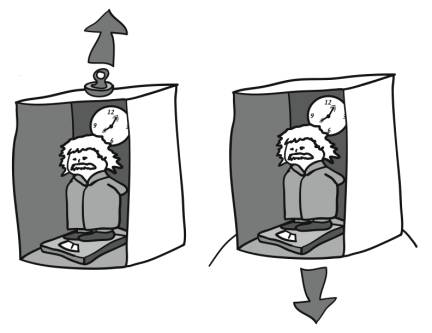
Figure
3:
Indistinctness between
Acceleration and Gravity.
A
concern whether this deformation of space and time is due to relative
velocity
or acceleration (as that due to gravity) must be addressed. Special
Relativity
deals with velocity not acceleration, otherwise the transformation
formulas
need not concern themselves with velocity nor be applicable.
General Relativity states
that the stronger a gravitational
field is the more the rate of time slows down. Accordingly, the more
mass an
object has the stronger the acceleration of gravity and the slower time
becomes. It is an experimentally tested effect, that time advances
slower near
the surface of a massive body than farther away, where gravity is much
weaker
(astronauts get older faster as they orbit in space).
Gravity, according to the
Theory of General Relativity, is
the result of the distortion of space in the dimension of time by the
mass of
an object. In other words, a mass
distorts
space in the dimension of time, which is expressed as gravity. The
severity of
the distortion of space-time by celestial bodies is proportional to the
density
of mass.
If acceleration, not
velocity, is then the defining factor,
it would be possible to keep acceleration low enough so that the
transformation
are kept low, and permit the speed of light to be attained and
exceeded,
provided long enough period of acceleration. If Special and General
Relativity's
indiscriminate effect are to extend to accelerating bodies, all is just
as
well. But Special Relativity is not concerned with a body's
acceleration, only
its velocity, which defines as an intrinsic property, independent of
reference
frame. Even in combination, it is inconsistent, since a moving object
alters
the curvature of space, a single light beam could not simultaneously
satisfy
its intrinsic relativeness with that of a massive body and remain
unaltered (a
circumstance similar to the two light beams and a stationary object
scenario
previously presented). Light having self-defined relativistic
transformations,
upon falling within a gravity well, must additionally alter its own
space-time
so as to not violate its own speed, as it is being affected by gravity.
General Relativity fails
to explain why free moving bodies
must curve the way they do, along the curvature of space-time, which is
defined
as gravity. Since an object must follow the geodesic path of the
space-time it
is found in, which is defined as the gravitational field, the
trajectory the
object takes is restricted by the structure of space-time itself. But
in
contrast lets us say that three-dimensional space is straight and
gravity is a
mere force that affects both matter and energy, these would still bend
object's
trajectories in parabolic path or elliptical orbits as we observe in
Newtonian
physics but does so as an effect of a force not as a restriction of the
structure of space. For Einsteinian physics, objects which travel
within a
distorted space-time will bend their inertial trajectory by the
restriction
imposed of the structure of space-time, a manifestation of gravitation.
Likewise, the straight path of light would bend according to the
geodesic path,
acting as gravitation. There would not be a force, per se, in the space-time model.
When it is convenient,
General Relativity pretends that it
regards the hypothetical four-dimensional distortion of space-time as a
potentiometric representation of the force of gravity, but it so
strongly
claims space-time to be an objective characteristic of the universe
that such
pretension are refuted. Space-time distortion, which manifests as
gravitation,
is solely responsible for the curve trajectory not only of light but
planets
and projectiles as well. Since gravity is really the deformation of
space-time
by the mass of an object, objects should be restricted to geodesic
paths.
To illustrate how this
mystery force arises, I propose as an
example that the reader thus take a sheet of paper and draw a line a
few
centimeters away and parallel to one of the edges of the paper. Lifting
then
the paper by one of the corners where the line ends, steep enough to
make the
corner's surface close to perpendicular to the rest of the paper, the
line will
twist accordingly. Imagine then a tiny sphere following along the line
towards
the raised corner; naturally affected by gravity and the inclination of
the
paper, it would start diverting off the line into a curve trajectory in
relation to the true straight path along the curved surface, which
represents
the curvature of space-time. Since gravity is defined as the curvature
of
space-time itself, an additional mystery force (expressed in the
example by
actual gravity) is needed so that the passing body diverts away from
the
curvature of space-time or geodesic trajectory. This additional
unspecified
force will be in the direction of time, perpendicular to all dimensions
of
space, which in the example is in the vertical dimension. So that, by
whatever
mysterious force objects fall, they neither follow a straight geodesic
path
along the curved space-time nor is gravity by definition responsible
for the
deviation. This is undeniably incoherent and although it could easily
be
defended with muddled four-dimensional talk, it should be enough to
discredit
General Relativity.
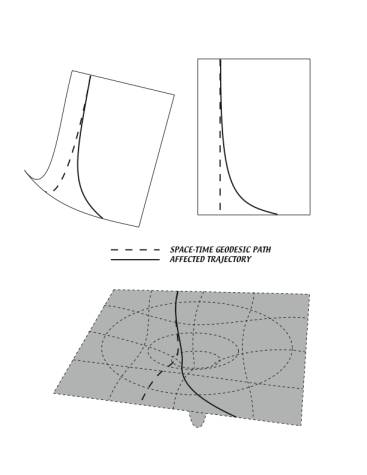
Figure
4:
Geodesic and Affected Path
in Curved Space-Time.
Although
it seems appropriate to attribute General Relativity to an object's
mass and
acceleration (agreeing with Newtonian physics) unfortunately the
Lorentz-FitzGerald transformation formulas for space and time regard
these
distortions as a function of velocity. Quite disturbing! Velocity being
a
relative quantity while the speed of light has no regards to any frame
of
reference, couple by the inapplicability of light itself to these
formulas.
Additionally, the transformation formulas fail to reflect time dilation
suffered by the effects of gravity for static systems. I realize that
Special
Relativity does not prescribe exclusively to these equations but they
are a
mathematical support to it.
Finally,
it should be pointed out, that there is a variation of the
transformation
formulas that applies to the mass of moving objects, which explains why
so much
energy can be expended attempting to accelerate a subatomic particle
and yet it
is impossible to reach the velocity of light. Theoretically, as the
velocity of
the object increases, so does its mass, so that the more energy is
inserted the
larger is the particle's inertia and the harder it becomes to
accelerate.
Surely, this transformation could be applied somehow to justify many
discrepancies in General Relativity but the overall model will remain
flawed.
Later
on, I will attempt to resolve these inconsistencies, explaining every
phenomenon that has lead to and come from Special and General
Relativity, and
do so without time, but must first ponder upon other matters.
"In quantum mechanics we speak of
mathematical
constructs called wave functions that give us information only about
the
probabilities of various possible positions and velocities." --Steven Weinberg
"The hindrances met with on this path
originate
above all in the fact that, so to say, every word in the language
refers to our
ordinary perception. In the quantum theory we meet this difficulty of
the
feature of irrationality characterizing the quantum postulate. I hope,
however,
that the idea of complementarity is suited to characterize the
situation, which
bears a deep-going analogy to the general difficulty in the formation
of human
ideas, inferent in the distinction between subject and object." --Niels Bohr
I
find no other structure in Nature as beautiful as that of an atom as
described
by Niels Bohr, Erwin Schršdinger and Max
Born, amongst others: orbitals of probability
model; subtle in
shape but complex in definition, simple in faculty but perplexing in
function.
A negatively charged electron attracted around a nucleus, an oppositely
charged
proton, forms an atom in its simplest arrangement. The structure,
however,
could not follow the classic rules of electromagnetism, or the electron
would
spiral down into the nucleus--this, couple with other strange
behaviors, set the
stage for Quantum mechanics.
The
properties of orbitals follow a
few simple rules on shape, size and the amount of electrons they can
carry, to
explain the whole range and diversity of chemistry from the remarkable
organization of Mendele•ev's periodic chart, to spectrum lines
(Balmer). I
could hardly dispute that which works so well at explaining natural
behavior,
be what it be; but one can never be certain, just as Niels Bohr
indicated: "there is no quantum world. There is only an abstract
quantum description."
The
model prescribes that the orbiting electron does not follow a specific
orbit
but moves about an orbital region in a manner described by a wave
function.
This wave function indicated the electron's position and momentum with
the
limitation that it can not be possible to measure precisely one
attribute
without compromising the accuracy of the other, causing an uncertainty
on the
exact behavior of the electron at any particular time, thus the orbital
designates the region of highest probability where the electron can be.
Even
when I am an advocate of Cause and Effect, quantum mechanics, which
lacks
predictability, is acceptable in this scheme. For as in Chaos, there
are
limitations on our appreciation and predictability of reality due to
the
overwhelming degree of complexity. In quantum, this uncertainty lies on
the
interference caused by observation to the sensitive physics of
subatomic
particles.
Werner
Heisenberg's Uncertainty Principle is an
understandable expression of our limitation on our means to measure the
position and momentum of atomic particles. Bohr points out "a
discontinuous
change of energy and momentum [Heisenberg's Uncertainty Principle]
during observation
could not prevent us from ascribing accurate values to the space-time
coordinates, as well as to the momentum-energy components before and
after the
process," so that, he adds, uncertainty is "the limited accuracy with
which
changes in energy and momentum can be defined."[ix]
Heisenberg himself, however, did not prescribed exactly to the notion
that the
uncertainty was a mere limitation of our instrumentation imposed by the
great
sensibility of the observed particle itself. For Heisenberg, it was
more an
intrinsic characteristic of the subatomic particle behavior, so that
classical
mechanics did not and could not apply to such particles. Quantum has a
contract
abridgement clause to violate the Natural Laws and Logic.
Upon
reading on the indeterminable mechanics of quantum particles one
continuously
stumbles upon the suggestion that proper classical mechanics do not
satisfactorily describe the behavior of electrons. This in turn is
presented as
a sort of frustration that where, quantum, at all possible to be
explained in
classical terms, the two realms would finally be compatible. So I am
tempted to
achieve this integration, although ungainly--since the complications of
Quantum
Physics go well beyond the uncertainty principle. (Quantum physics
involves a
series of implications, many of which are based on experimentation,
that have
also to be resolved in order for any explanation to be significant.) So
I
begin, if only with a mediocre attempt, demonstrating uncertainty at
the
macroscopic scale.
The
imaginary experiment consists on measuring the momentum of a large
solid ball,
but having only two means by which this can be measured: a spinning
wheel to
measure velocity, and a set of bowling pegs to measure trajectory--the
ball will
be restricted to roll along a horizontal flat surface.
The
first experiment consists of a paddle wheel, which axis is
perpendicular to the
flat surface so that when the ball hits the wheel some momentum is
transferred.
Ideally, the more momentum transferred from the ball to the wheel, the
better
the measurement, however, it will always be restricted from a remaining
momentum of the ball, which has nevertheless changed both velocity and
direction after collision. By the spin of the wheel, it can be
determined the
speed at which the ball collided with the wheel. Regardless, it is
impossible
to determine direction of travel by observing the spin of the wheel
alone.
The
second experiment consists of an array of pegs, the principle being
similar to
that of the game of bowling. As the ball strikes the pegs, it marks a
track
through which it has traveled, thus knowing the direction of travel,
but also
in doing so, not only is some momentum lost to the pins but the
direction is
slightly altered as well. And the idea here too, is that on account of
the
pattern left by the fallen pegs, velocity would be immeasurable.
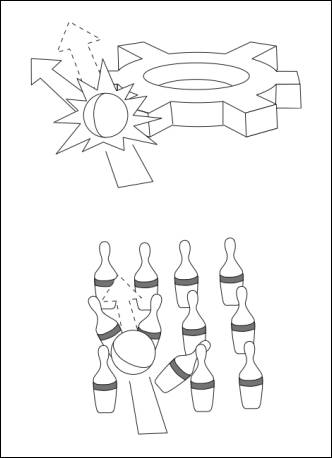
Figure
5:
Uncertainty at a Macro
Scale.
These
two experiments are analogous to actual meteorological instrumentation.
It is
either possible to measure direction with a wind vane or velocity with
an
anemometer, but where an experiment to restrict measurement to a minute
gust of
wind, it would be impossible to use both instruments without altering
the wind.
In
quantum physics, a more accentuated limitation is imposed due to the
fact that
it is electromagnetic energy the means of observation, which is at the
same
time the energy that rules the physics of atomic particles.
A
paper written in 1905 by Albert Einstein demonstrated
that photons came in small packages of energy
called quanta. It was this work which earned him the Nobel Prize in
Physics.
The experiment employed a diminutive light source, a photoelectric
plate, an
amplifier and a light bulb, and with it, Einstein help explained the
photoelectric effect by the absorption of photons, or quantum of light,
which
help propel the emerging concept of the dual nature of light as both
particle
and wave.
The
experiment utilized a photoelectric plate, which provided a
demonstration of a
phenomenon known as photo excitation, in which light would excite an
electron
in the plate. This exited electron, liberated by molecules in the
photoelectric
plate, were then reflected through a series of electrically charged
metal
plates, where it would excite additional electrons and consequently
causing a
cascade of electron with which a strong electrical signal was made (an
amplifier). A quantum was defined as the minimum amount of energy that
would
cause the first electron to be expelled out of the domain of the
photoelectric
plate's molecule. I shall return to this experiment shortly after the
next
discussion.
Quanta
are equivalent to the energy emitted when an electron is excited and
falls once
again to a lesser orbital to achieve a less energetic state. It is the
physics
of atoms as discovered by Niels Hendrick David Bohr that
only specific energies are permitted for electrons to jump to higher
orbitals.
His Third postulate says that the angular momentum of electrons exists
only as
a natural multiple of h/2¹ (h is Planck constant, 6.625^10-34
Joules
seconds). This discrete amount of energy, explains phenomena from photo
excitation to spectroscopy. The model depicts the electron not as
behaving
electromagnetically in continuous orbits around the nucleus but rather
in
stepped or distinct orbitals. (The energy required for electron
excitation and
de-excitation varies according to the level difference and the type of
orbitals
being dealt with.)
I
present a rather unconventional analogy to this most eloquent theory to
illustrate such behavior: residential apartments represent orbitals;
quanta
would be the different rents; and photonic energy the currency. The
electron or
resident must have to compromise between comfort and expense for its
accommodation. If the electron happens to gain energy its motion
becomes
larger, more erratic, so naturally a larger space to move about would
be more
comforting. But it can only move to the next higher apartment if it can
meet
the rent agreement of the landlord, the nucleus. If not, it must
suffice with
current accommodations of a less comfortable apartment. The natural
tendency,
which is to be at the lowest energy level possible, means that the
electron
must compromise by sacrificing comfort for economy of expense. This
does not
altogether agree with the actual physics of atoms, as described by the
quantum
model. According to the model, the electron does not collect energy
until it
has gained sufficient to allow it to jump to the next higher orbital,
but
rather, it receives that specific amount of energy and jumps. These
packs of
energy are quanta, and these are defined as particles of light.
Yet
the corpuscular or particular theory of light demonstrated by
Einstein's
photo-excitation experiment is not altogether complete, since light too
is
described as a wave. Thomas Young, around the year 1801, performed an
experiment that
definitely demonstrated light as waves, producing interference pattern.
It consisted of coherent light beamed through a
plate with two narrow slits to illuminate a screen on the other side.
The logic
is that if light is composed of particles then two bands of light would
appear
on the projection screen, instead, light shines through as a series of
bands, consequence
of the interference pattern emerging
from the two slits. If, however, one of the slits is covered, the
pattern
disappears (since interference requires the presence of at least two
waves). A
similar experiment performed by Sir George Biddell Airy in 1835 uses a
single
pinhole instead of two slits, consequently creating concentric circles
of light
and darkness. This experiment has been demonstrated to
produce
diffraction pattern with any type of wave (e.g. sound).
Modern
experimentation has enhanced these photoelectric experiments by
employing
sensitive photodetectors instead of a simple reflecting screen.
Utilizing
sources of light capable of producing very low intensity light,
individual
points of light are observed in the detector or photographic plate. The
molecules in the detector or photographic plate make these individual
points,
where only very few of them photo-excite given the very low level of
energy
employed. These points of light show up regardless if an interference
is
observed (when using greater intensities of light and arranged so as to
permit
interference), which accredits the particularity of light; when the
experiment
is arranged as to permit interference the same interference pattern
emerges but
collectively --the points of light fall along the bands of brightness.
Such
experiment seems to suggest a schizophrenic personality to the photon,
which
acts as a wave as long as it is permitted, without any definite
position (and
able to interfere with its re-directed half-self), but if observed in
such a
way as to attempt to detect a photons position or velocity, the wave
collapses
and becomes a particle.
The
particle/wave duality is a
concept that many have attempted to simplify in order to represent the
phenomena observed in terms of classical physics. David Bohm novel
attempt provides for an invisible pilot-wave that dictates the behavior
of the
particle. The complication is that the wave allows for a non-local
universe,
one in which faster than light communication permits relationships at a
distance to determine how the wave should collapse upon being observed.
Years
later John Stewart Bell proves
mathematically that in order for a model to explain quantum facts it
must be
non-local, which is to say that distant events are connected via
superluminal
information. But Bell's model though regarded as an accurate
description of the
quantum world, stands among many other theorems, which are not
necessarily all
logical concurrent. I argue in opposition to the particle/wave duality,
also as
a misinterpretation of experiments, specifically those involving
photo-excitement or photodetectors. My claim is that it is the quantum
physical
characteristic of electron excitation by atoms (Bohr's atomic model) in
the
phosphor or metallic plate being employed as detector that are solely
responsible for the particularity effect. Being an unrestricted wave,
energy
propagates continuously through space, but atoms behave quantitatively.
Electrons occupy different orbitals in discrete amounts of energy. The
influx
of energy disrupts the stability of the atom, but only after an
adequate amount
of energy has been absorb, a quantum, will an electron skip to a higher
orbital. When the source of energy is very low, only few atoms at a
time become
excited as sufficient energy is collected from the impending light for
photo-excitation. A good analogy would be the popping of corn in a
microwave
oven. The source of energy is continuous and uniform, but corns will
pop at
random, mostly one as a time. Since in fact the duality is raised as a
consequence of observation techniques, it would be justifiable to
attribute the
duality as a limitation of such techniques. My arguments are radically
different to conventional interpretations. Instead of quantized, light
is
continuous and existing only as wave. Bohr's Third Postulate is
understood as
harmonic states, and, it is the behavior of atoms that attributes to
the
apparent particularity observed in photodetectors, when low intensities
of
light are used. It is erroneous to project such physical characteristic
of
atoms to waves of light. The photon should remain as a virtual object
of a wave
function.
Although
waves can be "quantized", such does not occur when propagating through
space.
Nick Herbert describes this characteristic: "Quantized attributes
correspond to
confined waveforms like spherical harmonics, whose vibrations are
restricted to
the surface of spheres."[x]
Like waves on a string of fix length, only waves that are "harmonic" to
the
length, are permissible. By "harmonic" it is meant those wave with
wavelength
that are integer fractions to the string's length. Two attributes that
can
change the waveform confined to a string of fix length are the wave's
amplitude
and frequency (both of which are affected by the density and tension of
the
string or medium through which a wave travels). Light as it propagates
through
space, is unconfined, so every energy is permissible as we see in the
range of
electromagnetic waves, but only exists in specific colors when
restricted to
atoms (depending on their orbital configuration).
Leaving
the particle/wave duality to stand creates many controversies. Theories
like
Richard Feynman's sum-over histories, Hugh Everett many worlds
interpretation
or David Finkelstein non-Boolean quantum logic, derive as logical
implications
to the particle/wave duality of subatomic particles.
An
experiment can be set to receive light from an object, say a quasar
many
millions of light-years far away, provided that two light beams emitted
from
such same uh so distant source have converged once again at Earth, all
thanks
to a gravity lens of some distant intervening massive galactic cluster.
So then
it can be played with half-silvered mirrors within the telescope to
determine
if they are to interfere as waves, or select a particular route. The
interpretation suggests that the photon knew before hand (eons in
advance) that
it was to interfere with itself or not at a telescope in Earth. Such
argument
present itself, it anything, as sarcasm but the paradox has been stated
by John
A. Wheeler as a
serious extension of the non-local universe that light seems to
demonstrate. He
describes this as an observer-participancy universe, an astronomical
extension
of the delayed-choice experiment he so devised. Consequently, by
choosing how
to observe the quasar, either by including a beam splitter in the
telescopic
instrumentation or not, the observer has in effect participated in
determining
which characteristic (particle or wave) the photon has taken after
being
emitted from so farthest of stellar objects. "A strange inversion of
the normal
order of time," that can be resolved by re-defining the past as
non-existent "except as it is recorded in the present."[xi]
In turn, the idealistic experiment could only defeat its purpose by
supporting
the far-reaching idea that observation has more of a participating role
in the
history of the Universe. In logical context, it does serve as a strong
disprove
to the wave/particle duality theory, but it is excused into acceptance
by
regrettably claiming quantum logic, inaccessible by classical mechanics
and
classical logic.
In
my interpretation the experiment strongly suggest that it is in fact
the manner
in which light is observed which determines light's behavior. In other
words,
it is in the setting of the half-silvered mirrors and the detectors
that
determine whether the light is to interfere or take a particular path.
(This
fact must not necessarily be tag along to the observer-participant
model.)
Light acts with each setting thus accordingly, leading scientist to
well
suppose that both cases must in fact be true.
The
diagram below illustrates how the setting of mirrors, half-mirrors (and
polarized lenses) determine whether two light waves are to interact
with each
other to produce interference pattern or pass unhindered to two
photodetectors
which would reveal their "particularity". Light from a common source is
separated
by a beam-splitter so that the two are made to intersect each other
again by
mirrors. It is at this point that the observer has a choice on how the
observation is to be made. Either another half-mirror could be placed
which
would create an interference pattern, so that only one detector will
produce a
signal, or allow both beams to reach the detectors by not placing the
half-mirror.
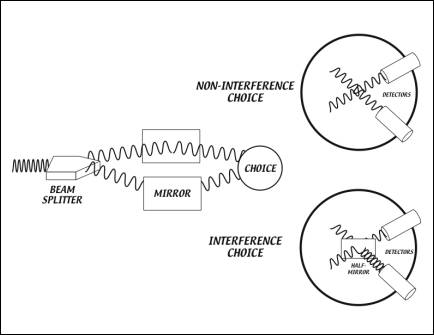
Figure
6:
Mirror and Half-mirror
Experiment.
It
is important at this point to explain the effect polarize lenses have
on light
in order to illustrate just how mirror and half-mirrors can affect
light into
destructive interference.
Without explaining what
is in itself the polarity of light, the behavior can be
ascertain. Polarize
lenses interfere with the "passage" of light according to the angle of
alignment to which it impinge, thus affecting the intensity of the
light.
A drastic effect occurs
when two lenses are utilized so that
variations in the angle of alignment between the two lenses affect the
"passage" of light from transparency to complete opacity. The accepted
interpretation to this effect is that photons have an intrinsic
polarity and
that the lenses block their "passage" according to the angle of
impingement. The
lenses are pictured as if they were molecularly composed of parallel
slits,
which trap photons of one polarity while letting those with adequate
angles
pass through. Yet, this blocking effect is actually an error of
interpretation.
The behavior of polarize
lenses depends
on the face side from which the light passes through.
So that between two lenses there are three possible combinations in
face
alignment. To differentiate between one face and the other, slanted
bars have
been placed at each end of the lens symbols in the diagram below. Only
the
configuration in the middle of the diagram can, at a particular angle,
"block"
completely the passage of light (the other two face arrangements can
only vary
the color--opaqueness is never achieved in any angle). This strongly
entertains
an alternative interpretation of a blocking slits phenomenon.
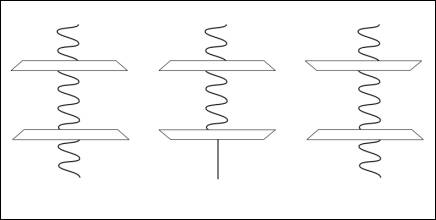
Figure 7: Possible Face Alignment of Polarize
Lenses.
Accepting
the blocking effect of the polarize lens face a few conflicting
observations
that can only be resolved if photons are given either a complex
polarity or an
ability to adjust before observation.
Photons
have a definite polarity. An experiment support in the intrinsic
polarity of
photons involves calcium atoms, which are photo-exited, releasing in
turn
photons of a specific polarization. So that regardless of the position
of a
polarize lens, as long as spherical alignment is maintained, then the
polarity
of the photons emitted are always "measured" to be the same. Defining
the angle
of alignment as angle a,
shifting the lens to an arbitrary angle b a decrease in translucency occurs, just
as is the same photon was to
pass through two lenses aligned at angles a and b.
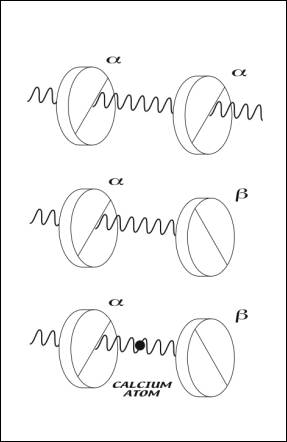
Figure
8:
Polarity of Photons from
Calcium Atoms.
The interpretation that
polarized lenses block the light,
becomes more disparate when a third lens is introduced into the
arrangement.
With the two lenses arranged so as to "block" completely the passage of
light,
by placing a third lens between these two, it will ironically allow
light to
pass through all three lenses. This completely demerits the
interpretation that
polarize lenses discriminate the passage of light by "blocking", as if
by
parallel slits.
Explaining such behavior
solely by photonic attributes,
forces a description of reality with non-local properties, as indicated
by
Wheeler and championed by Bell. Such behavior implicates a sort of
foresight
ability to photons, as to the manner that it will be observed. It was
the sort
of reasoning which inspired the Albert Einstein, Boris Podolski, Nathan
Rosen
argument, which points out Quantum Theory's inability to fully describe
photonic physics. The
Einstein-Podolski-Rosen (EPR) argument indicates an inconsistency
regarding
Heisenberg Uncertainty Principle for
measuring identical but distantly occurring events. So
that the precision of one measurement could not affect the outcome of
the other
if taken far apart. David Bohm later
supported the EPR argument experimentally. However, it
was John Bell's argument that
attributed not two
but three properties to the photon (i.e. position, momentum, and
polarity) that
dismisses the experiment. Thus implying that "action at a distance" was
the
only solution. And so photon would behave accordingly by superluminal
communication.
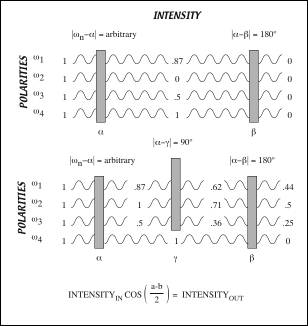
Figure 9: Effect of Lens Alignment to Light's
Intensity.
Non-locality
presents a photon capable of adjusting itself prior to crossing through
a given
configuration of lenses. All this askew logic that leads to
non-locality is
derived from misunderstanding the effects of polarity. This can be
avoided if
the phenomenon is not left entirely as an intrinsic attribute of
photons;
instead, if the phenomenon is explained as an effect of the lens, so
that the
incidence of translucency depends on the polarity of incoming light.
That is,
the intensity of light after passing through is determined by the
cosine of the
difference in angle between successive lenses times the intensity of
light
before it passed through (see Figure
9, above). The first lens receives light of
arbitrary polarity; the
preponderance of photons reduces intensity according to their angle of
incidence. Polarize lenses alter the polarity of light by phase
realignment or
shifting. A second lens when aligned orthogonally against the first
will
realign all passing light to obscurity.
Interestingly
enough, mirrors, without regard to any angle relative to the polarize
lens,
always reflects an image orthogonally opposed, so that the intensity of
light
is always reduce completely between the polarize lens and its mirror
image--phase out. Curiously, this happens with a face combination
between real
and virtual lenses, which would allow light through between two real
polarize
lenses (notice the slanted bars at the end of the lenses symbols in the
figure
below, comparing them with those in Figure
7).
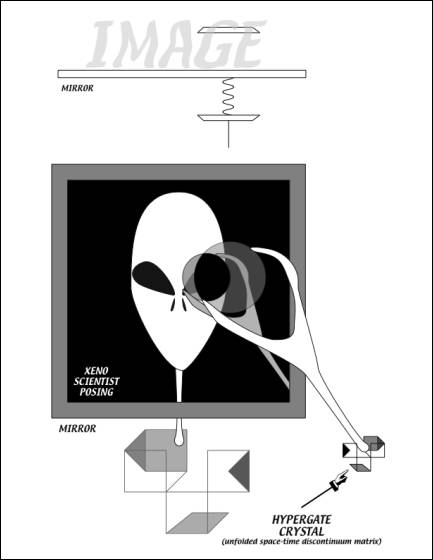
Figure
10:
Polarize Lens and Mirror.
This
experiment, probably the only one I have ever done regarding the
physics of
light, demonstrates how the mirror image of a polarized lens appears
black when
seen through the lens. The lens performs the same phase realignment but
to
orthogonally-reflect light, making it opaque. If polarity were due to a
"blocking" effect of the lens, it would seem that the light would pass
twice
unhindered, as the alignment is conserved.
In turn, every other
experiment performed, in order to
determine the behavior of light, must be reconsidered in light of such
effect
imposed by polarize lenses, mirrors and half-mirrors. By studying the
various
experiment arrangements, it becomes evident that an even-number
combination of
mirrors, half-mirrors, polarized lenses and detectors permits an
interference
pattern, while uneven settings destroys or impedes such possibilities.
To continue supporting
the blocking effect of polarized
lenses, depicted as slits, gives support to Bell's non-local
interpretation,
where the photon adjusts itself before observation. But the same
phenomena
could be explained as alterations to the phase of the electromagnetic
wave by
the lens.
Unfortunately, things are
usually more complex, so I could
not simply dismiss the particle/wave duality as a misinterpretation of
the
photoelectric effect or the phase alteration of mirrors and polarized
lenses.
For instance, the particle/wave duality has been extended to subatomic
particles other than photons.
Prince Louis Victor
Pierre Raymond de Broglie, being the first to
raise the
argument, contended that just as Einstein had shown how light waves had
corpuscular properties, so too would other particles of matter have
wave
attributes. An experiment, which reputably favors his conjecture, was
performed
by Americans Clinton J. Davisson and Lester H. Germer, which measured
the "de
Broglie wavelength" of an electron.
First, de Broglie's
intentions were to explain quanta with
wave harmonies, through electrons neither have fixed harmonious motion,
nor
propagates like a wave. Bohr's atomic model could very well justify the
behavior of electrons through wavelike motion. Only their nondescript
motion is
made undeterminable through observation.
Second,
de Broglie did not suspect the Einstein's photoelectric experiment
could have
been interpreted differently, so that instead of assigning the quanta
size
energy package as an actual corpuscular photon at its minimum energy
level,
that it be ascribed to the molecular reaction according to Bohr's Third
Postulate concerning atomic excitation phenomenon.
Third, to what Quantum
Mechanics refers to as wave are two
different things, which could be interpreted in certain models to
represent the
same thing. These two references are: the physical disturbances of an
energy
field; and, the mathematical curve of possibility for a particle. This
second
reference, describes the manner in which particles exist and can be
observed,
thus providing the means of measuring the probability of finding
various
particle attributes such as position and momentum at a particular
moment. For
example, alpha radiation, the nuclear decomposition by release of a
helium ion,
as presented by Gamow's theory of radioactive disintegration is
described as a
spherical wave that continuously emanates in all directions from the
nucleus.
But this spherical wave provides means to measure the probability of
disintegration that the alpha particle can emerge in any direction. The
highly
energized helium atom will thus be emitted in total randomness and
detected
only as a particle but described mathematically as a wave. Like S.
Weinberg said:
"In other words, [particle] waves are not waves of
anything; their significance is simply that the value of the wave
function at
any point tells us the probability that the [particle] is at or near
that
point."[xii]
This wavefunction have been even attributed to whole atoms.
Fourth, electrons and
other subatomic particles unlike
photons, have mass, so they are restricted to a space. Chemical
reaction, and
molecular configuration should be ample reasons to reject wave
attributes at
least to atoms. As for electrons, as demonstrated by experiments where
they are
made to impact a nucleoid, their particularity is always maintained.
Fifth,
waves can be restricted such as by magnetic fields to manifest
themselves at
discrete areas. So too do objects such as lenses and magnets, which can
be used
to focus or diffuse, altering the electromagnetic waves, thus
restricting any
affected electron accordingly.
And sixth, electron's
motion are governed by electromagnetic
waves through which they travel; though the raison d'entre of the force field are
the energy
and position of electrons and protons, the wave dominates the
particles'
behavior. So, the Davisson and Germer's experiment, which consisted of
the Airy
pattern, can be alternatively explained by the particularity of
electrons whose
motion is governed by electromagnetic waves on which they travel by.
The concentric
rings observed is a consequence of the atom within the nickel crystal
(or gold
metal foil) used to reflect and diffract the ray of electrons.
I nevertheless think it
is rather poetic to regard atoms as
a composition of waves enclosed in themselves. Like a little sound that
harmoniously vibrates in a spherical domain restricted by the force
that has
produce it.
Since I figure this does
not yet entirely dismiss the
particle/wave duality, additionally I present another natural
phenomenon, which
supports the wave nature of light and rejects its particularity:
Holography.
Holography is
the recording of light interference patterns in
a photographic plate, produced by splitting laser light so
that one beam reflects off an object to interfere with the other
undisturbed
beam, both of which are focused over the surface of the plate. The
interesting
phenomenon is that while the entire surface of the plate is
illuminated, some
areas in the picture will remain dark. This effect is easily explained
with
destructive interference of wave. Otherwise as a particle, photons must
become
of virtual existence so as to disappear, wherever the carrier
electromagnetic
wave destructively interferes. Although this virtuality of photons is
suggested
in other theories, it is not with the same context or intention (this
will be
discussed in a later chapter). It should be pointed
out, that
under current quantum interpretation the object being photographed
should poise
as a detector, adequately enough to collapse the photon-wave into
particle, so
that it should no longer interfere or act as wave.
A disturbing controversy
concerning the propagation of
photon waves should be clarified as well. The intensity (or square of
the
amplitude) of light diminishes with distance, while its energy remains
constant. Energy is equivalent to the frequency of light times Planck's
constant, and it is always the
same in every
direction and at any distance traveled from its source. Light, given
for
instance of blue color, from a far away luminous source, is still
observed as
blue regardless how distant, its frequency remains unchanged. If it
were to
loose energy it would shift to red, this can be observed in
cosmological
observations but for an entirely different reason of no concern here.
Only the
intensity of the light is reduced by distance. Since in fact the
frequency of
light defines its energy, this seems to suggest a violation in the law
of
conservation of energy. If one photon (a quantum wave of energy) is to
be
emitted spherically from an atom, consequently it could exalt
innumerable other
atoms by the same amount of energy. The paradox is largely due to the
corpuscular definition of photon. Imagine a series of infinitely
elastic
bubbles with no surface tension, expanding in regular intervals one
within the
other from a common point. The surface of each is traveling at a
constant
velocity, concentrically. Imagine then a small needle-like probe,
manufactured
solely for the purpose of measuring the passing of each bubble at its
tip. The
bubbles will not explode upon impacting the probe, but will continue
unhindered
their expansion. What the probe measures is the interval between
consequent
bubbles. A low measurement means large separations between bubbles.
Energy is
the frequency at which the bubbles come in contact and are detected by
the
probe. It is perfectly logical to conclude that the measurement would
remain
constant regardless of the position of the probe in space; what is
more, a
thousand or a million probes will all measure the same frequency, the
same
energy. Theoretically it would be possible to accommodate an infinite
number of
probes in space to measure the energy exerted by the expanding
concentric bubbles.
It is not the summation of all the measurements but the equivalence of
all
those measurements, since it is frequency that this experiment
measures. In the
real sense, these infinite expanding bubbles are light waves and the
probes are
any detector or eye.
There are two factors in
determining the amount of energy
needed to excite an electron, its appreciated frequency and its
intensity.
Concerning wave physics, frequency would be relative to reference
frame, while
intensity would not. The intensity of light diminishes by the spare of
the
distance, so it would require longer exposures for individual atoms to
accumulate sufficient energy to photo-excite. Thus a quantum, or photon
package, is the discrete amount of energy that upon absorption by an
atom causes
one of its electrons to jump to a higher orbital shell, on amount known
as
quanta. Neither a single crest nor a specific wave count constitutes a
photon.
It makes as much sense to define a wave as a particle, as defining the
length
of a point.
I could not completely
ignore Heisenberg's warning that the
uncertainty in determining a particle's momentum and position was not
to be
interpreted solely in terms of measurement disturbances. This ingenious
man had
arrived at this conclusion from first hand experimentation, knowing
exactly the
sort of behavior subatomic particles took. But in view of new
interpretations
given for the "particularity manifestation of photon" produced by
photodetectors; that such is a consequence of the quantized behavior of
atoms
within the metallic or phosphor screen and not of the wave that impinge
it,
couple by the general acceptance toward chaotic indeterminism in
contemporary
Science, it demands a re-analysis of the entire theory. This is not to
imply
that quantum mechanics is to be dismissed altogether. Quantum mechanics
continues to adequately represent and predict experimental results
through a
statistical approach, presenting the underlying causal reality with
chaotic
fields of probability (as described by Schršdinger's wave function).
The
uncertainty principle remains as an unavoidable limitation; since
subatomic
particles are governed by energy waves, they can never be observed
without
affecting either their position or momentum, if not both. Complemented
must be the
subjective description with an objective computation.
In light of this, I find
pertinent to discuss Richard P. Feynman's Quantum
Electrodynamics Theory, so as to take what is
good and dismiss
what is perceived as inconsistent with this new interpretations of
light's
interaction. His main argument is that light, a photon particle, does
not
necessarily travels in straight line, but rather take any arbitrary
route,
curve or what have it; but that the summation of all those possible
paths
always add up to that of straight and "least time" trajectory between
source
and detector. This must be clarified, since it might appear that the
intended
argument refers to the spherical propagation of light waves. Here,
however, the
intended description is for an individual photon particle, and imposes
an
unnecessary complexity to photons by describing an obscure trajectory.
Feynman's attempt in
figuring lights amplitude, the
probability of it to reflect on a given surface, is very effective,
though very
complicated to determine as a mathematical exercise. Amplitude is
calculated by
the addition of numerous and minute arrows which change direction
through time.
(The manner in which these vectors change direction reflects the
sinusoidal
behavior of light.) This is further complicated when interaction
between photon
and electron is concerned. So light, not only takes various paths but
so too,
have variation of speed. "It may surprise you," Feynman points out,
"that there
is an amplitude for a photon to go at speed faster or slower than the
conventional speed, c. The amplitudes for these possibilities are very
small
compared to the contribution from speed c; in fact, they cancel
out when light travels over
long distances."[xiii]
Yet this
idea is in need, in order to explain a slight imperfection in
measurement to
what was first theoretically calculated by Paul Dirac to
be the "magnetic moment" of an electron. Feynman further
explains that, "this correction was worked out for the first time in
1948 by
Schwinger as jxj divided by 2¹, and was due to an alternative way
the electron
could go from place to place: instead of going directly from one point
to
another, the electron goes along for a while and suddenly emits a
photon; then
it absorbs it own photon."
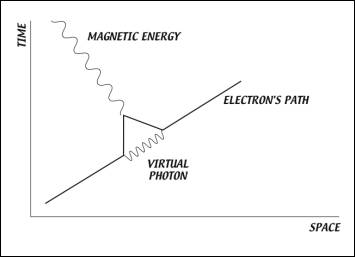
Figure
11:
Electron Virtual Photon
Emission and Absorption.
So no longer is the
electron's "magnetic moment" 1 (as is by
definition) but 1.0011596522±10-11 (the
minute
imprecision is due to the uncertainty as to what exactly is the value
of j).
What all this "most precise of all physical measurement" adjusts for is
simply
to account for the slight interim period between absorption and
emission of a
photon by an electron. Not being immediate thus arises the discrepancy.
Yet, in
order to justify this behavior of electrons, it calls upon action at a
distance, since electron must release a virtual photon just before the
electron
reacts, implying that some other information reaches the electron
before the
force signal itself.
Instead, if light is
accepted as a wave, it will require a
certain amount of electromagnetic energy before the electron reacts;
and even
then, a slight adjustment to account for the electrons inertial mass
could
further justify to the delay response. Again, this interpretation goes
in
accordance with quantum measurements--without the need for
particle/wave duality
and action at a distance.
In reality, light simply
propagates in spherical radiance
(or however restricted by the configuration of the source, e.g.
conical). Light
will spread through space, and the only means by which light can be
detected is
by direct impingements. Like the reflection of the moon upon a lake,
that of
one and only one moon, but the same image can be seen from any
directions along
a properly reflective angel (physically changing the location of
reflection
over the surface of the lake, we see only those light waves that our
eyes
intersect
"When I rest my head
on a quantum
pillow I would like it to be fat and firm, the recently available
pillow have
been a little lumpy to soothe me back to sleep." --Norman Mermin
"Not clear physics!" --my own silly pun
Quantum physics might not
prescribe the exact mechanism of
electrons and photons in an electromagnetic field, but it has precisely
described their physical relationship, holding true and unaltered since
1913.
Unfortunately, the same cannot be said of Particle Physics, which every
few
years must be reformulated, corrected, adjusted and complicated ever so
more
since the day Victor F. Hess discovered
cosmic rays. Nobel laureate Sheldon L. Glashow wrote
about the field in which he endeavors: "quantum field
theory is a science unto itself that does not necessarily deal with
things that
exist in the real world."[xiv]
Maybe so! Here is a science that has used the Uncertainty Principle of
Quantum
to allow itself the luxury of implementing the most unorthodox and
deranged
form of reasoning. A license to kill Reason! Just to briefly name a
few, there
is the Gauge Theory, space or time-reversal symmetry violations, and
intermediate vector gauge invariance of weak interaction, whose exotic
names
subtly disguises its insipid logic.
Heisenberg Matrix
Mechanics, Schršdinger's Waveform
Mechanics or Dirac's Transformation Theory, provides unsurpassable
predictive
properties to Quantum Mechanics. All in fact are describing
indeterminism with
probability. Because of the nature of probabilities, these exercises
are so
unrestrictive that each allows for over-implication, that is, non-real
attributes that are mathematically permissible. For instance,
Heisenberg's
Matrix Theorem could allow within its mathematics, imaginary time--a concept strongly
advocated by the
leading theoretical physicist Stephen Hawkings.
A perfect example of
over-implications is Sheldon Glashow's
conjecture, the charm quark. Taking Schršdinger's
wave of
probability to explain the non-occurrence decay of K-particle into two
muons
(subatomical particles will be discussed shortly), the charm quark
could be
presented as an out of phase wave to that of the strange quark's wave,
so that
there combined waveform would cancel the possibility, thus reducing the
probability of occurrence to almost never that the K-particle will
decay into
two muons as theorized.[xv]
Before continuing with the discussion of Particle physics, as a prelude
to the
kind of nit picking that will be conducted in these pages, I would like
to skip
back to the idea of time in face of quantum physics, to demonstrate the
type of
irrationality that although it has not surface, can occur in this crazy
field
of Quantum Field Theory for subatomical particles. As a matter of fact,
what I
am just about to present, had in fact surfaced before, but no one
recognized
the tip of that iceberg. Niels Bohr wrote: "In the conception of
stationary
states we are, as mentioned, concerned with a characteristic
application of the
quantum postulate. By its very nature this conception means a complete
renunciation
as regards a time description. From the point of view taken here, just
this
renunciation forms the necessary conditions for an unambiguous
definition of
the energy of the atomÉ In connection with the discussion of
paradoxes of the
kind mentioned, Campbell suggests the view that the conception of time
itself
may be essentially statistical in natureÉ according to which the
foundation of
space-time description is offered by the abstraction of free
individuals, a
fundamental distinction between time and space, however, would seem to
be
excluded by the Relativity requirement."[xvi]
Quantum mechanics provides a tolerance for inconsistencies by the
guidon of
uncertainty and probability. The position and momentum, which cannot be
precisely known simultaneously is represented by the mathematical
operations of
quantum theory as statistical relationship. It can almost be expected
that this
problem will tend to be resolved by the devising of quantum-time. Since
precision of measurement on the particle's position and momentum cannot
be
precisely measured simultaneously, by quantifying time, simultaneity
will be
evaded with non-causal events. This would almost tie Quantum with
Relativity,
which lacks of simultaneity. It will seem then possible to measure
exactly both
position and momentum on the exact instant, by employing two different
reference frames that would registered the instant at rather different
times
and then create an interference between the two time probability wave
functions
of the event. This will most expectably open the door for a complete
new array
of possibilities that could even include time particles, or chronons, whose virtuality
determines time.
I suspect an equation of the type,
Et -- tE = -ih,
will creep up, although I
would not imagine all the implications
and applications to have beyond those just mentioned. The fact is that
it
surprises me that quantum time has not appeared before, even more so
after
Heisenberg stated that the electromagnetic force is visualized by the
time part
of an "anti-symmetric tensor located in space-time."[xvii]
Particle physics branches
off from Quantum physics, so
whatever misinterpretation originated in Quantum, it naturally is
inherited by
Particle physics. Unfortunately, a series of mutations have taken place
and
Particle physics that has now become a monstrous theory of half-unreal
particles, which have no relevance in Nature. For the last fifty years,
from
the Cyclotron to the thousand times
more powerful
Tevatron (1.8 TeV), the collection of "elementary" particles have
increased to
numbers in the hundreds. Originally intended to simulate the nuclear
reaction
caused by highly energized protons (better known as cosmic rays) when
they
collide with the atmosphere. These machines have progressively
continued to
exceed their energy levels, and their original intentions, in hope of
finding
the smallest constituent of matter. Such collision fragments the
nucleus (or
what ever particle are used) into streams of energy. The higher the
energy put
into the collision, it is reasoned, that the fragmentation increases,
forming
smaller particles, with the eventuality that the smallest indivisible
constituent be observed. (Higher energy denotes smaller frequency,
which in
turns provides better resolution. So by association, the higher the
energy the
smaller the particle, and the large the mass of that particle, since
mass
equates to energy.) Collision of successively higher energy creates
heavier "particles"; these "particles" being many times more massive
than the original
particles they came from. This could go indefinitely, the higher the
energy
level attained the more mass produced. "It soon became clear that the
number of
[subatomic] particles in the universe was open-ended, and depended on
the
amount of energy used to break apart the nucleus. There are over four
hundred
such particles at present."[xviii]
Regrettably, not all scientists agree on such clear exposition. As new
"elementary" particles are created, Particle physics must change in
order to
accommodate their existence. Many of the more important particles (in
terms of
theoretical support) like the W-boson, have been created very recently
(Carlos
Rubbia, European Center for
Nuclear
Research, 1983) after colliders had achieved adequate energies of 300
GeV. The
heaviest and hardest to detect of these necessary "elementary"
particles to
date has been the top quark. The European Center for Particle Physics
in
Geneva, have determined a new lower mass limit to the top quark to
exceed
170GeV.[xix]
This would require energy levels (theoretically speculated) achieved by
the now
defunct Superconductor Supercollider ring.
Colliders can accelerate
an electron to energy levels on
excess of a thousand million electron volts, but under such conditions
it can
no longer behave as an electron. Just because it maintains its negative
charge
should not constitute it as an electron either. An analogy would be
like
energizing radio waves to frequencies at X-rays levels and still
classify them
as radio waves or comparing a small lug of lead in ones hand with a
fired
bullet.
Most particles created
have a life span of a mere billionth
of a second and fashion no relation in the structure of matter; these
can be
considered as disorganized packages of energy or deformed matter that
rapidly
decay through the least resistant route, towards a permissible state of
matter.
True, that to pursue higher energy levels the conditions created
approximate
those theoretically existed in the initial moments of the formation of
the
Universe (while still scientists try to reach cosmic rays' levels of
energy).
In doing so, the experiment might no longer pertain to elementary
particles per
se, but
do reveal
the rules or better yet, the path of least resistance taken by such
extraordinarily high energies towards the formation of naturally stable
mass.
Physicist carrying on
these experiments must discern from
the myriad of "particles" and identify their characteristics, such as
energy
and charge, in order to catalog them. Since some few hundred
"elementary
particles" have been created, it naively leads to the conclusion that
these are
no longer true elementary particles. So arbitrarily then, the various
attributes used in cataloguing these "particles" were in turn adopted
as
constituents of matter. So in a real sense, the idea of quarks arouse
as a way
of grouping by constituent characteristics (Murray Gell-Mann) like
decay time
or energy size (mass). These attributes are taken as real elementary
constituents and are even defined by a wave function.
Quarks make
up hadrons (common taxonomy is: fermions, which are
particles that follow Pauli's Exclusion Principle, and boson which do not.
Both
categories are further subdivided into particles affected by the strong
nuclear
force, hadrons, and those that do not. A fermion that is also a hadron
is
denominated as a baryon, while a non-hadron is a lepton, and a
boson-----hadron
is known as mesons), but they themselves are very numerous and allowing
them to
exits requires in turn an additional force carrying particle
responsible for
holding them together (gluons). Quarks are the epitaph of years and
trillionth
upon trillions of Joules spend in the creation of hundred of malformed
energies
that could not hold themselves together naturally. I personally feel
physicist are
privately laughing with uneasiness and marvel over these quarks they
have
concocted. For even in their naming reflects the sort of nonsensicality
they
have summoned: strange, charm, up, down, bottom, top. For some obscured
reason
it reminds me of the seven dwarves in the story of Snow
White.
What definitely can be
said about the collection of
malformed beast is that they reveal some patterns: the allowable terms
and
restrictions by which mass is formed. For instance, electric charge is
one
basic characteristic that energy suffers when becoming massive. From
all known
particles, deformed et al, chargeness comes in
integer multiples of the electron
charge (i.e., -1, 0, 1, 2). Another important
characteristic in
itself concerning charge is that it is a heavier toll on a particle's
mass. The
table below indicates charge and mass of various particles.
Table
1:Particle
Chargeness.

Notice
that as the negative charge increase for a type of particle so does its
mass.
Exceptions to policy are the p0 whose lifespan is about three
hundred
million times shorter (8.28 x 10⁻¹⁷ s) than its short lived
30
nanosecond (2.603 x 10⁻⁸ s) brothers, and the S*0
with a mass uncertainty measured at plus or minus eight units, which
could
place it properly between its two siblings. There is a variation
between the
mass increase due to chargeness within each set of particles, from
Ôquite
interestingly' 3 units between the nucleons to 13 between the X
and X* particles.
Implying that malformed beasts have permissible existence if there is
excess
energy. The surplus energy is thus released in the decay process.
These malformed particles
could essentially be
over-energized protons, which is an interpretation totally opposite to
that of
the current majority. Protons are not sliced to more energetic
substructures
but rather injected with excessive energy, which tends to break and
dismember
in order to decay back into a less energetic state, that is, back into
a
natural permissible structure. Electrons and protons would be true
"elementary"
particles from which other unnatural malformations could be
assembled--provided
sufficient energy. The idea of electron and protons as true elementary
particles is not only simpler but also experimentally sound. Such
conjecture
might be my weakest proposition but it present a much simpler model
than
Quantum Chromodynamics.


Figure
12:Proton
Neutron Gauge.
The quarks' charge
balances is balanced out:
(0)neutron Þ (1)proton + (-1)electron,
An electron has no quark
unless is in itself one, a
Ôdown-less-up'. This expands to,
(2 + --1 + --1)/3 Þ (2 + 2 + --1)/3 + (-1)
electron,
which is simplified as,
0/3 Þ 3/3 + (-3/3) electron
The electron/proton
constituency model suggests that energy
tends to naturally become massive in one configuration, namely the
neutron (an
electron-proton bonding). The neutron being a rather unstable
configuration if
left isolated decays into an electron and a proton, producing in turn
an
electromagnetic field.
Adding the constituent
masses reveals a relatively large
mass defect, somewhat larger than the mass of an electron or about
0.793 MeV.
This is exceedingly more
energy than that permissible for
the electron to orbit the produced proton, so it is violently emitted
with the
surplus energy. Being such a large exothermal reaction, it explains the
tendency of neutrons to be so short lived (918 seconds on average)
while
isolated. In the equation below, better known as beta-decay, I utilize
the
symbol for neutrino loosely, as the surplus energy. But in the
subjective
reality of particle physicists this missing mass accounts for an
"objective"
though "undetectable" massless particle, the neutrino.

n Þ p+ + e-
+ ne
I shall turn the
attention for a brief moment to the
neutrino. Wolfgang Pauli first
thought of the neutrino "particle" (which might well be
the only means by which such particle could ever be "observed")
intended to
carry away with the mass defect in beta decay so as to not violate the
Conservation of Energy Principle. The neutrino is theoretically a
massless,
charge-less and virtually an undetectable particle. Neutrinos are
theoretically capable of trespassing a lead
block as thick as the solar system without suffering any collision. It
was
deemed "observed" in an experiment by Cowan and Reines which comprise
of a
large underwater cage filled with pure water and wired by very
sensitive
instruments that could detect a produced positron and neutron from
reverse
beta-decay. The theory in play is that an antineutrino would strike a
proton
within a water molecule and cause it to change into a neutron and a
positron
that will in turn annihilate itself with an electron to produce light.
This is
the inverse process of beta decay, violating the PCT (parity, charge,
time)
symmetry, which is why antineutrinos are held responsible. Such process
was
indeed observed. The problem is that for each reverse-beta-decay
observed the
experiment must count with about a trillion of these ghostly
antineutrinos. As
I have mentioned in CHAPTER
VI: Force,
lower than expected results in solar neutrino
conflicts with the current model, which hopelessly evoke these ghosts.[xx] An alternative
explanation, which
excludes neutrinos, could be found using solely quantum mechanics: the
spontaneous entrapment of an electron by a proton. I realize that such
process
requires at least a "neutrino" of energy in order to occur. I also
realize that
such process does not clearly correspond with reverse beta decay, but
shortly I
will be explaining how the electron-proton constituency model clarifies
such
question. For now it can be said that the mechanisms within the nucleus
could
create unbalances for which the path of least resistance towards
stability
would be the reverse beta decay, needing thus to entrap an electron.
I am aware of the
significant distinction between
electromagnetism and weak nuclear force, where expelling a nucleoid is
all too
different than electron excitation. So the idea of radioactivity
resulting from
similar processes as electromagnetism might seem as an unacceptable
proposition
if expressed solely in terms of path of least resistance. Presented
however,
under different name, the unification of these forces becomes an
attractive
one. But why must one employ such nonsensical models as the Gauge
Mechanics,
the Electroweak Unification, the Spontaneous Symmetry Breaking Theorem,
and the
Grand Unification Theory in attempting this? When these concoctions
pull logic
arbitrarily from incongruent theorems and mathematical operations,
permitting
any hypothetical conjecture to stand as feasible. The electron and
proton
constituency model is not an attempt to synthesis a hypothetical
particle
responsible for the electromagnetic and weak nuclear force modulation
gauge, as
to become the electro-weak force, rather it presents or leads to an
explanation
in terms of field of least resistance, that works for both
electromagnetism and
nuclear reaction of the weak sort.
I should like to add at
this point, since it is the least
inappropriate place to mention it, that the Coleman-Glashow mass
formulas can
be better accounted for by the electron-proton constituency model:
2n + 2X = 3L + 1S
and,
S-
- S+ = (X- - X0)
+ (n -- p).
Of course, such model is
still inconclusive. Other
characteristics, such as intrinsic spin, lifespan, mass and association
amongst
themselves must also be explained (which I might add, standing models
can only
explain with strictly hypothetical quarks).
Just as the particle/wave
duality has
been the poltergeist of Quantum Physics, the concept of
force/force-carrying-particle duality has
been the downfall of Particle Physics' integrity. This
additional double role of matter is taken as a natural extension to the
quantum
wave/particle duality--a real aspect being the particle, and a virtual
aspect as
the force manifestation. Electromagnetism is carried by a virtual photon, gravity by a virtual
graviton and
nuclear forces by an array of virtual bosons. It provides a
particularity to
the seemingly ghostly and far reaching interactions of forces. So Earth
is
attracted to the Sun by an exchange of gravitons. But such reasoning
has
accumulated into a collection of off-spin theories employed solely for
the
purpose of this real/virtual duality. For such reason quarks have been
invented, as a face-saver to the duality. In the words of Glashow
himself, "in
this [virtual] role the photon is not observed as a real particle, for
it does
not emerge from the region of interaction to impinge on a detector--it
is
consumed in the act of producing the electromagnetic force."[xxi]
It is very hard to apply this comment when one is playing with magnets,
they
are interacting at great distances, enough time and space for virtual
photons
to manifest themselves and impinge on our eyes (which could be
diverted, say,
by mirrors).
Attributing a dual role
of particle/force was how pions were
rationalized by Hideki Yukawa to
express the strong nuclear force as
a virtual manifestation of a particle. For Glashow, such
constant interaction between nucleoids violates the law of conservation
of
energy, but it can be excused through quantum mechanics. With its
license of
inexplicability, such disruptions are allowed since "the intrinsic
uncertainty
in time corresponding to the energy of a virtual pion is about equal to
the
time it takes light to traverse the nucleon, about a trillionth of a
second.
Thus the virtual pion has an exceedingly fleeting existence."[xxii]
This statement illustrate the sort of irrationality physicists are
willing to
accept just to make place for virtual particles that could account for
the
existence of forces.
Because the hypothetical
pion acts across extremely minute
diameters of the atomic nucleus, it was so attributed a mass several
hundred
times larger than an electron, and an exceedingly short expected
lifespan.
Thus, to observe such a particle experimentally, enough energy had to
be
generated in order to produce such a heavy Ôparticle'. Cecil
Frank Powell
eventually attained this in 1947 and Yukawa's virtual particle was so.
The existence of the
fleeting pion was dubious regardless,
as it was observed for a mere trillionth of a second in the natural
collision
of cosmic rays with the atmosphere. Its quick path towards stability
produces a
muon, an unstable beast in itself, with a lifespan of two microseconds.
This
implies that the impact causes a great amount of energy that is quickly
released and consumed by surrounding atoms in the atmosphere.
Recent development has
added more controversy to the pion.
At the Los Alamos National Laboratory, atomic nuclei were bombarded
with
protons in order to observed pion interactions, but found they were not
involved in close proximity between nucleons. "Pions carry nuclear
force only
over distances of 0.5 fermi or more," indicates the article.[xxiii]
Speculations arise that gluons are thus "directly involved" with the
strong
nuclear force. Gluons are responsible for holding quarks together, so
now, the
pions are left without a purpose to be.
Another off-spin theory
that rooted out of this particle/force
duality was the positron, the antimatter
counterpart of the
electron. The idea of antimatter arose from Paul Dirac's (1931) explanation of
vacuum, as
a field of negative-energy electrons by which light could travel; a
substitute
to the unforgotten ¾ther Albert Einstein so
rejected three decades before, as if the light's
ability to propagate through empty space was hard to accept. By
inference, a
positive charge particle, originally believed to be a proton, canceled
out the
negative charge electron into a stable medium by which the virtual
photon
propagates through. But for the sake of symmetry the particle most have
the
same mass as the electron, thus a positron; discovered by Carl David
Anderson in
his studies of cosmic ray collisions--surely promoting the
credibility of Dirac's equation. I can't deny the veracity of
antimatter as it
not only observed as a byproduct of some radioactive processes but also
are
repeatedly produced inside particle accelerators, and spewed out in a
vast jet
stream from the center of our galaxy. In general, antimatter
would not
exist in equal amounts as matter does, as if made from a well-balanced
act of
cosmic creation. The study of electromagnetism shows that the field has
spontaneous right-hand-ness in formation. (Or at least, if the
direction of the
electric field taken by the current of charge particles happens to be
random,
the first of these would induce other charge particles to follow
accordingly.)
Nevertheless, the idea of space comprising of virtual electron-positron
pairs
strikes me as metaphysical, since for one thing they will annihilate
each other
upon contact. And even if Dirac's equation were subsequently altered by
renormalization and over again by quantum electrodynamics, the reason
for its
present dismissal was not on the obscurity in which the argument was
originally
based, but due to some measurable inconsistencies among further
experimental
findings. The discovery of positron, though serendipitous, it is still
regarded
as a consequence to Dirac's "prediction". I must add at this point,
that charge
and mass are basic characteristics of matter. The fact that a positron
exists
and is a stable particle while maintained isolated, demonstrates a
possible
state or combination of this two independent characteristics. When a
positron
and an electron annihilate each other in two gammas indicates that
positrons
cannot exist naturally, that it is wrongly assembled within this
universe of matter.
The idea I am trying to convey is that the positron has nothing to do
with
Dirac's negative electron sea, that it is simply misbehaved or better
yet a
misassembled particle. It has been Dirac's fortune that the conjecture
came
before the discovery. And that Dirac's inference was attained by
presumptuously
conceptualizing photons as virtual particles responsible for the
electromagnetic force, which would propagate through space by jumping
from
electron-positron pair to electron-positron pair.
The
force/force-carrying-particle duality has been further
strengthened by a hypothetical term known as intrinsic spin. It implies
that by
the rotational symmetry a particle possesses, it will either comply
with
Pauli's Exclusion Principle or
not. This does not hold loyal to the original idea of
intrinsic spin of an electron, which restricted the number that could
occupy a
given orbital to two, but it attained its purpose supporting the
duality: spin
1 is a particle, spin 0 is a force.
Alternatively,
the electron-proton constituency model accounts for
all relevant
phenomena explained by current models, but so too many other effects
and
behaviors of matter, which current models do not. For instance, a
narrow band
of allowable isotopes called the Band of Stability could be defined by
the
electron-proton constituency model in ways quarks never can.
A neutron, which is
rather unstable by itself, finds
stability by coupling with a proton. This relationship is very striking
in
order, and furthermore permits the conglomeration of proton-neutron
couplings.
Although not exactly a 1 to 1 ratio, as it tends to increase towards a
1:1.5
for heavier isotopes this coupling stability
is so much
so, that it is impossible to hold two protons together without a
neutron.
These facts reveal very
important interrelationship of
nucleons, that the coupling alleviated exuberance by defining a
balanced field.
The neutrons act as joining mechanisms between protons by alleviating
or
virtually eliminating their repulsion, acting also as a buffer in the
varying
electronic field that surrounds it. There clearly is a limitation on
the
effectiveness of the neutron to facilitate the gathering of protons,
due to the
growing need to enlarge the ratio as the proton number increases. So
there is a
small proton field instability that needs of additional neutrons as
this
discrepancy accumulates.

Figure
13:
Isotope Curve.
Nuclear
stability is not maximized at a 1 to 1 ratio, demonstrated by the
extensive
range of isotopes, the deviation away from the N=P line, and the
continuous
fusion of elements to higher configurations. Again, this is all due to
a slight
unbalance in the coupling between proton and neutron. Where it to have
been
perfect, it would all still by hydrogen, but the supreme exothermic
characteristic of the fusion of light atoms into heavier ones,
demonstrates the
feasibility, and provides for the tendency of nuclei to gather in
larger and more
stable configurations. True, that it takes large amount of energy to
fuse two
atoms together, a fact that has restricted this process to none but the
very
massive bodies in the cosmos. These processes are then only permissible
under
specific conditions where nuclear reactions present themselves as path
of least
resistance.
What is the most stable
configuration? If a table is
constructed plotting the binding energy pr nucleon according to
isotopes, a
curve of the manner depicted below is made. At the peek of this curve
lies iron
(Fe), one of the more stable nuclei. That is to say, when the
constituents of
the isotope: 26 protons, 30 neutrons and 26 electrons are added
together it
differs from the observed mass of iron-56 by the largest amount--just
about half
a proton's mass.[xxiv]
So the
configuration alleviates its internal energy by a less massive state.
This
should not be taken arbitrarily--it does require considerable stress in
the
environment, such as that of ancient stars, to allow for such nuclear
states to
be reached.

Figure
14:
Isotope Stability Curve.
By
expressing nuclear force with a state of least resistance, a very
simple
synthesis of strong and weak nuclear forces is achieved, that goes
beyond mere
implementation of common terms. If an unbalance in the nucleus is
enforced, the
energy and mass will seek the pass of least resistance to alleviate its
state
to one of lesser energy. There should be no restriction as of how the
release
of energy/mass be effectuated. It can take the form of electromagnetic
energy,
such as gamma emission, or the decay of a neutron into a proton and an
electron, depending solely on the present configuration. Radioactivity
is that
process of least resistance by which the atom reaches a more stable
nucleic
state.
Visualize the atomic
nucleus as a conglomeration of rapidly
vibrating protons and neutrons. Quantum mechanics
alone, should account for the spontaneous jump of a
nucleon or nuclei to be released from the set--the larger the nucleus
the
greater the likeliness. Yet this could very well occur in a relatively
stable
and simple isotope, say for instance an oxygen atom that has lost a
neutron. In
order to reach a more stable nucleic ratio, after loosing a neutron,
one proton
could entrap an electron to become a neutron, releasing large amounts
of energy
in the process. The oxygen unavoidably becomes a nitrogen atom. What I
am
describing here is "isomorphic" to the reverse beta-decay, a reaction used to
testify the
existence of antineutrinos. The two diagrams below illustrate the
correlation.

Figure
15:Isomorphic
Reaction to the
Antineutrino Reverse Beta Decay.
It should be noted that
the antineutrino represents a gain
in mass--the neutron being heavier than the proton and electron added
together.
Though both reactions gain mass, the antineutrino represents a greater
discrepancy since in itself lacks of any mass and additionally a
positron is
produced. The apparent violation to the Conservation of Energy Law for
both schematics is resolved by a mass defect resulting
from any proton-neutron coupling.[xxv] So neutrons within a
nucleus are
lighter than when isolated. Even when some electromagnetic energy is
released
in the reverse-beta-decay reaction, a mass balance is maintained. But
not all
the electromagnetic energy accounts for the mass defect. To balance the
mass-energy equation for all nuclear reaction, the nuclear binding
energy must
be accounted for. So for instance, the beta-decay, where a neutron
decays into
a proton which remains in the nucleus as well as emitting an electron,
instead
of attributing the mass defect to an undetectable neutrino, some of the
neutron's mass is converted to binding energy while the rest is emitted
as
electromagnetic waves. This produces a stronger, more stable nuclear
field.
Since nuclear stability depends on the proton-neutron ratio, variations
away
from the Band of Stability denote the propensity for nuclear
readjustment
through the path of least resistance. All in all, there are no
neutrinos, much
less antineutrinos.
Under the field of least
resistance model it should be
questioned what then prevents the electron from falling within the
nucleus and
couple itself to a proton. A neutron, after all, could be seen as the
lowest
state of electron excitation in the electron-proton constituency model.
It
would then seem reasonable that atoms would be tendentious towards this
more
stable state by reducing its electromagnetic field. This is in fact so
but to
an extent: it should not affect nuclear stability. The exothermic
nature of the
beta decay demonstrates that nuclear balance overrules. Were an
electron to
couple with a proton, it would unbalance the proton-neutron ratio,
which
requires much more energy to alleviate. It is less strenuous to repel
an
electron than to change the nucleon ratio--make the neutron responsible
for
this. Hence two contrary fields restrict the motion of electron thus
following
a path of least resistance, preventing the electron from falling into
the
nucleus [nuclear stability] while it lures it into proximity
[electromagnetic
stability]. This implies that for a simple atom as hydrogen, a balance
between
the two fields will describe a quite simple spherical field of
probability of
specific radii range, between the electron and the proton. This is in
accordance with the s orbital of the Bohr-Schršdinger-Born atomic model.
Accordingly, chemistry is
just as simple explained through
fields of least resistance. Atoms tend towards the more stable chemical
state,
noble configurations, where every orbital is occupied by two electrons;
thus,
the ionic variations. In order to maintain both electromagnetic balance
and
noble configuration, atoms either gain or loose electrons, which in
most cases
is best achieved by the sharing of electrons with other
atoms--covalence
bonding.
Finally, the most
elementary "particle" of all, the
photon--the wave that started all. It might very well be the building
block of
matter; after all, "subatomic particles" tend to propitious decay into
photons.
Take an electron and a positron, annihilate them by contact and the
resulting
energy is two very energetic photons in the gamma range (1.23x10²⁰
Hz or 0.511 MeV each).[xxvi] The equivalent of energy
to mass,
demonstrates that some mechanism in nature exist to define one from the
other.
The difference seems to lie in its motion. For energy to become massive
it must
turn unto itself loosing its field attributed, so in the term of
loosing its
wave propagation it gains particle exclusiveness. My belief is that in
it too
is locked the secret of gravity.
If the laws of Nature
permit energy to become massive into
one particular configuration, the neutron, it takes photons in the
energy levels
of the highest gamma (3x10²³ Hz) in order to count with
sufficient
energy to create such a particle. A photon wave cannot gain energy by
itself
from nowhere; in the same manner a photon cannot loose or get rid off
its
energy (x-ray cannot naturally become ultra-violet light). However,
given the
conditions believed to have existed at the beginning of the Universe,
photon
waves of such high energy would have existed. The physics of the
electromagnetic wave is that of a sinusoidal vibration. At very high
energies
it becomes very erratic, especially if dealing with higher amplitudes.
Under
such conditions if the wave folds unto itself, becoming massive, it
would ease
this high-energy field. What exactly is involved in this folding of a
wave is
too abstract for me, but I speculate that within the mathematics of the
quantum
wave function, such a transformation from sinusoidal to impact or
special wave
is possible.[xxvii] The formation of matter
seems a
rather futile attempt for an energetic photon to reduce its field state
to
particle state, as matter creates various disturbances of greater
impact to
space. These disturbances are exclusiveness, electromagnetism and
gravity. As
it turns out, it was a rather fruitful compromise that Nature had
allowed to
occur some 1080 times (atoms in the Universe).
What lacks is
the
question of gravity, which will require first a re-definition of
Einstein's
relativistic space, ridding off its fourth "time" dimension and to
behave
through paths of least resistance.
"[Gravity and
electromagnetism]É
all ye know on earth, and all ye need to know." --Albert Einstein
"This sudden success
on a grand
scale, after a generation of desperate striving by great minds, lends a
heroic,
even mythic, quality to the history of [quantum theory]. But,
inevitably, it
has also led to a sensitivity of the part of physicists, a kind of
defensiveness, ultimately arising from the fear that the whole delicate
structure, so painstakingly put together, might crumble if touched.
This has tended
to produce a ÔLet's leave well enough alone' attitude, which I
believe
contributes to the great reluctance most physicists have to tinker
with, or
even critically examine, the foundations of quantum theory. However,
fifty
years have gone by and the structure appears stronger than ever." --Daniel Greenberger
So far I have commented
disapprovingly towards contemporary
physics, dismissing time as a mental construct rather than a physical
dimension, revoke the Second Law of Thermodynamics with a diametrically
opposite observation, disregard the particle/wave duality of light as a
misinterpretation of a century old experiment, and reduce quantum
insipid logic
to a more palpable one which explains these uncertain phenomena by
paths of
least resistance. Now my task is mainly to construct a theory that will
explain
the Special and General Relativity theories with timelessness,
employing the
various concepts previously presented. For those who have approved on
my
previous views, will find this model a fulfilling complement. It is my
hope
that for those who disagree with what I have presented so far, that
after
finally reading this chapter through, I may get their concordance.
In the discussion
concerning the inconsistencies of
Relativity an alternative formulation was not given, but not until the
previous
chapter did I presented sufficient basis to provide such. With no more
undue
preamble I introduce the idea of event-space.
The term event-space is
synonymous to space-time but for the
time factor. Since the basic premise of this work is the
non-objectiveness of
time, Einstein's Relativity or rather, every experimental observation
must be
accounted for in terms of time as a scalar in order that this proposed
model is
accepted.
The word "event" refers
to action taking effect be it motion
of a particle or propagation of energy. The word "space" refers to the
boundaries establish for a described system. All may vary in the
density of
matter or the intensity of energy. It is the density of matter and the
intensity of energy that defines the event-ness of that space.
Event-ness represents
the "rate of change" within a space (congruous
with the definition of time as a standard ratio of harmonious motions).
A
system with a comparative larger event-space than an arbitrary standard
then
motion will be "larger" while smaller event-space where the space is
compressed
and motion is "retarded". "Shorter" or "smaller" refers to larger
compression,
akin to vibrations where a shorter wave means higher frequencies. And
as for a
standard of measure between any event-space, it may well be the already
established definition of a second, adopted by the General Conference
of
Weights and Measures.
Higher densities of
matter create stronger gravitational
forces that retard motion by increasing inertia. It is for this reason
that
clocks on earth tick (or vibrate) slower than they would in space for
the same
time period (it should be clarified that time scale is ultimately
defined by
Earth's rotation). This retardation is a result of the increase on the
inertia
of matter which gravity makes. Likewise, lower intensities of energy
reduce the
capacity of motion--less inertia and less acceleration suffered. In
general, the
density of matter and the intensity of energy have reciprocal effect on
the
event-ness of space.
While Einstein's General
Relativity describes
gravity as distortions of space-time, this
alternate model describes gravity as a force that distorts events in
space. Synopsis:
not gravity as distortion but distortion by gravity. Since an increase
in
gravity increases the inertia of matter, motions require more force so
things
are "slow"; which is why high-density matter (akin to black holes) have
small
event-ness (resulting in the retardation of motion and slowing down of
time).
However, higher force fields create greater accelerations so that
motions speed
up faster in shorter event-space.
The distinction might
seem irrelevant but the implications
are considerable. Space is the volume within which a dynamic system is
described, defined by the propagation of matter and energy (the events
themselves). The amount of matter and energy within the volume defines
the
intensity for both gravitational and electromagnetic fields. As fields,
these
forces affect the manner of interaction on every particle and their
energies.
Just like larger electromagnetic fields increase inductances that in
turn
increases flow, likewise, larger gravitational fields increase inertia,
thus
retarding motion by increasing the inertia of mass, but by the same
token it
causes higher acceleration. Systems acting under larger gravity fields
will
resist change more than systems in gravity fields of lesser potency;
but things
will accelerate faster.
The distortions caused by
gravity, may no longer be seen as
physical alterations in the hypothetical four-dimensional curvature of
space-time, but on the rate at which events take effect. Time is a
scalar by
which the periodicity or swiftness of the events (motions) in that
system act,
and may be referenced to similar events under different gravitational
and
electromagnetic fields to discern a difference.
As a consequence of these
distortions, relative measurements
are also affected. Electromagnetic energies may shift frequencies or
suffer
gravitational lens as a result of a gravitational field. Since both the
distance of space and the rate of time are scalar properties defined by
measurements of light, consequently both space and time vary according
to the
severity of gravity in an event-space.
The term event-space
itself is employed as a mean of
differentiating the severity of gravity from one region of space to
another. It
has an additional significance in that it attests to the dynamism of
the
Universe. The rule is simple: Space with high density of matter will
have more
compressed event-space.
Likewise, there should be
no appreciated difference for
matter, between the effect of gravity and acceleration by any other
forces.
This should be intuitive. Gravity being a force accelerates matter--the
degree
of acceleration depending on the amplitude of that force (which is
proportional
to the density of matter). But other forces may accelerate matter, so
it can be
deduced that all forces alter event-ness as well.
It is certainly
appropriate at this point to represent
event-space graphically. The figure below illustrates two light waves
of the
same wavelength traversing the same distance; the only difference
between the
two spaces is their event-ness, the shorter one being compressed by the
greater
mass density of the defined space. It would certainly appear as if
light
traveling in a longer event-space would travel faster than that of
shorter
event-space, but this is not so. Both rays traverse the same "distance"
at the same "speed". The logical resolution to this apparent paradox is
that gravity
(proportional to the density of matter) alters the wavelength and
frequency of
light. Since the velocity is determined as the product of these two
properties
(see CHAPTER
IV: Motion),
constancy is maintained. Relatively, both frequency
and wavelength remains constant; distance and time are defined in
reference to
these properties.

Figure
16:
Alteration of Event-ness.
Again, distance and time
are scalar, established by an
arbitrary coordinate system from which to reference. Notice, that
dimensions
are determined by measuring the properties of light. But as light moves
from
one event-space to another it suffers a deformation, the transition
being
undetectable (the difference established is only apparent by inference
not by
direct reference).
For Relativity's sake,
suppose that two transcending lights
in different event-space can be referenced by superluminal information.
It
would indeed be demonstrated that the light on longer event-space would
move
farther. This is only apparent if both event-spaces are reference from
another
non-event-space, such as imagination.
But taken separately,
there should be no discernible
difference in the definition of "time" between two different
event-spaces. I
explain: since time is a scalar. Suppose time is defined by
co-referencing a
clock with a quartz crystal, and two identical sets of clocks and
crystals are
placed at both event-space. Reference for both event-spaces between the
ratios
of the clock mark to the wave count of the crystal remains the same. A
second
is a second is a second. That is, a person will perceive the passing of
"time"
(by observing a clock) at the same apparent speed, regardless how
strong or
weak the gravity field is, even though the event-spaces are different
and
things do take place at different rates. This is only apparent through
non-event-space reference. This is akin to Relativity's discontinuity
of time,
but it is a trick we perceive by logical reflection and not something
that can
physically be referenced.
But not quite! Take for
instance the classical two identical
clocks experiment. Both clocks are set at the same time. One is taken
aboard a
rocket to orbit Earth, while the other stays on the ground. The
geometry of
astronomical objects permits an onion shell distortion onto space, of
gradually
longer event-space. The orbiting clock suffers a lesser effect from
Earth's
gravity field, so its atoms move much "swifter" by comparison.
Twenty-four
hours registered on the ground base clock might measure by the orbiting
clock
as a day and a second (hypothetical difference). In reality, it was one
time
period, a day--a single rotation of Earth around its own axis. The
larger
event-space of lesser gravity simply permits chronometers to tick
swifter, thus
marking more "time". But what time is it, Earth's time or Space's time?
Event-space does have its
implications, which directly
contradicts Special Relativity. Two photons approaching each other
would result
in a relative speed "twice" that permitted, even though they are still
moving
at light speed. However, it is altogether impossible to reference
except at the
moment of interaction, at which point they interfere according to phase
alignment. According to the field definition of waves, velocity is a
product of
the apparent wavelength times its reciprocal frequency, that regardless
if
these are affected by the relative motion of the observer the resulting
velocity
will remain a measurable constant. And as the two interfering waves
continue
their separate propagation, each would re-emerge unaltered as if they
never
concurred at all (such is the physics for all waves).
Light, being the standard
reference frame, continues
traveling through whatever event-ness at the same velocity.
Super-compressed
event-space does not imply that light would hardly get through, or that
it
could traverse such event-space as if it was a Hawking's wormhole. A
light
travels in a second what a light travels in a second regardless if is
in an
event-space stretch or compressed a million fold.
Interestingly, the model
does not impose limits for the
velocity an object can achieve. Though it remains extremely difficult
for a
mass to accelerate to velocities as that of light waves, there seems to
be no
physical limitation. As for what limits particle accelerators from
attaining
such speeds, is that as the magnetic field increases its even-space
shortens
and its inertia increase, being a circular trajectory, the deformation
is
apparent to an outside observer as a Relativistic-like limitation.
The model also implies
that as a massive object moves
through space it compresses event-ness forward while it stretches
behind its
trail. If a massive accelerated object approaches an observer, the
image would
be severely blue-shifted as a result of the accumulated compression
(more on
this accumulated effect in the next chapter).
The event-space model
resolves a mayor controversy of
Special Relativity that concerns the definition of rest or inertial
state.
According to Relativity, motion is a consequence of the reference frame
chosen
relative to the objects being observed, so that it is considered at
rest if the
reference frame elected is fixed on the object. And this must be so, in
order
for the Relativity transformations to take effect. In Relativity, there
should
be no relativity effect if no motion is observed (velocity being zero).
This
Relativistic definition is inconsistent with Galilean or Newtonian
definition
of state of rest, which states that a body at a state of rest is that
which is
exempt from any force that could avert its uniform motion, regardless
if this
uniform motion is observed by the chosen reference frame. Simply stated
an
inertial motion does not suffer acceleration.
Special Relativity
carries an aspect of observer-participant
reality. Choose any frame of reference and light strangely adjusts
itself so as
to maintain constant speed. But again, this is result of visualizing
light as a
photon "particle" which must suffer relativeness, not as waves.
Instead, event-space
concerns only with accelerations,
regardless if gravitational or electromagnetic forces make these, which
in turn
affects event-space by which the definition of distance and time is
made. This
is congruent with Newtonian mechanics and Maxwellian electromagnetic
relativeness in describing motion.
If gravity is not the
curvature of space-time but rather
gravity alters event-space, gravity must consequently be a force akin
to
electromagnetism. As gravity waves propagate through space, it shortens
the
event-ness of that space. A mass follows the path of least resistance
by
tending towards shorter event-space. As wave, gravity's amplitude
augment with
the amount of mass--its intensity being proportional to the density of
matter;
and as wave also its amplitude diminishes as a quadratic function with
distance.
Einstein suspected
gravity waves would never be observed.
Detecting gravity waves by the deformation of space as indicated by
Russell
Ruthen of magazine Scientific American: "Detectors one kilometer
longÉ would
change by less than a billionth of a meter. That is a distance about
1,000
times smaller than the diameter of an atomic nucleus."[xxviii]
On the account of quantum uncertainty alone the whole experiment can be
thrown
out the window. With such conditions, Einstein's suspicion seems almost
irrefutable. Yet such machines are being constructed at present time,
with cost
reaching over two hundred million dollars. The scientists
constructing such
apparatus expect to observe distant black holes as well. How are they
to focus
gravity waves, is a mystery to me.
However, an experiment
performed by Samuel A. Werner (1977)
found that changing the interferometer's orientation
relative to the Earth's gravitational field could alter the
interference
pattern formed by neutron diffraction.[xxix]
Such experiment seems to confirm the existence of gravity waves.
What produces gravity
waves? If matter is not a satisfactory
answer, I could not find a better explanation. If the idea of fields
that
define a path of least resistance does not suffice, disputed by a
virtual
force-carrying particle, then such a question will remain equally
unanswerable
to electromagnetism, nucleic decay, and Pauli's exclusiveness.
I emphasis that from what
I can recognize, without employing
extravagant particles and impenetrable logic, the event-space model
agrees with
every experimental observation of Quantum, Relativity and Classical
alike.
Unfortunately again, my mathematics abilities betray me, and the model
is
risked to stand without mathematical support, which would not only
establish
the model as logical but provides some tools for predictability as
such. I must
admit that this concept of event-space is a little muddle and can lead
to
relativistic-like discrepancies.
It should be simple: time
is a scalar. Time is an establish
ratio between two harmonious motions. This is referenced against the
rest of
the environment, as defined by the position and propagation of its
energy and
matter. Since energy and matter interact according to their relative
position
to other particles, the force fields generated effectively determine
the scale
of both distance and time.
"I'd much rather see a
theory
forbidding wormholes." --Stephen Hawkings
"It's impossible that
the Big
Bang is wrong. Perhaps we'll have to make it more complicated to cover
the
observations, but it's hard to think of what observations could ever
refute the
theory itself." --Joseph Silk
The model of Event-space
was in fact what initiated this
work entire thought process. Concocted as an alternative explanation to
Einstein's relativity theories with the premise that time was not a
physical
constituent of the Universe, such model implicated the many other ideas
I have
presented so far, most importantly the antithesis to the Second Law of
Thermodynamics: the tendency towards balance through the path of least
resistance. This Economy of Energy Principle explains gravity not as a
curvature of space-time, but as a field in all its classical sense. It
was
beyond all my expectations that the same principle could explain the
physics of
atoms, in view of all the controversial phenomena described by Quantum.
The model
might be so simplistic after all that I expect physicists will reject
it on
grounds that though it is much simpler, it is not deterministic since
there is
still plenty of room to accommodate Chaos and its chancy nature. I do
not know
how else to emphasis how this one law, the tendency by the system's
dynamic
response of its own configuration, allows for the development of
intrinsically
chaotic yet organized structures.
There are five principal
definitions for the Event-Space Model:
- The Universe is a
dynamic, self-configuring, non-linear system.
- Space is defined by the
propagation of matter and energy.
- The presence of matter
and energy generates fields of forces.
- Fields of forces are
causes for change.
- And changes take place
through the most economic means.
So the Laws of Nature, as
simplistic as they are, created
the wonderful formations throughout the cosmos, with interminable
variations.
In the style of Feynman's
quantum hieroglyphs the following
schematic representation of the interaction between energy, matter and
force is
given. I do not want to place much emphasis on the diagram, it is
merely a
pretty picture created with not much intricate thought.

Figure
17:
Interaction Diagram between
Force, Energy and Matter.
The Universe is defined
as an ever-expanding volume outside
of which nothing exists; that is, the Universe is everything that
exists.
The idea that the
Universe suffers a dynamic expansion came
by George Gamow's interpretation of
Edwin P. Hubble discovery
of galactic spectral red shift, stating that the
farther away galaxies are the greater the shift, thus the faster they
are
receding. Since the regression is observed in every direction, it is
inductive
to believe that the Universe, in its origin, must have been immensely
packed.
Such a state could be extended to extreme, compressing the Universe to
an
infinitely dense point, which would be so energetic that all matter
would have
been converted to energy. This state is known as supersymmetry, and
agrees with
the Second Law of Thermodynamics, so that present state universe is
more
entropic. Additionally, it can be stated that at the moment this
supersymmetry
was violated time and space where defined. This created an explosion
that set
the universe's expansion (at rates which vary according to the model
adopted)
during which time some mysterious influence created variations that led
to the
formation of the Cosmos. Edward Harrison and
Yakov B. Zel'dovich are
among many independent researchers looking for possible
explanation as to how galaxies appear from the super-symmetric
primordial
universe, with loop reasoning supporting the Second Law, as the result
of
minute fluctuations in the density of matter (as it has been recently
Ôobserved' in the background radiation). Should the Nature of
Things be
completely entropic, could there exist order?
As for the future state
of the Universe, scientist hope that
sufficient matter exists so that it would eventually slow the expansion
down
and cause it to contract. Let us assume that the Universe is to
contract. It is
to their belief reasonable that all would end as the hypothetical
"singularity"
state of the Big Bang model;
everything would fall back to its original
location--this is known as the Big Crunch Theory. Consequently, from
the moment
the Universe stops expanding and commence its reduction, entropy would
decrease, violating the Second Law of Thermodynamics. If such would be
the
case, it would be very interesting to hear from theorists what would
happen at
the moment expansions becomes zero. Could it be the end of causality
and the
beginning of a new universe? It would be absurd to suppose that history
would
reverse itself.
Contrariwise, if the
contraction is to avoid any violation
of the Second Law (in agreement with the Big Bang Theory), the final
conglomeration is to be of infinite disorder (whatever that means),
then "singularity" would hardly be an adequate term to describe such a
state. It
could not be presumed that such a disorder, or maximum entropy of
infinite
density would be organized. Consequently, if a model of the Universe's
End is
not to defy the Second Law, it should be that of an open universe
(endless
expansion).
An eternal universe being
a rather distraught idea
apparently rids us from a purpose to our existence (as if there was
any). A
renewable universe pleases the faithful. These wishes for a close
universe,
although have not been expressed too strongly, have been exited by the
proposition of the hypothetical "dark matter". If such particle exists,
it
could account for the exorbitant deficiency of mass now observed that
would
allow a contraction. This dark matter--which has been speculatively
attributed
to neutrinos, axioms, WIMPs, photinos, and neutrinos (maybe other
particles has
been concocted too)--is made responsible for the holding together of
galaxies as
well, since it appears apparently that there is not sufficient mass for
them to
be, or to be the way they are, and form the way they form.
Observations demonstrate
that the stars revolving in the
accretion disk possess escape velocities (to the mass observed), so
that
galaxies should have dismantled long ago. So too, is dark matter held
responsible in another astronomical mystery, the formation of the
galactic
clusters. It has been calculated that our galaxy belongs to a group of
galaxies
that are approaching one another towards a so-called Great Attractor.
Not
enough mass is observed amongst all our neighboring galaxies to pull
each other
close; thus dark matter.
To my relief, Hannes
AlfvŽn has
proposed an alternative theory to the Bing Bang, known as
Plasma Cosmology. I say relieved because
not until I
read the book by Eric J. Lerner which popularizes this theory, was
there any
alternate solution to the dark matter dilemma.
When electric currents
pass through plasma, dancing
filaments of light are form. Such phenomenon is responsible for auroras
as well
as the formation of solar flares and nebular gossamers. As electric
currents
flow through plasma, cylindrical magnetic fields are formed. These
attract
other currents flowing in the same direction, twisting and converging
into
larger vortices. "Given enough time, currents and filaments of any
magnitude,
up to and including supercluster complexes, could form--in fact, must
form."[xxx]
These provide sufficient force to shape galaxies into the
characteristic
spiral. "If the speed of gas rotating around the galactic center is
plotted
against its distance from the center, the curve first rises rapidly but
then
levels off. However, if the disk-shape galaxy is held together by
gravity
alone, the speed should fall steadily as distance increases. As in the
solar
system, outer planets move more slowly than planets close to the
sunÉ the flat
rotation curve emerges quite naturally in a galaxy wholly governed by
electromagnetic fields."[xxxi]
Filaments have been observed emanating from the center of our galaxy,
to prove
that currents the size of galaxies does form. Additionally, "in 1989, a
team of
Italian and Canadian radio astronomers detected a filament of radio
emissions
stretched along a supercluster, coming from the region between two
clusters of
galaxies. Electrons trapped in a magnetic field emit radio radiation,
so their
finding provided indirect evidence of a river of electricity flowing
through
the empty space." If electromagnetism is taken into consideration,
being so
much stronger than gravity. The formation of galaxies and superclusters
are
then possible without the need of dark matter.
It is this intergalactic
plasma as well, which is
responsible for the smoothness of the microwave background radiation.
"High-energy electrons spiraling around magnetic field lines within
filaments,
like any accelerated particle, generate synchrotron radiation--in this
case, of
radio frequencies. And Kirchhoff's law, a fundamental law of radiation,
states
that any object emitting radiation of a given frequency absorbs photons
from
the background and then re-radiate them in another, random direction,
they will
in effect scatter the radiation into a smooth isotropic bath, just as
fog
droplets scatter light into a featureless gray." Observation on the
apparent radio
brightness of galaxies suggests that waves at this frequency are being
absorbed
or scattered by the intergalactic medium. "Astronomers had observed
that as one
looks farther out into space, the number of radio sources increases
much more
slowly than the number of optical sources, and thus the ratio of
radio-bright
to optically bright sources decreases sharply. For example, a distant
quasar is
only one-tenth as likely to be radio-bright as a nearby one.
Cosmologists have
attributed this to some unknown mysterious process that somehow caused
the
early, distant quasar, to be less efficient at producing radio
radiation, even
though their optical and X-ray radiation is no different than that from
present-day, nearby quasars." (Though on page 148 of the same book, the
author
states: "As one looked outward in space and backward in time, there
were more
and more radio sourcesÉ" Though I might be taking the phrase out
of context, it
is certainly confusing.) Nevertheless, intervening "thickets" of
magnetic force-free
filaments resolve the mystery of such an isotropic radiation. Martin
Reed has
postulated that currently observed production of helium
is sufficient to account for all the microwave background energy.
Electrons in
the galactic filaments would repeatedly absorb and emit this microwave
and
effectively produce the isotropic radiation observed.[xxxii]
With all this in mind, it
may be concluded that current
model on the evolution of the Universe must change drastically.
We observe an apparent
expansion. It is by expansion that
the Universe reduces its energy per volume--the total energy remaining
constant.
It is then a matter of extrapolating in order to picture what sort of
state was
the Universe in at its origin. The young Universe was much denser both
in
matter and energy.
The Universe began as a
highly energetic field, glowing in
ultra-gamma light; the glow of which defined its volume. Since the
definition
of space is due to the propagation of mass and energy, the radius of
the
Universe would have increased as the speed of light. A natural law of
formation
of matter must have allowed ultra-gamma photon waves to fold onto
themselves
and become massive in order to reduce the energy state of such. Yet
such mass
particles would only be permissible only after the energy of the
Universe
dissipated over large enough volume. Yet, as the super-colliders on
Earth have
demonstrated, high-energy malformations of matter can be assembled. So
as the
temperature decrease, the Universe must have suffered a series of
transformation before neutrons where at all allowed to exist; all that
malformed matter eventually decaying into less energetic states through
the
least resistant path (the mechanisms by which lower energy photons were
generated). It can be expected that most ultra-gamma photons would have
converted themselves into massive particles; only those with
insufficient
energy would remain as energy. The ratio suggested by scientist of a
billion
photons per nucleon, indicates that only a minute range of gamma
photons had
adequate energy level (though this number might not mean much after
all).
Only after mass particles
were formed was a gravity field
generated, which would consequently create turbulence to an already
chaotic
event-space continuum, (since the gravity propagates at the same speed
as the
electromagnetic wave, by then the Universe was large enough to expand
eternally.) Electromagnetic unbalances came later when energies had
dissipated
sufficiently low that permitted neutron decay (by beta process).
It was at the state that
permitted particularity, where
motion could be referenced. So the formation of mass constitutes the
first
event, the beginning of time. Before this stage of formation, I dismiss
the
notion of time for reasons of discontinuity or lack of reference.
Photon
interaction is that of concurrency (interference) but matter suffers
"cause and
effect" by its exclusiveness. All forms of waves (including light) do
not
suffer a change per se when interfering with another wave. It is a
concurrent
existence, which manifest as either constructive or destructive
interference
depending on the phase alignment while the waves occupy the same space.
Each
wave conserves its shape after separating, so that there is a lack of
"interactive effect". But where matter is concerned, the "information"
of
change is conserved.
As for the state of high
energy that existed before time was
defined, I must leave it to versatile mathematicians and theorists to
determine
the extent in both volume and change that must have occurred before the
critical limit was reached when mass was permitted to exist. I can only
speculate that such state was much larger and of greater duration than
accounted in the Big Bang Theory.
The evolution of the
Universe after the formation of mass
was determined by the interaction between forces and matter/energy,
which
prescribed the changes to be taken through the path of least
resistance.
Gravity and electromagnetism took its hold on the Universe and matter
clumped
together to form the Cosmos. There is no sinusoidal history in the
state of
entropy, and no mysterious influence, which created variations in the
highly
symmetrical expansion of the supersymmetry.
Under the model of
event-space, the volume of the Universe
would expand to reduce the density of energy. An accumulative
distortion of
event-ness would result from the uniform expansion, perceived as an
increase
spectral shift as the distance of the objects observed increases. No
need here
for four-dimensional non-Euclidean space or Hawkings' imaginary time.
Event-space would stretch as space expands in the diffusive density of
matter.
Under such configuration, Hubble's equation of distance would still
hold but
with a slight difference in interpretation. Greater spectral shift to
red would
not be a consequence of a greater velocity of the more distant object,
but as a
result of the distance alone. The increase in the shift would be the
accumulated result of continual distortion suffered by the light wave,
as it
crosses ever-longer event-space (plus the Doppler shift cause by motion
of the
emitter and observer). The more elongations suffered the larger the
difference
of event-ness that has traveled through from origin to destination. The
argument is not geared towards the disapproval of Hubble's equation,
rather to
present a much simpler dynamic of the cosmos, one of more inertial
expansion.
Consequently, the universe is smaller and older than previously thought
by
Hubble's equation and ultimately more static.
Mapping of millions of
galaxies by Peeble, and clusters of
galaxies by Tully and Fischer show how they form filaments, which
contradicts
the homogeneity assumed by the Big Bang model. The formation of such
filaments
require at least four times longer than the age of the universe as
determined
by the Hubble Expansion. This is but one of many observations which
calculate
the age of the Universe to be much larger than that computed by the
Hubble
Constant. For example, two diametrically opposed galaxies as observed
from our
own galaxy, being at more than five thousand million light-years away,
would
had taken almost eight time longer than the age of the Universe to
separate
themselves form a common origin since galaxies apparently do not move
themselves much faster than a thousand kilometers per second (which
might be
the reason behind the INFLATIONARY UNIVERSE
SCENARIO, see CHAPTER
XI: Theory).
It is certainly a
disconsolation that the reasonable
implication to the event-space model is that the Universe would end in
the most
uneventful manner, a cold death toward endless expansion with the
condensation
of billions upon billions of overly dense galactic objects spread
beyond
further conglomeration. But such death would still allow for the
recycling of
matter somehow.
Theoretically, an object
could become so massive that no
longer would electromagnetism and nucleon exclusivity could hold the
force of
gravity. Such objects are named black holes. This, by far, had been the
best mathematically
describe hypothetical object in physics; and supported by indirect
observations
it has an accountable probability of existence so high that it is
virtually
accepted by the entire scientific community. There are some
discouraging facts
that I have thought of, however, which should discourage this unanimity.
It is generally assumed
that black holes are non-rotating
objects. Roy Kerr is
credited with a set of solutions describing rotating black
holes.[xxxiii]
I was perplexed by what this implicated. Taking the Sun's current spin
and
hypothetically collapse it to become a black hole, its angular momentum
being
conserved, would extremely increase its angular velocity. This is as if
sitting
in a rotating chair and impulse one self with legs stretch out, by
pulling them
in, the angular velocity increases considerably, and this is only in
human
scale, imagine then contracting a body as big as the Sun into a
diminutive
sphere. To resolve my suspicions, I performed the calculations. By
contracting
the Sun to the density of neutron star, that is 5x1026 Kg
per Km3
(about a billion tons per cubic inch) or about 10 km radius (six and a
half
miles), the rotational velocity at the equator would be 8.99x10⁴
kilometers per second. To contract the Sun even further to a radius of
1 Km, at
which density would be that of a black hole, the equatorial speed would
have
multiplied one hundred times to 3000% the speed of light. I was shocked
by this
result and figured my calculations wrong; however, I have since checked
my work
and confirm it as correct. Consequently, I had to reread the source of
my
information concerning Roy Kerr's solutions, the book A Brief
History of
Time by
Stephen
Hawkings, and realized that Kerr
had
employed relativistic formulas. So I can only assume that physicists
are aware
of this superluminal violation, but apply Lorentz's transformation
formulas to
the severely curved space-time within the black hole to accommodate the
numbers
within the law. How exactly this is performed, I cannot imagine, for
the
transformations formulas become undefined (imaginary numbers) for
speeds
greater than light's. This superluminal rotation is a tremendous flaw
to the
model of black holes. It is reasonable to believe that the Sun was
created
under very similar circumstances as the trillions upon trillions of
other stars
in the Universe, so that hardly any would have zero-spin. And what is
more, the
larger a celestial body is, the faster it rotates, so stars large
enough to
become black holes would spin considerably much faster than that
calculated
here for our Sun. Unless an explanation is given that would allow a
spinning
object to loose angular momentum, the theory of stellar collapse into
dense
black holes should be revised. A possible solution might be that as the
density
of matter increases, the increase in inertia due to the increase
intensity of
the gravitational field would slow the rotation of the star, but this
comes as
an unlikely hypothesis.
I will even go as far as
question the conjecture that
gravity would overwhelm the forces of electromagnetism (referring to
the
exclusive definition of whole atoms), and nuclear exclusivity.
Chandrakansa's
black hole model is based on the assumption that the attraction of all
nuclei
in a stellar objects over two and a half times the mass of the Sun,
would
collectively overpower the exclusiveness of individual atoms. I would
agree
that upon thermonuclear deficiency, a star might collapse but only to
the
extent permissible by the atomic exclusiveness; such collapse could
generate
sufficient energy to allow for a nova explosion for instance thus
evading the
path towards black hole compression.
The contraction of any
gas raises its temperature and
pressure, naturally tending to resist compression. Extending this to
the
extreme, the state of matter at high temperature and pressure is
plasma.
However, there is various other naturally opposing forces which tend to
impede
the increase in pressure by gravity: the release of energy of
thermonuclear reactions
to increase temperature, and the rotational momentum that enlarges
volume.
Hypothetically, provided
sufficient mass to overpower even
these forces, there is still the particularity of atoms to resist
further
reduction of volume through exclusivity.
Gravity is
very weak; the intensity rate per atom between gravity and
electromagnetism is 1:1040.[xxxiv]
Yet, the accumulation of matter can impinge so much pressure it could
theoretically heat plasma beyond particularity, thus converting mass
into
energy. In such a case it could only increase temperature so as to
resist even
more the collapse of matter under gravity. In any case, such a state of
energy
would hardly constitute a "black hole".
However, the collapse of
matter by astronomical objects
cannot be entirely avoided. Since matter tends to conglomerate, a
galaxy could
expectably collapse into a billion-solar-mass object. Such objects
would
certainly push the limits of exclusiveness towards collapse, turning
mass into
energy. A state where the particularity of matter is compromised would
resemble
the state of the Universe before particularity was permissible. Lacking
of any
apparent motion, and time undefined, I have named such a field of
energy as a
luciferous state; outside of which, would remain, over-energized and
super-compressed matter standing as prospectors to compromise.
Nevertheless, energy in a
state of lucifer would be unable
to escape. The ultra-gamma energy would radiate only to facilitate the
conversion of more mass into energy, thus reducing the gravity
pressure.
Another solution would be for the energy to assemble into antimatter,
which
would interact with matter to become energy, effectively reducing the
amount of
matter in the system as well.
All in all, the collapse
of stellar objects to "black" that
so strongly supports the concept of space-time curvature of General
Relativity
can be rejected.
The
predominant theory for galaxy
formation has it that from an ellipsoid cloud of proto-suns, bands form
in a
spiral pattern as an expression of gravity waves alone.
An alternate theory
proposed by Stephen R. Holland, places the spiral arms
before the
ellipsoid cloud. That is, it is reversing the order of formation so
that an
ellipsoid galaxy is not the earliest manifestation but the oldest. The
sequence
of pictures below illustrates this novel approach. Current standing
theories
have no explanation for the almost linear galaxies, since spiral arms
come
after an ellipsoidal formation by a phenomenon known as gravity
pressure.

Figure
18:
Galactic Development.
After the last picture to
the right in the above series of
picture of galaxies, galaxies reach a state of electromagnetic
homogeneousness
and at that point its prominent inertial vector points to the center
form any
point in the sphere, so it begins to collapse under gravity alone.
At one point in its core,
matter begins to transform to
energy. That energy (very high gamma) cannot easily escape from all the
falling
matter (billions of stars). The energy may be expressed as antimatter,
which
would reduce the mass pressure. Eventually, an eruption will occur,
liberating
a long stream of matter, as that observed with M87 (NGC 4486). This jet
could
again start to twist in an electromagnetic current created.
This in turn agrees with
Hannes AlfvŽn galactic model so
elegantly presented (in scientific terms) by Eric J. Lerner in his book
"The
Big Bang Never Happened" by Vintage Books 1992, ISBN 0-679-74049-x
To make the Universe
truly eternal, its End could be the
Beginning of an ortho-Universe. If and when the Universe reaches a
state where
all energy is homogeneously distributed and all matter rest at the
lowest
energy state, the presence of ortho-matter would result in the
alleviation of
the state of the universe, and ortho-integration stands as the path of
least
resistance towards universal balance.
So an energy field,
regardless of how weak it is, may fold
in order to form an ortho-matter corresponding to the neutron. Static
and
isolated it would decay into a simple energized and ionized pair of
ortho-proton and ortho-electron. So will be that their presence will
generate
two forces: ortho-gravity and ortho-electromagnetism. The ortho-cosmos,
which
would eventually form, growing large enough that it would collapse,
while the
outside universe continues to fall within; an eternal cycle like yin
and yang--a
balance of opposites.
In the words of Hannes
AlfvŽn "There is no rational
reason to doubt that the universe has existed indefinitely, for an
infinite
time. It is only myth that attempts to say how the universe came to be,
either
four thousand or twenty billion years ago." Additionally: "Since
religion intrinsically rejects empirical methods, there should never be
any
attempt to reconcile scientific theories with religion. An infinitely
old
universe, always evolving, may not be compatible with the Book of
Genesis.
However, religions such as Buddhism get along without having any
explicit
creation mythology and are in no way contradicted by a universe without
a
beginning or end. Creatio ex nihilo, even as religious
doctrine, only dates to around AD 200.
The key is not to confuse myth and empirical results, or religion and
science."
And so this has been my
attempt explanation on the nature of
the universe. By taking time as an abstraction, the Second Law of
Thermodynamics also as an appreciation and not an inherent tendency,
and by
explaining gravity and quantum mechanics as fields of least resistance,
in
equivalence to electromagnetism, Nature as a whole can be explained in
classical yet chaotic terms using statistics as a tool to determine the
most
probable behavior.
Reviewing what has been
stated, four forces account for
every phenomenon: gravity, electromagnetism, nucleic stability, and
Pauli's
Exclusion principle (the particularity of matter). Each will interact
with one
another in a play of gods, forming the Cosmos as is.
My Theory of Everything:
-1. Force is the result
of
differences
- Matter and energy--the
same
- A tendency for balance
"It's disturbing to
see that
there is a new theory every time there's a new observation." --Brent Tully
Here follows a series of
proposed theories that I find as
metaphysical. The concoction of so many outrageous theories during the
last few
decades is indicative of the uncertainties and inconsistencies that
established
theories have in face or resent discoveries.
ANTINEUTRINOS
While most of the
antimatter produced in that well-balanced
explosion that formed the Cosmos out of a "super-symmetric" state, have
since
then mostly been annihilated, yet much of the antineutrinos remain, as
they,
like their counterpart, interact very weakly between themselves and
with other
particles (plus the fact that stars are producing antineutrinos,
theoretically
as a byproduct of helium fusion). What exactly is an antineutrino is
hard to
say. Originally, the idea of antimatter was that of particles which
held the
same characteristic of normal particles except for its charge, which
was
reversed. Neutrinos only interact by weak nuclear force, not
electromagnetism,
so they lack of charge. So then, the definition of antimatter was
broadened to
encompass other particles, so they too possess corresponding
anti-particles.
This was achieved by proposing additional symmetries: parity and time.
Parity
describes the left and right-handedness of an object's shape or
rotation, while
time accounts for the direction of its action in chronological order.
If
neutrinos are thus the byproduct of beta-decay, antineutrinos are
consequently
responsible for reverse-beta decay.
BABY
UNIVERSES
(See also INFLATIONARY UNIVERSE
SCENARIO, below.) For this I will
quote E.
Lerner: "From [the efforts of postulating a quantum gravitational
theory] came
the most bizarre theoretical innovation of the eighties--baby
universes--pioneered by Stephen Hawkings. At the scale of 10-33
cm, less than one-million-trillionth of a proton's diameter, space
itself is,
according to this idea, a sort of quantum foam, randomly shaping and
un-shaping
itself; from this, tiny bubbles of space-time form, connected to the
rest by
narrow umbilical cords called wormholes. These bubbles, once formed,
then
undergo their own Big Bangs, producing complete universes, connected to
our own
only by wormholes 10-33 cm across. Thus from every cubic
centimeter
of our space some 10143 or so universes come into existence
every
second, all connected to ours by tiny wormholes--as our own universe
itself
emerged from a parent universe. It is a vision that seems to beg for
some form
of cosmic birth control."[xxxv]
Apparently the model is very attractive to theoretical physicists
despite the
absurdities, because they keep working at it, even after fifteen years
without
a single contribution to science. Oh well, of course, the COBE results
for
which everyone takes credit. So what can make this theory more
conceptually
insipid: theoretical physicists should try some fractal mathematics to
truly
reach the ludicrous.
CENTRIFUGAL FORCE PARADOX
Black holes are
particularly attractive to the minds of
theorists, as it tends to support General Relativity very nicely by
demonstrating space-time curvature in its severest. It too, provides a
series
of implications, due to the extremity of its relativistic state, which
borders
on the metaphysical. For instance: since gravity affects light, the
field
around a black hole could be so intense, that at a particular distance
known as
the event horizon, light would curve so much it could not escape, thus
the name
black hole. According to Abramovictz and Lasota, light traveling
parallel to
the surface of the black hole at three times (3X) the radius of the
event
horizon will bent 45 degrees while at one and a half times (1.5X) it
would
orbit. "[We] realized that motion along the path of a circular ray
appears to
be so acutely paradoxical because it is difficult to accept the fact
although
this light ray is really circular; it is also in a certain sense,
perfectly
straight."[xxxvi]
The
authors go on to claim that such optical geometry denotes physical
geometry, so
much so that a ship traveling along such an orbit would not feel
"centrifugal
force" as it is "in a certain sense" traveling straight. Below this
orbit the "centrifugal force" would be reversed in direction.
DISCOHERENT HISTORIES
A readjustment of Hugh
Everett's "many worlds"
interpretation,
originally devised to describe the universe through quantum mechanics
by
assigning a wave function, assign a probability of occurrence.
Personally, I
see no other probability than unity. "For practical purposes; it does
not
matter whether one thinks of all or just one of them [universes] as
actually
happening."[xxxvii]
(Murray
Gell-Mann and James B. Hartle)
GAMMA-RAY BURST
To date, some few hundred
gamma-ray bursts have been
observed by the recently launched Gamma Ray Observatory (GRO), for
which not so
satisfactory a theory exists.[xxxviii]
These bursts, which last a few seconds in duration, have been detected
from
indiscriminate directions in the sky. The idea that the gamma burst are
produced by astronomical objects, such as pulsars, which beam their
energy so
that those that happen to radiate their beam towards Earth can be
detected,
lacks in that the source itself has not been identified nor account for
the relative
consistency in their intensity. "The shortfall of faint bursts," says
Bohdah
Paczynski, "may indicate that
bursts did not
exist in the early universe of that faint bursts are so distant that
their
radiation has shifted to wavelength longer than those of gamma rays."[xxxix]
But no x-ray bursts holding the same characteristics have been
recorded. If the
source are so recent, it presents more problems; presumably only large
objects
such as galactic centers or black holes could stress matter so much so
as to
radiate in gamma energy. Such sources could not be to proximate and
regardless
of distance the beaming produced by such monstrosities would certainly
be
prolong for more than a few second, if not at least periodically
repeat.
Paczynski has proposed that the bursts could be the result of
encounters
between neutron stars and black holes.[xl]
Yet, the bursts count could have already pass the neutron star and
black hole
population, especially if at the rate at which the two hundred or so
number
have been observed so far, was to be extrapolated through the age of
our
galaxy. In other words, the rates at which these bursts appear exceed
the
theoretical rate of neutron star-black hole encounters by magnitudes
billions
of times over.
So an alternative theory
should be welcomed. I have placed
it here with the other theories for no better place to mention it. I
speculate
that these bursts of energy are a result of spontaneous nucleic decay.
Free
neutrons have a mean like of eleven minutes and naturally would not be
expected
to exist as such in space, yet there is a process by which they can
form--the
electron entrapment of a proton. The arrangement that would permit such
a
formation in space would be a very unstable configuration. The greater
stability
of helium would propel the conversion of one proton into a neutron,
permitting
a conglomeration with the other two protons (see CHAPTER
VIII: Particle,
on reverse-beta decay). So one of the protons
absorbs an electron and becomes a neutron. Yet, this does not
necessarily leads
towards a helium arrangement of the nuclei. Enough energy must be
readily
available for the helium configuration to result. The greater
probability is
that the neutron looses its hold from the molecule (path of least
resistance).
The remnant hydrogen molecule remains as a stable configuration and the
neutron
decays shortly there after into a free proton, a free electron and a
pair of
gamma photons, which is what is observed. If eventually one of these
bursts
were recorded as being emitted from Earth or the Moon itself, then
there would
be sufficient proof for the claim.
A more roman-tech
possibility (as I name the subject of
extraterrestrial life) would be that these are unnatural.
INFLATIONARY UNIVERSE
SCENARIO
(Alan H. Guth, 1980) The Universe
began by an
exceedingly rapid expansion, 10-30 seconds in duration,
expanding
from 10-28 centimeters to about a meter (this is roughly
equal to
the speed of light, no surprise there). This "hyper-expansion" was a
consequence of gravity, which for some reason unexplained was
repulsive,
creating thus a "negative pressure". This was a cold stage but thanks
to the "decay of the scalar-field matter producing the expansion" the
universe heated
up.[xli]
Hawkings and Hartle further support this model with the concept of
imaginary
time. And further on supported by Andrei D. Linde and Alexander
Vilenkin by a "tunneling" proposal: that the universe must have
tunneled (similar to
quantum-tunneling) through nothing during this period.
PROTON DECAY
The Standard Theory
predicts the proton's lifespan to be
virtually eternal. As for the Gauge Theory, a half-life of more than 1030
years is attributed to the proton but calls for a collection of twice
as many
bosons as the Standard Theory, bringing forth a great many
complications. One
in particular, the X-boson, responsible for the
stability of
matter, would mass over 1015 GeV.
PULSARS
Not that these are
hypothetical objects, but the idea that
these are spinning neutron stars whose powerful magnetic field, askew
from the
axis of rotation, beams radio waves which sweeps by an observer once a
rotation, strikes me as hard to believe. Rather more acceptable would
be to
contribute the variation in the radio emissions as the result of
spherical
vibrations of the star's surface. This stellar vibrato could account
for the
regularity and the periodicity of pulsars as well as some
quasi-periodic
pulsars recently observed.[xlii]
(Discovered by Anthony Hewish and S, Jocelyn Bell, 1967).
QUANTUM FOAM
A state of space-time
that might exist where the curvature
is so high that relativity becomes wedded with quantum mechanics and
wormholes
are created. Such regions would have dimensions of about 10-23
centimeters. The diameter of a minuscule proton is 10-13
centimeters. This area would certainly be two million times smaller
than an
electron. My belief is that the person who came up with such a theory
definitely has quantum foam in his/her brain. Just kidding, of course!
RADIATING
BLACK HOLES
"The Second Law of
Thermodynamics has a rather different
status than of other laws of ScienceÉ because it does not hold
always, hast in
the vast majority of cases." This was Stephen Hawkings arguing
that black holes tend to violate the second law by
reducing entropy outside of it, since it is "impossible to see the
entropy
inside a black hole" (paraphrased).[xliii]
But Jacob Bekenstein argues
that such increase in entropy inside the black hole
could in fact be observed indirectly. As matter carrying entropy falls
into a
black hole, the area of its event horizon would go up.
First, such argument,
does not explain how such matter,
compressed denser than the nucleus of atoms, has any entropy at all; it
no
longer has any capacity to change, there is no longer heat from atomic
vibration, no electromagnetism either for resistance.
Secondly, how compressing
matter further accounts for an
increase in entropy in the first place.
Nevertheless, Hawkings
argues against Bekenstein's
supposition in that entropy implies that the black hole radiates
temperature, "in order to prevent violation of the second law."
Eventually Hawkings himself,
devices a model in collaboration with two Russian physicists, which
supports
this radiation not from within the black hole but just above the event
horizon.
The model takes into consideration Dirac's negative energy space with
its
continuous creation and annihilation of virtual particle-antiparticle
pairs, of
which one (generally the negative energy particle, the explanation of
which is
that these involve negative-kinetic energy) happens to fall below the
event-horizon while its other pair remains liberated. Hawkings comments
at the
end: "But what finally convinced me that the [Zel'dovich-Starobinsky]
emission
was real was that the spectrum of the emitted particles was exactly
that which
would be emitted by a hot body, and that the black hole was emitting
particles
at exactly the correct rate to prevent violations of the second law."
STRANGE STAR
Strange quark as
proposed by Arnold R. Bodner allows
the formation of stable multi-quark cluster, beyond
the limitation by definition of three quarks to the hadron, thanks to a
slight
positive-ness in charge (somewhat more than 1/2 of a proton). A
conglomeration
of the sort could unleash a chain reaction if it where to collide with
a
massive neutron star, converting down quarks to strange as these would
provide
a lower energy state. Such consumption of a neutron star into a strange
star
could take less than one minute. This strange state would occupy less
space
since intrinsic quark forces would bind the whole body. This
meta-hypothetical
state of matter could be observed by half-millisecond pulsar since
ordinary
neutron stars cannot spin that rapidly.[xliv]
SUPERSTRINGS
Twenty-six
dimensions--four for Einstein, twenty-two other to
curl up into infinity; or for the more economical theorist, make it
then only
six extra dimensions--to which conveniently apply incomprehensible
mathematics
to describe everything. The underlying idea is, that as Einstein had
explained
gravity as distortions on the fourth dimensional fabric of space-time,
likewise
nuclear and chemical forces could have their own dimensionsÉ
Well, an ancient sage
eight millennia past, was even more
economical in his theory, proposing the existence of an entity, which
lacked of
any dimension yet it was all encompassing. Maybe Edward Witter should
reconsider, or approach the problem from simpler
equations, possibly employing, say for instance something like a
"superdot"
that is, if he does not like to accept the sage's proposition.[xlv]
Sometimes in confusion
I felt so lost and
disillusioned
Innocence gave me
confidence
To go up against
reality
-Rush,
Circumstances
Now, I close my eyes to
dream of improbable things.
If time is but a
reference system to motions, and gravity or
any other force acting on a mass, retards or encumbers motion as a
consequence
of inertia, then if it were at all possible to construct a machine that
could
accelerate for a long "time" it could then be possible to extend life,
more
than what the mass of the planet could provide, that is, a machine to
further retard
the eventfulness of space more so than the effects of Earth's gravity.
What sort of machine
could this be? Maybe a spinning
carousel but most likely a rocket. A spinning carousel would have
little use. A
rocket instead, would accelerate in one direction, serving as a
transport
toward any arbitrary direction. Pick the nearest star! So given
sufficient
distance, one could accelerate comfortably for an extended period and
reach or
exceed Einstein's Luminal Limitation, while still slowing down "time"
due to
the shorter eventfulness.
One year accelerating at
one Earth's gravitational force
(1g) will travel 0.516 light-years distance and a velocity of 309264.5
Km/s,
which violates Einstein's luminal limit. Two years at 1g equals 2
light-years
at 2 times the speed of light. Three years equals 4.6 light-years at 3
times
the speed of light. Four years get up to 8 light-years travel. Ten
years and
you would travel over 51 light-years. There are plenty of stars within
those
limits. It would be much better to increase the acceleration at least
to 2g,
which would reduce eventfulness as well.
INDEX
®
¾ther......................................................
26
A
Alan H.
Guth.......................................... 91
Albert Einstein...............................
26, 34,
46
Arnold
R. Bodner................................... 92
awareness.................................................
27
B
Big Bang............................................... 82
Bohdah
Paczynski................................. 90
buckminsterfullerene's................................
17
C
Carl
David Anderson.............................. 67
Carlos
Rubbia........................................ 61
chaos......................................................
19
chaotic systems.........................................
31
charm
quark........................................... 59
Conservation
of Energy Law.................. 71
D
David
Bohm...................................... 47,
52
Doppler shift............................................
25
E
Edward
Harrison.................................... 82
Edward
Witter........................................ 92
Edwin
P. Hubble.................................... 82
electron-proton
constituency model........ 68
entropy....................................................
19
Ernst Mach..............................................
24
Erwin
Schršdinger.................................. 43
event-ness............................................. 75
event-space..................................... 75,
81
Exclusion
Principle............................ 61,
68
F
First Law of Motion..................................
23
force/force-carrying-particle
duality......... 66
G
Galileo Galilei..........................................
23
General
Relativity................................... 76
George
Gamow..................................... 82
gravity.................................................... 87
gravity
waves......................................... 79
H
Hannes
AlfvŽn....................................... 83
Hendrick Antoon
Lorentz............................ 34
Henry Poincare.........................................
34
Hideki
Yukawa....................................... 67
holography............................................ 55
Hugh
Everett......................................... 90
I
imaginary time....................................
31,
59
Immanuel Kant.........................................
28
inertia.....................................................
23
interference
pattern............................... 47
interference
patterns.............................. 55
Isaac Newton............................................
23
J
Jacob
Bekenstein.................................. 92
James Clark Maxwell.................................
20
John A.
Wheeler.................................... 48
John
Bell...............................................
52
John
Stewart Bell................................... 47
L
Le Chatelier's
Principle.............................. 19
logic.......................................................
10
Lorentz-FitzGerald
transformation formulas.... 35
Ludwig Boltzmann....................................
20
M
Martin
Reed........................................... 84
Max Born............................................... 43
motion....................................................
23
N
neutrino................................................. 65
neutrinos.................................................
33
Niels
Bohr......................................... 43,
46
Norman Mermin.......................................
27
O
opinion.....................................................
9
orbitals................................................... 43
P
particle/wave
duality......................... 47, 66
path of least
resistance................................ 21
patterned ground........................................
18
Paul
Dirac......................................... 57,
67
Pavel Cherenkov.......................................
37
perception................................................
10
photons...................................................
36
pions..................................................... 67
Planck's
constant................................... 56
Plasma
Cosmology................................ 83
polarity
of light....................................... 49
polarize
lenses....................................... 50
positron................................................. 67
Prince
de Broglie................................... 54
Q
Quantum.......................................... 43,
70
Quantum
Electrodynamics Theory.......... 57
quarks................................................... 61
R
reason.......................................................
9
reverse
beta-decay................................ 70
Richard
P. Feynman.............................. 57
Roy Kerr................................................ 86
Rudolf Clausius........................................
19
S
S.
Weinberg...........................................
55
Samuel
A. Werner.................................. 79
science....................................................
12
Second Law of
Thermodynamics............. 15, 31
Sheldon
L. Glashow.............................. 59
speed of light......................................
25,
37
Stephen Hawkings.....................
31, 86, 89, 91
Stephen
R. Holland............................... 87
strange
quark........................................ 92
strong
nuclear force............................... 67
T
Theory of General
Relativity....................... 37
Theory of Special
Relativity........................ 34
Thomas
Young...................................... 46
Time...................................................
6,
27
timelessness...............................................
8
U
Uncertainty
Principle......................... 44, 51
V
velocity...................................................
36
Victor
F. Hess........................................ 59
virtual
photon......................................... 66
W
waves......................................................
25
Werner
Heisenberg................................ 44
Wolfgang
Pauli...................................... 65
X
X-boson................................................. 91
Y
Yakov
B. Zel'dovich............................... 82
[i] The Arrow of Time, P. Coveney and R.
Highfield,
BALLANTINE BOOKS, 1990, pp. 163-165.
[ii] Fullerenes, R. Curl, R. Smalley,
SCIENTIFIC
AMERICAN, Oct. 1991, Vol. 265, No. 4, pp. 54-63.
[iii] Patterned Ground, W. B. Krantz, K. J.
Gleason and N.
Caine, SCIENTIFIC AMERICAN, Dec 88, p. 44.
[iv] Boojums all the Way
Through,
N. D. Mermin, CAMBRIDGE UNIV.
PRESS, 1990; p. 111.
[v] Coveney & Highfield,
p. 145.
[vi] More Evidence of a
Solar
Neutrino Shortfall,
I. Peterson, SCIENCE NEWS, Vol. 140, Dec. 21 & 28, 1991; p. 406.
[vii] Revolution in Physics, B. M. Casper and R. J.
Noer;
p.312.
[viii] Inconstant Cosmos, SCIENTIFIC AMERICAN,
May 1993; pp.
110-118.
[ix] Quantum Theory and
Measurement,
edit. J. A. Wheeler and W. H.
Zurek, PRINCETON UNIV. PRESS, 1983; p.5.
[xii] Dreams of a Final
Theory,
S. Weinberg, VINTAGE BOOKS, 1993;
p. 72.
[xiii] QED, The Strange
Theory of Light
and Matter,
R. P.
Feynman, PRINCETON, 1985; pp. 89-90.
[xiv] Interactions, S. L. Glashow, WARNER
BOOKS, 1988;
p.148.
[xv] Quantum Reality, N. Herbert, ANCHOR
BOOKS, 1985;
pp.97-98.
[xvi] The Quantum
Postulate and the
Recent Development of Atomic Theory, NATURE 121, 580-90
(1928); reprinted N. Bohr 1934, Atomic
Theory and the Description of Nature, CAMBRIDGE UNIV. PRESS;
pp. 52-91.
[xvii] The Physical Content
of Quantum
Kinetics and Mechanics, Heisenberg.
[xix] SCIENCE NEWS, Mar. 21,
1992; p.
189.
[xx] At last, Neutrino
Results from
GALEX, I.
Peterson,
SCIENCE NEWS, Vol. 141, June 13, 1992; p. 388.
[xxiii] SCIENTIFIC AMERICAN, May
1993; p.
30.
[xxiv] General Chemistry, H. F. Holtzclaw et
al., D.
C. HEATH AND COMPANY, 1984.
[xxv] SCIENCE NEWS, Sept. 24,
1994, Vol.
146, No. 13; p. 199
[xxvi] SCIENTIFIC AMERICAN,
Jul. 1991;
p.32.
[xxvii] Textures and Cosmic
Structures,
D. N. Spergel and N. G. Turok,
SCIENTIFIC AMERICAN, Mar. 1992; pp. 52-59.
[xxviii] Catching the Wave, R. Ruthen, SCIENTIFIC
AMERICAN,
March 92, Vol. 266, Num. 3; pp. 90-99.
[xxix] Quantum Philosophy, J. Horgan, SCIENTIFIC
AMERICAN,
Jul. 1992; pp. 94-104.
[xxx] The Big Bang Never
Happened,
E. J. Lerner, VINTAGE BOOKS, 1992;
p. 49.
[xxxiii] A Brief History of
Time, S.
Hawkings, BANTAM BOOKS, 1988;
p.96.
[xxxvi] Black Holes and the
Centrifugal
Force Paradox, M.
A. Abramowitz and J. Lasota, SCIENTIFIC AMERICAN; pp. 74-81.
[xxxvii] Quantum Cosmology and
the Creation
of the Universe, J. Halliwell, SCIENTIFIC AMERICAN, Dec. 1991; pp.
76-85.
[xxxviii] A Shower of
Gamma-ray findings, R. Cowen reporting from
meeting of
the American Astronomical Society, SCIENCE NEWS, Vol. 141; p. 60.
[xxxix] SCIENCE NEWS, May 15,
1993, Vol.
143,. No. 20; p. 319.
[xl] Star Burst, C. S. Powell,
SCIENTIFIC AMERICAN,
Dec. 1991; p. 32.
[xli] J. Halliwell, p. 77.
[xlii] Radio Pulses Hint at
Unseen
Planets,
R. Cowen,
SCIENCE NEWS, Vol. 141; p. 20.
[xliv] The Search for
Strange Matter, H. J. Crawford and C.
H. Greiner,
SCIENTIFIC AMERICAN, Jan 1994, Vol. 270, Num. 1; pp. 72-77.
[xlv] Profile: Edward
Witten,
J. Horgan, SCIENTIFIC AMERICAN,
Nov. 1991; pp. 42-47.