 |
|
|
|
|
|
|
|
|
|
|
|
|
|
|
|
|
|
|
|
|
|
|
|
|
|
|
|
|
|
|
|
|
|
Links
Index Cottage Rules Cottage Use Application History Events Volunteer Page Game Night Spaghetti Dinner Harvest Fest FOCP Picnic
Christmas 2003 |
|
|
REFLECTIONS OF THE FIELD HOUSE PAST |
|
|
|
|
|
|
In early 1939 the long time consensus of the Columbia Park community and clubs became apparent when they urged the city for a new field house, insisting that the old house was a disgrace. This was also supported by the then Superintendent of Parks, C.P. Keyser, with the statement that The Park had never had the kind of central building that it should have had.. This led Mr. Lloyd Jones, of the University Park Club, to represent the citizens of the district at a City Council meeting held in April 1939. At that time, after a stormy council session, the City took steps toward the project, launched by Commissioner J.E. Bennett when he sent an ordinance to the City Council to authorize the employment of an architect for the building. The brick building community center was to cost $10,000.� Accordingly, on June 12, 1939, the local architectural firm of Barrett & Logan drew up plans for the "Field House". Mr. Thayne J. Logan was the designer and his plans included the large public meeting room to be the "auditorium" with a fireplace and the surrounding rooms to be the kitchen, dressing rooms and restrooms.
Written by Hiledene Westerlund |
|
|
|
Thayne J. Logan (1900 - 1990) |
|
|
|
 |
|
|
|
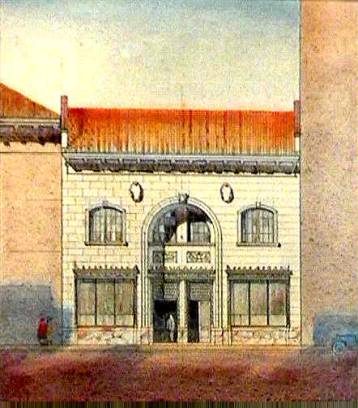
Puget Sound National Bank Building (Tacoma Art Museum) ;
Circa 1925 ; Watercolor ; 10"x 8" ; Signed Lower right |
|
|
|
Thayne J. Logan was born in Joplin MO. In 1900.� He was a pupil of the University of Utah; Benson Polytechnic (Portland); and the University of Oregon. Studied art under Clyde Leon Keller and Sidney Bell (Portland). He was a member of the Oregon Society of Artists, and the American Inst. Of Architects. Awards: Oregon Society of Artist 1937 to 39; Oregon State Fair 1927-30, 1934. He was an art critic, an architect, and a painter. Thayne Logan died in 1990 (Portland). |
|
|
|
Although there was generally City Council backing for such a project, including Mayor Carson, it was voted down due to the fact the cost would have had to be paid out of the "Emergency Fund" and also the fact that other city parks were turned down for funding at that time. Subsequently, the neighborhoods and nearby clubs became directly supportive by finding ways to raise funds. This was achieved and construction costs in the amount of $10,000 were borne by Portsmouth and University Park residents, as well as businesses along North Lombard, with the University Park Community Club (together with three other clubs) organizing raffles and special events that they called "Hoorahs". When completed, the funds were turned over to the City, and the community and others decided it would be best to do the work by contract thru the City. |
|
|
|
����������� Dedication of the long sought after brick field house was held Sunday afternoon June 16, 1940, at a formal ceremony in the Park with four Portland community clubs (all from Zone No. 1) joined forces to celebrate the achievement. City Commissioner Bennett gave the address and Paul Sayre, president of the Federation of Community Clubs spoke. Entertainment and games followed such as softball or horseshoes followed, as well as a baseball game at 3 pm. |
|
|
|
����������� During World War II, the Oregon Guard used the new center for its emergency state headquarters. Following the war, the auditorium room became a popular scene for community recreational events and gatherings. From the late 1940's through the 1960's, the building was host to folk dances, various classes, preschool programs, garden club meetings, Lombard Boosters, and some wedding receptions. The U.S. Coast Guard Auxiliary took over the use of the auditorium room during the decade 1970. |
|
|
|
COLUMBIA PARK - BITS and PIECES |
|
|
|
Tall evergreens tower in Columbia Park, a mecca for picnicking, sports, and swimming.� Columbia Park's 33 acres, were patterned after a famous park in Berlin, Germany, by a man named Hoch, who joined the city as a gardener for Washington Park, and later took over much of the design work for Columbia Park. |
|
|
|
1902: Peninsula Park was cleared out and its name changed to Columbia Park. Citizens of the area requested a baseball ground on the cleared area and the board allowed a temporary ground only in the area of the part cut off by the streetcar line. |
|
|
|
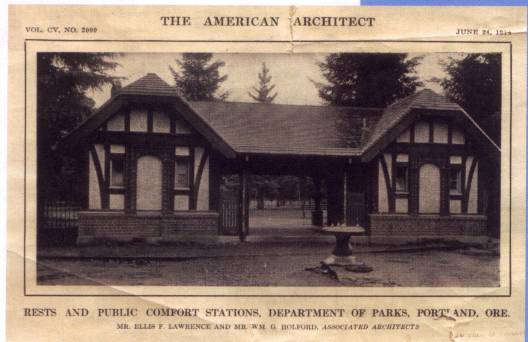
1920: New playground constructed. Playgrounds were still segregated by gender.� The play would be supervised during school vacations by mostly male physical education specialists. E.W. Lawrence a prominent Oregon architect and Dean University of Oregon School of Architecture, was hired to design comfort stations� (rest rooms) near the playground. |
|
|
|
 |
|
|
|
Comfort station at the Northwest corner of Columbia Park. |
|
|
|
 |
|
|
|
1939: Funding was obtained for a community house (now Columbia Cottage). |
|
|
|
1942: Mrs. Elizabeth Yeon, daughter of John Mock, namesake of Mock's Crest and widow of John Yeon, former state highway commissioner and civic leader, donated property in Mock's Crest for a parkway on N. Dana between Willamette Boulevard and Lombard Street. |
|
|
|
Dorothea Lensch paid special attention to the needs of large groups of war workers in Pier, Columbia and Peninsula parks by providing what was essentially free childcare. Playground supervisors in the parks were available to tend small children whose mothers had them in the park for extended periods of time. In addition, summer playground activities increased, with free zoo trips, bicycle tours, softball, tennis, dance, and crafts. |
|
|
|
 |
|
|
|
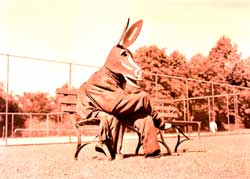
Columbia Circus |
|
|
|
1922-1935: The bureau of parks displayed vision in their concern for developing recreational property and scores of the green parks were strategically scattered throughout the metropolitan area. |
|
|
|
1935: Neighborhoods had community houses featuring bingo games and card parties. |
|
|
|
1940's: Air wardens for each block and soldiers from nearby camps and training centers bivouacking in the city parks and victory gardens springing up in the backyards across the city. Blackout curtains hung on the windows. |
|
|
|
Information on this page came from: A Point of Pride |
|
|
|
The University of Portland |
|
|
|
Story by James T. Covert |
|
|
|
 |
|
|
(Professor of History) |
|
|
|
|
|
University of Portland |
|
|
|
|
|
|
Victory gardens and "Rosie the Riverter" posters inspired patriotism at Columbia Park.
Several members of the FOCP were Riveteers. |
|