Growing up in Southeastern Massachusetts, in a small town called West Bridgewater, my summers were spent at our cottage on Cape Cod in the town of Falmouth. Separated by only about 40 miles, the two places I grew up could not have been more different. As I grew older I became suspicious of the differences in wildlife between two geographically adjacent areas. Taking a look at the two regions perhaps we can uncover what would account for such a difference.
 |
Present day North America has a rich and sometimes uncertain geological history spanning deep into pre-historic time. During the Paleozoic Era, some six hundred million years ago, a warm and shallow inland sea covered most of present day North America |
 |
| During the Mesozoic Era the Appalachian Mountains were a dynamic and geologically active zone dotted by volcanoes and rocked by earthquakes. Sediment from eroding mountains and volcanic ash were spread over the landscape creating zones of rich fertile soil amid piles or rocky terrain. |
 |
|
Millions of years passed and these processes slowed as the Appalachian Mountains became geologically quiet. |
| Cape Cod was formed during the Pleistocene Epoch by the Laurentide ice sheet. The name is derived from Laurentian, the region of Canada in which the glacier first formed and spread approximately 25,000 years ago. | 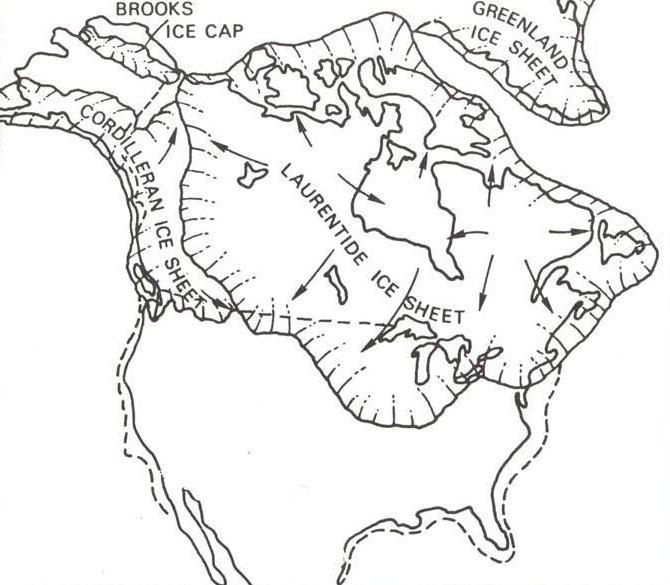 |
 |
|
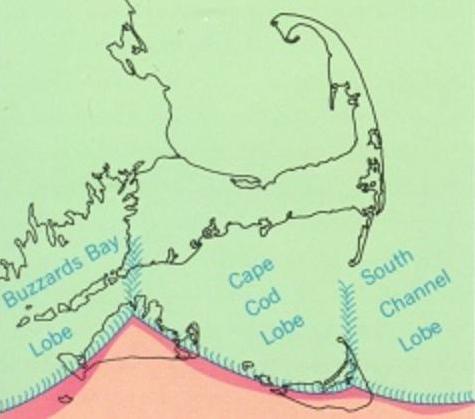
When the glacier reached its maximum position about 23,000 years ago the gravel and rock that had accumulated in the indented areas remained in place and formed Martha's Vineyard and Nantucket. |
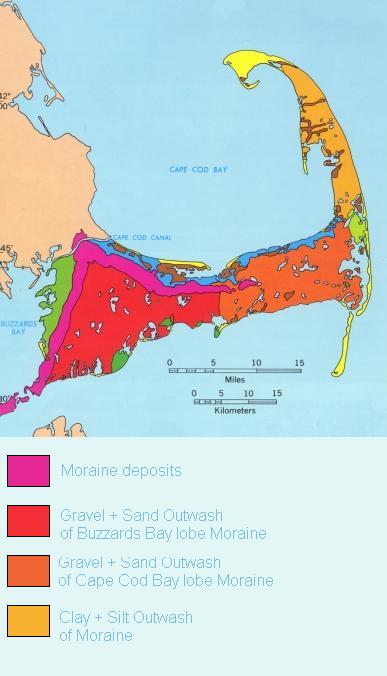 |
The western part of Cape Cod was formed by the Buzzards Bay lobe. Moraine deposits from the foot of the glacier form a stripe running north to south along this area, known as the Upper Cape. Flowing eastward from the moraine meltwater streams carried off debris and deposited the gravel and sand to form the rest of the Upper Cape. The Cape Cod Bay lobe formed the Mid Cape in a very similar fashion, this time with an east to west stretching moraine and south as well as east flowing streams. The Lower Cape consists of stratified clays and silts which were washed all the way down the meltwater streams into these glacial lakes where they were then able to settle out. |
|
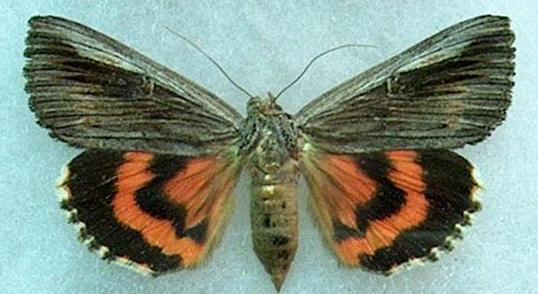
One of the most rare species of moth found in North America, Gerhard�s Underwing is found almost exclusively on Cape Cod. |
 |
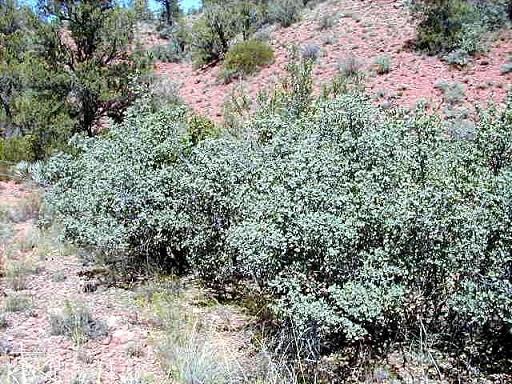 |
This silk producing moth is found living among open pitch pine and scrub oak barrens. They seem to favor scrub oak thickets growing on large sand planes or rocky mounds and ridges that are barren of any woody growth other than scrub oaks. The sandy or rocky soil retains much less water, giving the eggs a better chance at hatching by not rotting in pools of water and moister. This makes Cape Cod a perfect area for Gerhard�s Underwing because of its gravely substrate and open sand fields. |
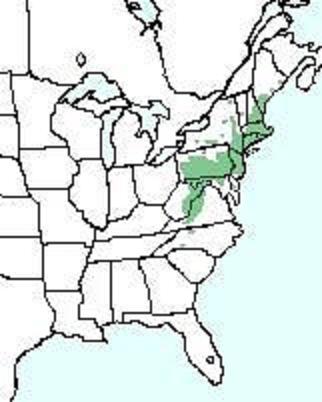
Although the scrub oak vital to Gerhard�s Underwing can be found in abundance from the eastern shores of Maine to the mountains of West Virginia the moths have made their home solely on Cape Cod |
 |
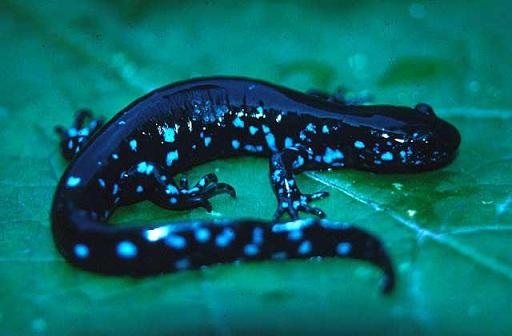 |
| The Blue-Spotted Salamander is typically found in temperate hardwood forests that are well shaded and moist. Vernal pools that form during wet seasons are used as breeding sites. |
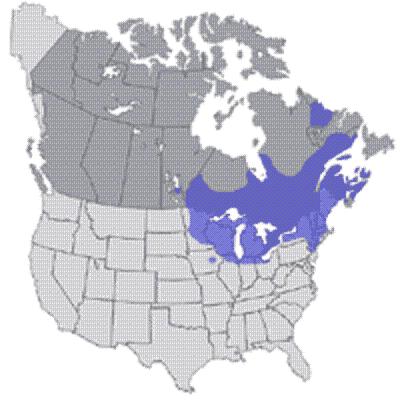 This Salamander can be found from the Mid-West, throughout New England, and well into Canada; but not on Cape Cod. |
The dense hardwood cover in biologically rich areas that the Blue-Spotted Salamander thrives in exists across the expanses of its dispersal. The somewhat less dense forests of The Cape coupled with its mineral rich and salty soils likely make Cape Cod�s vernal pools unsuitable for Blue-Spotted Salamanders. |
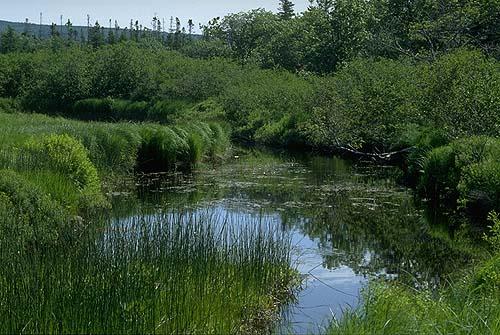
| A true acclimatize Coyotes can be found throughout North America, in almost every climate and environment. They are extremely adaptable and can survive in virtually any habitat. Deserts, swamps, tundra, grassland, dense forests, and mountains have all been known to support coyotes, as well as urban and suburban zones as well. This ability to adapt to any environment is the key to a coyote�s ability to live both on Cape Cod and throughout Massachusetts, along with most of the rest of North America. |
 |
