Semans Saskatchewan
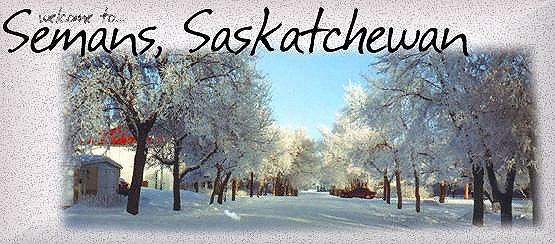
Photo taken on the street where I live
Semans is a very small but friendly village, with a Co-op grocery store and gas pumps, post office, Credit Union, Village Office, R.M. office, the hotel and another cafe, and Zeke's repair, also a beauty salon, gymnasium and Legion Hall for social events, the United and Pentecostal Churches. Both cafes have excellent meals. The Hotel cafe has a smorgasbord every Sunday and the other cafe has them periodically and both have a very active "Coffee Row"!
We also have a skating rink with a figure skating club and our senior hockey team "The Semans Wheat Kings".
The doctor from Nokomis comes to town on Wednesday afternoons. He works out of the Health center in Nokomis which is about 20 miles from Semans. Our nearest town is Raymore which is 10 miles east. Raymore has two grocery stores, a meat/bakery shop, a pharmacy, a gift shop, two garages, cafes, beauty salons and the hotel, and a very active curling club and all ages of minor hockey. Our children are bused to Raymore to school. Raymore has four churches, the United, Catholic, Baptist and Anglican.

Camping, Fishing, Boating
Our Local Lake is Last Mountain lake which is about 30 miles from here. Lots of cabins, camping, boating and fishing over there. And we are about 1 1/2 hours from the Qu'Appelle Valley Lakes. That includes Echo lake, Pasqua Lake, Mission Lake and Ketepwa Lake and the beautiful scenery of the Valley.
~~**~~**~~**~~**~~**~~**~~**~~
Qu'appelle Valley contain a chain of lakes including Echo Lake, Pasqua Lake, Mission Lake and Ketepwa Lakes, as well as the Qu'Appelle River. These lakes are often referred to as the "Calling Lakes" Pauline Johnson"s Poem "Qu'Appelle" tells the story of a young Indian brave returning home to his love and as he is paddling his canoe he hears some one call his name and He replies "Qu'Appelle? Qu'Apelle"
or in English "Who Calls? Who Calls" When he reaches home he finds his young bride to be has died and at the exact time he heard someone call his name he is told that she called his name before she died. Because of the hills and the lakes the Qu'Appelle Valley is famous for its Echoes.
The Legend of Qu'Appelle Valley
I am the one who loved her as my life, Had watched her grow to sweet young womanhood;
Won the dear privilege to call her wife,
And found the world because of her, was good,
I am the one who heard the spirit voice,
Of which the paleface settlers love to tell;
From whose strange story they have made their choice
Of naming this fair Valley "Qu'Appelle".
You can read the rest of Pauline Johnson"s Poem "Qu'Appelle" on my...
Poem Page
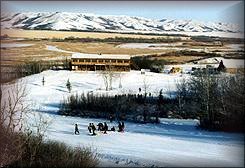
Ochapoway Ski resort in the Qu'Appelle Valley at Broadview, Sask. There is another ski resort in the Qu'Appelle Valley at Fort Qu'Appelle called Mission Ridge.
The Great Sand Hills
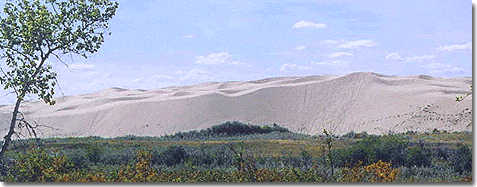
The Great Sand Hills are located in Southwestern Saskatchewan. The Hills are ecologically rich and are home to rare and endangered species. The sand dunes make a magnificaent landscape and are unique to Saskatchewan. The Sand Hills became a Prime protected area under the 1991 Great Sand Hills Land use program.
The Great Sand Hills support a wide range of vegetation including native prairie grasses, cacti and creeping juniper, as well as an assortment of small shrubs like rose, saskatoon, chokecherry and silver sagebrush. Sharp-tailed grouse are more abundant here than anywhere else in Canada, and the mule deer population is the densest in the province. Antelope, white pelican, merlin, peregrine falcon, coyote, white-tailed deer, golden eagle, badger, weasel, burrowing owl, mourning dove, porcupine, sand hill crane and fox are just a few of the walking and winged creatures who make the hills their home. The desert-adapted Ord's Kangaroo Rat is found nowhere else in the province.
So as you can see The Great Sand Hills are a very unique part of Saskatchewan.
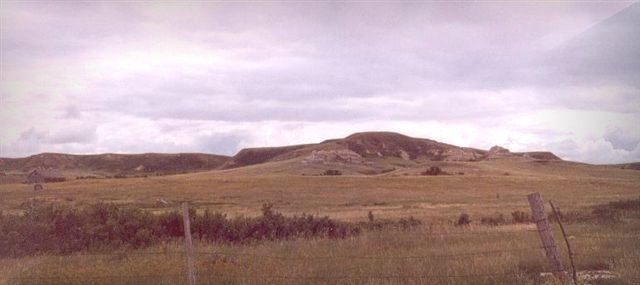
The Big Muddy Bad lands in Southern Saskatchewan
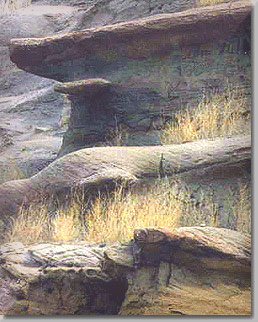
The Big Muddy Badlands region is located just north of the international boundary separating south-central Saskatchewan from northeastern Montana. The badlands are punctuated by the Big Muddy Valley, a 55-km cleft (35 miles) up to 3 kms wide and as much as 160 metres (500 ft) deep. Carved by melt water during the last ice age, the valley runs in a southeasterly direction into Montana, where it meets the Missouri River basin. Hills in the Big Muddy are commonly smooth, rounded and rolling, covered with natural grass and grazed by cattle. The far more dramatic scenery includes fascinatingly rugged buttes, cliffs and hogbacks that reveal the sedimentary layering process that created them over a series of geological periods beginning 65 million years ago. In some areas, seams of the coal that's used to fire the nearby Poplar River power plant can be seen near the surface. The only significant surface water in the valley is found in Big Muddy Lake and creek, which all but disappear in a dry summer. In a wet one, they say, a person can canoe down the creek all the way to the Gulf of Mexico.
The above information was used with permission from Dave Yanko's Virtual Saskatchewan website.
~~**~~**~~**~~**~~**~~**~~**~~
Sitting Bull came to Wood Mountain after defeating Custer at the Battle of the Little Big Horn. Wood Mountain is close to the Badlands. Many American outlaws also used the Saskatchewan Badlands to escape American lawmen.
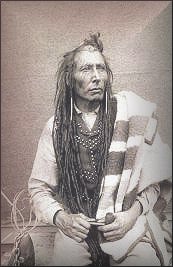
Poundmaker (Pitikiwahanapiwiyin)
Named for his skill at building and employing pounds used for hunting buffalo, grew to be one of the most influential leaders of the Northern Plains. He was a key figure in the 1876 negotiations for Treaty Six, as well as a late fighter for fair implementaion of its provisions. With Cree Chief Big Bear (Mistahimaskwa), he was a central character in the momentous events surrounding the Northwest Rebellion/Resistance of 1885.
The picture and information were used with permission from Dave Yanko's Virtual Sakatchewan site.
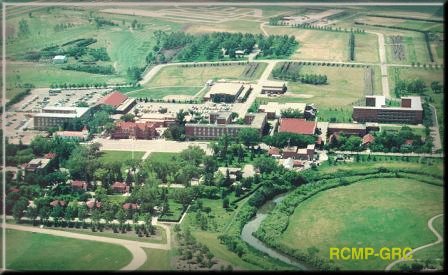
RCMP training Academy in Regina
All RCMP Officers are trained here. This site includes the oldest building in Regina which is
The RCMP Chapel.
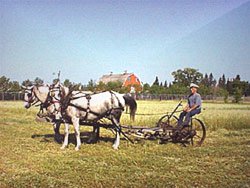
A picture of a "mower" this is the way they used to mow the fields in the very early days of farming.
A "mower" is what was used before people had swathers to cut down the crops. After the crops were mowed then the binder would make the sheaves and then the sheaves would be put through the threshing machine and this is the way the grain was cut for the binder to pick it up.
Nobody uses horses to farm now a days!
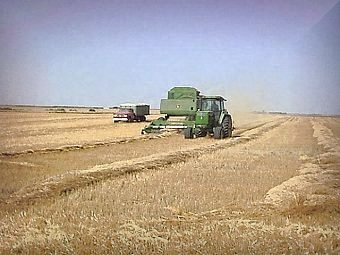
Modern day harvesting in Saskatchewan
A combine harvesting grain in Saskatchewan.
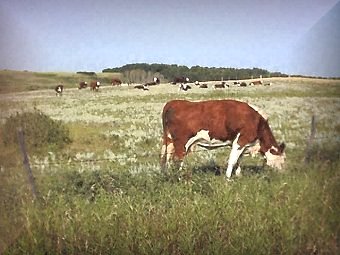
Cattle grazing in the Qu'Appelle Valley


Back to Top

Design by Pattianne
Updated August 2005
|