|
 MAIN PAGE MAIN PAGE
DATA
MARS FACTS
STAR STORIES
FLIGHTS TO MARS
MY
MARTIAN CLUB
SIGN GUESTBOOK
AWARDS
PICTURES
ABOUT
THE AUTHOR
| |
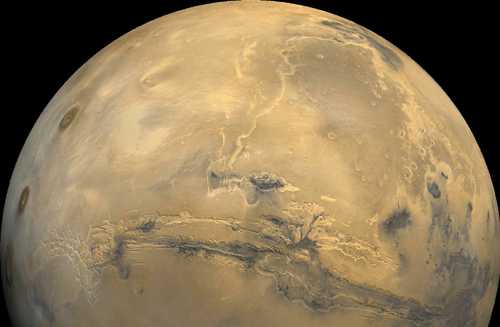
For early watchers, the red planet stood for blood and violence. The first
Mars-watchers saw a small, reddish circle through their telescopes. By 1659,
Christopher Huggens, a Dutch astronomer, found out the rotation of Mars, and
that it was almost identical to Earth's. Modern calculations have fixed Mars's
day to 24 hours, 37 minutes and 30 seconds.
In
1666, Giovanni Domenico Cassini, an Italian astronomer who was in charge of King
Louis XIV's observatory in Paris, discovered white areas at Mars's poles. Later,
it was confirmed that those were polar caps that grew in the course of the
Mars's year, just in the same way that Earth's ice caps do.
In
the beginning of August, the 1877 Asaph Hall begun his search for satellites of
Mars. But, at that time, Mars was so close, that it produced a glare, when it
was viewed through a telescope. By August 11, Hal was convinced that there was
nothing to be found, but his wife urged him on. That night he saw something. It
was very small. Then the clouds came. On August 16, the sky was clear again, and
there it was! The next day, Hall was thrilled to find another moon. Hall named
them Phobos (Fear) and Deimos (Panic) in honour of the war-god's chariot horses.
Asaph Hall was not able to find the size of the moons. Later observations have
established that Phobos was 12880 km. and Deimos measured only 420 km.

|
