| |
-
Shahadah
- Declaration of faith
-
Salah
- Five
compulsory daily prayers
-
Zakah
- Welfare contribution
-
Sawm
- Fasting during Ramadan
-
Hajj
- Pilgrimage to Makkah
|
|
A
Muslim declares his faith by reciting:
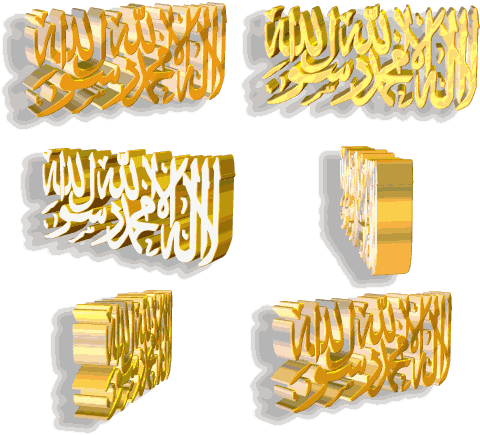
"There
is no god but Allah, Muhammad is the messenger of Allah"
La ilaha illal lahu muhammadur rasulul lah
This
declaration is called Kalimah Tayyibah. It summarizes the
whole of Islamic Belief. The first part (la ilaha illal lah)
is about the Oneness of Allah (Tawheed in Arabic) while the
second part (Muhammadur rasulul lah) concerns the prophet hood
of Muhammad (SAW).
|
 |
|
Salah
is the second pillar of Islam. It refers to the five
compulsory daily prayers. Salah is offered five times a day
individually or in congregation. We offer Salah to remember
Allah. It brings us closer to him.
The
Quran Says:
"Establish
Salah to remember me (Allah)"
(20:24)
Salah
is the Practical proof of our faith in Allah and Islam. It has
been made compulsory at certain fixed times.
The five daily prayers are:
Fajr
- From dawn until just before sunrise
Zuhr
- After midday until afternoon
Asr
- From late afternoon until just before sunset
Maghrib
- After sunset until daylight
ends
Isha
- Night until midnight or dawn
|
 |
Zakah
(welfare contribution) is the third pillar of Islam. The
Arabic word Zakah means to purify or cleanse. Zakah is to be
paid once a year on savings at the rate of two and a half
percent. This rate applies to cash, bank savings and gold
& silver jewellery. The rate for cattle and agricultural
produce is different.
Payment of Zakah is a means of keeping our wealth clear of
greed and selfishness. It also encourages us to be honest in
our earnings and expenditure.
Zakah is a compulsory payment and is neither charity nor a
tax. Charity is optional and taxes can be used by the state
for any purpose, but Zakah has to be spent under fixed
headings like helping the poor, the needy, payment of salaries
to its collectors, to free captives and debtors, for travelers
in need, to win over hearts and for the cause of Allah (9:60)
Zakah is an act of Ibadah. Ibadah is an Arabic term which
means worship and obedience. It includes all activities of
life, if we do them to please Allah. We pay Zakah to gain
Allah's favor.
Zakah provides us with the opportunity of sharing our excess
wealth with those less fortunate than ourselves. In fact we
and our wealth belong to Allah. He is the real owner and we
are mearly the trustees of His wealth. We do our duty as
trustees if we pay Zakah as an obligatory part of Ibadah.
We learned earlier that Islam is a complete code of life which
includes among other things, the economic side of life. Islam
has its own economic principles. Zakah is one of the basic
principles of the Islamic economy, based on social welfare and
fair distribution of wealth. In addition to the compulsory
payment of Zakah, Muslims are encouraged in the Qur'an to make
voluntary contributions to help the poor and needy, and for
other social welfare purposes. This voluntary contribution is
called Sadaqah (Charity).
Through the payment of Zakah, the rich share their wealth with
the poor and thus the process of concentration of wealth is
checked and fair distribution ensured.
|
 |
|
Sawm
(Fasting), the fourth pillar of Islam, is another act of
Ibadah. All adult Muslims must fast from dawn to sunset every
day of Ramadan, the ninth month of the Islamic calendar. This
means abstaining from eating, drinking, smoking and conjugal
relations during the hours of fasting. Travelers and the sick
can defer fasting during Ramadan and make up for it later.
Sawm develops self-control and helps us to overcome
selfishness, greed, laziness and other faults. It is an annual
training programme to refresh us for carrying out our duties
towards Allah, the Creator and Sustainer. Sawm gives us the
feeling of hunger and thirst. We experience for ourselves what
it is like to have an empty stomach. This develops our feeling
for the poor and hungry people. Fasting teaches us to control
the love of comfort. It also helps us to keep our sexual
desires within control. Hunger, comfort and sex are three
factors which must be kept under control to behave as Allah's
servants.
It
helps us to remain truly obedient to Allah's commands. That
is why the Qur'an says:
"O
you who believe; Fasting is prescribed for you as it was
prescribed for those before you that you are expected to be
truly obedient".
(2:183)
A
truly obedient Muslim is called a Muttaqi and his true
obedience or piety - developed through Sawm - is known as
Taqwa in Islam. Taqwa keeps a person away from sin. The month
of Ramadan is a month of forgiveness, mercy and means of
avoiding that punishment of Hell. The duty of fasting is only
for Allah's sake and there is a very pleasing and attractive
reward for this in the life after death.
The following acts will break the fast:
Deliberate eating or drinking during fasting hours If
anything enters the body through the nose or mouth; this
includes smoking or sniffing any powdered substance Having
any conjugal relations during fasting hours. An injection
in the muscle is allowed during fasting but not an intravenous
nutritional injection. Unintentional eating or drinking due to
forgetfulness or rinsing out the mouth or bathing and putting
drops in the eye do not make the fast invalid.
A Muslim is expected to remain away from all bad actions
during his fast. He should not tell a lie, break a promise or
do any deceitful act. The very purpose of fasting is to make a
Muslim able to control his passions, so that he becomes a
person of good deeds and intentions. Anger – a common human
weakness–can also be brought under control
by fasting.
In addition to the compulsory fasting in Ramadan, a Muslim may
fast during other times of the year. These facts will be
treated as Sunnah. Fasting is not allowed during menstruation
of women. They are required to make up the days lost during
this period at some other time. A Muslim must not fast:
On
the day of Idul Fitr
On the day of Idul Adha
The
Qur'an was revealed in the month of Ramadan. There is a night
in the month which is ...
"better
than a thousand months"
(97:3)
This
night is called Lailatul Qadr (Night of Power). According to
Hadith, this night occurs during the last ten days of Ramadan
(most probably the odd numbered nights). It is a night of
great importance; we should worship as much as we can on this
night.
An additional prayer known as Tarawih (20 rakah or 8 rakah) is
offered during Ramadan after Isha. This is a sunnah prayer in
which efforts are made to recite as much of the Qur'an as
possible. In many mosques, the whole Qur'an is recited in
Tarawih prayer. This prayer is generally offered in
congregation. Those who cannot join a congregation should
offer Tarawih at home. A pre-dawn meal known as Suhur is taken
in Ramadan.
At the end of Ramadan Muslims celebrate Idul Fitr, a day of
thanksgiving and happiness. It is one of the great occasions
for the Muslim community. On this day, Muslims offer special
prayers in congregation and thank Allah
for His blessings and mercy.
|
 |
Hajj
is the fifth pillar of Islam. It is a visit to Al-Ka'bah, the
house of Allah in Makkah, once in a lifetime by those Muslims
who can afford to make the journey. It is performed during the
period from the 8th to 13th Dhu'l Hijjah, the twelfth month of
the Islamic calendar.
Al-Ka'bah, known as Baitullah (house of Allah), is a cube-like
one storey building which was built originally by Adam and
later rebuilt by Prophet Ibrahim (Abraham) and his son Ismail
(Ishmael). It is the first house ever built for the sole
purpose of the worship of Allah. Allah has blessed this Al-Ka'bah.
Muslims who can afford to make the journey and are physically
fit come here every year from all over the world.
The occasion may rightly be called the Annual International
Muslim Assembly. During Hajj, the Islamic brotherhood becomes
particularly evident and can be experienced in a special way
by everyone who takes part. Barriers of language, territory,
colour and race disappear and the bond of faith is uppermost.
Everyone has the same status in the house of Allah – the
status of His servant.
|
|
|