 |
| What is Orienteering? |
| Orienteering is..... ...the sport where competitors navigate their way between control points marked on a map. For the experienced athlete, orienteering means the challenge of reading the map and choosing the best route over rough natural terrain while moving at high speed. |
|
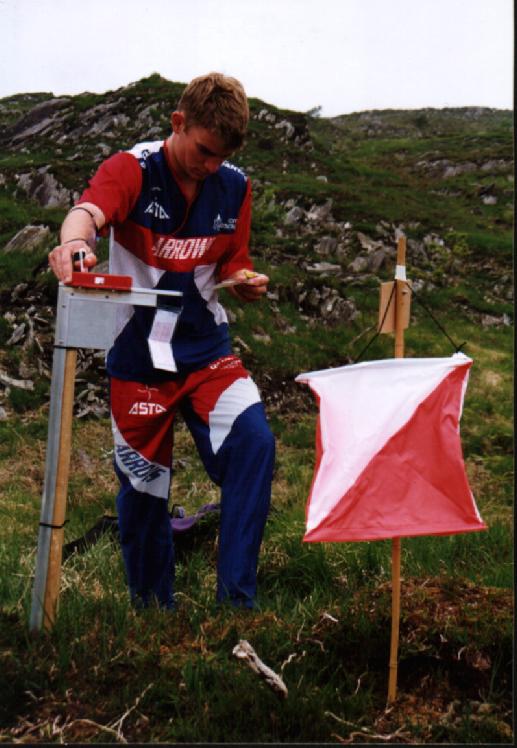
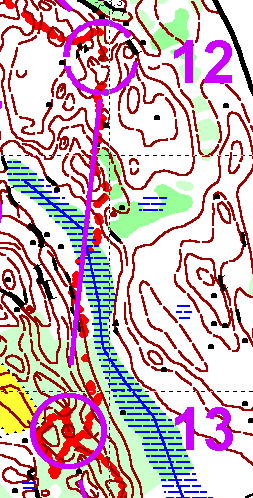
| On your way, you must vistit a number of controls at different terrain features. These controls are in terrain marked by a red/white control marker (see left) and on the map with a red or purple cirle (see above). The task is to interpret the map correctly and choose the fastest route between the controls and visit the controls is a predetermined order. Thus orienteering is not only a physical sport, but also one requiring quick thinking. The person completing the course in the fastest time is judged the winner. |
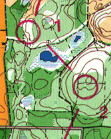 |
| Advances in technology mean that your time at each control is electronicaly timed using a small chip carried in the hand, and inserted into the timer at each control point (above). The promise of real-time tracking at the 2001 World Championships provides exciting times for orienteering in the next few years (example that could be presented on a large veiwing screenfor the crowd, right) More on tracking system. |
| The most important aid to the orienteer is the map. The map is especially made for orienteering and is quite detailed. Normally, an area is represented at a scale of 1:15000 or 1:10000. Features on the ground are represented by a number of symbols and colours according to international standards, meaning you can immediately read and understand an orienteering map no matter where you are in the world. |
| Orienteering comes in many forms (mountain bike, skiing and wheelchair) but is most commonly performed running. Competitors compete against each other over a number of disciplines: |
 |
 |
| Sprint An individual format, short in time, built on high speed running in any environment. 12-15min (both men and women). Games Format An individual format with the highest possible level of technical orienteering, often looped course. 30-35min (both men and women). This format is the base format in the proposed international competition programme. Classic Distance A very physically demanding format with a normal line course that tests the endurance of individuals. At International competition 70-80min (women) and 90-100min (men). Relay Each particpant on a team completes a normal orienteering course before tagging their next team member. The race begins with a mass start with competitors split into slightly different courses. The first team to finish is the winner. Night Event A normal orienteering event but at night. Competitiors generally wear head lamps to help find their way. Multi-Day Event An orienteering event taking place over more than one day. Each day is run like a normal orienteering event but the total time over all the days determines the winner. Often, the last day is a chasing start. You start the exact minute and second you are behind the leader over the preceding days. The first across the line on the last day is the winner. |