| Orienteering Highlights and Sporting History |
| How it Started I first learnt about the sport of orienteering at primary school in Year 6 (1988) thanks to my Deputy Principal, David Tilbrook. After a few warm-up events, Paul Harvey and I managed to win the 11 pairs, State Schools Orienteering Champioships by him telling me where to run, and me tearing off to get the control points. It wasn't unitl 1992 that as a cross-country runner, I was invited out to my first "real" orienteering event near Burra, in South Australia's mid-north by the then National Junior Coach, Kay Haarsma. Here I took over 3 hours to complete a 5km course in lightning fast terrain, and was amazed by the speed of junior girls whilst orienteering. That year I made the State Schools orienteering team, and through pure discipline with compass and distance finished 5th at the National Schools. We then travelled on to the Australian Championships, and I got completely lost, unable to finish the M16's course. 1993: An important year This year was both a fortunate, and very important year in my orienteering career. Somehow I managed a 3rd in the National 3-Day competition held near York, Western Australia in M16. This result gave me the chance to go on to the National Junior Training Camp later that year, and it is from these camps and the people I met, that my orienteering developed over the next few years. Thanks to coaches such as Jim Russell, Kay Haarsma, Bob Smith and the South Australian Senior Squad (now Southern Arrows) for this learning environment. 1996: First taste of the real deal Despite what I thought was a disappointing Easter 3-Day, I was selected to the Australian Junior team and competed at the Junior World Orienteering Championships (JWOC) in Romania. On this trip I learnt a lot, including orienteering, and my trip to Sweden and Belgium afterwards was a real eye-opener to the international scene. I didn't run that well, but I got a taste of what has to be done. Nationals in 1996 were in Tasmania, on a map that contained a creek by my name, "Rattray Creek", but it wasn't meant to be, and arch-rival Dave Sheherd was too good on the day beating me by 7seconds over the 75min course. 1997: Didn't make enough of it Captain of the JWOC team to Belgium was pretty cool, but I was disappointed with the way I ran, I had developed, but not enough for competition of this standard. 1998: First year senior After a hard Summer of training, I wanted to make the most of it, and Easter was my first real chance. Unfortunately, I did a little too much and came down injured, severely hampering my preparation for Easter, when at the same time, I was struggling with work as a manual laborer. It was motivation that got me through the last day of the 3-day, and the 2nd place for the day (10th overall). Someone was smiling on me, and I was selected to the World Cup teams in Ireland and England. The World Cups were another eye opener, and I soon learnt how much more had to be done. I went on and ran a few races that year whilst travelling, and competed at the the World University Orienteering Championships in Trondheim, Norway. Unfit and not focussed, I ran poorly, and then spent the rest of the year travelling, and for a time, working in England, not orienteering. 1999 was a write-off despite some glimpses that I could do it. 2000: The penny dropped, kinda... Well before the season started, I had decided I needed to do more or I was getting nowhere. I trained hard, made sure I did a lot more technical work, began working with Warren Key on technical aspects more, and moved to Canberra. In Canberra I bacame involved with the ACT Academy of Sport Orienteering squad, and they have since helped me move to the next level. Injuries hurt my results, and consequently, my ranking, but it was a productive yyear, that almost could have been completely lost. Mid-way through the year I knew I was a better orienteer than I had shown, but I needed to prove it, at least to me. I decided to go to the World University Orienteering Championships. The decision was helped by qualifying for the team to go to the World Mountain Running Champiosnhips in Germany shortly after. In the classic race, I grabbed 10th, Australi'a best ever male result at these championships. The short qualifying was, I thought, better, but I blew the race. But things started to work out, thanks largely to Warren, I had a plan, and the following Summer, I have been working harder than ever to make sure its even better... 2001-2002: Athletes worst nightmare... serious injury 2003: Comeback! |
 |
 |
 |
 |
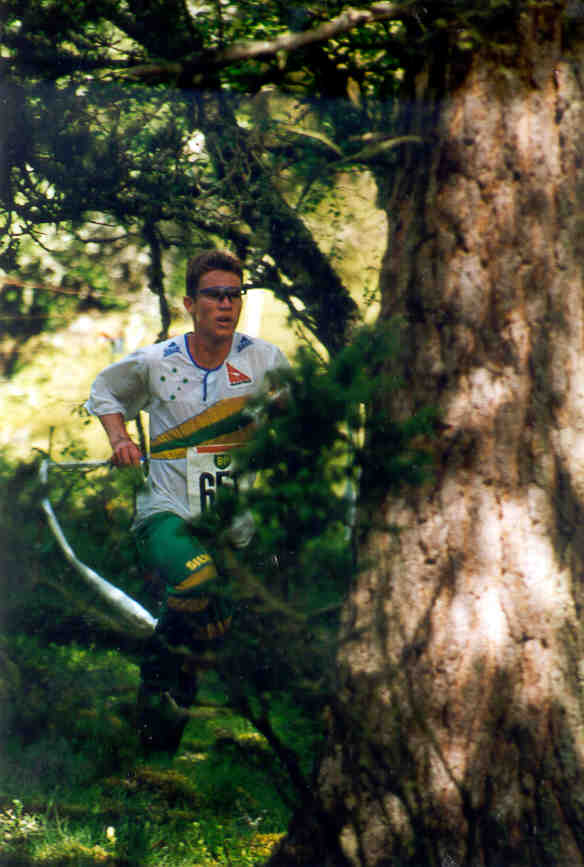 |
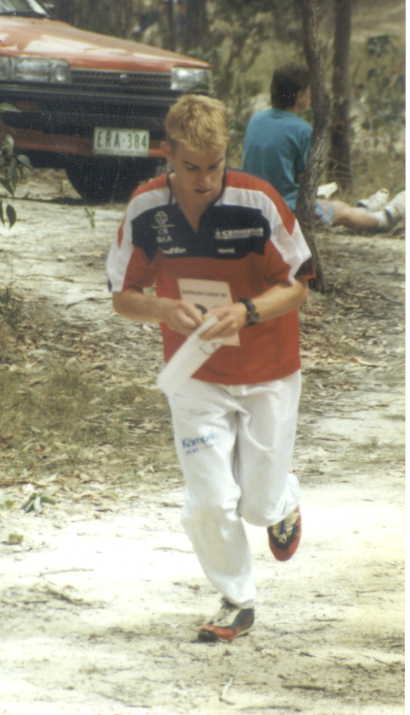
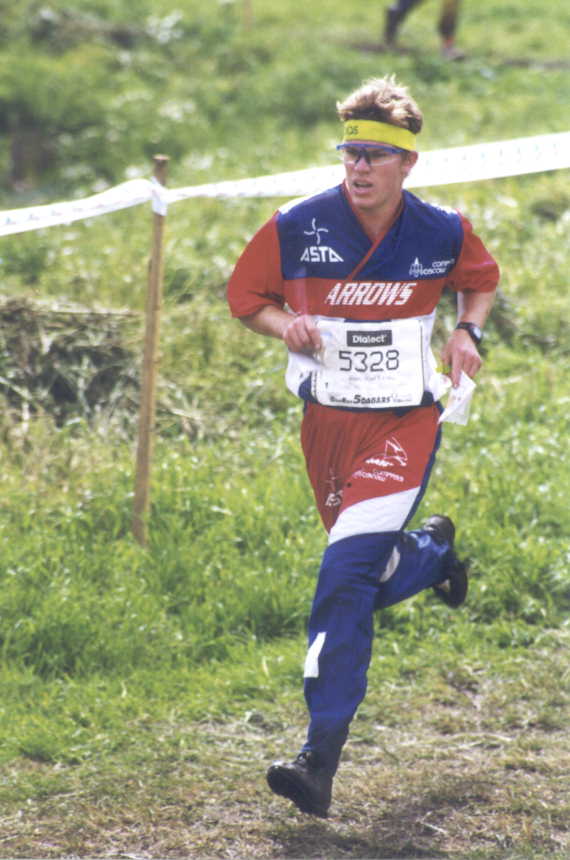
| Running the Scottish Relays in 1998, my first year as a senior. |
| The 1997 Eureka Challenge, one of my first elite races. |
| Finishing a day of thye 1997 Swedish 5-Days |
| 2002 - no serious race |