I first saw this pattern in a book by Oliver Kite called "Nymph Fishing in Practice" - Originally tied by Preben Torp Jacobsen and named "Ollie" both because it was designed to imitate an Olive fly and to honour his friend Oliver Kite.
The original pattern was tied as follows:
Hook: 15 Mustad 72709 (modern size 12-16)
Thread: primrose gossamer (Pearsall's No. 3)
Tail: buff Orpington hackle fibres
Body: four heron herls dyed in picric acid, twisted round the tying silk
Rib: fine silver wire
Body Hackle: natural blue dun hackle (henny cock) palmered along the body
Head Hackle: light honey dun cock (like a Metz sandy brown)
...and can be seen, as I first saw it, just below.
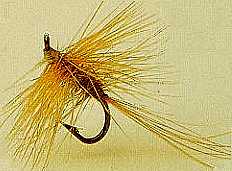 Preben Torp Jacobsens Light Ollie Original
My first stab at an imitation of Prebens imitation, due to not having read the preceding page in the book where the pattern for the fly is given, looked something like this:
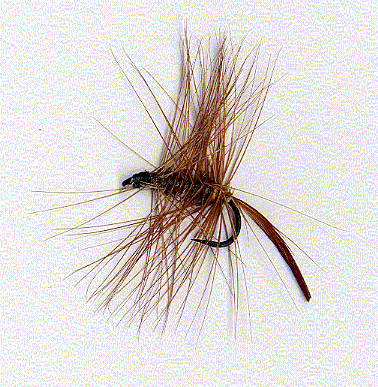 Flukes Dark Ollie Variant
Which, as you can see, is nothing like it at all. My pattern consisted of a much simpler design, incorporatng the only ingredients I had to hand at the time:
Hook: Sprite Perfect dry size 16
Thread: Black and fine
Tail: Single, shortened hackle tip
Body: Peacock tail herl
Rib: None - I couldn't see one on the original so there seemed little point.
Body hackle: Red cock hackle, same as tail
Head hackle: None, continuation of the palmer up to just behind the eye of the hook was more than enough on a size 16.
Much simpler to tie... but did it work? I've caught fish on it, but thats no guarantee of a working pattern, I'm still testing it in a fishing environment - every time I find fish that will rise, I tie one on - you'll know more as I do.
The following is a much closer approximation of the true light Ollie... unfortunately some of the original ingredients for the fly are either illegal (i.e. Heron herl) or a little hard to come by (i.e. anything died with picric acid as thanks to is explosive properties its now a restricted substance in the UK) so substitutes were the order of the day.
A huge thank you to Mr. Andy Wren, formerly of the Sharpes of Aberdeen Tackle shop (67 York St., London) for helping me out here. No only did he give me (as in gratis, for no financial consideration etc.) half a blue dun cape, he also hand mixed some articial dubbing to the approximate the colour of picric died heron herl (which I've never seen so wouldn't really have a clue about). It was then simply a matter of adapting Prebens original pattern to my modified ingredients and my somewhat lower tying skills.
It ended up as follows:
Hook: Partridge Sedge Hook in size 16
Thread: Pale yellow/cream
Tail: Blue dun hackle fibres (between 4 to 6)
Body: Dubbed "Wren" in pale olive yellow
Rib: None - I still couldn't see one on the original despite looking hard and the winding of the palmer made a nice body segmentation
Body hackle: Blue dun hackle, same as tail
Head hackle: None, I continued the palmer up to just behind the eye of the hook again.
You can see the final result here.
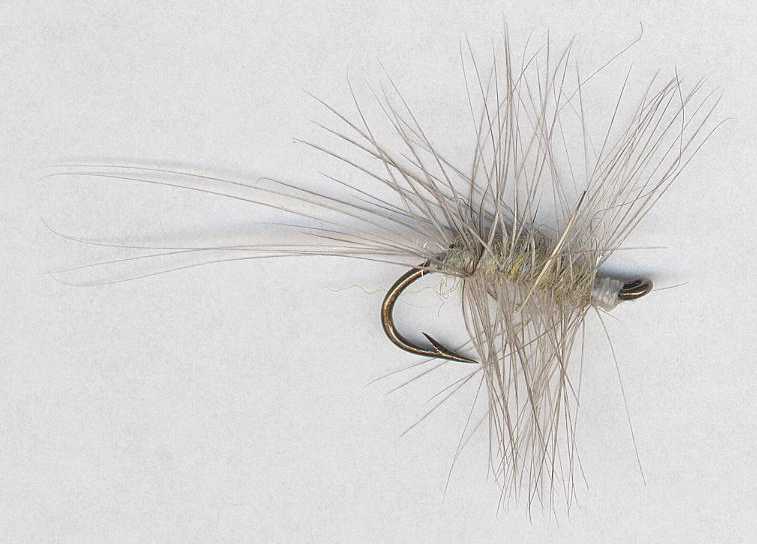
Flukes Light Ollie Variant
A little lighter that the original, I know, for which I can only imagine the fact that I scanned the fly directly in a scanner, whereas the photo of Prebens original fly was almost certainly a lot more professional and balanced light levels etc. All in all though I'm quite pleased with the overall shape of the fly, albeit a little flattened in the picture shown.