There are two flies described on this page - the first is a fairly simple parachute fly, similar to a klinkhamar in general shape, but significantly smaller and narrower in the abdomen. This I use, mainly, on running water thanks to its great buoyancy, it's tendency to always land gently despite my rather 'active' casting style and it's relatively easy to see on the surface.
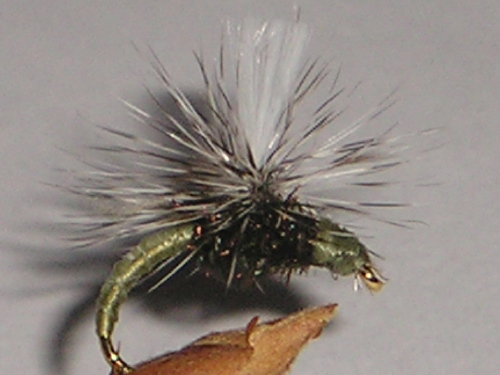
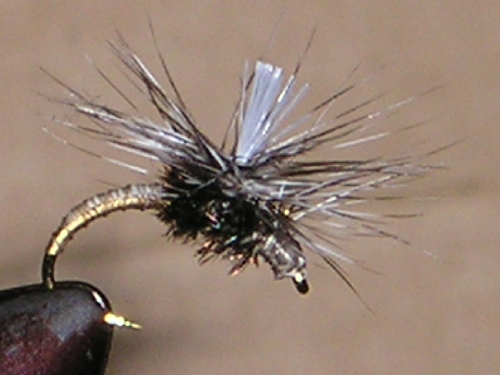
The second fly is a very similar design, but uses a CDC loopwing for buoyancy, which I've found makes it much more prone to sinking on running water, particularly where it's rough, but in settled water means it can float for much longer. When seen from underneath it has a fantastic profile, much closer to the profile of a hatching insect than the parachute, which makes it superb for water where the fish have a longer time to inspect the fly - eg stillwaters.
Ingredients for the Parachute Midge Emerger:
Hook: Kamasan B100 or B100G grub hook, or for a straight version use a Sprite Perfection Dry Fly in a similar size. I'd recommend size 14 grub hooks and size 16 standard hooks.
Silk: As per required body colour, anything from bright red to black
Thorax: Peacock herl
Wing Post: Your choice, I use a bundle of GSP fibres as they float well
Hackle: Grizzle
Rib: Special - see instructions
As I mentioned above, this fly is very similar in makeup to the Klinkhamar so start by tying in the post and continue the thread down around the bend of the hook to form a slim, tapered abdomen. Spin the bobbin to tighten the silk and wind in open turns from the tip of the abdomen to the thorax to form a rib from the tightened thread - this is the 'special' rib mentioned in the ingredients, it's surprising how visible it becomes underwater.
Tie in the peacock herls just before the wing post and make three or four turns of them, straddling the wing post to form a thorax. Tie in an appropriate grizzle hackle and form a parachute, tie off at the eye and whip finish.
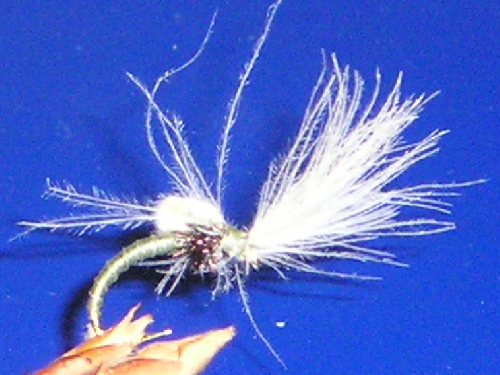
Ingredients for the CDC Loopwing Emerger
Hook: Kamasan B100 or Kamasan B100G grub hook.
Silk: As per required body colour as above.
Thorax Peacock herl
Wing: Two natural/white CDC feathers
Rib: Special - see instructions
The inspriation and much of the design of this fly is owed to an extremely talented Dutch flytier called Hans Droest that I met online a few years ago. The original fly was tied on a wide gape TMC grub hook with a very fine wire guage that I've not been able to source in the UK. The silk colour was a pastel orange colour and made from a single layer of very thick silk, which gave both a nice, slim, abdomen and a rib in one go. Mine is a little more complicated to tie, but, at best, only as effective as Hans' original which I would encourage anyone to tie. I will point out the differences as I describe this fly.
Start the thread at the thorax and remove the tag as soon as it's secure. Carry the thread down to the bend of the hook and approximately half way around it. Bring the thread back to the thorax area by spinning the bobbin to tighten the thread and winding in open turns to suggest a rib
Tie in two peacock herls - colour is up to you. Twist the herls together and form a short, bulky thorax leaving a space before the eye to tie the CDC wing into.
Tie two CDC feathers in between the thorax and the eye of the hook by the butts of the feathers so the rest of the feather lies along the shank of the hook towards the bend - trim the butts close so the roots of the feather are removed.
Form a simple loopwing by folding the tips back towards the eye over the thorax and tie them in over the same postition the butts were tied into. This should give you a nice tight loop which covers part of the thorax and a "spray" of CDC herls pointing out of the front of the fly over the eye. The original fly tied by Hans didn't use a loop wing, but a small 'noodle' of CDC herls ripped from the stalk. This was tied over the thorax and secured in front of and behind the thorax. Depending on the amount of CDC used either a floating or very slow sinking fly could be made - devastating for stillwater fish feeding on chironomid emergers.
IMPORTANT! Don't trim the tips of the CDC feathers, even if they appear too large for the fly - they can be ripped down to trim them but the "shaggy" effect is vital. The neat, clipped edges that you get from trimming with scissors or a blade spoils the effect.
The fly is mimicking a chironomid in the process of emerging, the CDC loop keeps the fly buoyant and has much the same shape as the abdomen emerging natural while the sprays of CDC over the eye mimick the confusion of legs and wings as the fly struggles from it's pupa.
If you find the fly isn't floating as well as you would like, it's worth paying some attention to the loopwing. Too tight a loopwing and the CDC cannot trap enough air - this is the essence of CDC buoyancy after all - try to keep the CDC herls seperate when tying them in rather than rolling them into a mass. If the fly still appears too heavy, the most likely problem is waterlogging of the abdomen or too heavy a hook, using a well waxed thread should stop the water ingress and a lighter hook is an obvious solution for the other possibility.
The CDC loopwing is a neat technique for other emergers too, small pheasant tails and hare's ears tied onto lightweight hooks make superb upwing emergers.