
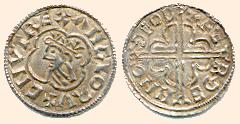
A royal official named Farthegn struck this coin one thousand years ago.� Unlike many silver pennies minted during this period, this coin has no waves or cracks, indicating the great care that the moneyer took to let the coin cool down slowly.� It was well-struck and well-centered.� Farthegn made a fine coin.
Reverse side (image on the right):� Reference guides show that the spelling "FERDEN" was a form of Faerthegn.� The mint location is indicated by the word "DEOD".� It's an abbreviated form of Thetford in Norfolk, England.
Obverse side (image on the left):� This particular Farthegn was a moneyer for King Cnut, the first Scandinavian King of all England.� The crowned bust of the king is looking to the left and is framed in a quatrefoil.� The words "CNUT REX ANGLORV" are arranged around the outer edge.
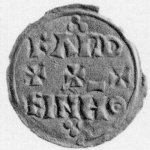
The coin shown above was created by yet another moneyer named Farthegn (here spelled "Fardein").� Minted sometime between 959 A.D. and 972 A.D., it was minted somewhere within the Danelaw during the reign of King Eadgar.� The reverse side of the coin, shown on the right, shows the moneyer's name in two lines separated by three crosses followed by "M--O".� The obverse side, shown on the left, shows "+EADG'AR REX"� arranged around the outer edge of the coin with a cross in the center.
Almost a hundred years had elapsed since the first Vikings had settled in England and they had begun to consider themselves to be more English than Scandinavian.� However, there were still cultural differences between the residents of the Danelaw and "Saxon" England. Acknowledging this, King Eadgar went out of his way to make the Anglo-Scandinavians feel welcomed and many men of Scandinavian descent, such as Farthegn, became royal officials.