
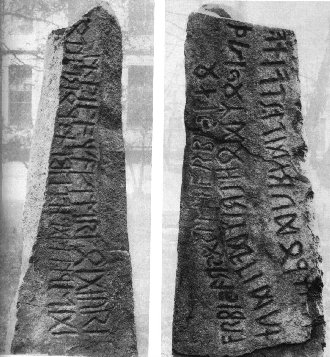
On a previous page I spelled the name Farthegn with letters from the 24-character 'elder futhark' (the runic alphabet).� During the Viking Age this futhark was shortened to only 16 characters, requiring certain letters to do double duty.� For example, since the letter "e" was no longer used, the e-rune had to be represented by the i-rune.� The g-rune� was sometimes replaced by the k-rune.� As a result, the word thegn was spelled "thikn", "thign", and even "thiakna" on some rune stones.
"Thegn" was also used as a Scandinavian personal name and, like thousands of other personal names, eventually developed into an English surname (in this instance, the surnames Thain, Thaine, and Thayne).
page 189:� "Titles like thegn and drengr most probably belong in the military sphere, the first used of veterans, the second of younger warriors."
page 267:� "We may presume that the ranks of the retinue were filled by 'thegns', 'drengs', and 'svens', (Old Norse thegn, drengr, sveinn),� all recruited from the best families in the country (and abroad)."
page 285-6:� Svend Aakjaer "maintained that the Scandinavian 'thegns' and 'drengs' were -- like their Anglo-Saxon counterparts -- royal 'servants', members of the group of nobles, who gave the king personal service and other members of his retinue or bodyguard."� Since the earliest Danish example of the word 'thegn' on a rune stone is "associated with lith, host, warband or the like, we may reasonably assume it denoted a kind of military status.� 'Thegn' is then a title of rank (cf. the man dubbed Knight in the Middle Ages or commissioned as an officer today)."
page 287-8:� "We may assume that 'thegns' and certain 'drengs' were associated in some way with the King's military organization.� Many of them were probably quite simply hemthaegar, members of his household who acted as advisers, administrators, and commanders.� And once a 'thegn', always a 'thegn'.� After a period of service in attendance on the king, he remained a 'thegn' but was now a captain or colonel of the reserve.�� Some 'thegns' were probably given official functions in the countryside, at royal residences and on crown demesnes, bailiffs or revenue collectors or the like.� Others likely returned to run their own family estates. This is the picture of 'thegns' that can be drawn from Anglo-Saxon parallels and the occurrence of the word in runic inscriptions.�
"It will be self-evident that 'thegns' were drawn from the best families in the country."�
Previous Page......Next Page�