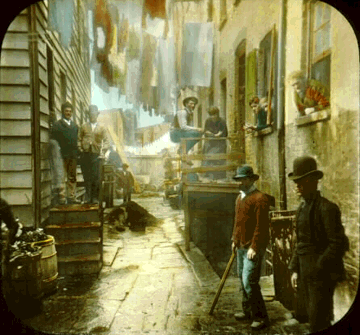
3. Still the pressure of the crowds did not abate, and in the old garden where the stolid Dutch burgher grew his tulips or early cabbages a rear house was built, generally of wood, two stories high at first. Presently it was carried lop another story, and another. Where two families had lived ten moved in. The front house followed suit, if the brick walls were strong enough. The question was not always asked, judging from complaints made by a contemporary witness, that the old buildings were "often carried up to a great height without regard to the strength of the foundation walls." It was rent the owner was after; nothing was said in the contract about either the safety or the comfort of the tenants. The garden gate no longer swung on its rusty hinges. The shell-paved walk had become an alley; what the rear house had left of the garden, a "court" Plenty such are yet to be found in the Fourth Ward, with here and there one of the original rear tenements.
4. Worse was to follow. It was "soon perceived by estate owners and agents of property that a greater percentage of profits could be realized by the conversion of houses and blocks into barracks, and dividing their space into smaller proportions capable of containing human life within four walls. . . . Blocks were rented of real estate owners, or 'purchased on time,' or taken in charge at a percentage, and held for under-letting." With the appearance of the middleman, wholly irresponsible, and utterly reckless and unrestrained, began the era of tenement building which turned out such blocks as Gotham Court, where, in one cholera epidemic that scarcely touched the clean wards, the tenants died at the rate of one hundred and ninety-five to the thousand of population; which forced the general mortality of the city up front l in 41.83 in 1815, to 1 in 27.33 in 1855, a year of unusual freedom from epidemic disease, and which wrung from the early organizers of the Health Department this wail: "There are numerous examples of tenement-houses in which are lodged several hundred people that have a pro rata allotment of ground area scarcely equal to two-square yards upon the city lot, court-yards and all included." The tenement-house population had swelled to half a million souls by that time, and on the East Side, in what is still the most densely populated district in all the world, China not excluded, it was packed at the rate of 290,000 to the square mile, a state of affairs wholly unexampled. The utmost cupidity of other lands and other days had never contrived to herd much more than half that number within the same space. The greatest crowding of Old London was at the rate of 175,816. Swine roamed the streets and gutters as their principal scavengers.[1] The death of a child in a tenement was registered at the Bureau of Vital Statistics as "plainly due to suffocation in the foul air of an unventilated apartment," and the Senators, who had come down from Albany to find out what was the matter with New York, reported that "there are annually cut off from the population by disease and death enough human beings to people a city, and enough human labor to sustain it." And yet experts had testified that, as compared with uptown, rents were from twenty-five to thirty per cent. higher in the worst slums of the lower wards, with such accommodations as were enjoyed, for instance, by a "family with boarders" in Cedar Street, who fed hogs in the Stellar that contained eight or ten loads of manure; or "one room 12 x 19 with five families living in it, comprising twenty persons of both sexes and all ages, with only two beds, without partition, screen, chair, or table." The rate of rent has been successfully maintained to the present day, though the hog at least has been eliminated. |