
In the first couple of months in 2003, my dad and brother started building a set
of air seeder openers to be attached to an existant cultivator frame (Figure 1).
This was not the first work to be done in this project. Up to this
point many hours of brainstorming, discussion and theorizing, combined with way
over 60 years of combined experiece led to the design now being built out of
steel. The initative was rooted in the difficulties of seeding into what we consider our 'heavy' soils. (In our range of soil conditions, this opener was developed to work in our heaviest, or most claysish soil. I'm sure there are soil conditions around Canada and the world that have much more clay in them.) Especially in wetter conditions, heavy soil is stickier than lighter, sandier soil. We use John Deere air drills, which have a dual-disc opener followed by a packer wheel. We also have a similar unit in an air drill configuration. While the dual-disc opener / packer wheel system works quite well, it has two inherant limitation. First, speed of the seeder is limited as there is a period of time that the soil, opened by the double discs, needs to fall back into the furrow before the packer wheel comes along to pack the furrow. If the seeder is travelling to fast, the soil does not close the furrow adequetly and the packer wheel drives right over top the freshly laid seed. This is undesirable. Second, with the packer wheel driving over the fresh soil in the furrow, the packer wheel would be driving over fresh sticky soil and get gummed up. On the air drill, it is the packer wheel that regulates how deep the opener disks cut, thereby regulating furrow depth. If the wheels gum up, it's diameter increases, the wheel runs the discs too shallow and the furrow is too shallow. The new openers were to directly sidestep these two main concerns. If you notice in the packer wheel in in the second setup, single disc opener, the wheel does not run in the fresh soil. (See Figure 4) This means two things. First, since the wheel runs beside the furrow, it does not matter if the furrow has closed over itself after the opener disc has passed, the wheel still packs soil over the seed thereby removing much of the speed limitation. Second, the wheel does not run over top of the furrow, it runs beside it, caving in the furrow. The wheel is running on undisturbed soil which is probably crusted over slightly. I seeded my barley this spring with no packer wheels gumming up and at an average of 7 miles per hour. Normally I'd have to seed at 4.5 to 5 miles an hour, or not at all if the soil sticking to the wheels. Figures 2 and 3 show the final opener arms, complete with seed hoses (white) and seed placement pipes Building the seeder arms took about a month. Assembly, installation and adjustments took about 2 more weeks. This system currenly is a single-shoot configuration. Future configurations would be double-shoot, allowing simultaneous placement of fertilizer through separate openers. |

Building an Air Seeder System |
Figure 2 - Front view (looking back) |
Figure 3 - The Openers looking down on them (in the direction of travel) |
Figure 4 |
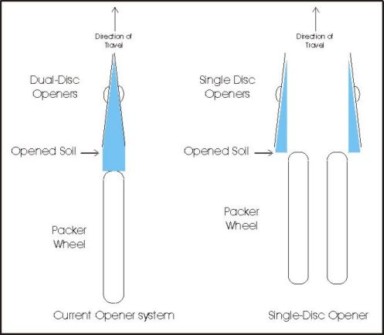
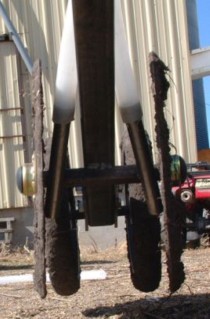
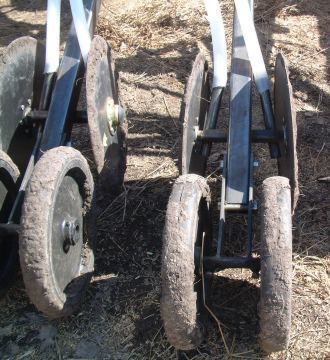
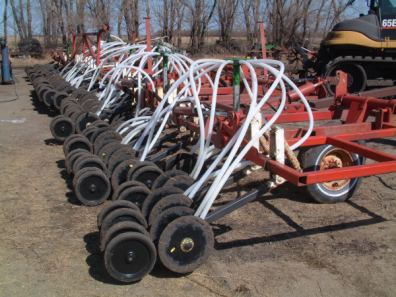
Figure 1 - Seeder mounted on cultivator frame |
Last updated Oct 11.03 |