 |
| Getting Started Pulling |
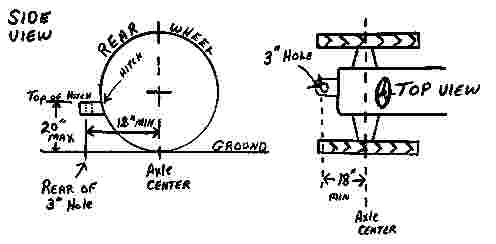
| First thing, you need a Tractor to pull with. Most any full size Farm Tractor will do, but pick one that you are familure with. Some people like the two lungers, while othere prefer 6 cylinders, but it is all up to your own preference. It must be strong running, but doesn't have to be up to new specifications, nor does it even have to look good. I seen some that they dug out of the manure pile, they burn more oil than gas and they pulled them. They do good and sometimes we can't touch them. "Never judge a tractor by it's looks!" The second thing is you need some way to transport your newly aquired hobby to the pull. This can be accomplished by having a flat bed car carrier transport it there, which can be the most expensive way, or you can drive it there if it's down the street. You can rent a trailer to tow behind your pickup, or get your own flat bed truck or trailer of your own. This is the cheapest way if you are going to pull a lot! Now to the tractor. There are diffrent weight classes to pull in, and a horsepower limit at each class. An Oliver 880 is a 58 HP tractor, and can not pull in the 4500 lb class which has a maximum limit of 45 HP, but it can be pulled in the higher 8000 lb class. It is better to start in the lower classes and get your feet wet, so to speak, and it isn't as costly to start this way. To modify your tractor is not too difficult. You need a special made hitch to hook a chain to the drag, and restricted on tire size, and a place to hang or bolt on your weights quickly. The specifications are on the rules page. Heres some tips. Make a hitch that you can adjust up and down with turn buckles or some way and it can not be any closer than 18 inches from the center of your rear axle to the rear of the hole. It can not be higher than 20 inches above the ground, and must have a 3 inch hole in it. (SEE SKETCH BELOW) As to tires, taller is better, usually. A 38 inch tire will grab better than a 24 inch tire of the same width. Too wide will make you loose ground pressure and spin, too narrow will not have enough area and spin also. Diffrent tracks require diffrent widths of tires. Cut tires work better than stock tires, and worn tires are better than newer ones with deep lugs. Tire pressure also can make a full pull, or make you spin out. Usually 6 to 9 PSI is used to adjust traction. If 6 PSI work well in a 4500 lb class, usually you have to add 1 lb of pressure for the next class. Too low of pressure, and you will spin a tire on your rim, too much pressure, and tire will be hard and not get maximum traction. It's a gamble, thats what makes it fun. You need to make a place to attach weights to your tractor. Many people use just hang on weights, while others use just wheel weights. Either way, it adds to the total weight of the tractor. Make some type of assy to slip wheel weights onto the wheels quickly, and a weight bar out front to add weight there as needed. Remember, the higher the weight class, the more weight you have to add up front. Our rules limit weights to be within 2 foot of the front of the tractor. I personally use both hang on and wheel weights. If you are in the very high weight and high HP classes where the wheels spin fast, then use only hang on weights. The weights are added to balance out the tractor. It also makes all tractors weigh the same in each class. Where the weight is placed can mean winning or not. The perfect balance is one that when the tractor just starts to get light in the front end when it is lugging during the pull. If the front end comes up, the hitch drops and you loose the angle on the chain, and if the front end is too heavy, the back wheels will not have the greatest weight available and they will loose traction and spin sooner. The chain length on the drag makes a big diffrence as to where you should place your weight. A short chain means you add more up front, while a longer chain means more on the rear of the tractor. You also must have a working PTO, so you can be checked. There are limits to the HP in each class. Thats to keep things somewhat equal, and no one can cheat. And last but not least,....GOOD LUCK AT THE PULLS ! |
|
 |
| Sketch Of Hitch Requirements |