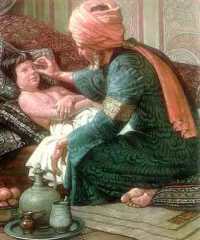
It has been established by modern historical research that the earliest human civilization dates back to about 7,000 years. Egypt and Babylon were the first countries to feel the impact of civilization, which was disseminated through various other countries including Assyria, China, India, Persia and Phoenicia, ultimately reaching Greece where it found the most congenial atmosphere for its adequate development. Romans inherited their knowledge from such eminent Greek intellectuals as Socrates and Plato, Aristotle and Pericles, Demosthenes and Sophocles. The downfall of the Roman Empire caused intellectual stagnation and the storm of barbarism which swept over the world presented the greatest threat to cultural progress, which would have been in danger of total extinction, had it not been saved by the timely intervention of the Arabs. "The Arabs" says Humboldt, "were admirably situated to act the part of mediators, and to influence the nations from the Eupharates to the Guadalquivir and Mid-Africa. Their unexampled intellectual activity marks a distinct epoch in the history of the world."'
The golden era of Muslims' achievement in the field of scientific and philosophical research, began in 900 A. D. and lasted for two centuries. The physicians and scientists of the Islamic world having stood on the firm foundation of Greek science began to rely upon their own resources and to develop from within.
Al-Razi:(Latin Rhazes 865--925 A.D.) was born at Rayy (Persia) in 865 A. D. "Rhazes" says Max Meyerhof, "was undoubtedly the greatest physician of the Islamic world and one of the great physicians of all time."' In his young age he practised as an alchemist but later he devoted himself exclusively to the development of medical science both in theory and practice. He wrote Kitab Al-Mansuri (called Liber Almartsoris in Latin) a 10 volume treatise dealing with Greek medicine which was published in several editions. According to an European writer, "His erudition was all embracing and his scientific output remarkable, amounting to more than 200 books, half of which are medical.' His outstanding work, Al-Judari-wal-Hasbah a book dealing with smallpox and measles is one of the most authentic books on the subject even to the present day. It was translated into Latin and other European languages and was published more than forty times between 1498 and 1866 A.D. It contains detailed information regarding the treatment of postules. The greatest achievement of Al-Razi in the realm of medical science is his celebrated work Al-Hawi (Latin Continens) the most comprehensive encyclopaedia of medicine ever written by a medical man, which runs into 20 volumes. This book was translated into Latin by the Sicilian Jewish physician, Faraj Ibn Salim, on the order of Charles I, King of Sicily, and named Continens. "Its influence on European medicine was thus very considerable," says Max Meyerhof. Al-Razi has also contributed to gynecology, obstetrics, ophthalmology and has written valuable treatise on the treatment of some common diseases in the East including stones in the bladder and kidneys. He was also an eminent surgeon and is the inventor of 'Seton' in surgery. He settled in Baghdad where he founded a hospital named Bimaristan. He selected its site by hanging pieces of raw meat in various localities and choosing the spot where they showed least signs of putrefaction.
Ibn Katina, the Moorish physician who died in 1369 A.D. is the author of excellent book on the plague. A severe plague which ravaged Alemaria in Spain in 1348-49 A.D. caused the celebrated physician to write a treatise on the plague which was superior to all earlier works on the subject. This book was edited and translated in Europe in the 15th century A.D. and revealed the contagious character of the plague and its remedies which were not known to Greek physicians.
Hospitals in Medieval IslamThe Muslims, even in the days of early Islam; had, developed a high culture and had organized their administration on a sound footing. The Islamic Caliphates as well as other Muslim principalities had created separate departments for different subjects which were headed by Ministers and supervised by Secretaries. Organized on highly efficient lines was the public works department whose function was the construction and maintenance of roads and bridges as well as the provision of sanitation and medical facilities to all classes of people. Never before had medical facilities been provided for the common people on such a large scale and in such an organized form. The Muslims were the first to establish hospitals, dispensaries and medical schools in the world. "In the curative use of drugs," writes Philip K. Hitti, �some remarkable advances were made at this time by the Arabs. It was they who established the first apothecary shop, founded the earliest school of pharmacy and produced the first pharmacopoeia." Several pharmacological books were written by Arabs. The author of the first of these books was the celebrated Jabir bin Hayyan. The greatest medical theorists during mediaeval times were Zakariya Razi (Rhzes), Ibn Sina (Avicenna), Tabari and Majusi. Among these Razi and Ibn Sina were also two of the outstanding practising physicians of their time.
Even before the anvent of Islam, Haris Ibn Kalda, ?a resident of Taif who had mastered medical science was welcomed in the court of the Persian emperor, Nausherwan, the Just. His son, Nasir Ibn Haris, earned an even greater reputation than his father as a physician and was instrumental in popularising medical science in early Islamic Arabia. Hazrat Omar, the second Caliph of Islam despatched a company of physicians along with the Arab army bound for Persia. The Omayyad Caliphate represents a period of consolidation and proper organisation of Muslim resources. The third Omayyad Caliph, Walid Ibn Abdul Malik, who took much interest in public works, founded an institute for blind and disabled persons. He established the first medical dispensary in Islam in 88 A. H. and staffed it with a number of able physicians and surgeons. Soon afterwards dozens of small dispensaries sprang up all over the vast Omayyad empire.
The Abbasid Caliphate provided the most congenial atmosphere for the development of culture and the advancement of public welfare activities. The early hospitals in the Islamic domains were founded on the models of the old academy-hospitals of Jundeshapur and were named Bimaristan, The first hospital was founded at the beginning of the 9th century in Baghdad during the reign of the celebrated Abbasid Caliph Harun-ar-Rashid. Five more hospitals were established during the IOth century A.D. Greek and Persian methods of medical treatment were prevalent during the early period of the Abbasid Caliphate, but the talented Barmekides also introduced Indian methods. They invited a number of Indian raids, had their medical works translated into Arabic and founded a big dispensary in Baghdad in which patients were treated by Indian methods. Harun-ar-Rashid also created a separate department of health, which used to run several Government dispensaries staffed by talented physicians. The department was supervised by an Inspector-General of Health and Bukht Yishu was the first to be appointed to this high post in 171 A.H. The same post was occupied by his son Jabriel in 175 A.H. The medical practitioners were highly paid and Jabriel received ten thousand dirhams as his monthly salary and five thousand as allowances from the imperial exchequer. In addition he earned lacs through his private practice, mostly from high dignitaries of the State. His house and his person rivalled in luxury to that of the Caliph. According to the author of the Chahar Minar the biggest income of all the physicians was that of Bukht Yishu bin Jurjis. His salary from Harun-ar-Rashid was 10,000 dirhams a month. The value of presents received by him was estimated to be over 3,00,000 dirhams a year. From the house of the Caliph he received a retaining fee of 4,00,000 dirhams. He was also physician to the Barmekides who paid him 25,00,000 dirhams a year for his services. In addition to all this be received from his private practice about 5,00,000 dirhams a year. This amounts to a total income of not less than 40,00,000 dirhams a year which represents about- ?1,75,000 per annum.
The maintenance of efficiency and high standards in the medical profession was also looked after. As early as the days of Mamun and Mutasim, pharmacists- had to pass a sort of proficiency test, before starting their practice.
In the reign of another Abbasid Caliph, al-Muqtadir Billah, the Medical Department registered phenomenal progress. His talented minister Ali Ibn Isa took a lively interest in public welfare activities. Sinan Ibn Thabit Ibn Qurra an eminent physician was the Inspector-General of Health. The outbreak of large scale epidemics in the Abbasid domains necessitated the expansion of the Health Department. A number of new hospitals were opened and a separate hospital was attached to each jail. A section of temporary dispensaries was also opened. Hundreds of physicians were appointed who toured the rural areas with mobile dispensaries and attended to ailing persons. In addition to these arrangements, Muqtadir Billah also founded several large hospitals, one of which was built on the bank of the river Tigris and spent about Rs. 35,000 a year. Another hospital built in his own name, had an annual expenditure of about Rs. 12,000. Due to the discovery of a case of malpractice, Sinan, who was the Inspector-General of Health, was ordered by the Caliph in 931 A.D. to test all practising' physicians and grant certificates to those who could satisfy him, Diplomas were awarded to successful candidates. Arrangements were made for practical instruction. Orthopaedists were examined as to whether they were acquainted with anatomy and surgery. Like surgeons, the ophthaImologists had to undergo a further test and were-forbidden to practise unless they knew the gross anatomy of the eye-ball. They had to satisfy the examiner that they knew the three principal diseases of the eye as well as their complications. Hence a system of medical proficiency tests was introduced and over 860 men passed the test in Baghdad alone and started their practice. In this way the Metropolis of Abbasids rid itself of its quaks.
Medical facilities were provided in the distant part of the far flung Abbasid domains. At least 34 hospitals were scattered all over the Islamic world during the Abbasid Caliphate and mobile clinics existed in the 11th century. The hospitals trained physicians as well as treating patients. They were divided into male and female sections and also contained medical libraries which offered courses in medicine.
