Living in Denpasar, Bali
HOME
R E J O I C E
"Should rejoice be the sweet of life
then be it the bloom of health
for there is no greater rejoice such the one
created from the conscience of frankness
and that will be the source of beauty"
(anonym, Schopenhauer and Mencius)
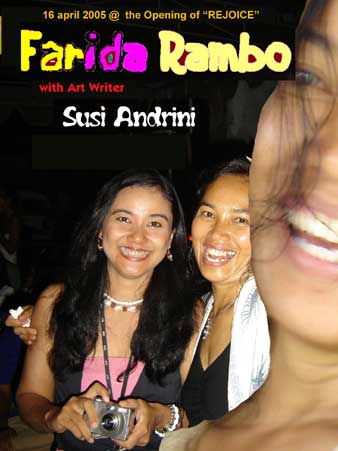
Farida Rambo, an artist who initiates this exhibition named “REJOICE?came to me for a foreword. Rejoice should tell about happiness, joyfulness - not that easy to compose different tastes all to come up in one package of idea. This is a group exhibition where 9 artists from 6 countries are gathering, they are Farido Rambo and her youngest daughter Melanie Rambo (Canada), Shiro Kamibeppu (Japan), Roland Dulac (Switzerland), Cok Gus and Nanang (Indonesia), Emile Snellen van Vollenhoven and Polart/Michel Pol (The Netherlands), and Sepi Valeriu (Singapore).
The expression of joy the artists are trying to put on canvas and papers, and on sculpture by the only sculptor participating in this group exhibition, Shiro Kamibeppu, is meant to be the expression of frankness through their art works. And to be frank, again it is not that simple to get the core meaning of a group exhibition, yet I challenge myself to know what the artists are trying to show from this “Rejoice?exhibition. The exhibition idea came in the first place from Farida Rambo, an Indonesian autodidact now living in Canada. She has come to Indonesia this time for vacation, while grabbing the chance to get her multinational artist friends together to exhibit in Bali.
Rejoice - and who is more entitled to feel it but our own self ?
Whether it comes from inside of our heart, or outside, only us to recognize the real feeling of rejoice.
Look at many of Farida’s paintings which tell about happiness of children. Farida likes to show how children interact with their peers, parents or how they respond to their environment and God in a ritual used to be held in their homeland, Bali. See some of her paintings, ?#060;i>Tenganan? ?#060;i>Best Friends? ?#060;i>Festival in Pajeng? All the realistic paintings of Farida come out of her love on children and on observing their lives, apparently also out of her own past memorable life as a child in her homeland, Indonesia.
Melanie, Farida’s daughter, too catches the life of Balinese children. A half Canadian and half Indonesian, Melanie did her paintings with full of _expression she got when she came to Bali, see, and touch with Balinese culture which she found different from Canada, the place where she was born.
Nanang and Cok Agus, both Indonesians, are clear with their messages though in different dimension and style. It is clear their hearts and minds are present through the paintings. There is strong emotion and desire in Nanang’s painting ?#060;i>Di Antara Pilihan?(Between the Choices), described in a style of cubism. There is a peaceful and beautiful silence and serenity in Cok Agus’s painting ?#060;i>Ceremony?
The two artists from the Netherlands, Michel Pol and Emile Snellen are too present with their specialties. In Michel Pol’s ?#060;i>Ink of Paper? there shows naïvet? and expressionistic drawing. While Emile’s are clear and strong lines of paintings showing some parts of human body like navels he might mean as a central element. Looking into his paintings, like the one titled “The Love Spirit of the Bali Spring?feels like going into a different world made up of peace and love -- love to human fellows and to the Creator of life.
Roland Dulac from Switzerland, comes with a show of landscape and naturalism with meticulous decorative of romantic moments.
The Singaporean artist, Valeriu Sepi, on her work “Woman Drawing?plays with techniques on canvas.
Shiro Kamibeppu (Japan) the sculptor, gesticulates human bodies in his sculptures trying to show the senses of purity, honesty and frankness which at the end give the sense of beauty.
According to Zeising, what can be categorized as purely beautiful is something that gives you the feeling of joy. And a medieval philosopher and a fan of Aristotele, Thomas Aquinas, says that beauty must come from 3 conditions: integrity or perfection, proportion or harmony, and brightness or clarity.
Beauty relates closely to joy as it gives the feeling of joy to the one who sees it. The Sufis from the 5th century BC from Athene believe that beauty of what is good on eyes and ears. However, the joy that comes from beauty must be out of disinterested pleasure. An artist should express his thought in an artwork with no pretence or side interest. Whether it is about silence, party, human, environment, or God, all is about beauty which is to give joy and pleasure.
Now I give the honor to you to see and decide, whether those in this exhibition give you the feeling of happiness and rejoice, whether those are ones of medicines of our sometimes suffered heart and soul?
Susi Andrini
Art writer
Living in Denpasar, Bali
HOME