 |
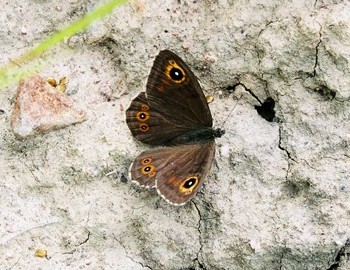
| Large Wall Brown (Lasiommata maera) making use of the minerals found in clay. Photo by Taina |
| Lasiommata maera � Large Wall Brown (Nymphalidae) Appearance: This delightful brown butterfly has a wingspan from 45 to 52 mm. The male butterfly has grey-brown upperwings while the female is of a richer brown shade. Both have one large twin pupilled eyespot and a tiny satellite spot on the forewing, which helps identifying the butterfly. On the hindwing there are three smaller spots. The female butterfly is more colourful than the male, having the spots on a light orange band. Undersides: The undersides of the hindwings are dappled with grey and brown with 6 small eyespots. The undersides of the forewings are of a slightly warmer shade of brown and with an emphasized, dark eyespot on the tip of the wing. Geographical distribution/ habitat: Europe excluding Britain in altitudes up to 2000 m; in Central Asia and North Africa. Prefers grassy and rocky areas in forests, can be found in near rocky slopes, on mountains, along tracks, on meadows with a lot of flowers. Host plants: Grasses (Graminae). Food plants: Visits wildflowers for nectar. Flight time: Usually on the wing from June to August. In South however there can be two generations on the wing from May till the end of September. Other: Hibernates as a caterpillar in a dried up tussock of grass. Bears close resemblance to Lasiommata petropolitana that looks very much like Lasiommata maera, but is only smaller, darker and is on the wing earlier. L. petropolitana however has three dark lines on the underside of the forewing that L. maera does not have. L. petropolitana occurs in woodland and heath land. Can be found throughout Europe excluding Britain and the temperate regions of Asia. Taina's Butterfly Page Photos and Information Index Home Butterfly Garden |