 |
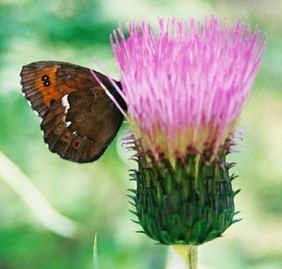 |
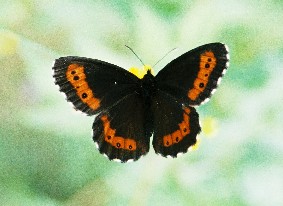
| Erebia ligea, male (above) and female on Cirsium heterophyllum (right) with the distinctive white band showing. Both photos by Taina. |
| Erebia ligea � Arran Brown (Nymphalidae) Appearance: This beautiful dark butterfly presents much variety in size (44mm-50mm) and colour. The male butterfly has rich dark brown upperwings with orange bands containing four black white-pupilled eyespots. On the hindwings there are three similar eyespots on an orange band, but they are often smaller. The forewing pattern is repeated on the underside while the underside of the hindwing has a more muted colouring. On the underside of the hindwing however an irregular white band can be found, which helps fundamentally identifying the specimen. This is more emphasized on the female butterfly, that generally has a lighter brown base colouring with wider orange bands and with more emphasized eyespots. Geographical distribution/ habitat: The North and the East of Europe and the temperate regions of Asia. Prefers coniferous grassland and woodland and can be found in the altitudes up to 1500 m. Host plants: Grasses (Graminae), eg. Milium. Food plants: Visits wildflowers for nectar, eg. thistles, Knapweed, Leontodon spp. Flight time: On the wing from Mid-July to Mid-August every other year. Usually more common on odd years, depending on the locality in question. Other: A Biennial specimen, which means the butterfly requires two years to complete the life cycle. The adult butterfly lays eggs in the summer and on the first winter the egg will hibernate. On the following winter the caterpillar will hibernate. Taina's Butterfly Page Photos and Information Index Home Butterfly Garden |