
Faras Ghani, 26 years
old, born and bred in Karachi, a resident of London and Manchester at times and currently pursuing
a journalism career in London.
My interests
lie in football, cricket, bird-watching, photography, eating, sleeping,
random theories and coming up with crazy ideas.
I can be found
on msn (yung_foo0),
on facebook, on twitter, on blogspot or by plain email (farasghani[at]yahoo.com) |
|
 |
Intel VIIV, the digital home
Imagine the kitchen with no
radio, a lounge with no VCR or DVD player or a bedroom with no CD
player. Your coffee table actually has space for coffee now that the
numerous remote controls have disappeared. You have no television
stand to bang your knee against or a cascade of different media
players for the dust to settle on. Most importantly, there are no
cables for your pet vermin to masticate and there is no longer any
need to come out from the comfort of a warm blanket on a winter
evening to change the DVD.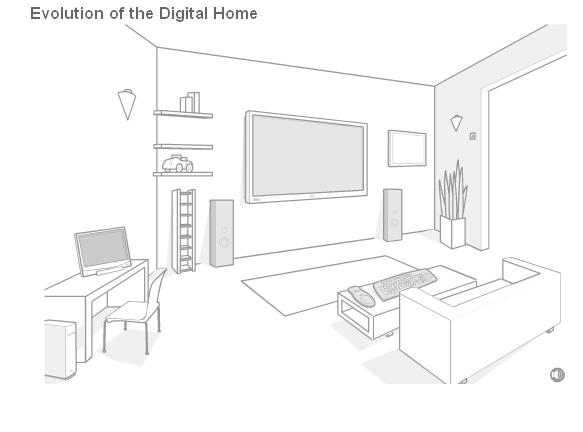
Life would then only be school, work and play – useless, in other
words. Now, imagine all the clutter that has disappeared fitted into
one solitary box – your computer – and accessible via a single
remote control.
Credible enough? Intel has made sure it is. Intel's VIIV technology,
hyped as the evolution of a digital home, is a platform to replace
the numerous pieces of hardware cluttering up precious desk space in
a house with a single box. Powered by the Intel Pentium D processor
with the help of the Intel 945 Express chipset family, VIIV provides
high-definition graphics with up to 7.1 channel surround sound while
playing your DVDs and MP3s straight from the PC without any need for
separate hardware.
The package collectively referred to by Intel as VIIV, brings
together a fast, dual-core processor, designed to withstand a
strenuous workload and multi-task efficiently while using Windows XP
Media Center on the software side to allow users to make their
experience entirely digital.
The Intel Pentium D processor features two processing cores that
share the same packaging and run at the same frequency, but operate
as distinct execution cores. The two cores provide more resources
for higher throughput and simultaneous computing. Twin-core
processing allows users to multi-task efficiently and tasks such as
rendering a home-made video and burning a DVD that would have
drained the life out of a single-core processor can now have
separate processing cores assigned to complete the task faster.
Intel VIIV technology-based PCs support the Intel Quick Resume
Technology Driver. It allows the PC to behave like a consumer
electronic (CE) device – after an initial boot, customers can turn
their PCs on and off amazingly fast, just like they do with their
televisions.
Intel High Definition (HD) Audio is integrated audio that delivers
the features and high-end performance of an add-in audio card. All
Intel VIIV technology-based PCs support at least 5.1 surround sound
and offer multi-streaming capabilities, allowing users to send two
or more different audio streams to different locations around the
house. This means users can listen to a movie in surround sound in
the family room while another user can listen to music streaming
from the same PC in the kitchen.
Intel Matrix Storage Technology provides users better protection
against losing valuable digital entertainment files. It also offers
enhanced performance whether users have one or multiple hard drives.
Microsoft Windows XP Media Center Edition brings the powers of an
operating system and offers two user-interfaces – the standard
desktop interface and an alternate menu-driven system that provides
easy access to media. With Media Center, you can play DVDs, MP3s and
recorded media off your hard drive, watch and record live TV, view
your photo collection or create slideshows with music of your choice
in the background, listen to radio stations as well as watch online
movies via subscriptions.
Intel VIIV technology is a new platform for home entertainment. It
offers its customers performance for playing multiple media files
simultaneously and connectivity for the latest online entertainment.
So how does the digital home work if you have a powerful PC with
masses of storage space, HD graphics and 7.1 surround sound? What
makes VIIV a package for the future?
With the help of a Digital Media Adapter (DMA), your mother can sit
in the kitchen and watch Jamie Oliver’s recording from the night
before while your father watches live football in the living room.
At the same time, little Johnny can watch cartoons from his room.
And if that wasn’t enough, your aunt can shuffle through the
family’s MP3 collection while working in the shed. In the end, all
these users are accessing one computer from remote locations within
the house.
DMAs allow the media box to be placed in a central location, such as
the living room and have remote terminals (LCD screens and remote
controls) scattered as and where required. All Johnny would need to
do to view the cartoons is use the remote control and flick through
the channels on the screen with Windows XP Media Center as the
portal. Chef mum can do the same with the screen and remote in the
kitchen as she prepares dinner just like Jamie did the night before.
The aunt uses the remote control to browse through the music
collection and select what she wants to hear. She can also turn on
local or internet radio straight from the remote if she were to get
bored of the MP3s. Dad, meanwhile, enjoys the couch to himself while
his team creams the opposition. And while the goals keep on coming,
Scrubs season five is being recorded in the background to be viewed
later.
For the remote (wireless) functions of VIIV to work one needs to
have a decent broadband connection, a phenomenon little known to
home-users in Pakistan. Downloading and streaming of various
multimedia files require a fast connection to work efficiently.
Also, for the media and the internet connection to be shared around
the house, a broadband connection is somewhat of a necessity.
However, as a stand-alone entertainment PC with Windows Media Center
installed, you don’t need an internet connection at all. The user
can simply view their own video and photo collection, play DVDs,
listen to music and have a photo slideshow on a single screen. With
a TV card installed in the PC and a terrestrial antenna or a cable
connected to the back of it, the user can view, pause and record
live TV. It can then be edited if required and copied on to CDs or
other PCs for personal viewing.
So that is Intel VIIV technology, the evolution of a digital home.
With or without the DMA, the VIIV technology is sure to be a hit
across the country at least amongst the gadget-worshippers. Or would
it?
 Not
at this point in time, according to the views reflected by Intel
Pakistan. Intel is not too keen on promoting and advertising VIIV at
the moment because broadband is not a household name in the country
and there is an absence of media content providers in Pakistan. It
is due to these facts that VIIV will not be able to fulfill the
promise and potential it holds and users will not be able to
appreciate its capabilities to the extent Intel want them to. Not
at this point in time, according to the views reflected by Intel
Pakistan. Intel is not too keen on promoting and advertising VIIV at
the moment because broadband is not a household name in the country
and there is an absence of media content providers in Pakistan. It
is due to these facts that VIIV will not be able to fulfill the
promise and potential it holds and users will not be able to
appreciate its capabilities to the extent Intel want them to.
The blame lies with PTCL’s infrastructure and usage policy that has
hampered ISPs’ plans to provide a high-speed broadband connection to
home users. Due to PTCL owning the telephone lines and the fibre
network across the country, it can afford to charge premium rates
for the flow of data. A study recently revealed that the cost to
ISPs in Pakistan for transferring 100 Kbit/s is 1600 times more than
the cost in South Korea. Keeping this figure in mind, it comes as no
surprise that home users here are still dependent on dial-ups and
shared cable networks.
As a result, Intel is not too keen on pushing their VIIV-enabled
boxes out into the market just yet. “VIIV technology is all about
access to digital content over a broadband connection and without a
decent connection it’s just a stand-alone fast PC with extra
storage,” says Junaina Saulat, marketing program manager for Intel
Pakistan.
However, Wateen Telecom, a sister concern of the Abu Dhabi-based
enterprise Warid Telecom, plans to lay a comprehensive
telecommunications infrastructure that would consist of an
international optic fibre network linking Pakistan with China,
Central Asia, Afghanistan, India and Iran. In addition to this
international linkage, a 5,000 kilometre wholly-owned nationwide
optic fibre transmission network is to be laid. This, together with
a 3.5 gigahertz wireless access network infrastructure in selected
metropolitan areas will have the potential to facilitate Voice over
IP (VoIP) telephony, broadband internet and virtual private networks
(VPN).
The new infrastructure is planned to be in place towards the end of
2006 and, according to Intel, that is when VIIV will be ‘launched’
and promoted to home users in Pakistan. Intel is also in lengthy
discussions with WorldCall who plan to launch an online content
service in Pakistan in early 2007. That is good news not only for
manufacturers and distributors but also for the technology-obsessed
in our very own country who could previously only read about such
things happening in foreign shores.
With all the hype and excitement that VIIV has created, there are
some who still think of it as nothing but a convergence of hardware
and software that already exists. Pakistani users will have to wait
till the end of this year at least to see what it actually is. Until
then, whether VIIV is worth the hype and the wait will remain a
question in our minds.
© Faras Ghani 2008.
Published in Spider
Jul 2006
|
|
Books &
Authors
Cafe reviews
Cricket
Exhibitions
Fashion
Film
IT & computers
Music
Phones & gadgets
Politics
Pharmacy
Social issues
Stage
Travelogue
Photography
Concerts
Cricket
Events
Fashion
Friends
Me, the great
Portraits
Politics
Products
Stage
Street photography
Travel
|
|
|
|
|
life as a
journo
I started writing at the age of 15 - much later than few I
know involved in the field of journalism - as a contributor
to an e-newsletter. I wasn't very good at it but kept
pursuing it, so much so that I was forced to change career
paths; landing into print journalism from computer science.
I have written on topics ranging from sports, politics and
news to IT, fashion, entertainment and the world of pharmacy.
Landing free concert passes, chance to
interview celebs and sports personalities and travelling around
the globe on company expense, I am in love with the world of
journalism.
Click here to view
some of my contribution and payback, to this world. |
my travelling experience
Pakistan - Karachi, Thatta, Islamabad, Pindi, Lahore, Peshawar,
Gilgit, Murree, Faisalabad, Hyderabad, Multan
England - London, Manchester, Birmingham, Southampton, Portsmouth,
Oxford, Salisbury, Coventry, Warwick, Sutton, Winchester,
Liverpool, Bradford, Preston, Wigan, Suffolk, Stockport,
Bolton, Bath, Brighton, Horsham
Wales - Cardiff
Scotland - Edinburgh, Glasgow
Ireland - Dublin
France - Paris
Spain - Reus, Barcelona
Turkey - Istanbul
USA - New York, Philadelphia, Lancaster, Swarthmore, Chicago, St
Louis, Columbia, San Diego, OC, LA, Las Vegas, Washington DC
UAE - Dubai, Abu Dhabi, Sharjah
Jump to my travel photos |
the interest in photography
An
interest in photography developed randomly and grew into a hobby that I started
dedicating more than a few minutes to.
Covering cricket matches, fashion
shows, music concerts and
randomly walking around with a camera, I have taken,
and
edited, a few photos that I like.
As before, comments welcome and appreciated.
Jump to
my photography page, portfolio, some decent pictures,
and cricket.
|
publications and employers
England
The Sun, Cricinfo, Asian News, Asian Woman, IWTV, Student Direct,
LiverFM, ALL FM, City Life, Sensazn, AMG, Cricket Bloggers
Pakistan
Cricinfo, Dawn, Spider, Images, Dawn Magazine, Books & Authors, Sci-tech
world, Star, Newsline, Herald, Xpoze, The News, getIT.pk, The Review, Right Solution
Also, IBM, Financial Times, Superdrug,
Woolworth's, Ultima Thule, Exxon Mobil, GSK, Big Picture, Gekko,
Frontline Focus, Barclaycard, 3G Hutchsion, JD Sports and many
more. |
|
|
|