
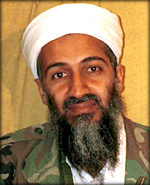
Osama bin Laden, labeled "one of the most significant financial sponsors of Islamic extremist activities in the world," has been linked to many major terrorist attacks and initiatives in recent years � including the 1998 bombings of two U.S. embassies in Africa and the attack on the USS Cole in the Yemeni port of Aden in October 2000.
Now, the Bush administration says he is the prime suspect in the coordinated terrorist attacks on the World Trade Center and Pentagon on Sept. 11.
The Taliban, the ruling party in Afghanistan, where bin Laden resides, has rejected speculation the reclusive Saudi exile may be involved, but Taliban officials were told Monday they would pay a military price if they continue to shelter him.
Bin Laden's al Qaeda organization is a loose umbrella association of radical groups and people believed to operate in dozens of countries around the world. Group members are suspected of association with previous attacks against U.S. interests, including the 1993 World Trade Center bombing, plots to kill President Clinton and the pope, and attacks on U.S. troops in Saudi Arabia and Somalia.
He also has used his millions to bankroll terrorist training camps in Sudan, the Philippines and Afghanistan, sending holy warriors to foment revolution and fight with fundamentalist Muslim forces across North Africa, in Chechnya, Tajikistan and Bosnia.
Ordinary Young Man � Then Joined Jihad
Born in 1957, bin Laden is the son of Saudi Arabia's wealthiest construction magnate. Saudi sources remember him as an ordinary young man whose intense religiosity began to emerge when he grew fascinated with the ancient, holy mosques of Mecca and Medina that his family's company was involved in rebuilding.
In the 1980s, bin Laden left his comfortable Saudi home for Afghanistan to participate in the Afghani Jihad against the invading forces of the Soviet Union � a cause that, ironically, the United States funded, pouring $3 billion into the Afghan resistance via the CIA.
Bin Laden became a leader of Arabs living in Afghanistan and a regional hero, but was careful throughout to distance himself from U.S. influence. The war cemented a hatred of the U.S. government and radicalized bin Laden's politics.
Afterwards, he declared the Saudi ruling family "insufficiently Islamic" and increasingly advocated the use of violence to force movement toward extremism.
One of the most insular Islamic countries in the world, Saudi Arabia stripped bin Laden of his Saudi nationality in 1994 for his alleged activities against the royal family, and he went into exile in Sudan � but was expelled from the country five years later under U.S., Egyptian and Saudi pressure. In 1996, he took refuge in Afghanistan.
Former mujahideen commanders close to the Taliban say that, in Afghanistan, bin Laden bankrolled the Taliban's capture of Kabul under the leadership of the reclusive, one-eyed Mohammed Omar and has become one of Omar's most trusted advisers.
Bin Laden is said to personally control about $300 million of his family's $5 billion fortune. His role as a financier of terrorism is pivotal, experts say, because he has revolutionized the financing of extremist movements by forming and funding his own private terror network.
Bin Laden has devoted not only his own fortune, but his business acumen to the cause, and through a nebulous network he calls the Foundation for Islamic Salvation � which sources say runs money through companies in the United States, Europe and the Middle East � the powerful recluse has funneled money into the promotion of terrorist causes around the world.
 Links to pages on this Site
� 2001 [email protected]
