|

|
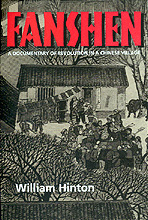
What does my name mean? Background Notes to Fanshen On April 3, 1999, a one-day conference, �Understanding China�s Revolution: a Celebration of William Hinton�s Lifework� was held at Columbia University to celebrate his eightieth birthday. At the conclusion of the conference, organized by China Study Group and cosponsored by Monthly Review and Columbia�s East Asian Institute, Hinton gave an impromptu talk on the background to the writing of Fanshen: A Documentary of Revolution in A Chinese Village. The talk was transcribed and we publish its text here, as revised by Hinton in October 2002. Fanshen was first published by Monthly Review Press in 1966. It is an account of how land reform was implemented in one village�Long Bow�in northern China. Hinton first visited China in 1937. He returned in 1947 with the United Nations Relief and Rehabilitation Administration and stayed on in the liberated areas of north China as a tractor technician and teacher until 1953. During that time, mainly living in Long Bow, he was witness to the great social convulsion that was the Chinese Revolution. Along with his Chinese academic colleagues, Hinton advised the residents of Long Bow on the complicated tasks of teaching peasants to read, breaking up old feudal estates, insuring the equality of women, and replacing the old magistrates who governed the village with elected councils. While there, Hinton took more than one thousand pages of notes about what he saw. In them he detailed not merely measurable successes and failures of the revolution, but the deep scars of struggle, the resistance to change, and the uniquely Chinese process, often painful and violent, of criticism and self-criticism. Hinton was witness to a world literally �turned upside down.� |
|
|
What I'm busy with
|

|
Copyright © August 2008 Fanshen Peteros All rights reserved |