 KARATE
KARATE
KARATE DO literally "empty hand"
from KARA = empty and TE = hand
Hand as physically as all what that performs the technique, therefore also the mind for arriving to the fundamental concepts of the KARATE "clear the mind from all and gather on an only point and only on that."
Karate is a martial art that developed in Okinawa at the beginning of XVI century.
Master Gichin Funakoshi has been considered the creator of Karate.
Although this is not exact, Funakoshi was the first to spread KARATE in Japan and then his school has been known in therest of the world.You can see his picture in many schools of European Karate.
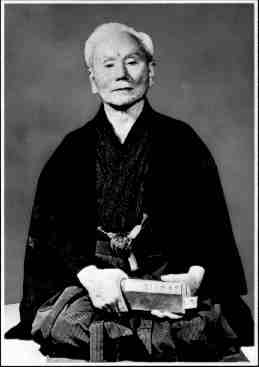

The traditional KARATE is a self-defence art, it uses the human body in the most effective ways, using varied techniques that involve combinations of specific movements. Through this discipline it is possible to widen and improve one’s own physical and mental ability.
The learning and practise of KARATE has developed through three methods:
 |
KHION |
|
KATA |
|
KUMITE |
KHION : involves the performance of several techniques that make up the method of Karate, repeating them many times until they become automatic and faster. This practice goes beyond learning the techniques, bul also teaches how to use your own energy, breathing and co-ordination of one’s own body.
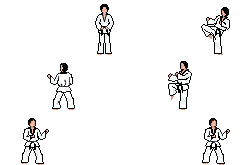
KATA
: It
is the technical aspect of the KARATE. It is a whole set
of exercises that symbolize a real fight against several adversaries. The
daily training confers the necessary calmness for
exercising in the Kata and helps to concentrate on a point and only on that,
with the spirit and the thought.
The movements of the Kata help to mould the body, strengthen it completely and stimulate the reflexes.

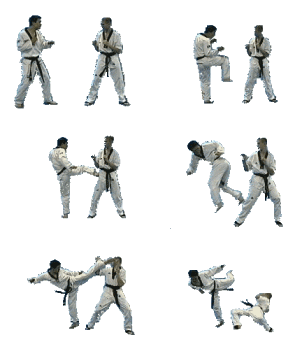
KUMITE : It represents the fight between two adversaries, during which the techniques learned in the Khion are applied. The fight must be faced with serenity, loyalty and correctness, respecting the adversary’s abilities.
No technique must be performed with the intention of hurting. The power exercised and the appointment must be a way for reach a more and more tall level.
The athlete who hits the adversary in a fight without control, suffers penalties and also the disqualification if the infringement is very serious.
The styles of Karate are several and they have developed throughout the years. Currently, the most spread are: Shotokan, Goju-Ryu, Wado-Ryu, Kio-KushiKai and Shito-Ryu.
Every
Karateka keeps to the style to which he belongs
When we talk about "style" we do not imply different methods used in the same school, but in different schools.
The
Japanese terminology identifies the method of a certain Teacher and his school
with the term Kanji-RYU .
At first in the Italian KARATE, the difference between the methods was clearly felt, but lately, due to the formulas of competition, this rivalry decreased and the technical comparison between the athletes has improved KARATE in general. In each case, out of respect for the traditions, each school maintains the techniques of its own RYU alive.
 At
the beginning KARATE did not think
about the apprentices wearing a
uniform. The use of the white Kimono goes back
to1921, in JUDO discipline,
and then it was introduced in KARATE.
At
the beginning KARATE did not think
about the apprentices wearing a
uniform. The use of the white Kimono goes back
to1921, in JUDO discipline,
and then it was introduced in KARATE.

There are different belts to represent the level of the apprentice. This method was born in about 1950 in JUDO and some year after in Karate.
The colors today are:
|
White (initial level) |
|
Yellow
|
|
Orange
|
|
Green
|
|
Blue
|
|
Brown
|
|
Black
(professional
level) |
The Red belt and the Red-white belt also exist to show the degree of the teacher.
When the black belt is reached, there are ten degrees (DAN) that point out the level of cleverness of the black belt.
For reaching an elevated degree of black belt, much work and belief in one’s own ability are needed.
The first Western athlete honoured with the VIII° degree of TAE KWON DO and WITH the title of GRANDMASTER X° degree of TANG SOO DO is Chuck Norris world champion from 1968 to 1974 .


