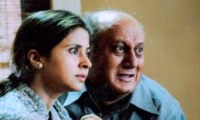
But let's make one thing clear at the very outset! MAINE GANDHI KO NAHIN MARA doesn't deal with Mahatma Gandhi, but his ideologies. The film peeps into the mind of an aged man who believes he had mistakenly shot the Mahatma. In that respect, yes, MAINE GANDHI KO NAHIN MARA steps into a new territory as far as Bollywood is concerned.
But, to be honest, MAINE GANDHI KO NAHIN MARA would've been ideal as a play/stage or tele-film. The concept isn't exciting for movieplexes and even if a section of moviegoers do appreciate the effort, its appeal would be restricted to just a handful of people.
Besides, even the mature audiences that go for a film like MAINE GANDHI KO NAHIN MARA wouldn't be in complete agreement with the conclusion to the story. The entire courtroom episode in the post-interval portions makes it too theatrical, too abstract.
At best, MAINE GANDHI KO NAHIN MARA will be remembered more for Anupam Kher's bravura performance than the experience in totality!
Professor Uttam Chaudhary [Anupam Kher] is a retired Hindi teacher who lives with his daughter Trusha [Urmila Matondkar] and son Addy [Addy] in Mumbai. He is suffering from brief periods of forgetfulness, blanks in memory. Little does anyone realize that the problems are much deeper and that this is just the beginning of a journey that will end in a man becoming a prisoner of his mind.

As his memories start to fade, a childhood trauma surfaces -- a memory of being accused of murdering Mahatma Gandhi. The more his life is whitewashed, the stronger this one memory remains.
Amidst all this, Chaudhary's daughter is a positive force, the only lifeline that can save her father from drowning in the universe his mind is creating.
MAINE GANDHI KO NAHIN MARA talks of Alzheimer's disease, an issue that hasn't been tackled on Hindi screen before. All the same, the film talks of the Gandhian ideologies that the generation of today has, perhaps, forgotten or overlooked. The film also delves into the parent-kid relationship and the feeling of being 'unwanted' that a senior citizen experiences at times.
The first hour builds the drama beautifully and a number of sequences make a sweeping impact. Starting with the sequences between Anupam and Urmila on breakfast table to Anupam's sequence with the barber and of course, the 'disclosure' at the interval point. Director Jahnu Barua catches your hand and makes you experience a cinema that's refreshingly different, realistic, unadulterated.
If Barua's screenplay was most absorbing in the first 45 minutes, it slackens considerably in the next 45 minutes. The post-interval portions are engaging in
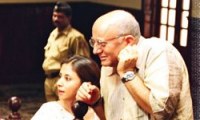 bits and spurts, like the flashback portions [Raju Kher explaining the Mahatma
Gandhi episode is remarkable]. But the basic thought of making Anupam shed his
guilt by cross-examining in court seems far-fetched, inappropriate, totally
uncalled for. Yes, a path-breaking subject deserves an equally different
conclusion, but the finale is difficult to absorb. The lawyer [Boman Irani]
screaming at the patient [Anupam Kher] appears very harsh and overtly
dramatic. In fact, the patient could've collapsed during the dummy courtroom
proceedings. Therefore, a faulty finale!
bits and spurts, like the flashback portions [Raju Kher explaining the Mahatma
Gandhi episode is remarkable]. But the basic thought of making Anupam shed his
guilt by cross-examining in court seems far-fetched, inappropriate, totally
uncalled for. Yes, a path-breaking subject deserves an equally different
conclusion, but the finale is difficult to absorb. The lawyer [Boman Irani]
screaming at the patient [Anupam Kher] appears very harsh and overtly
dramatic. In fact, the patient could've collapsed during the dummy courtroom
proceedings. Therefore, a faulty finale!Jahnu Barua's direction is competent when you look at the on-screen performances or handling of certain emotional moments. But, as the screenplay writer of this enterprise [along with Sanjay Chouhan], Barua gets abstract in the latter part of the film and that is its biggest undoing. In fact, a psychiatrist hiring junior artistes or stage actors to cure a patient of Alzheimer's looks ridiculous and spoils the impact to a major extent.
Bappi Lahiri's background music is soothing, especially the usage of piano at various moments in the narrative. Raaj A. Chakravarti's camerawork is topnotch.
MAINE GANDHI KO NAHIN MARA belongs to Anupam Kher completely. Roll out the red carpet to an actor of extra-ordinary range. To state that Kher lives the part with flourish would be an understatement. It's his most accomplished work after SAARANSH, a film that marked the 'birth' of Kher.
Urmila Matondkar is superb as the caring daughter. Note her expressions when she bursts out at her father soon after the all-important meeting with her fiancé's parents or when she realizes that her fiancé has ditched her and married someone else -- she deserves distinction marks here!
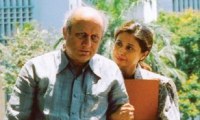
MAINE GANDHI KO NAHIN MARA has a number of actors, but those who register an impact are Prem Chopra, Parvin Dabas, Raju Kher, Divya Jagdale [the maid] and Vishwaas Pandya [the fiancé]. Waheeda Rehman is wasted. Boman Irani goes over the top, which does come as a surprise. Newcomer Addy is first-rate.
On the whole, MAINE GANDHI KO NAHIN MARA is the kind of cinema that may meet with diverse reactions. While the critics, the festival circuit and mature audiences [a tiny segment of moviegoers] may go for it, the majority might find the experience too theatrical. At the box-office, the film caters to a niche segment, but beyond the boundaries of a handful of cities [that too select multiplexes], the film won't meet commercial success.