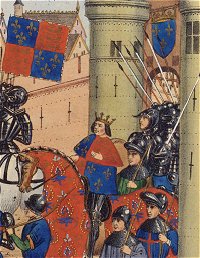
 William the Conqueror (born 1028 died 1087):
Was of the (Scandinavian) Norman race.
Born in Falaise, Normandy, the illegitimate son of Robert "The Devil" who was the fifth Duke of Normandy. William became duke when he was seven-years-old.
William the Conqueror (born 1028 died 1087):
Was of the (Scandinavian) Norman race.
Born in Falaise, Normandy, the illegitimate son of Robert "The Devil" who was the fifth Duke of Normandy. William became duke when he was seven-years-old.
King Edward the Confessor (1042-1066) the Saxon monarch of England who was put on the throne by Earl Godwin. Edward allowed Normans into key posts of his administration and they in turn drove Godwin and his family from England. After he and his son Harold II returned from exile, southern England supported them and the Normans left England.
"The name 'William' in French is 'Guillaume'!"
The Vikings colonized Normandy in the year 866. 200 years later their sons decided that it was time to move again.
Before King Edward died he named Harold Godwinson as the next king of England. William claimed that Edward had named him as heir to the throne, and also claimed that Harold, whom William rescued from a French count, pledged the throne to him. The king of France also got into the act, sending soldiers to England, only to lose the battle. Six weeks of bad weather delayed William. Harald Hardrada, king of Norway also wanted the throne and sent an invading force to England several days before William arrived. He scored victory against two English earls, but Harold rode northward and defeated Harald Hardrada at Stamford Bridge.
Three days later William arrived at Pevensey with barons and knights from Normandy, Brittany and Flanders. Harold and his reduced forces head southward. The foot soldiers cold not keep up with the mounted troops and reinforcements from the southwest were also late in arriving. They battle at Sussex. Harold, his thanes, (or thegn �� land-holding freemen), the fyrd (national military force) and housecarls (bodyguards or household troops) battle the Normans on Caldbec Hill, six miles northwest of Hastings, on the south edge of the forest of Andrepsweald. This is known as the Battle of Hastings. Harold and his housecarls are slaughtered, and William is King of England in 1066.
12,000 men (half of them were cavalry) and 5,000 knights controlled 1 1/2 million Anglo-Saxons. Harold's supported lost all their possessions. There was some opposition to William's rule, but the rebels were defeated. The Anglo�Saxon earldoms no longer existed, although some remained in the north and west. This also put an end to the Anglo-Saxon language (which was considered peasant jargon), the Norsemen speaking Latin and Gentry French.
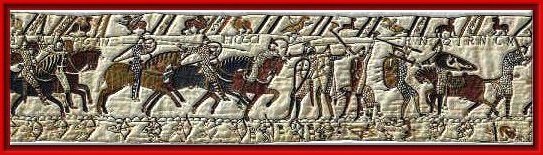
This scene from the Bayeux Tapestry is from:
battle1066.com
The webmaster there has two other sites:
hastings1066.com
qwhi.co.uk
You'll find the Tapestry in its entirety, as well as the webmaster's account of British history and the backgrounds that he has designed.
