The information on this web page came from Samuel R. Coe of Wexford Ireland, who at the time, 1997, was the Wexford Walking Tour Guide. There was no mention of the book from which the information came from. In the letter Mr. Coe mentioned William Marshal�s Sistern Abbey, and that it was occupied up to thirty years ago (in 1997). He also mentioned that the Abbey is being (or possibly by now has been) restored by the Board of Works. The outdated spelling has been copied here as well as the footnotes.
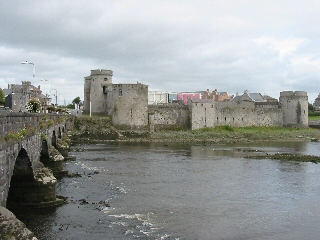
King John's Castle is the name given to several large castles built in Ireland during the reign of King John of England (1166-1216). This one is in the center of Limerick City, on King's Island next to the River Shannon and nowhere near Wexford.
This photograph is from en.wikipedia.org
For more information you can go to www.shannonheritage.com
Castles in Wexford Town
Hays Castle
This castle was in Hays Lane now known as Cinema Lane. In 1641 it is called an ould castle owned by Walter Hay and later granted to Leonard Bolan.
Kenny Hall
This was the town house of the Kenny family and was situated where the present Woolworth�s store is built, part of the walls can still be seen.
Selskar Castle and Abbey
An article in the People [The People, Wexford] of 1890 gives the following account of this ancient monument: It is said to have been built by the Danes in the 11th century or very early in the 12th century. There is not much certainty as to the particular date of its erection or by whom it was founded. Some attribute it foundation to the Roches of Artramont Castle; but this can scarcely be so, as Selskar Abbey was in existence at the time of the Norman Invasion and its church shortly afterwards solemnized the first marriage of an English born couple in Ireland, Raymond le Gros and Basilia, sister of Strongbow. The Abbey Church was composed of a double roof like the Dominican Chapel at Clonmines. The windows are very slightly pointed, which shows the antiquity of the building, for most other ecclesiastical structures of late in the 12th century or early 13th century are of Gothic style of architecture. Adjoining the church ruins is the old square tower, which has been renovated in modern times. On the other side of the tower the monastery stood. The ruins of the monastery were cleared away for erection of the present Protestant Church in 1818. The abbey belonged to the Canons Regular of St. Augustine of which there were several monasteries in Co. Wexford. Its Abbott sat in Parliament as a Baron. A Parliament was held here by Edward IV in 1463. It was also called the Priory of St. Peter and St. Paul. The Roches of Artramont were the patrons of the Abbey and were also munificent benefactors. In 1240, John, Bishop of Ferns, held a Synod here. The property of Selskar was disposed as follows. In 1551 it was granted to John Parker, constable of Dublin Castle. In the same year, the said Parker enfeoffed or invested John Devereux of Wexford, merchant, in the priory of Selskar and Paul Turner of Wexford, of the other premises. Turner was brother-in-law of James Devereux and also of Alexander Devereux, the then first Protestant Bishop of Ferns.
From the Hore MSS we have this account: Selskar Castle and Abbey built by the Roches in the 12th century. It was founded about the year 1190 for Regular Canons of the Order of St. Augustine, by the Roches. The tower or castle, formerly attached to the priory is in a good state of preservation. This church with six others were demolished by order of Cromwell in 1649. The others, being, St. Patricks, St. Marys, St. Bridgets, St.Johns, St. Peter and St. Mauds commonly called Maudlintown. The bells of Selskar church were shipped to Chester and removed a few years afterwards to the old church, near River Street, Liverpool, where they remain to this day.
T. Lacy * writes as follows: The castle, which is externally about 25 ft. square resembles the generality of those built about the same period (it was erected by one of the Roches) and was doubtless intended as a defensive appendage to the Abbey. It is in excellent preservation, having been well built, with cut stone quoins. It is about 80 ft. high, with lights, of limited dimensions and slits for the discharge of arrows. In the western face of the lower part of this tower and within the recess formed by what was originally the entrance to the interior of it, are to be seen some ancient relics, consisting of slabs inlaid in the walls with marginal inscriptions which are not very easily decipherable. This castle is at the eastern end of the northern division of the church, with which there is a communicating door.
*Sights and Scenes in our Fatherland by T. Lacy, 1843
Inquisition held at Wexford on August 27, 1610 � it was found that Sir Henry Wallop was seized of the ecclesiastical priory, parish and rectory of St. Peter the Greater, town of Wexford, otherwise called Selskar, with great and small titles of fishing, milling and all other titles of this said priory, held from the King as from his castle of Wexford by so much homage and common socage and put in capite at a rent to be paid annually to the said King, his heirs and successors.
[fairauthor�s note: homage was the loyalty and service pledged by a vassal to his lord]
[fairauthor�s note: socage was the possession of land in return for agricultural or other nonmilitary services or for payment of rent]
[fairauthor�s note: capite � all land belonged to the king who would grant portions of it to his tenants (tenant in capite) who had permanent possession of the land and its profits]
Another Inquisition was held at Wexford on March 6, 1618 � Philip Devereux, late of Wexford, was found, seized of all the surrounding lands and of the monastery of Selskar in the town of Wexford and of two gardens, 2 acres of land, 2 orchards, a certain garden and an enclosure assessed to the monastery of Selskar, of one park called White�s Park, in the parish of Carrige, containing 3 1/2 acres, of the castle on the said Wexford together with a dwelling house and a house called a bakehouse, 33 tenements and a gate called �a postern gate�, all of which are parcels of the said monastery. The said Philip died on June 25, 1583. John Devereux was the son and next heir of Philip, he was 31 years old and married, he immediately entered on the premises. This John Devereux was of the Deeps Castle q.v. being seized of the Manor of Deeps containing 6 carucates of land besides much other land and including Castle Sue. The said John Devereux made his last will bearing date November 12, 1615.
[fairauthor�s note: q.v. indicates a cross reference to something within the book (not necessarily included on this webpage)]
[fairauthor�s note: a carucate was the equivalent of about 120 acres]
Stonebridge Castle
Built by the Staffords of Ballymackane, a branch of the same family lived here. The castle stood between Oyster Lane and the Stone Bridge. After Wexford Castle was destroyed by Cromwell, this castle was used as a prison. When the large County Jail was built, it was turned into a home for old and infirm people and eventually after the opening of the Workhouse, it was demolished by the late Richard Devereux of Wexford and houses were built on its site in 1866. 1641: The property of David Stafford and afterwards granted to John Cotterall*. The exact site is now unknown.
*Hore MSS
Waddings Castle (Parish of St. Patricks)
The People, October 26, 1889: Waddings Castle in Wexford was situated in Gibson Street (Peter Street) on the corner of St. Patricks Lane, it stood until about 16 years (1873) ago, when it was leveled by the late Mr. Wickham, who built houses on its site. It is marked on the Cromwellian plan of the town. It was built by the Waddings of Ballycogley and this castle was their town residence. It was here that Luke Wadding, Bishop of Ferns resided.
Gratten-Flood gives a similar account: Waddings Castle stood adjoining the church of St. Patricks, at the west corner of Patrick�s Lane where it entered Peter Street. Three small houses were built on the site of the castle, part of which was used as a small forge in 1869 and the site of the �slate house� is now a malt house.
Westgate Castle
Erected by Sir Stephen Devereux in 1300 when he completed the town wall. The castle would appear to have been attached to Selskar Abbey, it was also called the �Cow Castle�*.
*Miss K. Browne�s MSS
A strong and ancient castle*, which is attached to the town walls, stands a few yards N.W. of the churchyard of Selskar Abbey and was doubtless an appendage to the monastery. In style and appearance it greatly resembles that of Selskar, being equally strongly built and of the same significant extent and height, the only difference being in the masonry, which is of plain stone.
*T. Lacy 1843
This tower was one of the main gateways into the town, the vaulted roof is unusually low and there was apparently no floor immediately below the vault, there is no plaster. It has four storeys and a fireplace remains on the 3rd floor. A large window with stone seats on first floor. In the gateway are two large recesses probably for the gate keepers and on the other side a small cell under the stairs for wrongdoers. The stairway is in good condition up to the battlements, and a garderobe exists in the north east corner.
Wexford Castle [Philip Hore, 1906]
The Norman Castle, the site of which is occupied by the present military barracks, was situated outside the walls of the town on the south east side, on a rocky eminence commanding the port and town. This castle in its time may have occupied the site of the Danish stronghold. There formerly was a chapel dedicated to the Holy Trinity on Castle Hill, which was demolished and the materials used for the repair of the castle in Cromwell�s time. 1231 The first mention of the Castle of Wexford on April 11, on the death of William Marshall the Younger, Earl of Pembroke, a royal mandate was issued to the Constable of Leinster, to deliver their castles to the custody of Walderand Teutonerus, those of Wexford, Ross, Kerry (probably Carrick) and the Island, mentioned among others.
1420 Gilbert, son of Sir Richard Talbot was found to have died seized in 1419 of the Castle of Wexford and several baronies and manors there, as Lord of Wexford. On the death of his daughter, Ankerat in 1431, the lordship descended to his brother, the renowned Sir John Talbot, subsequently created Earl of Shrewsbury and Waterford. It remained with his descendants until the Statute of Absentees 1536. Wexford then ceased to be a County Palatine and the Talbots ceased to possess jura regalia. The royal liberty of Wexford, however, was revived by Henry VIII, but with qualifications, and justiciars and other officers were appointed there by the Crown long afterwards.
[fairauthor�s note: jura regalia: the king holds title to all lands in his dominion]
The date of the building of the Castle can be only approximately given, but we may be confident that it was before the year 1185 and subsequently to 1172. By the former date we find the castle erected, as Richard, the Janitor is mentioned in Prince John�s charter to Lord Fitzwilliam.
The assertion that the Castle was erected by order of Henry II before he embarked for England from this port in April 1172, commends itself most to our mind as being nearest to the truth. The castle was, admittedly the largest and most considerable in the county and it accordingly stands first in importance on the list of those, which were remaining in the 16th century.
In 1323-24 the castle is descried as follows: a stone castle with four towers and attached to it a hall roofed with shingles, and two other houses thatched, with a meadow below the castle.
1608 The castles of Wexford, as also the borough, were granted to the Wexford Corporation at a small rent.
1649 Captain James Stafford of Rahayle Castle q.v. was governor off the Castle of Wexford and surrendered it to Cromwell.
1682 Colonel Solomon Richards writing in this year has the following account of the castle �At the north eastern end of the town stands the castle, just outside the walls. It is a great old antique building, said to be raised by King John at the time of his being in Ireland. Cromwell battered it and it surrendered on his own terms. It anciently was a garrison but now not so�. The castle was somewhat destroyed by Cromwell who granted it and the lands to Christian Borr.
Another account is given in Griffiths Chronicles*: To the walls of the Ostman, a castle was erected by the order of Henry II, on his sailing from outside Wexford Haven for Milford on April 17, 1172. The builder was Lord Geoffrey de Marisco, illegitimate son of Robert Fitzstephen, when he constituted Wexford a borough town. Wexford Castle was undoubtedly the largest ever built in the County and it stands accordingly first in importance on the list of the very numerous buildings, which were remaining in the 16th century.
*Griffiths Chronicles of Co. Wexford
Benjamin Hughes* writing in 1910 has the following to day about the Castle of Wexford �April 4, on this day 1173, Henry II, a few days before he took departure for England, gave order for the erection of the Castle of Wexford. The present military barracks occupies the rest of the castle, which was considered the largest in the county, having massive towers at each angle. In the year 1874, the late Mr. Thomas Wallis, architect, had a contract under the Board of Ordinance, to take up the old flagged floors of the barracks and to replace them with strong boards. In order to allow proper ventilation he had to excavate some depth, and then was laid bare the foundation of the weather tower and the walls extending south, which showed the size and strength of the original building, the remains being 17 ft. thick.
*Benjamin Hughes several times Mayor of Wexford, published an almanac for several years
Mr. Hughes does not seem very reliable, the date should by 1172, and it is very doubtful if the walls were as thick as he states. The D.S. map shows a very large castle here.
It was demolished during the reign of Queen Anne 1702-1714 to make room for military barracks.
The office of Constable of Wexford Castle was annually granted to warriers of English birth. Sir John Blytherly was so constituted by Edward III and residing in England. He was allowed to name as his Lieutenant, Thomas Esmonde, Esq., one of the two justices of the Shire. In 1356 John Botelston, was appointed, in consideration of his good services for a long time performed to King Edward II, and received a yearly fee of �10.
Herewith a list of the Governors or Constables of Wexford Castle from the earliest times.
William Fitzadeln de Burgo, first Governor, died 1204-5.
1311 John de Harbeston
1312 William de Aldeshales
1312 On October 5, John de St. John
1331-2 John de Harbeston
1332 John de St. John
1334 William de Aldeshales
1335 Thomas de Sutton
1336 John de Elleker
1347-8 John de Blyterly During his absence in England, Thomas Esmond was his deputy.
1348 Henry Larkin (William de Curtansian tempory)
1348-9 Richard Talbot
1356 John Botelston
1366 John de Blyterly
1369 John Eydley
1375-6 John Botelston
1375-6 November to May 1376 � Walter Ewer
1376 May 2, John Coulstane
1397-8 David Esmond
1412-3 Raymond Rossiter
1415 Thomas Moyne
1427 Nicholas Fitzwilliam Hay, of Slade (Forth). For more than 100 years there are no records of any Constable.
1537-45 William St. Loo. Fee �5, also Seneschal fee �20.
1545 John Brereton � 22/1 to 1/4/1549
1553 Francis Asgard
1555 Philip Isham
1563 Nicholas Heron
1569 Nicholaz White, also Seneschal.
1585 Thomas Masterson of Ferns
1590 Sir Richard Masterson of Ferns, also Constable of Ferns Castle
1615 Sir Richard Morrison, also Governor of town and county at fee of 10/- per day
1641-46 Nicholas Stafford
1646-49 Captain James Stafford. Surrendered the castle to Cromwell, October, 1649.
1650 Col. George Cook
1651 Lt. Col. Throgmorton
1662 Lt. Sir Richard Clifton
1666 Lt. Sir Richard Clifton
1686 Two companies of Sir Thomas Newcomens Regiment in charge
1689 Col. Walter Butler
1690 Capt. Kelly
1652 Some of the walls were out of repair, as reported by W. Stodder Waggor Master, General; he was ordered to send an estimate of the expense of restoration.
1656 Up to this period the castle had been the common goal of both town and county, but on January 9, a house belonging to Mr. Walter Reade in the town, was selected by the Justices of the Peace, as a common goal and house of correction for the county. Later Staffords Castle at Stonebridge was converted to a prison.
1666 Lt. Sir Richard Clifton, Governor of the town called attention to the decayed state of the castle and stated that it could be repaired for about �25.
After the restoration, the Castle and surrounding grounds were granted to Mr. Christian Borr. The castle was sold by Mr. Borr�s representatives to the government early in the 18th century and converted to a barracks.
Whites Castle
Part of the walls of a castle can be seen in Trimmer lane behind the photographic shop of Murrays, it seems about 4 ft. thick and has part of the usual recesses found in the basement of most towers. Nothing seems to be known about this building. As it is Trimmer lane it possibly belonged to the family of White, who had a castle at Trimmer in the Barony of Forth.
