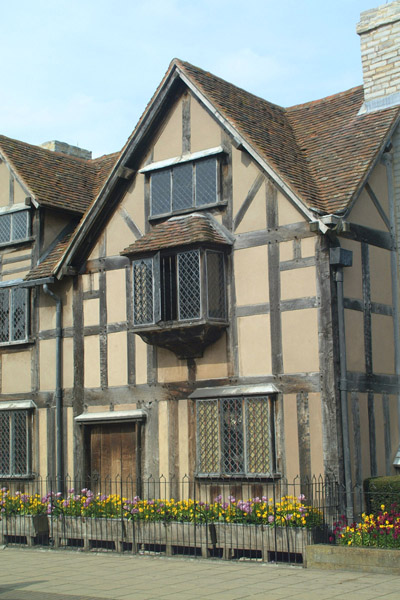
This is a photo of William Shakespeare's Birthplace, Stratford upon Avon.
The photograph is from www.freefoto.com
These notes on the Medieval Theater were taken from the book The Dramatic Story of the Theatre, by Dorothy and Joseph Samachson
An early morning Easter play performed in England circa 975:
Candles lighted the church. For the introduction to Mass there is a chorus of angels and three singers as Mary. Sung in Latin. The idea spread to other churches. By the 14th century dramatization of Biblical stories was common throughout Europe and performed in the different languages of the nations.
Two types of dramas:
The dramas based on the �holy mysteries� of the Bible were called mystery plays. The dramas about the miracles of the Saints were called miracle plays. Most of these plays included some comedy.
An example of a church play:
The Second Shepherd�s Play: This was an account of a group of shepherds honoring the birth of the Savior. This group included a non-believer named Mak, who was a thief. He stole a sheep and his wife hid it in a cradle and covered it, pretending that it was a baby. The other shepherds searched for the sheep and to deceive them the woman sang a lullaby to the stolen animal:
I pray to God so mild,
If ever I you beguiled,
That I eat this child,
That lies in this cradle.
The sheep is discovered and Mak is beaten.
Over the centuries the length of the plays increased and they also became more elaborate. The plays also were performed on church steps, then on church property, and finally in the largest square in town. This was more so in France and in Germany where the Passion Plays were more elaborate than in England.
By the time the 15th century rolled around the plays were often performed over several days. This included an increasing number of characters and costumes. There were also stage props such as wind and thunder machines for visual and sound effects. Birds and animals were also used when telling the story of the Creation.
Going to Hell?:
If you�re going to tell stories about the good and the evil sooner of later the subject of hell is going to come around. Hell was portrayed as frightful as possible, because some people don�t want to do the right thing and to get them to reform you have to scare the crap out of them. The entrance to hell was a mouth with large jagged teeth. Once in hell there was smoke and flames and, of course, devils that jabbed the doomed with their pitchforks.
But just like watching television and going to the movies, the evils of man and his doom portrayed in these church plays were the more interesting and more fascinating than anything else performed on the stage. Sensing the appeal of hell the actors and playwrights embellished these scenes and added a certain level of vulgarity, making the church plays into more of a farce (sort of like watching the average sitcom on television). The church got wise to this, however, and most instances were stopped.
Another type of play is introduced:
In the 14th century the morality play made its debut. This was designed to teach proper conduct to the audience. Its character included such themes as Pride, Gluttony and Envy. There were also virtues. Over time these some of these plays also took days to complete.
The shorter ones that lasted less than an hour were given as interludes between the miracle plays. One such famous morality play, Everyman, survived the ages and has been performed on modern stage.
William Shakespeare based some of his characters on these earlier plays. The devil�s helper, known as Vice, was dressed in a fool�s outfit and carried a wooden sword. This was the forerunner of Shakespeare�s fools, and there are other of his characters that had their beginnings in the morality plays.
As the plays grew in size the associations of small craftsmen known as the guilds ran them. These were performed in squares outside the churches, as pageants on wheels that were pulled on horse-drawn wagons.
The appeal of the theater led to the increase of minstrels, who added plays to their repertoire. The performed in public squares, barns, manor houses, and sometimes in the yards of inns, groups of building that encircled the courtyards that were the forerunners of the theatre building that Shakespeare�s plays were performed in. They stood on platforms that were placed on barrels. They collected their fees just as the climax of the play was about to begin. Also traveling with the minstrels were gambling devices fixed to cheat the players and there were also pickpockets who traveled along with the minstrels.
The upper class, which considered itself to be too dignified for the aforementioned forms of entertainment had what was known as court dramas. They had their own poets for these performances, with actors performing as gods and goddesses and kings and courtiers. These plays were the re-telling of the ancient mythological tales or ancient Greek history.
Thomas Sackville and Thomas Norton wrote the first English tragedy, Gorboduc or Ferrex and Porrez, circa 1561. Nicholas Udall wrote the first English comedy, Ralph Roister Doister, circa 1550. A few years later Gammer Gurton�s Needle was written, the author uncertain.
Commedia dell� Arte
This was the comedy of the art, the Italian Comedy or the Improvised Comedy.
An Italian Public Square circa 1600: In the midst of the shops and merchants the crowd gathers around a six-foot high platform on which the performers were to entertain the audience. Preceding the main act is a pair of jugglers with plates and balls.
Behind the platform is a curtain on which is a charcoal sketch. Men and women actors perform the comedies; most of the men are wearing cloth masks that cover the face, but not the jaws.
The troupe consisted of about twelve performers. Some of the main characters were:
Pantaloon: a silly easily fooled old man.
Harlequin: a shrewd and tricky fellow.
Corneto (or Zany Corneto): a clownish fellow.
The Doctor: Pantaloon�s friend. He uses multi-syllabic words he is unsure of and is not aware that he is stupid.
The Spanish Captain: a fierce braggart who is really a coward. He sometimes gets a beating from Harlequin.
These plays were improvised; the troupe manager presented the performers with only the plot. The performers, knowing their character�s traits and habits made lines up as the play progressed and also resorted to the lines and speeches recited in earlier plays. The performer played one character for life, which helped him with his improvisation and his memory of previously spoken lines. Also included in the act were singing, music and acrobatics.
These plays could be bawdy riots at times and their fame spread throughout Europe, replacing even the court theatre of the upper class. At first the Church denounced them, its actors being denied burial on consecrated grounds. Buy over time the Church changed its opinion. This art form lasted for a few centuries, reaching its peak in the 16th and 17th centuries.
London, The Globe Theatre, 1603, the Elizabethan period:
The actors stood on a platform that reached into the pit of spectators. The performers projected their voices as loud as possible in order to accommodate the entire audience. There were no women performers; boys performed the roles of the female characters. Without masks the art of facial expression of emotions developed.
Spectators stood, their heads on level with stage floor. Upper classes seated in the galleries that stretched all around the theatre. In other theatres the upper classes sat on edge of platform. Food is sold during the performance.
To the rear of the stage on both sides are doors that lead to dressing rooms. There are several stages in the Globe Theatre. An inner stage was used as a den or a study; an upper stage was used when it was necessary to depict the walls of a city, the deck of a ship or a balcony. There are bay windows on either side of this particular stage.
When the spare stages are not in use they are covered with a curtain.
The stages are furnished with hangings for scenery and props. To keep the audience aware of any changes of location during the play, there are signs on the stage indicating the locations of every scene. For scene changes during an act either the sign was changed or the actors moved to another stage or another section of the platform.
There was a covering above the stage, but the audience is left to the elements. A flag flew over the Globe Theatre when a performance was being held.
William Shakespeare (1564 � 1616) (Too many works to mention here)
Christopher Marlowe (1564 � 1593) The Tragical History of Doctor Faustus
Ben Johnson (1572 � 1637) Volpone; Bartholomew Fair.
Writing styles: prose and blank verse, which is poetry without rhyme used for emotions too lofty or exaggerated for ordinary speech. Bombastic speech and melodramatic action permeated the performances.
Soliloquy: talking directly to the audience.
Asides: when a character addresses the audience without the other actors �hearing� them speak.
There was some fame and fortune for actors, but most are set in a low social position. [In Roman times actors and athletes were considered the lowest professions. I think if the Romans were alive today they would think that we were the pagans.] Playwrights also were not respected. In attempts to improve their social standing, the playwright sometimes flattered kings, queens and nobles, gave support to certain political ideologies and insulted religious groups.
Paris, 1659
Most theatres were converted tennis courts with a stage at one end decorated with meager scenery. The seating was not very good for those placed in front of the stage or those seated in the balconies along the sides of the court.
Moliere (1622-1673) was considered the greatest comic dramatist since the ancient Greeks. Learned from the Commedia dell� Arte. Ridiculed the ruling class, doctors, and merchants, all except the king. His Tartuffe brought the wrath of the French clergy, banned five years.
Other plays by Moliere include:
The Imaginary Invalid; The Forced Marriage; The Bores; Love as a Doctor; The Doctor in Spite of Himself; The Learned Ladies; The School For Wives; The School for Husbands; The Miser; The Would-be Gentleman; The Misanthrope.
Other French playwrights:
Jean-Baptiste Poquelin, The Learned Ladies, which ridiculed upper-class women snobs.
Pierre Corneille (1606-1684) Le Cid
Jean Racine (1639 � 1699)
Corneille and Racine patterned their plays after Greek tragedies.
Spanish playwrights:
Lope de Vega (1562-1635) wrote 1500 - 2000 plays.
Calderon de la Barca (1600-1681)
The Sheep Well:
This is De Vega�s play about the inhabitants of a village who kill their oppressive lord. Suffering through demands and punishments to name the guilty persons they only name their village, the Sheep Well. The king intervenes and spares them.
