When Rome was destroyed most of the knowledge of the previous centuries was lost for 100's of years. Gone was the wisdom of the Greeks and the ingenuity of the Romans. This period of stagnation is known as the Middle Ages (or dark ages), and it lasted from about the year 450 to 1400.
The Arabs, who translated Greek writings, had an edge in education during this period. In the mid-12th century, European scholars translated the Arabic writings on medicine, arithmetic, geography, astronomy and science. This led to an increase in knowledge and lead to the period of time known as the Renaissance.
The migrating Germanic and Scandinavian peoples, who spread from northern Europe southward, westward, eastward had much to do with the darkening and the awakening of Europe. The Germans, French, English and Italians would become leaders of the Renaissance, which spanned from the 14th to the 16th centuries.
After the Germanic tribes sacked Rome, later migrations (under various names) of the Germanic/Scandinavian peoples went into England, Ireland, France, Russia, Italy and Spain. While there was little increase in knowledge in Europe or anywhere else in the world during these years, there was a conversion of the European peoples to Christianity and this helped somewhat, taking some of the edge off of these peoples. It is sad to say, however, that there was little understanding and obedience of the true Faith. The religion they had was pray today, kill tomorrow, plunder the next � hardly Messianic. Even though most of the Europeans were subject to fear and oppression by their kings, barons, the Catholic Church and Viking and Arab raids, there were some bright spot in the midst of all this, although enjoyed by the few.
The following is a list of some import men and advancements made throughout the middle ages. Following this is a similar list concerning the Renaissance, which began in the 15th century. While it won't be as impressive as computers, cars and sending men to the moon, the Renaissance was the starting point for the progress that followed.
10th and 11th centuries:
Venice and Genoa, Italy are involved in trade between Asia and Western Europe. Oxford and Cambridge Universities (England) studied medicine, and medicinal study established in Salerno, Italy. Genoa, Venice, Pisa and Naples traded with the Arabs during the Crusades. Slaves, weapons, lumber and hide to Egypt for jewels, ivory, spices and silk.
12th, 13th 14th centuries:
Arabs living in Spain during the 12th century reintroduced the astrolabe, an ancient astronomical �computer� invented by the Greeks in 200 B.C., to Europe. There was also a mariner's compass in use in the 12th century.
1202: "Arabic numerals" to Europe (the Arabs got this numerical system from India in the year 814).
Paper was introduced into Italy and Spain (the Arabs learned how to make paper from the Chinese in the year 712).
Colleges, universities and cathedrals were built throughout Europe.
The fork was invented in Italy (or in France). Until the fork was made, meat was secured with a piece of bread (or a napkin) and cut with a dagger.
Salvino D'Armate invents spectacles (circa 1290).
Roger Bacon (born 1214 died 1294):
Bacon excelled in science, philosophy and mathematics. Experimented with gunpowder. Was similar to Leonardo da Vinci in imagination: dreamed of spectacles, flying machines and motorized ships. His writings on wisdom and faith led to accusations of heresy and several years of imprisonment.
Marco Polo (born 1254 died 1324):
A Venetian, Polo was important for trade and progress.
1260: When his father and uncle were returning from a trading mission to Constantinople, a war being waged forced them to reroute their trip. This took the to Kublai Khan's eastern capital.
1266: When they returned to Kublai's kingdom, they took Marco with them.
1271: Marco conducted business for the Khan covering North China, Southeast Asia, which included India. He even ruled the city of Yangchow, China.
1295: Marco returned to Venice.
The Bubonic Plague (a.k.a. the Black Death):
1347-1351: Fleas from Asian rats strike throughout Europe. The plague killed 1/3rd of the population of Europe, about 75 million people. This first brought on economic crisis � a shortage of manpower caused crops to rot and land was not cultivated. After this, however, fewer peasants meant fewer laborers so the survivors sought better treatment and higher wages. Parliament then sought to fix wages and prices to the pre-plague rates. This failed and, along with a peasant rebellion in 1381, brought on the end of serfdom.
"My favorite composer is JavaScript Bach!"
The later Renaissance years gave us ballet (Italy and France) and opera (Italy), and Classical music would soon become the most creative, beautiful and intelligent art form ever invented. The clavichord and harpsichord were in use since the 14th century. The harpsichord was the forerunner of the piano (Italy) (1709-1731). For many centuries there were stringed instruments played with bows. The early form of the violin was around in the 1400's, and came near to its present form in the 1500's (Italy again � while much evil and oppression came from the Church at Rome, there would be little culture and civilization without the contributions the Italian peoples made to music, art, food and science). As far as the organ is concerned, the ancient Greeks invented it possibly before 100 B.C.
The following is a list of some important men who lived during or just prior to the Renaissance.
John Wycliffe (1330-1384): Forerunner of the Protestant Reformation who opposed the Catholic Church.
Jan Hus (1369-1415). Same as Wycliffe. Was a martyr.
Johann Gutenberg (1396-1468): the inventor of the European version of the printing press.
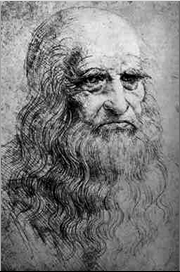
Leonardo da Vinci (1452-1519) Artist, sculptor, architect and scientist. Drew sketches and plans for such things as the helicopter, parachute and machine gun.
Nicholaus Copernicus (1473-1543): Astronomer who concluded that the earth moved around the sun.
Martin Luther (1483-1546): Started the Protestant Reformation and led many away from the oppressive Catholic Church.
Hugh Latimer (1485-1555): Protestant martyr.
William Tyndale (1494-1536): Protestant martyr.
Tycho Brahe (1541-1601): Astronomer.
Johannes Kepler (1571-1630): Astronomer and mathemetician.
Johann Lippershey (?-?) Inventor of the telescope.
Galileo Galilei (1564-1642): Astronomer and physicist. Invented the astronomical telescope. Made astronomical discoveries and proved the Copernican theory.
William Shakespeare (1564-1616): Dramatist and poet.

.
.
.
.