Pirates:
As long as there have been things to steal there have been thieves. Some thieves operated on land and others operated on the seas. So as nearly as long as there have been boats transporting cargo, there has been Arab, Asian and European pirates. Piracy has been recorded as far back as 2,000 B.C. when the Phoenicians ruled the seas. Piracy was also seen in and Greeks and Roman times and after this (as far as Europe is concerned) came the Vikings and the Arabs.
There are still pirates today, poor, unscrupulous people sailing the islands, looking for plunder.
Due to Hollywood, the pirates of the 17th and 18th centuries have had an image makeover. A well-groomed actor like Erroll Flynn could not offer a true portrayal of a pirate fiend and a movie like �Abbott and Costello Meet Captain Kidd� made the pirate king seem incompetent and a loveable oaf. Another thing that might soften our opinion of them is that the kings and queens, whom the pirates stole from, could be as greedy and merciless as they were. But this does not make pirates any better than what they actually were. They were thieves and murderers.
If you still aren't convinced that pirates were bad guys (and gals), just look at all the words that can be found in the word "pirate": irate, rat, ate, te! (I had to look this up, but �Te� is the abbreviation for the chemical known as tellurium, which is usually found mingled with SILVER and GOLD!) Therefore a pirate was (an) irate rat (who) ate te � an angry, contemptible person who devours other people's riches!
Sea-codes:
Rhodian and Bascilican codes of the later Roman Empire were known in the early middle ages in the sea laws of many Italian maritime towns (Venice, Genoa, Pisa among them).
Those who invaded and conquered this region since Roman times did not diminish from these valuable sea-laws or add to them. These rules covered such things as collision, shipwreck, piracy, salvage, insurance and many other subjects. These codes then spread to France, Spain and northward.
Other sea-codes:
The Judgments of Ol�ron: an influential code for seafarers from an island trading-town on the west coast of France. Possibly dated as far back as the 11th century. This code was later adopted as laws for Brittany, Normandy and England and the Netherlands, where it was known as the Sea Laws of Flanders.
In the Baltic there were the Town Laws of Wisby and the Law of L�beck that the later sea-law of the Hanseatic League was based on. The Consulate of the Sea was from Barcelona.
In 1259, L�beck, Rostock and Wismar had an agreement that any of these cities which allowed known pirates or robbers to dispose of their goods in it would be considered of equal guilt with the outlaws. Following this there were similar agreements made to protect merchants from pirates and other thieves. Over the following decades these laws were applied throughout North German towns.
Some instances of Medieval Piracy or conflict over sea-trade:
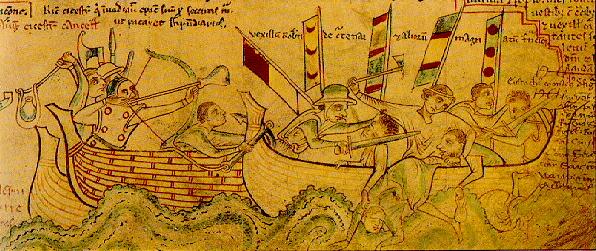
In 1217, after young Henry III became king, his main men William Marshall and Hubert DeBurgh defended his kingdom. While Marshall, Ranulf de Blundeville and French mercenary Falkes de Breaut� fought the invading French knights and soldiers on land, De Burgh and King John�s illegitimate son Richard Fitz-John routed the French reinforcements at sea at Sandwich, defeating naval captain Eustace the Monk, a French mercenary and probable pirate, who was executed and his head exhibited on a spear.
The Hanseatic League, formed in the 13th century, was created partially to provide mutual defense against northern pirates roaming the North and Baltic seas.
In 1319 an agent for a Venetian merchant was either murdered by his English crew or died on ship, and the crew took the wool on board and sold it. The English king made recompense. A few years later, after Venetians and some Englishmen had a "rumble" on English soil, two Venetian ships were plundered. There were also disputes in 1370 and 1374, concerning goods seized by Englishmen. Because of problems like these, oarsmen would even be denied shore leave to avoid altercations and problems between nations.
The English once ordered a fleet of galleys to "strike their sails". When the Venetians refused, the English attempted to board the ships. The Venetians then battled the English sailors, eighteen Englishmen were killed and two Venetians. The English King decided that sailors were to bear their own losses and the matter was closed.
Venetians and other foreigners suffered abuse in these instances, and others, including the English rebellions in 1381 and 1456. The Venetians, Genoese, Florentines and Luccans deserted London and for a period of time set up shop at Winchester.
The "great galley" ships were introduced circa 1290. They were 120 to 150 feet in length. Could sail a crew of over 200 men. There were 20-30 bowmen, and the oarsmen were also armed, all to defend against pirates and hostile merchantmen. The Italians were the first (at least in Europe) to equip their ships with cannons. This was done by the Genoese in the early 14th century.
Members of the Ottoman Turks also had their pirates in Europe. Turks in the early 14th century were not only known as pirates in the Aegean but as merchants, invaders and mercenaries as well.
Handicaps of Colonial Overseas Trade: Along with detrimental trade acts, a chief obstacle to overseas trade was piracy (robbery committed by ships of friendly nations). Henry VIII passed an act in 1536 that provided for pirates to be tried in England before a commission. Also a problem was privateering (authorized attacks and seizures of enemy ships in wartime).

"Pirates spent some of their ill-gotten loot on liquor and carousing. They also did quite a bit of dancing, making them the first to shake their 'booty'."
Links to other medieval pirate sites:
skullcrossbones
kumc.edu
