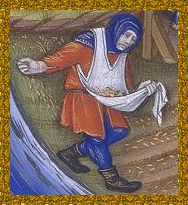
When Duke William of Normady became king of England the defeated Anglo-Saxon population became his peasants and serfs, bound to the land of the Norman barons.
The Peasants and the Manor:
The peasants lived on their baron's property which was called a fief. There were about 28 cottages on either side of the road in the peasant's village, about 150-190 inhabitants, and their church was in the center of the village. The baron's manor house was placed far away from the peasant's village. Also on the fief were workshops, barns and a mill.
The peasant's cottages and the property that accompanied it were called a toft. The toft land was used for light gardening. The larger fields that were given to the peasants were called crofts. This was used for growing grains and beans. In return for their humble abodes they worked in the baron's fields, gave of their harvest and paid dues.
The free families or freeholders were tenants of the baron. They paid rent and like the peasants they sometimes worked on the baron's property (also called demesne land) for a few days or for a fixed number of sheaves of corn or head of poultry at harvest or Christmas.
The peasant's beds were pallets of straw or bags of dried ferns or heather. They slept in their day-clothes and used animal pelts or their cloaks for covers. Their cottages were made of thatch and wattle. Thatch (dried reeds) for the roofs and wattle (wood poles and woven sticks and branches with straw in between) for walls. The outer surface was a layer of mud, straw and cow dung. The outside walls were whitewashed. The peasants also kept stacks of manure near their cottages for use as fertilizer.
The cottage had one room, and the hens and livestock were kept inside at night. Some of the better homes had two rooms, with a bedroom (or bower). They cottages did not have chimneys; the fire was contained in a clay-lined pit in the floor, the smoke escaping through windows doors and crevices. Bathrooms were earth closets or a pit. Dirt floor, muddy and wet with rain and the rushes on the floor rotted. Furniture: boards on trestles, tree stumps for stools, wooden bowls, plates (or trenchers) and spoons; their daggers were used as knives. They also had a cupboard, bench and a trunk.
The peasants provided for the baron's knights, who were free men. The villeins were not free, so they could not move, sell livestock or marry without the baron's permission. The poorest, called cottars, only had a garden and no land in the field. Old widows and spinsters lived with their families. Alewives and some widows lived alone. Some villagers were employed as servants and hired others to tend their land. Peasants owned oxen, cows, pigs, beehives, hens, geese and ducks. They also owned a few dogs each. Cats roamed freely. Dogs were "lawed"; their front claws were cut. Peasants were not allowed to hunt; a peasant killing a deer was likened to killing a man. There was a nightly watch-and-ward; all suspicious travelers were apprehended after nightfall. Peasants were also known as villeins or bordars, the poorest called cottars or serfs.
Peasant's clothing:
The peasants wore a blouse of gray or blue-colored cloth or sheepskin, leather belt, woolen hosiery, woolen caps and wooden shoes. In winter a thick, woolen mantel and heavy leather boots. Women wore dresses of similar color and material.
Peasant's diet:
The peasants ate mostly vegetables: onions, cabbage, garlic, radishes, beans and peas. Some beef, fowl, bacon, fish, cheese, butter and milk would be consumed. They also ate oatcakes and rough, black whole-meal bread. In winter they ate salted meats, bacon, pea and bean soup, pease (pea) pudding. In the early spring the flour bins and the food supply was low. Some peasants poached hares, rabbits, pigeons, eels, fish and singing birds. They owned one or two apple trees and collected nuts from the woods. Drank ale and cider. The poor drank perry and "October brew". Perry-white from pears was mixed with cheap ale and sold in taverns.
Chores:
The peasants would rise before sunrise and do their chores, then eat breakfast. They did all the work on the fief, the baron's field taking priority over their own. Planted wheat, barley, oats and rye. During the winter they cleaned ditches, gathered wood, tended to the animals and made tools. They also repaired and constructed barns, sheds and fences, and made ricks (piles of firewood) until harvest. Women spun wool, flax and tow on their distaff and spindle, and embroidered, sewed, made baskets and clothes, knitted, weaved and made tapestries. They also worked in the field during harvest.
Peasant children did not go to school. They collected nuts and berries, weeded the fields, picked stoned from the fields and chased the birds from the fields also. The peasants plowed the fields with the oxen and when they got old (the oxen, not the peasants) they were used for leather and meat.
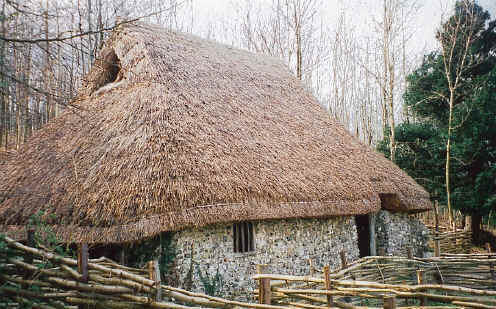
From the Weald and Downland Open Air Museum
a Medieval Cottage (13th century) from Hangleton, Sussex
taken from www.wealddown.co.uk/
Manor Court:
Peasants had no rights when it came to the barons, but had rights against each other. Met twice a month in winter in lord's hall or under oak tree in the summer. The steward presided and the clerk was the scribe. Covered in the court were things like land transfers in the family, the buying and selling of land, marriages, collection of dues, thievery, assaults and poaching. Also heard the reeve's reports on misdeeds and fines were given out.
Payments made by peasants:
Tallage paid at Michelmas (the feast of archangel St. Michael) for land use.
Incoming tallage for new lord.
Heriot tax��the death tax. When villein died his best cow was taken. If he was poor, the baron took his best possession.
Mortuary��second best beast given to the priest.
Merchet��a fine paid on daughter's marriage.
Relief��man takes over father's or widow's land.
Wood penny��to collect dead wood in the forest.
1/10th of wheat crop.
1/16th of flour.
Newborn animal out of ten to church.
Eggs and hens at Christmas. (The barons told them it was better to give than to receive.)
Eggs and hens at Yule.
Fine if son becomes a priest or monk.
Fee for grinding wheat.
Fee for baking.
Money taken when beast was sold.
Fee when son (of baron) was knighted.
Peasants could also buy their freedom.
Some of the hardships of the peasants:
Bound to the soil and sold with the estate.
The barons would ride through their fields in pursuit of game.
Children of slaves (serfs) could be taken from parents and sold.
If the baron had company, the village provided for the food. This could starve a whole village. For example:
King Richard II and two other lords and their retinue consumed 120 sheep, 16 oxen, 152 pigs, 210 geese, 900 chickens, 1,200 pigeons, 50 swans, 11,000 eggs, 130 gallons of milk and cream.
If a baron was at war with another lord he could force his villeins into duty. They was a chance that some of the peasants would be killed or mutilated, and since their cottages were outside the walls surrounding the baron's manor house they were often looted.
Peasants were not "law worthy". They had no defense in royal courts.
