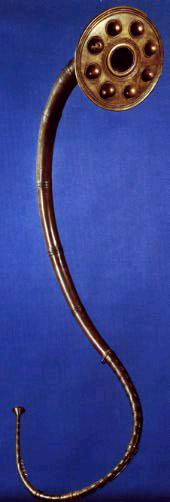
This is a photo of a Danish lur.
credit for this photograph goes to:
NATIONALMUSEET / THE NATIONAL MUSEUM OF DENMARK
www.natmus.dk
Chapter V
The Iron Age:
The Bronze Age came to the abrupt end in Norway and elsewhere in northern Europe. The reason is yet known [at least at the time this book was written]. One theory is the change in climate, more humidity, rain and snow causing depopulation of agricultural areas. Iron did not fill the void. No votive offerings, no hoards or huge burial mounds. Rock art practically ended.
The Pre-Roman Period (5th c BC to 1st c AD):
Information on the early Iron Age has been gathered from the finds in cremation burials and in flat graves. The bodies were burned on a funeral pyre. The charcoal, earth and bones were then cast into a hollow in the ground or placed in a vessel made of wood, bark or clay. Many graves were covered with stone slabs. In the west the burnt bones were placed in an urn and put in a small cist.
Cremation pits: Less than 20 inches across, 8 to 20 inches deep. Covered with stone slabs or placed beside a small boulder. Sometimes circles of stones were set around the graves or the graves were paved over. In many cases the flat graves were located together forming cemeteries, a common practice east of the Oslo Fjord.
The Early Iron Age contains little grave furniture. The few finds include pottery, iron and bronze brooches, neck rings, iron fibulae and buckles and belt rings of bronze and iron. Also sickles, curved knives and awls of iron. Grave-customs shared in eastern Norway and Germany and southern Sweden. Only a couple of spear points and swords have been found. Eastern Norway was influenced by Bornholm and eastern Germany. Western Norway was influenced by northwest Germany and Jutland.
The Roman Iron Age (Circa 1st to 4th c AD):
The use of iron and agriculture became dominant. More land was settled in Norway and more contacts were made with the rest of Europe. Iron Age culture reached north of the Arctic Circle. There were also an increasing number of imported goods.
Two factors in Norway's expansion at this time was the learning of how to smelt iron, and contact with Rome-influenced Europe that enabled the buying and selling of goods.
Burial custom remained on the ancient traditions, but were modified somewhat by Scandinavian and European ideas. A new look was more grave furniture and a more imposing monument. Often the dead were inhumed though most were still cremated, the remains sometimes stores in clay urns. Large cemeteries were formed where some of the cremation burials were surrounded by either a triangular, rectangular or circular stone edging. These graves frequently contain more than one burial.
Those finding their wealth by trade had a different approach to burials. There was more grave furniture and these along with the bones of the deceased were often placed in a bronze urn or a fine clay vessel. The site was also marked with a large earthen mound, a cairn or huge stones. When the dead were inhumed the grave might have been sunk into the ground or a wooden coffin or a stone cist was used. Most graves of this sort were also marked with a monument.
The weapon-graves of warriors are found mostly in eastern Norway. Warrior graves are located at strategic points along the coast and in good agricultural districts inland and near routes to the hunting grounds.
Many of the weapons were imported from Germanic peoples. Found in the graves were short, broad single-edge swords (based on the Roman gladius), one or two spears and a thin, wooden shield. Over time, a long, slim double-edged sword (based on the Roman spatha) replaced the single-edged sword.
The spear also changed its appearance, becoming more a Roman-like weapon, long and with barbs. They also carried a heavier leaf-shaped lance. The earlier shields were thin and made of wood. Later shields were also light and either round or rectangular. Some were covered with leather and a few were decorated with bronze mounts.
In the better weapons the sword hilt and the shield boss were bronze or covered with silver sheet-foil. Spurs also bronze and sometimes with silver sheet.
Imported goods are many, such as ornaments and glassware. Glassware: shallow bowls, drinking horns and many tall beakers. Bronze vessels: bowls, ladles, cauldrons and buckets. Round-bellied cauldrons known as �stlandskjele were made in Italy and then in Gaul. Another large bronze vessel was the Vestlandskjele also from Gaul; its shape was low and wide.
Four graves in particular:
Grave # 1:
Found in eastern Norway in Stabu, 75 miles east of Oslo. A warrior's grave with two swords, five spears and two shields from 2nd c. AD. One sword with the initials SF in Roman letters and decorated with a bronze inlay representing Victory. One spear has (possibly) RAUNIJA etched in runic on the blade.
Grave # 2:
Found at Avaldsnes, a harbor on the southwest coast. Situated in an excellent location, it was a stop for merchants from the north, west and southwest. In this grave is a man's body, fully clothed and buried in an oak coffin. With him were a shield, a sword and two lances. The sword had a silver pommel. The scabbard was leather covered and decorated with plates of silver, some gilt. The boss of the shield, tapering to a point, was iron and partly covered with silver sheet-foil. Also an arm ring of gold, four gold finger rings, a tin-plated bronze mirror, a pair of bronze scales and thirty glass gaming pieces. A large hanging-bowl of bronze, a bronze bucket with a twisted handle that was decorated with silver inlay and a bronze sieve all came from Rome. Also found was a silver beaker and the rim mountings of a drinking horn.
Grave # 3:
Found on the island named God�y in western Norway, 200 miles north of Avaldsnes. On this island is a monumental cairn containing a cremation burial with the ashes in a Vestlandskjele. There were also two beakers of silver, a large arm ring of gold and a gold medallion. Also remnants of arrows and a comb made from bone. The medallion is a copy of a Roman type. On it is the portrait of Emperor Constans I (337-350) with the imperial charioteer on the reverse.
Grave # 4:
Located on the island of Steigen. The deceased had not been cremated. He was well armed and his clothing fragments were of wool. In the grave was a double-edged sword in a wooden sheath that was covered with leather and decorated with a U-shaped ferrule. Two spears, arrowheads and a shield. Also in the grave were a pottery vessel and a gold finger ring. There was also a shield that was painted red and blue and was with some silver-gilt. Dated to the latter half of the 3rd century.
Even in the Iron Age Norway's hunters were still making tools and weapons from antler and bone. There was a settlement on the western Norwegian coast at the mouth of a large cavern, Skjonghelleren, which provided such items. Found with the usual stone hunting tools were spindle whorls made from bone. Personal ornaments were also made from animal teeth. Some of the items in this site suggest that women were also present and that this site was more than a seasonal hunting camp. Spoons were also carved from bone.
The Migration period (Circa 400 to Circa 600 AD):
Homes and farms in southwestern Norway were isolated, not in villages. One to five homes to a farm for extended families, long rectangular buildings walls of earth and rubble. The roof was supported by two rows of posts; archaeologists are unsure how high roof was pitched. Enclosures surrounded the home, fields and graves. Walls were 3 feet thick and 5 feet high. Horses, cattle and sheep kept indoors during the winter in the western part of dwelling. Fires were set in the floor of the living quarters and cooking pits were sunk into the floor beside stone hearths.
Length of homes: 27 feet wide, 65 to 100 feet long, but as much as 300 feet. The area of the farms varied from 2 1/2 acres to 25 acres. Low stone walls surrounded the property and a fenced path lead to the house. The property was divided between pasture and agricultural sections. There is usually a group of tumuli within the enclosure. [Tumuli are large mounds of earth placed over a burial site. Some tumuli can also be of stone or are rows of stone placed in circles around a grave.] Grew wheat, barley and oats, but livestock was more important. The farms in Norway are similar to farms found in Gotland, �land, Bornholm and Jutland.
There is a group of homes also of the Early Iron Age that does not fit the mold; their origin and function are unclear. These complexes are arranged around small, enclosed open space. These long homes are a community of 15 to 20 buildings placed close to each other and radiating from the center. The gable ends were facing the center of the open space were either open or built of timber, the remaining walls were built of earth and rubble. These homes were also with hearths and post-supported roofs. Lacking, however, is a barn for livestock, enclosures and field complexes. The homes were located in densely populated, prosperous areas. The author theorizes that this could be soldier's barracks, escorts numbering a couple of hundred for the safe arrival of goods. These radial complexes are found in Rogaland and northern Norway.
Another settlement is located at Mogen by the mountain lake of M�svatn, not far from modern Rjukan in Tememark. Found was a house 25 feet wide by 40 feet long with a large mid section, its side walls of earth and rubble were slightly curved. Several hearths were once inside. Objects embedded in the earth floor were iron tools and weapons, finely decorated pottery, some jewelry and fragments of earth beakers. Slag from iron smelting also found. They were hunters, numerous arrowheads found. Bones in the refuse heap: 95% reindeer 3% domestic animals. Reindeer hides were Norway's one of their biggest fur exports during the middle ages, as it probably was earlier in date.
Grave finds of western Norway:
The largest numbers of graves that are found in western Norway are from the 5th and 6th centuries. Cremation and inhumation contain grave furniture. Stone cyst graves are several yards long, sometimes lined with birch bark or bear skins. Clothing remnants of wool, silk and linen. The deceased were often covered with woolen blankets. With them are a double-edged sword, two spears, a shield and occasionally a bow and arrow. Sometimes buried with a belt with metal mounts (to hold the tinderbox), knife, awl tweezers and other items. Merchants were buried with a small pair of scales and gold currency.
Other graves of the wealthy:
The Snartemo finds located in the county of West Agder in southwestern Norway.
Two graves producing double-edged swords with pommel, hilts and scabbards richly decorated with gold and silver. Same decorations are found on strap-tags and various mounts. Four gold rings, two glass beakers, five bronze vessels, and a pair of scales complete with a set of weights. Textile fragments also found [with, I guess, the same wool, silk and linen as stated previously].
Found elsewhere was a key ring and keys all made from bronze.
Women's graves contained much jewelry. Large, cruciform brooches and ornate "relief brooches" of silver, numerous smaller pins, buckles, rings and hooks.
In some areas the custom dating from the Roman Iron Age was to prepare a lavish table for deceased men and women containing a great number of eating and drinking vessels. Glassware and bronze cauldrons and dishes topped the table, although wood and clay items were more numerous. Also highly decorated bucket-shaped pots made from asbestos and talc.
Personal ornaments of the very rich were gold bracteates (amulets with a picture on one side). Originally copies of coins and medallions featuring the Roman emperor's portrait, the Scandinavians eventually re-designed their ornaments. Naturalistic features were stylized, and they incorporated magic symbols and runes. These bracteates would feature entwined images and designs.
During the Migration Period the artisans mastered their professions. Work in casting, repouss� (beating a pattern on the underside of a sheet of metal), chasing, (embossing on metal) engraving, granulation work and filigree (delicate ornamental work with intertwining wires of gold or silver) was at its finest. Wealth increased for the leading families and craftsmen.
Runes and runic magic: Runes were produced by the chieftain/priests and some of the symbols may have had a link to witchcraft. They were known during the Roman Iron Age, and were in common use during the migration period. Germanic peoples developed the runes and these runes made their way to Norway and elsewhere throughout Scandinavia. The earliest inscriptions date from the 3rd century AD, found in Germany and Norway. Borrowed from the Greek and Roman alphabets, the common German Alphabet had 24 runes.
Hill forts: Most are in east Norway, where over 200 once stood. Their construction and location are set by strict rules: Always on steep hills and approachable on one side only. Ramparts built at the access point were dry walled. They are large with low stone walls several hundred yards in length. Most forts were built in sight of its closest neighbors. In populous areas they formed a defensive network. Most forts stand in or near ancient settlements, especially areas greatly affected by the growth and development of the Roman Iron and Migration Ages. Some forts were in sparsely populated areas and were most likely frontier posts and roadblocks.
The hill forts were built during the Early Iron Age, the 3rd and 4th centuries. This was a time of unrest in eastern Norway; western Norway suffered the same warlike state during the 5th and 6th centuries. Warrior graves abound in these two periods.
Boats:
Better boats were needed due to the increased trade during the Roman Iron and Migration Ages. Remains of boathouses from this era have been found. Boats were also the theme of some burials. Boat burials were large stones set in the ground in the outline of a ship. The stones increase in height from the center stones to the largest stones representing the bow and stern. [A picture accompanying the book is of an 80-foot long boat grave. From this picture I estimate that the stones representing the bow and stern are 10-15 feet high and the smaller stones in the center of the boat frame are 3 to 4 feet tall.] There were also votive offerings of the sailing vessels themselves.
Votive offerings let in a bog at Kvalsund on the west coast.
The largest boat was about 60 feet long. Manned by pairs of oars and probably rigged for sailing. The eight strakes were in part lashed, in part nailed to the ribs. The boat had a true keel making it far more reliable on high seas than earlier Scandinavian sea vessels. The smaller vessel was a 33-foot long rowing boat. Funerary ships (boats that the deceased were buried in) were provided throughout Scandinavia, but most common in Norway.
Large, elliptical boathouses were raised for winter storage. Could be 100 ft long by 27 feet wide with low walls of earth and rubble that were paneled on the inside. Roof rested on the walls without support from posts. Ruins of hundreds of these boathouses have been found along the coast. Built from the Early Iron Age to the Viking Age and Middle Ages. The number of sea vessels and the improved navigational skills of the seamen led to expansion and the military and colonization of the Late Iron Age.
The Late Iron Age (Circa 600 AD to Circa 1,000 AD):
Many cultural changes occurred to the language, attire, beliefs, burial habits, warfare and the arms and armor of Norway. Technical innovations were in abundance and Roman influence had ended.
Late Iron Age graves from the years 800-900 AD. Grave mounds from the Late Iron Age, especially its last phase known as the Viking Age. Built of earth and rubble, they were circular and domed. Eastern Norway mounds could be as much as 100 feet in diameter and 13-20 feet high. Few cemeteries, the mounds are in small groups, as in one farm or family. Inhumation and cremation both practiced.
The providing of the dead with eating and drinking vessels of pottery, glass and bronze had ended. These items were replaced with increasing amounts of tools, driving and riding tackle and weapons. Glory in battle was the theme. Small farmers and chieftains were all buried with their weapons and the tools of their trade or their status symbols.
During the Merovingian Age (500 to 752 AD) and more so during the Viking Age (8th, 9th and 10th centuries) women's graves were abundant with objects reflecting work and pleasure. Along with her ornaments the deceased woman also "took with her" weaving implements and household utensils.
There was also something new added to the men's graves. Domestic animals, usually a dog and a horse, quite often made the journey to the great beyond with their masters. [The animals were sacrificed just as human servants have been. After all, how often does a man, his dog and his horse die in the same day? Maybe if they're standing under the same tree during a thunderstorm.] Along with warfare and travel, the horse signified social status.
Roman Iron Age: Permanent Iron Age population north of the Arctic Circle.
Migration Period: migrants moved further north and elsewhere. Merovingian Age: Norway inhabited to the nearly extreme north. At the End of Iron Age migrants brought the Iron Age all the way to West Finnmark. These settlers who arrived from the south shared northernmost Norway with the Lapps.
Late Iron Age and Norway's awakening and the establishing of themselves as a people and nation:
Swords and spears are still the tools of warriors, but the axe becomes a common weapon. Bow and arrows are popular though not as popular as the axe. Most weapons were locally made.
Smiths were buried with their tools: heavy tongs, hammers, smaller chisels, files and tools for drawing wires and forging nails. Also found was equipment for smelting and casting. These smiths also made equipment for horses and locks [and keys also].
Woodworkers: woodcarving, carpentry and boat building. They were buried with: scraping irons, plane irons, carpenter's axes, drills, saw blades, awls, chisels and other tools.
Agricultural tools found in graves: sickles, scythes, iron shoes for hoes, iron ploughshares.
Boats:
The Norwegians had developed their boats to near perfection and would soon find a new use for them. Boat burials: more than 100 found.
Travel by land:
Horse Gear: At least 1,200 graves contained the remains of harnesses and over 1,000 horse-bits. Also found were stirrups and spurs, including a highly decorated spur of gold. Travel on land was not only on horseback, but on wagons and sledges (or sleigh) as well.
The Osberg find:
This was the grave of a queen, that contained a large wagon, three sledges decorated with carvings and one ordinary sledge. Fifteen horses were buried along with her [obviously not all standing under the same tree]. Also with the queen were an ox, flour, grain and other comestibles.
The Viking Age:
The increase in trade, wealth and skills opened the eyes of the Norwegians. They wanted more and set out to sea, sometimes looking for plunder, sometimes looking for new lands to inhabit.
