This report is on the book titled Norway, by Anders Hagen. It is about the archaeological finds in the graves of ancient Norway from the Stone Age to the Iron Age. It is an interesting book, but not much fun. It is mostly about tools, weapons, housing, jewelry and rock art. Taking notes was a chore.
The people the author writes of are dead and he makes no attempt to bring them back to life. Looking back on reading the book I think this was the problem I had with it. It does nothing to stimulate the imagination. So I will try.
It is unfortunate, but these ancient Norwegians, like all other ancient peoples, were superstitious pagans. You can still see these traits in the primitive peoples living in the world today.
Music, dance and storytelling belong to all primitive cultures. The ancient Norwegians had drums and flutes of some sort. I don't know about stringed instruments. They probably danced about and sang songs about their weapons, hunting and the animals they hunted.
At night, under the stars and the northern lights, these Norwegians sat around the fire and told stories about the hunt, battles or their ancestors. They also told stories about their gods and magic.
For "religion" they relied on their shamans for their physical and spiritual well being. These shamans ingested hallucinogenic plants or drank some sort of potion so they could dream and see visions (or at least think they did). I guess that the shamans drew some or much of the rock art. The shamans also wore bearskins or deer pelts as they danced about, imitating the animals they would hunt.
Hunting was one of the more important things in the lives of these peoples. Therefore the fathers must have taught their sons how to make arrows, axes and other tools and taken them on hunting trips, the knowledge of one generation passing on to another. This to them was "quality time".
They believed in the afterlife, an afterlife in which they would resume being who they were and doing the same things they were doing as humans. Therefore they were buried with their possessions instead of leaving them to their children. These possessions have since been found, allowing archaeologists to gather a better understanding of the past and to allow me to add two more pages to my website.
The size and peculiar dimensions of Norway and the regional contrasts in resources, climate and flora led to its varied lifestyles and customs. A long and narrow stretch of land, Norway offered to its inhabitants coastal areas, islands, mountains, forests, valleys and lowlands.
The distance between north and south means that Stone Age and Bronze Age peoples could exist at the same time in the same �country�, the more advanced lifestyles in the south due to its contacts with the rest of Europe.
Game animals: reindeer, red deer, elk and bear, and also hunted were otter.
In the north, where large-scale hunting took place, hordes of animals were chased to the edge of a cliff, falling to their death (obviously not done with the otter).
Harvested from the sea: whales (small-toothed whales), porpoise and seals (harp seals). Also taken from the sea were salmon, cod, white fish, halibut, flat fish and shellfish. Birds and their eggs were also consumed.
The agricultural south had cattle, oxen, and sheep. Wheat, barley, millet and corn were grown. Dogs and horses were kept throughout Norway.
The era in human development known as the Stone Age is divided thusly: Paleolithic (or Eolithic), Mesolithic and Neolithic. Since progress affects some areas sooner than others the dating of the Stone Age is difficult. I�ll throw some numbers at you, but don�t swear by them.
Paleolithic: 2 million BC to 13,000 BC
Mesolithic: 13,000 BC to 8,000 BC
Neolithic: 8,000 BC to 1,500 BC
(If you don�t believe in evolution you�ll surely disregard the first numbers, unless you believe in the pre-Adamite theory.)
Tools are divided into two categories. Larger tools, such as axes, are called macroliths and the smaller tools, such as arrowheads, are called microliths. Basic tool shapes are blade, flake and core.
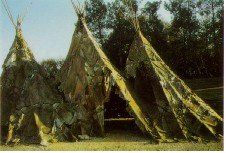
Reconstruction of hide covered Perigordian tents from Le Thot, near Perigord, France. About 33,000 to 20,000 BCE.
Photograph taken from: Stone Age Habitats
Thanks to: Dr. Wladyslaw Jan Kowalski
The Indoor Environment Center, Department of Architectural Engineering, The Pennsylvania State University www.arche.psu.edu/iec/wk.htm
Chapter I
The First Inhabitants
The earliest date for the settlement of Norway is during or towards the end of the last Ice Age, approximately 10,000 to 8,000 BC. There were Ice Age hunters who frequented the area. While they either set up temporary camps or sought temporary shelter in caves they never settled. By 7,000 BC the ice was gone and humans could populate the land with the mountain dwellers hunting reindeer and other game and the coastal dwellers fishing and hunting.
The H�gnipen Find:
The earliest signs of habitation are found in the forests east of the Oslo Fjord in �stfold, then much closer to the changing shoreline than it is today. These Stone Age settlements may have been established before 7,000 BC. In the three sites found (each site about 120 square yards) there is no evidence that they lived in huts or tents. But the site was paved with stones and rows of sloping posts indicate that there was a windbreak with the opening towards the sea allowing for seasonal residency.
[The author describes the time period that these inhabitants arrived in as �pre-boreal�. However, he does not adequately explain this. Pre-boreal more or less means �before north�. He is of the opinion that the first inhabitants were the descendents of Ice Age hunters, maybe this means they lived in temporary shelters while hunting in Norway before the north was completely free from ice, preventing permanent residence.]
These hunters had tools that were made of flint. The tools: axes, arrows, scrapers, knives, burins (for working antler and bone), borers (for drilling), microliths (tiny points of needle-shaped rock that were added to tools of bone and antler). Similar tools have been found in Poland, Belgium and Sweden, and of the Lyngby culture of Denmark.
The Fosna Complex:
Hundreds of settlements have been found that were settled by hunters and fishers of the Mesolithic era. This find is of seasonal camps of 1,000 to 2,000 square feet settled by hunters during the Mesolithic era, east of the Oslo Fjord. No traces of huts or tents have been found.
Tools made from flint and quartz. Scrapers (for preparing reindeer hides), small tanged arrows, burin (for working antler and bone), microliths (used as points and fixed to other tools of antler and bone), blade knives (usually with a curved back and retouch) and flake axes that were also common on the western Swedish coastline. Along with tools they had boats (hides stretched over a wooden frame). The Fosna Complex existed from about 7,600 - 6,200 BC. There was a culture at this time known as the Erteb�lle of Denmark.
The Komsa Complex:
About 100 settlements of this hunting culture have been found ranging from the coast of Finnmark (northernmost Norway) to the arctic coast of Russia. They lived in open camps and no traces of living quarters have been found. The people of this complex were dwellers of the coast. They were of the Mesolithic era.
Macrolithic (long stones) and microlithic tools and discoid nodules [unexplained purpose] have been found. Tools were made from quartz, quartzite, greenstones and other fine-grained stones. Tools are similar to the ones uses by the Fosna people. Some tools: tanged arrowheads with oblique edges, burins, curved knifes, scrapers, hand axes, flake axes and large scrapers. The archaic Komsa tools were in use as the newer implements (polished axes, re-defined arrowheads and pottery) appeared. Komsa influence did not disappear until 2,000 BC.
Two lesser-known cultures:
The comb-pottery culture: 3,000 BC, northern Finland.
Askola culture: Most settlements found near Helsinki, Finland. They were contemporary with the Komsa Complex.
The N�stvet Complex:
Named after a locality 12 miles south of Oslo. This was a coastal hunting and fishing culture that existed from the early to late Stone Age, (Mesolithic to the Neolithic eras, 5,000 to 4,000 BC). Evidence gathered of these people is from eastern Norway and western Sweden and also western and northern Norway. Finds are also available on B�mlo, an island located halfway between Bergen and Stavanger.
Tools included a pick-like core axe, hammer-stones and possible sledgehammers and wedges used in quarries to dislodge stones for tool making. They ventured to the islands for the stone, such as the tiny island known as Hespriholmen. Boats made of hide and wooden frame. Tools made from flint, greenstone and other local stones. Similar tools used in Sweden.
Chapter II
The Neolithic Age and the First Farmers
The Late Stone Age and Neolithic Farmers:
Villages were built in the north; hunters journeyed southward. Farming and stock-rearing societies developed. The first of the farming communities appeared near the Oslo Fjord. In Sweden were the huge megalithic stone graves. The Norwegians constructed flat graves. The votive offerings (objects dedicated for religious purposes), grave goods and hoards were common practices of the Funnel-Beaker Culture. Votive offerings of axes were either buried in the earth or sunk in water or bogs.
The forests had to be cleared. This was done by starting fires and the use of axes, as was done in Demark. Farming declined, however, giving way to the hunters once again.
The Boat-axe culture:
This group was the dominant of the agricultural Norwegians and Swedes. Left behind distinctive axes and pottery. Busied themselves with stock rearing and farming, but they also hunted.
The Pitted Ware culture:
This group was also found in Sweden and Denmark. Contemporary with the Boat-axe culture, they were hunters and fishers and may have combined cultures with them.
Settlements of these peoples were of family groups. Rectangular or oval huts post supported to roofs and walls were of wattle and daub. Some floors were paved with stone. Remains of wheat, barley and millet were found in what remained of the clay walls. Corn also grown. They raised cattle and sheep. Flint daggers and sickles found. Stone cists (in-ground tombs lined and topped with rock slabs) are also used along with flat graves.
Agriculture, stock rearing and forest clearing increased dramatically towards the end of the Stone Age. As far as the tools were concerned, western Norway was influenced by Jutland and eastern Norway was influenced by Sweden. Tools included fishhooks, bodkins (instrument with sharp point for making holes in cloth) and harpoons.
Chapter III
The Sub-Neolithic Cultures
Villages by the Varanger Fjord:
Settlements ranging from the coast of east Finnmark to the Russian border have been found. And by the Varanger Fjord, where the Arctic Ocean and the moorlands meet, the settlements are many and varied. Over 250 homes have been found across 6 miles of shoreline. Not all of these homes existed at the same time, however, most ranging from the Early Neolithic age to the Bronze Age.
From these communities are archaeological finds that allow for reliable chronological divisions.
Period I:
Cultural changes slowly develop on the Arctic coast. The people of this period still used archaic tools made with hard, coarse stone. But along with this were tools made from softer stone that was ground and polished. Heavy axes were also in use. Instead of the open camps of the earlier Komsa hunters, oval huts 10-13 feet across were built, with low earthen walls.
Period II:
The older tools, still in use at this time, finally give way to the new. Large spear points, long arrowheads, knives, scrapers and crescent-shaped tool are all carefully hewn and retouched, made from unpolished quartzite. Along with these implements are axes, chisels, knives, spearheads and arrowheads made from polished slate and greenstone.
The key feature of this period is the decorated pottery of the Comb Pottery people, an influence from Finland, circa 2,000 BC.
Period III:
Homes in the Karlebotn complex in the Varanger Fjord. Built by the sea with the entry facing the steep slope of land for shelter. These 40 oval huts were set in two or three rows, housing 200-300 inhabitants at a time. The settlement was 550 yards long. Inside was 300-square-feet of living space. Walls of earth and contained a hearth or two, but no chimney. Slate was the material of choice, thus the village belonged to the "slate culture" group, Late Neolithic.
Along with their quartzite tools were some polished tools made of slate and greenstone. Tools from this period are no longer fashioned in the ancient Komsa style.
Tools: long lances, slender arrowheads, knives, bodkins, etc.
Period IV:
The subject of this period is the Grasbakken settlement, located 6 miles east of Karlebotn. These homes were either oval or rectangular in shape. The homes were built half below ground level. The homes offered 400 square feet of living space with two stone hearths and earthen benches along the walls. The two hearths imply that there may have been two families living in the same residence.
Tools: harpoons, gaff-points (large strong hooks on a pole or spear for catching large fish), fishhooks, fishing spears, daggers, knives, arrows, bodkins, chisels, scrapers and needles. Bone was used to make fishhooks, combs and harpoons. Some bone implements were decorated and animal sculptures were found. Pottery with surface impressions made by textiles, dated about 1,000 BC. Similar pottery found Finland, north Russia and Sweden. Reliable boats were needed for whaling.
Skeletal remains of adults and children found in Varanger Fjord sites in graves and settlements are dated from 1,500 BC to 1st Century AD.
Slate Complex:
Circa 2,000 BC slate was the preferred material for tools. Some tools polished, as was also done in Sweden.
Pottery types were various: comb pottery, �asbestos� ware and textile-decorated wares. Found in all environments, mountain, forest and coastal ranging from Norway to Sweden, Finland and Russia.
Hunters in southern mountains had exploited the land more than the earlier generations. They founded settlements at nearly every productive lake and river, living in open camps and homes. Among their other tools were flint cores and grinding blocks. Some hunting groups fashioned their tools from quartz and quartzite. Along with hunting, the Stone Age Norwegians also skinned their prey and tanned their hides.
The Inhabitants of the Western Islands:
Some Norwegians got their food from the sea, filling their bellies with seal, whale and cod. On the islands on off the coast of Bergen their tools remain, such items as polished axes and chisels, arrowheads and pottery. This was a relatively permanent camp. Some bones of big-game animals have also been found.
Chapter IV
The Bronze Age
The hunters to the north remained in the Stone Age while the agricultural community in the south entered the Bronze Age (at the latest 1,200 BC?). The ritual rock art is the dominant archaeological material. Several thousands of images depict such things as boats, carts, and weapons, domestic and wild animals. There are also human figures in "stick" form.
Hundreds of earth-and-stone barrows have been found. Votive offerings also found. Used soapstone moulds for casting bronze weapons such as axes, daggers and swords, and the musical instrument known as the lur.
Three centers of the Bronze Age culture: the oldest was in the agricultural area of the southwest. Next was in the Oslo Fjord area. Third was in central Norway.
Southwest Norway:
The monumental graves near Stavanger and Jutland are located near the coast. Long burial chambers, often covered with stones, topped with a mound of earth. They can be up to 100 feet in diameter and 13-16 feet high. These are the burials of chieftains and men and women of wealth. The cists sometimes contain two bodies, and there are often geometric patterns carved into the square stones.
Grave goods found have been found:
The weapons left behind by the men are swords and daggers. Also found were razors, tweezers, awls and buttons. Remnants of garments made of woven wool.
Ornaments left by the women: arm rings, belt clasps, neck rings and brooches, imported from Danish workshops.
Votive offerings to a spring between Stavanger and Bergen:
The Axe Cult was a religion that called for sacrificial offerings of an axe or axes. The offering was of three bronze axes decorated with spirals, zigzags and other linear patterns from about 1,200 to 1,100 BC. Along with the offerings were probably religious festivals for sunshine, rain and good harvest. Rock art found nearby the offering.
The lur (lurer plural): Lurers were very large bronze horns (that is to say a musical instrument) that consisted of several long tubes joined together with ends curving left and right. Lurs were 5 feet 10 inches long and had a mouthpiece and a collar-like end. Used in religious ceremonies. There was a lurer cult that placed these instruments in patches of marshy ground. Many have been found in bogs and swamps in Denmark where the practice probably originated. About fifty of them have been found.
[Since the author, in my opinion, did not do a thorough job explaining the lur, I had to go Online for more information.]
With no finger holes the ancient lur produced sound in one pitch only, and a frightful one at that. Because of this it was also used to signal the onset of battle. It was also used by herdsmen and probably sounded at funerals. The lur can also be smaller and made of wood. These lurs are also straight, looking like a clarinet. It is still used today in Norway and Denmark.]
North of the monumental grave finds are cairns (raised stones used as markers for graves), sometimes containing grave urns and burnt bones. Some bronze objects and rock carvings seem to indicate that a mixed-culture Bronze Age existed, lagging culturally behind the south.
East Norway:
Bronze Age arrived later, 800-500 BC although some areas remained mired in the Stone Age. Burial rites, ceremonial sacrifices, and pictorial magic also seen in the east.
Chieftain graves: Cairns built over one or more stone cists, about six feet long; most round or oblong. The deceased were either inhumed or cremated. Constructed in a diameter of 65-100 ft and 13-20 feet high, and frequently located by ancient highways. Weapons in grave: daggers, swords, lances and axes. Since the men had to pay for these imported goods they are believed to have been fur traders.
Hoards and votive finds mostly imported from Denmark. Most common: heavy neck rings, ornate belt boxes, sturdy brooches and claps. Other items from beyond Scandinavia: Wendel-rings, swan�s-neck pins and certain swords from Central Europe. Some East Norwegian and Danish religious customs were similar. The goddess symbol was the neck-ring.
Not much is known about Bronze Age homes. A few small, rectangular house foundations with low, earthen walls have been found in southwest Norway. But it is believed that they had permanent settlements with homes and pastureland along with tilled fields.
In �stfold County:
Found was a hill-fort, standing stones, burial mounds and prehistoric agricultural fields where the same method of furrowing was practiced as in continental Europe. Same evidence of tilling also found Kvams�y in western Norway where agriculture was practiced for at least six growing seasons before elements forced the residents to move elsewhere.
Rock Art:
Rock art is pictures, hewn, incised or painted on any size rock or rock wall. Subject matter includes, humans, animals, inanimate objects, geometric patterns and non-figurative ornaments. Such rock carvings have been found in Denmark and Sweden [and by peoples all around the world].
The reason for rock art was ritual, a magic form of art. The farmer's goal was the fertility of the land, the seafarer to ensure fair weather and the hunter to gain power over his quarry.
Norway's rock art is divided by north and south or "arctic" and "south Scandinavian".
The northern art is regarded as the work of a hunting culture, the south farming culture.
The artwork of the north was created mostly during the Stone Age, but it is also dated from the Bronze Age also.
Some southern art is found up north. Some carvings particular to north are also found in south, central coastal and east Norway. In central Norway there are even examples of the two types of art in close proximity, even on the same rock face.
Northern art:
The arctic art is known as the hunter�s art. Considered mainly "Stone Age" work, carved into stone about the second millennium BC. Elk, reindeer, red deer and bear are the main themes. Seals, whales and fish are carved occasionally. They drew some boats and very few human figures. In some places geometric, checkered patterns, abstract linear patterns have been found. Also drawn are spirals, crosses inscribed in circles, labyrinths, certain boats and the sole of the foot, all these images borrowed from the south.
Southern Scandinavian rock art:
Began in Stone Age times though regarded mostly as Bronze Age artwork. The farming culture art revolves around fertility magic. Main images are of boats, human figures, horses, oxen, spears, swords, axes, bows and arrows; the plough, carts and wagons are also drawn. There are also geometric figures, spirals, circles, labyrinths, cup-marks, grid patterns and the sole of the foot. These drawings are considered to be of the Bronze Age and more modern than the ideas than the north. Rock art had mostly ended by the onset of the Iron Age, though it continued in some places in western Norway until the fourth or fifth century AD.
