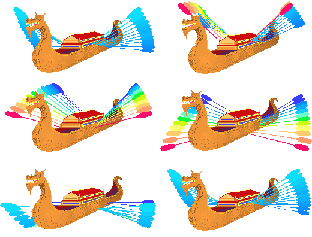
From the 8th century to the 11th century, Europe was plagued by Norsemen, who came from the north, Arabs and Turks from the south, and even by Hungarians, who came from the east.
The Norse Invasions:
The Scandinavians took three routes to either plunder or colonize:
Eastern route��From Sweden to Slavic territories and Russia, then southward to Constantinople. In Russia the Scandinavains became the Czars who ruled until 1917.
Western route��From Norway to Normandy, Ireland, Scotland (and the northern isles), Wales the Isle of Man, Iceland, and Greenland.
Central Route��From Denmark along the north coast of Europe, England, Normandy (France), Spain, along the Mediterranean, North Africa.
circa 790: The Vikings begin their raids on Britain, Ireland, Scotland, Wales, Spain and along the Mediterranean coasts, concentrating especially on Ireland and Britain.
832-870: Most of the damage was done during these years as monasteries are plundered, monks are killed and slaves are taken, sometimes sold back to the villages from where they were taken from. Some villages bought their safety. While taking plunder appealed to most Norsemen, many settled in Ireland and Britain instead, building towns and farming and trading.
860: Danes devastate East Anglia, Northumbria and Mercia. King Alfred of Wessex (from 871-899) was the only British ruler who was able to ward off the Vikings.
871-955: Alfred and his family ruled Wessex, England. He urged religion and education for the people of his kingdom, kept historical records and started schools.
877: Spared by storm that destroyed Viking ships.
878: Defeats Viking at the battle of Ethandune. Instead of killing his captives, he forced King Guthrum (of Denmark) and his followers to convert to Christianity and sent them home.
943-975: King Edgar of Mercia tried to unite the English, Britons, Vikings, Danes, Scots and Welsh. He failed and the raids continued.
1016-1020: Canute the Dane completes the Scandinavian conquest of England. He is the king of Denmark, Norway, England and Hebrides. After he dies his kingdom is divided among his three sons. Harold gets England, Sweyn gets Norway and Hardicanute gets Denmark. Harold dies, succeeded by Hardicanute. He dies and is succeeded by (Saxon) Edward.
By the 11th century the Scandinavians had converted to Christianity and the plundering from the north seas stopped.
The exploration of North America
986: Bjarni Herjulfson is credited with the sighting of the mainland of North America.
circa 1000: Leif Erickson explored the North American coast.
After this a colony existed in Newfoundland for a few years.
1004-1007: Leif's brother Thorvald explored North America's Atlantic coast.
1010-1013: Thorfinn Karlsevni took three ships and 160 men on a Alantic coastal exploration. May have sailed into the Hudson Bay.
Hungarian Invasions:
9th century: The Hungarians (a.k.a. Magyars) were horse breeders and warriors. They mixed with the Turks and set out from the Asiatic Steppes, raiding throughout Europe. While they sometimes hired themselves out as mercenaries, they mostly plundered, reaching as far as Germany, northern Italy and Gaul (France).
10th century: The Hungarians took money from conquered populations (Bavaria and Saxony) in return for safety. In 955 King Otto of East Francia, confronted and defeated a band of Hungarian raiders. Creates two marches in the Alps for defense (one of the commanders was named Ostarrichi, from where the name "Austria" comes from).
11th century: Like the Scandinavians, the Hungarians converted to Christianity, leaving the Arabs as the only threat to Europe (besides the kings, barons and the Catholic Church!).
