When William of Normandy became king of England his fellow Normans became the "nobility" of their new land. They were the barons who were given land and in return swore to defend William's kingdom. The "nobles" became rich and over the years they and their kings sought more wealth in Wales, Scotland and Ireland. Not as successful in these Celtic lands as they were in England, they had to settle for the east coast of Ireland.
Attire of the Nobility:
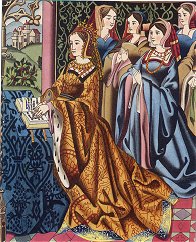
Brightness of color and length of clothing was a sign of status. Velvet, silks and furs were used.
Men wore: Tunics fitted close to the hips, reached the knees or ankles, secured by a belt. Silk hose and robes of silk and fur.
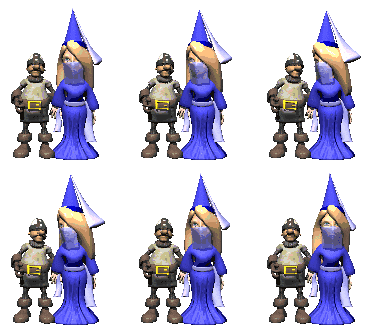
Women wore: Dresses with long, trailing sleeves with gold embroidery and pearl beadwork.
Mantle��A loose, trailing cloak, lined with fur and decorated with silk tassels.
Worn with a cape.
Pelisse��A long, fur-edged winter garment.
Underwear��made of white linen.
Headdress��Chaplets, worn on gala days, a thin, gold wreath of floriated design or studded with pearls. Women also wore brightly colored velvet or cloth bonnets. Some had flattened, square tops called mortiers. Braided hair intertwined with linen. During bad weather a chaperon was worn, a cape with a peaked cap.
Gloves��Made of chamois (soft deer leather).
Belts��Leather studded with jewels. Women's belts of linen or silk. Women also wore outer girdles embedded with agates or sapphires.
Outer girdles��embedded with agates or sapphires.
Purse��Made of silk held by silver chain at belt.
Shoes��leather or cloth, could be plated with gold or studded with jewels.
Also��Rings, jewels, brooches, gold pins, necklets, buckles and women wore mascara.
The Diet of the Rich:
Best food eaten, but the meats and desserts negated the nutrition of the vegetables. Drank wine, strawberry, raspberry mulberry drinks, and verjuice and honey. Verjuice was the sour juice of apples or grapes. Desserts included gillyflower comfits, pudding, apple and quince tarts and marmalade. Ate fish, fowl, and meats from their livestock and the game animals that were forbidden to the peasants.
Children of the Nobility:
Girls would learn how to read and write, do arithmetic, and study astronomy and medicine. Then, starting at about age 15 or 16, they would be eligible to become a baroness.
Sons would stay at home until they were 8-years-old. They would become the page of a knight or another nobleman. At age 16 they would become a squire and a knight at age 20. Boys age 7 or 8 learn fencing with wooden and blunted swords. Age 10 learn how to ride a horse, use hawks, train dogs and go into the forests to develop resourcefulness, sense of direction and woodcraft.
They would learn how to read and write. Play chess, checkers and backgammon. Play harp and sing. Shoot with arbalest (crossbow), fence, use lance and shield. The squire kept his lord's sword, lance and shield. He would be given weapons and a coat of mail and learn to joust.
The squire would rise at dawn to curry his master's horse. Then back to the castle to help his master wash and dress. He would wait on his lord and lady at table and carry his lord's banner when out riding. The squire was also responsible for the guests, and had to learn courtesy. He was also a messenger, and carried a purse and keys for his lord's coffers and also accompanied the seneschal on his last rounds and slept at his master's door.
Practicing with the ring and quintain, putting a lance through the ring while riding, and striking quintain with the lance, developed his jousting skills. The quintain was a post with two revolving arms, one that held a club. If the lance missed the post and struck the arm, the other arm would swing around and hit the rider.