This is a list of most of the medieval composers and musicians of the 16th century. The other 16th century musicians and those living prior to the 16th century are on page 1. This information was taken from The New Encyclopedia of Music and Musicians edited by Waldo Selden Pratt. Definitions for some of the words are at the bottom of the page.
16th century German and Austrian
Martin Agricola (1486-1556): Important Silesian composer and writer, from 1527 cantor at the Altstadter Schulein Magdeburg; works from 1552 and treatises from 1528 (including an invaluable account of instruments).
Christoph Demantius (1567-1643): In 1597-1604 cantor at Zittau and then at Freiberg (Saxony); works from 1592. One of the early composers of Passions.
Johannes Eccard (1552-1611): Thuringian pupil of Lassus, in 1578-80 employed by the Fuggers at Augsburg and then court-director at Konigsberg; important works from 1574
Fugger family: A line of wealthy merchants at Augsburg from 1504 having the title of nobility, who were famous patrons of art and music, maintaining a princely establishment far into the 17th century (one member of the family also in Munich).
Hans Gerle (d. 1570): Maker of viols and lutes at Nuremberg, probably son of Konrad G. (working from 1469); author of a noted book in tablature (1532, 3rd edition 1546), a song-book (1533) and a further lute-book (1552).
Henricus Glareanus [Heinrich Loris] (1488-1563): Famous Swiss teacher, in 1515-17 at Basel, then at Paris, from 1522 again at Basel and from 1529 at Freiburg (Baden; author of a small text-book in 1516 and of the noted Dodechordon, 1547, treating of both Gregorian and mensural music (with important examples)
Hans Leo von Hasler [Hassler] (1564-1612): Eminent Bavarian organist, pupil of Gabrieli, from 1585 under the patronage of the Fuggers at Augsburg, from 1601 at the Frauenkirche in Nuremburg and from 1608 court-organist at Dresden; strong and varied works from 1590.
Hans Judenkunig (b. 1526): Swabian lutenist at Vienna, author of two very early lute-books (1515-23)
Martin Luther (1483-1546): Famous leader in the German reformation, gifted in music and eager to turn it to service in popular religion. Besides many references in his writings and his liturgical plans of 1524-26 (the foundation of the Lutheran service), with his tractate of 1538 and his poem Frau Musica, composer of various choral-melodies and about 35 hymns or translations. His most famous production is Ein� feste Burg, 1529.
Andreas Ornithoparcus: Theorist of a wandering life, author of a noted Micrologus, 1517 (many editions)
Lucas Osiander (1534-1604): Protestant clergyman in Wurtemberg, author of the earliest Choralbuch with the melody in the treble (1586). He was also an organ-maker
Michael Praetorius (1571�1621): Organist at the Marienkirche in Frankfurt then at Wolfenb�ttel and from 1604 Kapellmeister; from 1613-16 at the Saxon court at Dresden. Works include the nine-volume Musae Sioniae (1605-10) with 1,244 vocal arrangements; chorale concertos and other religious works; Terpsichore, a collection of instrumental dances; a three-volume treatise Syntagma musicum (1614-20) on contemporary musical practices and instruments.
Hieronymus Praetorius (1560-1629): North German, in 1580-82 cantor at Erfurt and then organist at the Jacobikirche in Hamburg (succeeding his father); important works from 1599
Hans Sachs (1494-1576): Famous poet at Nuremberg (by trade a cobbler) becoming the leading spirit among the later Meistersinger.
Arnolt Schlick: Blind Bohemian organist and lutenist in court-service at Heidelberg; book on organs and organ-playing in 1511 and a collection in 1512
Wolfgang Schmeltzl (d. 1561): Bavarian teacher and singer in Vienna from about 1540 and later pastor at Steinfeld; song-book in 1544
Nikolaus Selneccer (1528-92): Bavarian theologian, from 1557 at Dresden, Jena, Leipzig (1568-70, 1574-88), Wolfenbuttel and Hildesheim in turn; author of many hymns and melodies
Ludwig Senfl (1492-1555): Eminent Swiss composer, pupil as choirboy of Issac at Innsbruck and in 1515-19 as court-director, then at Augsburg and from 1526 at Munich (after 1530 as court-director); various notable works from 1525. Luther greatly admired his style, though adapted to Catholic worship.
Tylman Susato: Noted music-printer at Antwerp from 1543, having previously been one of the town-band (from 1529), and also a considerable composer. His origin is disputed, probably born at Cologne.
Kaspar Tieffenbrucher [Duiffoprugcar] (1514-71): Bavarian violin-maker, from at least 1553 working in Lyons; no absolutely certain examples are extant, but a few viols are ascribed to him. He seems to have belonged to a family otherwise associated with Italy
Sebastian Virdung: Bavarian priest, from about 1500 at the Heidelberg court; author of the oldest work on instruments as used in the early 16th century (1511)
Johann Walther (1496-1570): Famous friend and coadjutor of Luther, from 1525 electoral choirmaster at Torgau (in 1548-54 at Dresden); works from 1524 (the first Protestant hymn-book)
16th century English
Richard Allison: London teacher, contributing to Day�s Psalter in 1592 and issuing his own in 1599 (having the melody in the treble); part-songs and lute pieces later.
Hugh Aston (d. 1522): Early composer of masses, motets and some virginal-pieces
William Bathe (1564-1614): Irish priest and diplomat, from 1591 on the Continent, mostly in Spain; two theoretical handbooks, 1584, 1600, the former the first English work of its kind
John Bull (1563-1628): Eminent organist, in 1582-85 at Hereford Cathedral, in 1591-1613 at the Chapel Royal, from 1613 at the court in Brussels and from 1617 at Antwerp Cathedral; a fine player and an ingenious composer; works include several anthems and about 150 pieces from organ and virginal
William Byrd (1538-1623): Distinguished organist and composer, from 1563 at Lincoln Cathedral and from 1572 at the Chapel Royal (both in spite of his being a Catholic); from 1575 the holder (with Tallis) of exclusive rights in printing and selling music); many strong works from 1575, including church-music, madrigals and keyboard-pieces
Thomas Este [East] (d. 1609): Important London printer from 1587, including a Psalter, 1592, and many sets of madrigals and canzonets
John Farmer: In 15915-98 cathedral-organist at Dublin and later active in London; hymn-tunes in Este�s Psalter, 1592 and madrigals in 1599
Giles Farnaby: In 1592 contributor to Este�s Psalter and some secular pieces from 1598
Richard Farrant (1530-80): From about 1547 in the Chapel Royal and from 1564 organist at St. George�s, Windsor; several fine anthems
Robert Fayrfax (1470-1521): From 1498 organist at St. Alban�s Abbey; Mus.D. of Cambridge in 1502 and of Oxford in 1511 (the first there); in the Chapel Royal under Henry VIII; various scattered works, sacred and secular
William Hunnis (d. 1597): Gile�s predecessor as choirmaster in the Chapel Royal; various curious settings of religious texts
Robert Johnson: Scottish church-musician; works to both Latin and English texts, including some with secular words
Georg Kirbye (d. 1634): Eminent madrigalist from 1597, besides many tunes for Este�s Psalter, 1592
John Marbeck [Merbecke] (1523-85): From about 1541 organist at St. George�s, Windsor; best known as the adapter of the new English service to Gregorian melodies (1550); author of various religious books
Thomas Morley (1557-1603): Pupil of Byrd, in 1591-92 organist at St. Paul�s, London, and then (till 1602) singer in the Chapel Royal; from 1598 holder of a license to print song-books and music paper, having been engaged in editing various collections of canzonets, etc., from 1593; many notable madrigals, ballets, etc., besides services and anthems, and a text-book, 1597
John Mundy (d. 1630): From about 1585 organist at St. George�s, Windsor (with Giles); Mus.D. of Oxford in 1624, secular and sacred works from 1594 (including some descriptive keyboard-pieces)
John Shepherd: In 1542-54 organist at Magdalen College, Oxford, and later member of the Chapel Royal; many fine masses and motets
Thomas Tallis (d. 1585): From about 1545 organist of the Chapel Royal (previously at Waltham Abbey); as composer of the sundry parts of the new English services (including the Litany) and of many notable motets, anthems and canticles, he is often called �the father of English cathedral music�.
John Taverner: In 1526-30 organist at Christ Church Cathedral, Oxford. Numerous sacred works to Latin words, relating him to the best composers of his time
Christopher Tye (d. 1572): In 1541-61 organist of Ely Cathedral and in orders from 1560; many able masses, motets, anthems, etc.
Robert White (1540-74): In 1562-66) organist at Ely Cathedral, then at Chester and finally at Westminster Abbey, London; extremely able motets, anthems, canticles, etc.
John Wilbye: Commonly counted the best of the English madrigalists; works from 1598
16th century Italian
Afranio: Canon at Ferarra about 1525; often called the inventor of the bassoon (from the notice of his �phagotum� by Albanesi in 1539)
Andrea Amati (1530-1611): First of a line of famous viol- and violin-makers at Cremona, perhaps pupil of Da Salo, associated with his brother Niccolo and followed by his sons Antonio (1555-1638) and Geronomo (1556-1630)
Felice Anerio (1560-1614) and Giovanni Francesco (1567-1620), brothers: The former in 1575-79 singer in the Papal Chapel and in 1594-1601 Palestrina�s successor as composer there; works from 1585. The latter also early in the Papal Chapel and finally maestro at S. Maria di Monti; works from 1599, some important in the early history of the oratorio
Giovanni Animuccia (1500-71) and Paolo (d. 1563), brothers. The former Palestrina�s successor as maestro at St. Peter�s in 1555-71 and a collaborator with Neri in introducing the laudi spirituali in 1563-70; works from 1574. The latter maestro at the Lateran in 1550-62; works from circa 1560
Il Padovano Annibale (1527-75): From 1552 second organist at St. Mark�s, Venice, and from 1556 at the grand-ducal court at Gratz (Styria); works from 1556
Giovanni Matteo Asola (1560-1609): From 1578 maestro at Treviso and 1581 at Vicenza; many works from 1584. One of the first to use the figured bass
Ippolito Baccusi (d. 1609): From 1572 maestro at S. Eufemia, Verona, from 1584 at Mantua and from 1592 at Verona Cathedral; works from 1570. A pioneer in using instruments in unison with the voices
Baltarazini: Piedmontese violinist, from about 1560 in court-service at Paris, introducing Italian dances and collaborating on the Ballet de la Royne (1582)
Giovanni Bardi, Conte del Vernio (1534-1612): Cultivated art-patron at Florence, at whose house gathered the �dilettanti� engaged in applying �monodies� to dramatic purposes. The circle included Caccini, Corsi, Galilei, Peri, Rinuccini, Strozzi and others
Giovanni Bassani: In 1585-1615 variously employed at St. Mark�s, Venice; notable instrumental works from 1585
Ludovico Bellanda: An early experimenter with the monodic style, probably at Venice; works (mostly secular) from 1593
Valerio Bona (b. 1560): Maestro at Mercelli, Mondovi, Milan, etc.; works from 1591 and books on theory, 1595-96
Ercole Bottrigari (1531-1612): Wealthy and cultivated Bolognese writer on theoretical questions in 1593-1609
Giulio Caccini (1546-1618): Roman singer and composer from 1564 in Florence and a leader in the circle of Bardi and Corsi. In 1605 he visited Paris with his daughter. A pioneer in artistic solo-writing, not only in his Euridice, 1600, but in Nuvoe Musiche, 1601, etc.
Fabritio Caroso: Author of a valuable treatise on dancing, with dance-tunes
Emilio de Cavalieri (1550-1602): Roman noble, long in court-service at Florence and associated with Bardi and his circle. One of the first to use the figured bass and the composer of the Rappresentazione di Anima e di Corpo, 1600 (Rome), �the first oratorio�.
Girolamo Cavanozzi; organist at Urbino, important as the first to publish organ-canzone (1543)
Jacopo Corsi (1560-1604): Florentine noble, with Bardi interested in the new monodic style. Peri�s Dafne and Euridice (1597, 1600) were given at his house
Girolamo Diruta (b. 1560): Noted organist, from 1597 at Chioggia and from 1609 at Gubbio; author of Il Transilvano, 1593-1609, the earliest treatise on organ-playing
Baldassare Donati (d. 1603): All his life in the choir of St. Mark�s, Venice, being in 1562-65 head of the �capella piccola� and after 1590 choirmaster; fine madrigals from 1548, motets from 1599, etc.
Antonio Francesco Doni (1519-74): Florentine friar; author of a Dialogous Musices 1534, and a useful catalog of his library
Muzio Effrem (b. 1555): From about 1590 in service of Prince Gesualdo of Venosa at Naples, then at Mantua, Florence and Naples again; works from 1574 and edition of Gesualdo�s madrigals in 1626, besides collaborating with Monteverdi and others on Maddalena
Costanzo Festa (1490-1545): From 1517 in the Papal Choir; one of the earliest writers of ingenious motets and madrigals in the best 16th-century manner; works from 1519. His Te Deum has been regularly sung at the election of a new pope.
Giacomo Fogliano (1473-1548) and Ludovico (d. 1539). Modenese musicians, probably brothers, the former long organist at S. Francesco, Modena (works from 1507), the latter from 1513 singer at St. Peter�s, Rome, in 1529 issuing a treatise following Odington and Ramis in emphasizing tone-relations by thirds as well as fifths
Andrea Gabrieli (1510-86): Noted Venetian organist, pupil of Willaert, in 1536 in the choir of St. Mark�s, from 1556 second organist and teacher of his nephew Giovanni, Hasler and Sweelinck; works from 1554
Giovanni Gabrieli (1557-1612): Nephew of Andrea. In 1575-79 apparently and Munich and from 1586 Merulo�s successor as first organist at St. Mark�s, Venice, where he developed polychoric writing on a grand scale, as well as the union of voices with instruments; works from 1587
Vincenzo Galilei (1533-91): Father of the noted astronomer. Prominent member of Bardi circle at Florence and said to have been the first to make a dramatic monody (story of Ugolino); author of Il Fronimo, 1568-69
Silvestro Ganassi: Author of works on playing the direct flute (1535) and the viol and bass-viol (1542-43)
Gasparo da Salo (1542-1609): Famous maker of viols and some violins at Brescia. The family name was Bertalotti
Marco Antonio Ingegneri (1545-92): From 1576 maestro at Cremona; important works from 1573. Teacher of Monteverdi
Cristofano Malvezzi (1547-97): From 1571 court-director at Florence; works from 1577, including interesting Intermedi for the marriage of Grand-duke Ferdinand (1589). Teacher of Peri
Luca Marenzio (1550-1599): For a short time court-director in Poland, but mainly associated with noble patrons in Rome; fine madrigals from 1580
Florentino Maschera: Organist at Brescia, one of the pioneers in purely instrumental canzone; works from 1584
Claudio Merulo [Merlotti] (1533-1604): From 1557 second and from 1566 first organist at St. Mark�s Venice, after 1586 court-organist at Parma; important works from 1561, including early examples of independent organ-writing
Claudio Monteverdi (1567-1643): Famous Cremonese violinist and composer, pupil of Ingegneri, but largely self-directed, especially in secular works from1583. From 1590 he was in court-service at Mantua and from 1613 maestro at St. Mark�s, Venice. From 1607 the foremost exponent of the new operatic development, not only unfolding the possibilities of the monodic vocal style, but laying foundations for the later orchestral style. His epoch-making influence belongs wholly to the 17th century
Giovanni Maria Nanino (1545-1607) and Giovanni Bernardino (1550-1623), brothers: Eminent Roman composers, the elder a pupil of Palestrina and in 1571 his successor at S. Maria Maggiore, but in 1575-77 at S. Luigi and then in the Papal Chapel, becoming maestro in 1604, and the younger maestro at several churches. The former started a school to promulgate the Palestrina style (numerous strong pupils). Works from about 1570 and 1588 respectively
Filippo Neri (1515-95): Florentine priest, from about 1533 in Rome, where from 1551 he conducted special services in the oratory of S. Girolamo and of S. Maria in Vallicella in which laudi spirituali came soon to be much used, the place giving the name to the new Brotherhood of the Oratory or Oratorians (1575) and later to the sacred drama or �oratorio�.
Giovanni Pierluigi da Palestrina (1525-94): The most distinguished Italian composer in the a cappella style, from perhaps 1537 a choirboy in Rome, in 1544-51 organist at Palestrina, the trainer at the Cappella Julia in St. Peter�s in 1555 in the Papal Chapel for a short time and then maestro at the Lateran and from 1561 at S. Maria Maggiore, returning in 1571 to St. Peter�s. Extensive sacred and secular works from 1554 that still arouse high admiration
Jacopo Peri (1561-1633): In high favor at the Florentine court and active in the Bardi circle; many works from 1597 (Dafne) in the new monodic style, including a setting of Euridice, 1600, that were the beginning of the opera
Ottaviano dei Pertucci (1466-1539): Famous music-printer at Venice in 1501-11 and at Fossombrone (his birthplace) in 1513-23, bringing the new process of typography to successful commercial application and issuing many invaluable collections, both sacred and secular
Alessandro Piccinini: Bolognese lutenist at the courts of Modena and Ferrara, said to have invented the large bass-lute or theorbo in 1594
Costanzo Porta (1530-1601): Famous Cremonese composer in the best a cappella style, pupil of Willaert, from 1552 maestro at Osimo, from 1565 at S. Antonio, Padua, in 1567-75 at Ravenna, then at Loreto and from 1595 again at Padua; works from 1555. At Ravenna he taught several fine pupils
Ottavio Rinuccini (1562-1621): Florentine poet and librettist for the plays set by the Bardi circle
Alberto de Ripa (d. 1551): Famous Mantuan lutenist, from 1529 in court-service at Paris; works published in 1553-58
Rocco Rodio: Calabrian madrigalist (from 1570) and author of a treatise on counterpoint (1600)
Orazio Scaletta (d. 1630): Cremonese church-musician at Salo, Cremona, Bergamo and Padua (S. Antonio), with works from 1590 and a small theoretical handbook (1598, many editions)
Alessandro Striggio (1535-87): Able lutenist and organist at the Florentine court and from 1574 and that of Mantua; works from 1560, including early intermezzi (from 1566)
Pietro Strozzi: One of Bardi�s circle at Florence, joining Striggio, Caccini and Merulo in music for a court marriage in 1579 and setting Rinuccini�s Mascarata in 1595
Francesco Suriano [Soriano] (1549-1620): Important Roman composer, pupil of Zoilo, G. M. Nanini and Palestrina, in 1580-87 and 1588-95 maestro at S. Luigi, in 1587-88, 1595-99 and from 1600 at S. Maria Maggiore and in 1599-1600 at the Lateran; works from 1581. He was engaged with Palestrina in the Editio Medicaea
Vito Trasuntino: Venetian harpsichord-maker, apparently one of a family of such makers, at work through the century
Stephano Vanneno (b.1493): Augustinian monk at Ascoli, author of an able theoretical treatise
Orazio Vecchi (1550-1605): Erratic Modenese priest who wrote the comedy Amfiparnasso, 1594 (in madrigal-form), besides other works (from 1566)
Ludovico Viadana [Grossi] da (1564-1645): Pupil of Porta, in 1594-1609 and also later maestro at Mantua; many works from 1590. Often called the inventor of the basso continuo, really the first to use the term and apply the principle on a broad scale and for the organ
Nicola Vicentino (1511-72): Vicenzan musician, pupil of Willaert, long in court-service at Ferrara (many years with Cardinal d�Este at Rome); noted for his efforts to restore the use of the Greek modes, for his contest with Lusitano (1551) and for the design of an enharmonic organ (about 1561); theoretic work in 1555. His able followers in the use of chromatic harmony were De Rore and Gesualdo
Ludovico Zacconi (1555-1627): Augustinian monk at Venice, from 1585 singer at the court of Gratz and in 1591-95 at that of Munich; author of a highly important treatise on counterpoint and on concerted composition (1592-1622).
Gioseffo Zarlino (1517-90): Eminent theorist at Venice (born at Chioggia), pupil of Willaert, from 1565 maestro at St. Mark�s; author of important treatises from 1558, including a large unpublished work that is lost. Besides being an authority on counterpoint, he was the first to foreshadow equal temperament and harmonic dualism
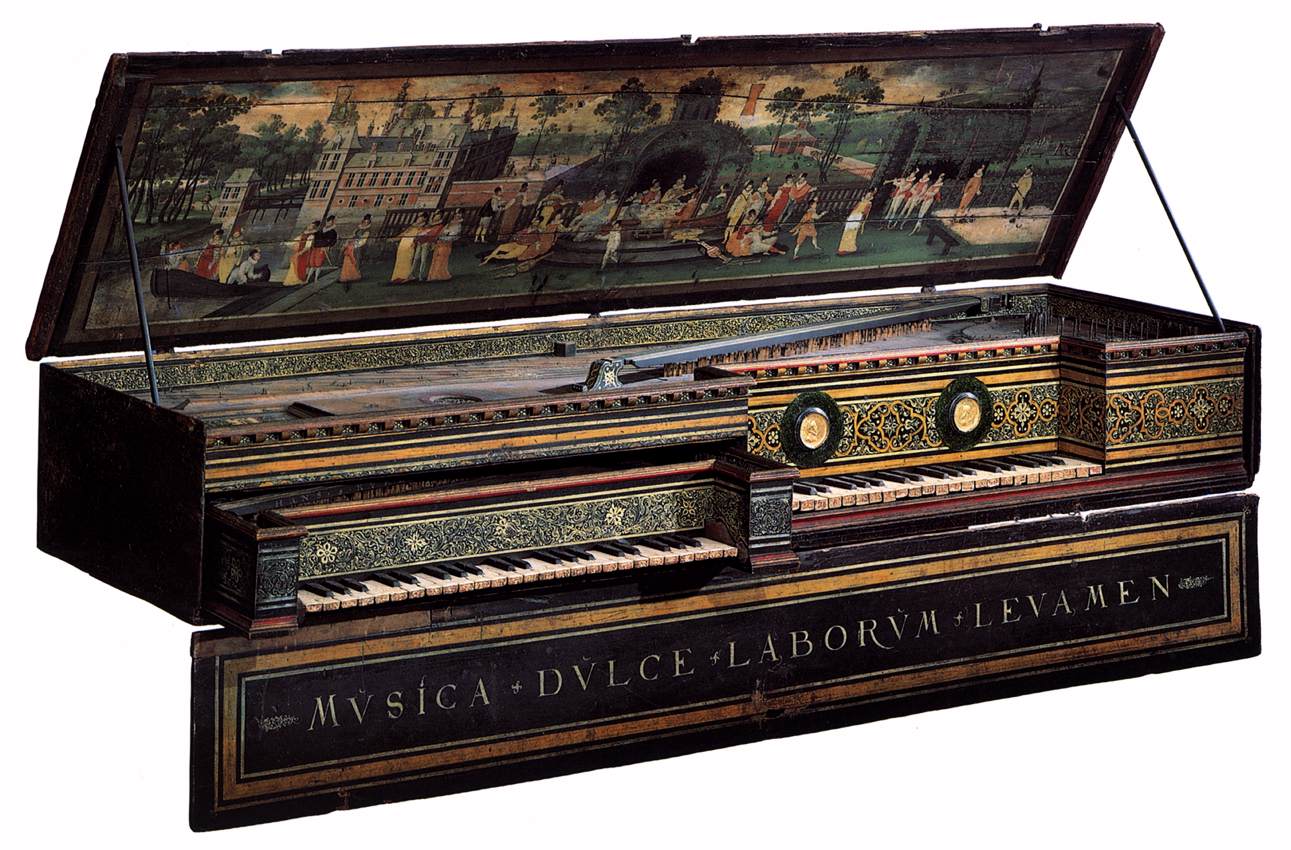
RUCKERS, Hans the Elder
Double virginal
1581
Wood and various other materials
Metropolitan Museum of Art, New York
This sumptuously painted virginal, the oldest extant work by Hans Ruckers the Elder, was made in Antwerp in 1581, when Spain dominated Flanders. Above the right keyboard are medallions of Philip II and his fourth wife, Anne of Austria. On the underside of the lid is a painted scene of a garden fete; the panel below the keyboards bears a Latin motto meaning "Music, sweet solace of labour." The double virginal, which anticipates the double-manual harpsichord, consists of two instruments. When the higher-pitched "child" at the left is withdrawn from its compartment and placed above the "mother," both can be played by one person.
Definitions for some of the words on this page:
a cappella: choral singing; in the style of church or chapel music without accompaniment
canon: a melody imitated tone by tone by another voice. (2) canon: a clergyman serving in a cathedral
canticles: a psalm or hymn used in church service
cantor: in Lutheran and Anglican churches, the choirmaster or precentor, in Geman schools, the music-master
canzone: an Italian folk- or popular song
canzonet: a short canzone
chromatic: a tone, interval, scale or chord deviating by a small interval from the typical major or minor form
coadjutor: an assistant, in particular one bishop helping another
counterpoint (also contrapuntal): the rules of counterpoint, which was either a melody accompanying a melody note for note, or notes played or sung indepedant of each other, but still harmonizing
dilettanti (dilettante) : an admirer of the arts, although sometimes used in contempt
Gregorian music: A general name for the ritual music associated with the liturgy of the Roman Catholic Church. Unison singing, without regular rhythm; also plain-song or plain-chant
intermezzi (intermedi): in the 16th century were usually madrigals or a song with instruments in madrigal-style
laudi: popular religious songs sung in unison or simple 4-part settings
libretto: the literary text of an extended vocal composition
libretist
litany: prayer or intercession. In the Rom. Catholic Ch. these invocations are to the saints, Mary, or in the name of the Savior
liturgical: pertaining to public worship
madrigal: (1) a short poem, usually a love poem, that can be set to music. (2) in the 15th through 17th centuries was a contrapunal song with parts for several voices that was sung without accompaniment
mensural: rhythmical compostion and notation developed from th 12th century on in connection with the rise of polyphony
mode: a type of scale; a method of selecting tones within an octave for melodc and harmonic purposes
Monody (monodic): melody or song for a single voice; homophony
motet: a secular form of part-song (2) from the 25th century a musicl setting of a Biblical text or the verse of a sequence in elaborate contrapuntal style
Mus.D. or Doctor of Music: one of the academic degrees for music in England and America. In England the degree is given after a considerable examination and the presentation of an exercise (one or more original compositions). There is also a Mus.B. or Bachelor of Music. The Mus.M. or Masters rarely applies to music.
oratorio: a large and complex vocal work on a religious subject or at least heroic subject and text. The original naming of the oratorio came about due to the services of Filippo Neri (circa 1565) in the oratory of S. Maria in Vallicella. The "child" of the medieval religious play, the oratorio appeared in 1600 with The Soul and the Body by Emelio de Caveliere.
part-song: utilizing one or a few voices
Passion: a dramatic presentation of the death of the Messiah
psalter: a version of the Psalms for use in religious services. The "breviary" in the Rom. Catholic Ch.
tablature: the system of rules adopted by the Meistersinger guilds (15th to 16th centuries) governing the construction of texts for musical setting and the setting itself
Te Deum: a famous hymn or canticle
(equal) temperament: the tuning or modulation of instruments and/or voices for favorable pitch-relations
tone-relations: having to do with vibration-numbers and acoustics
treatise: an essay or book on any subject dealing with facts, evidence or principles and the author's conclusion on the subject
virginal-pieces: a virginal was a small harpsichord (a.k.a. spinet) named by Sebastian Virdung in 1511. The name may have originated with religious compositions dedicated to the Savior's mother