
"Before King John signed the Magna Carta
he tried to pull the old 'My pen ran out of ink' trick!"
1066: After Duke William of Normandy became William the Conqueror, he claimed the English forests for himself and future kings. This added up to 69 forests, totaling 1/3rd of England and most of the deer, boar, stags, hart, hinds and hares. Since William had to figure out how to keep everyone out of his woods he came up with the great idea that poachers should be mutilated. Although his successors reduced the penalty to death, it was still a steep price to pay for a worm-infested boar.
William also started the Feudal System. This meant that he was lord of all. The poor Anglo-Saxons became peasants, the nobles supplied him with knights and soldiers in return for land, and heavy taxes were collected for castle building and wars.
For the steady flow of money William began the Domesday Survey in 1086, keeping count of the possession of all his subjects for taxation.
William was always good at passing laws. In 1040, as Duke of Normandy, he passed the "Truce of God" on his fellow Normans. This Truce stated that only he and the king of France could battle between Wednesday evening and Monday morning, and during Lent and Advent.
"Before King John signed the Magna Carta
he tried to pull the old 'My pen ran out of ink' trick!"
6-15-1215: After many years of abuse the barons brought King John to Runnymede by the Thames River, and it was there that the Magna Carta was signed. The Charter gave political and civil liberties to the barons, and a forest charter accompanied it.
Some provisions of the Magna Carta:
The king needed the consent of the great council to demand scutage (a fee in lieu of military service) or aid other than the three aids allowed by feudal custom.
Pardoned those outlawed for breaches of forest law.
Gave the right to kill a beast or two to every baron or prelate passing through the forest.
Freemen could drive swine through the forest.
No loss of life or limb for poaching.
Poachers pay a heavy fine instead of being executed, then imprisoned and finally banished.
No freeman, merchant or villein can be excessively fined for a small offense, can't lose livelihood, merchandise or implements of husbandry.
The longbow was also banned.
The Charter prevented the kings from levying the older kinds of Feudal taxation, except without the consent of his chief vassals. He also could not use the instruments of his private household � the wardrobe and his private seal � to enlarge his revenue or powers.
61 clauses in the charter, and a recital of wrongs by Englishmen under the king. 25 barons chosen by their order became the charter's guardians. They were empowered to take up arms against the king. Copies were sent to every county in England. John honored the Magna Carta for only a few weeks and this led to his civil war.
The Provisions of Oxford:
1258: In debt and with the Church asking for money and threatening him with excommunication and interdict, King Henry III wants tallage of 1/3rd of all possessions, the barons oppose him.
They attend Parliament in full armor, Henry and Prince Edward agrees to their advice which is contained in the Provisions of Oxford. This created two new administrative bodies and called for three Parliamentary meetings a year, with or without the king present.
24 in committee to deal with difficulties, 1/2 chosen by Henry. Made reforms and restored co-operation between Crown and magnates. A council of 15 would advise king with a majority rule and a right to veto. Also had authority over the officers of state (justiciar, treasurer, chancellor).
Reforms made to the royal household, foreign members banished, chancellor can't use the royal seal without council's knowledge.
Castles held by native-born custodians, and the sheriffs appointed annually from men of the counties they administered.
Most important measure, the regulation of Parliament meetings three times a year. The council of 15 repudiated Henry's Sicilian commitments, dismissed foreign advisors, forced him into a treaty with France and renounced John's lost provinces.
Henry's foreign relatives left England, and Parliament sought to help merchants, the poor, widows, minors and the lesser freeholders.
After the civil war (1265) King Edward confirmed the Provisions of Oxford and its companion document, the Provisions of Westminster.
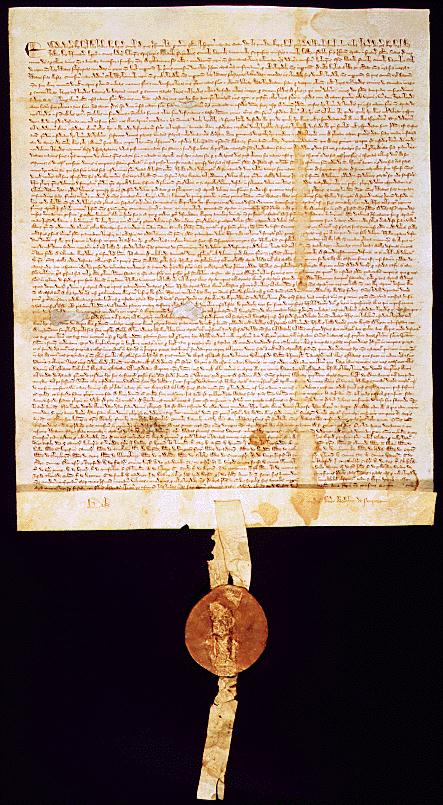
This photo of the Magna Carta was taken from this site:
www.nara.gov/exhall/charters/magnacarta/
The Magna Carta is property of the Perot Foundation.
