This literature page contains notes taken on the book Titans of Literature written by Burton Rascoe. The book I have was copyrighted in 1932.
Montaigne and the Average Man
Montaigne proclaimed that he was not a hero. He also thought little of himself, saying that everything is wrong with him but his health. He was short of stature, which bothered him to no end, and he referred to it as a defect bordering on deformity. Montaigne realized that it is �easier to understand mankind than to understand a man�, so he set out to understand himself, or rather to reveal himself and let others make what they could out of it.
Michel Eyeqem de Montaigne had one of the most glorious fathers in the history of literature and the famous Essays of Montaigne are a long comparison of the son with the father, with the son coming out on the losing end.
Montaigne�s father was a soldier under Francis I, waging war on Italy. He was also very athletic. Montaigne was just the opposite although he claimed to be a good horseback rider. He tried to impress others with apparel in order to make up for his lack of appearance and had a library of a thousand books.
Montaigne greatness is found in nearly every great work of French prose; he and Rabelais gave final form to the still plastic French language, before the standardizing of it set it under the direction of the French Academy. He invented the familiar essay; he was the father of the spirit of inquiry, which produced Voltaire and the French revolution. He aspired to simplicity, clarity and easiness in writing. He was one of the first to espouse the doctrine of equality for men and women. He immeasurably increased the estimate of the dignity and worth of human life while searching his own soul.
Montaigne wrote in what may seem to some readers as trivial, such as his like, distaste, then the liking again of the taste of radishes. This, according to Mr. Rascoe, is a paradigm of Montaigne�s great contribution to thought.
The author then quotes from a translation of the French critic, Jules Lemaitre: �One of Montaigne�s favorite thoughts is that we can have no certain knowledge since nothing is immutable, neither things or intelligences, and the mind and its object are both borne along in perpetual movement. Ourselves changing, we behold a changing world. And even when the object under observation is forever fixed in its forms, the mind in which it is reflected is mutable and multifarious, and this is enough to make it impossible for us to be responsible for anything more than our momentary impression.
�How, therefore, could literary criticism constitute itself into a doctrine? Works pass in procession before the mirror of our minds; but, as the procession is long, the mirror becomes modified in the interval, and when by chance the same work returns, it no longer projects the same image.�
Michel Eyquem feigned to be of the nobility, hence the false �de Montaigne� addition to his name. He falsely asserted that his ancestors had occupied his residence, the Chateau Montaigne, for many generations, although possession is traced to his great-grandfather in 1477. The estate was located in Perigord, not from Bordeaux. Michel was the eldest of nine (or possibly eleven children) and was born in 1533.
When Michel was six-years-old he was sent away to the College of Guienne at Bordeaux he already knew Latin literature and spoke a kind of Latin better than he spoke French. He said of himself that he was dull and backward as a child, a dreamer who was never much in danger of mischief because he did nothing whatever. �For, though I was of a strong and healthful constitution, and of a disposition tolerably sweet and tractable; yet I was withal so heavy, idle and indisposed that they could not rouse me from this stupidity to any exercise of recreation nor get me out to play.� He envied the ability of other children to excel in athletics but not to the point of emulating them; the only thing he enjoyed in the nature of exercise was horseback riding.
His father wanted him to be a lawyer and was educated for the profession. He left the school at age thirteen and served an apprenticeship in Toulouse when he was twenty-one-years-old, and his father purchased him a magistracy. Two years later Michel was practicing law in Bordeaux.
It was then he met Etienne de la Boetie, a brilliant young lawyer. They became friends. As a young man, Michel was dissipated and self-indulgent and bored with his profession. Even with these faults he was still approved of by Henry III and Henry of Navarre and was entrusted with various diplomatic missions between the rival factions.
When Boetie died he left Michel his library. Montaigne married when he was thirty-three-years-old, and his bride, Francois de la Cassaigne, brought him a considerable dowry. She was invaluable to him for she was efficient, cautious, and capable. She managed his affairs on the estate while Michel had no business or monetary sense and no knowledge of farming. He was negligent and forgetful, could not read his own handwriting two days after he wrote something and was utterly helpless in practical affairs.
They seemed to have had a happy marriage. Quoting Montaigne: ��The fact that happy marriage is so rare is a sign of its value. When we fashion it finely and take it the right way, there is no nobler institution in society.� Montaigne and his wife had six children, all girls, with only one of them reaching maturity. In 1568 his father died, leaving him the chateau and the estate and four years later Montaigne retired from public life to the chateau where he dedicated himself to his writing.
At first Montaigne wrote his comments on the things he read. He then began self-examination and also recorded his contacts with peasants and trades-people. In 1580 Montaigne published the first two volumes of these Essays. He then traveled through Europe and kept a diary of the things that interested him. When he returned to France he was elected mayor of Bordeaux, the office his father held before him. During the plague of 1587 he was absent from the city, waiting out the plague in the chateau. This caused the people to remove him from office. While in Paris, superintending a publication of a new edition of the Essays he was imprisoned by the Catholic League, but was released within eight hours.
Montaigne died in 1592 after long months of pain from kidney stones. Towards his final years he wrote much about death, but with a brave attitude. Montaigne�s greatest single work is the Apology of Raimond Sebond, a long sustained work of irony. On the surface it is a vindication of Catholic orthodoxy and reality an assault upon every conviction, Catholic or Protestant, upon which faith is based, his most bitter satire based upon the fratricide between Catholics and Huguenots, which in a few years had taken eight hundred thousand lives.
Cervantes and the Spirit of Mockery
As a young man Miguel de Cervantes attempted writing both prose and verse, but it was not until he reached the age of fifty-seven that he showed any signs of ability, and that with the writing of Don Quixote. Mr. Rascoe considers Don Quixote to be the first and most perfect specimen of a unique genus, so rich in substance that it is possible for several different persons to read it and derive dissimilar impressions. Young people will see it as a fantastic tale of adventure while older readers will see a humorous satire about the weakness of human nature, or see it as a book of deep and mellow wisdom that may even bring them to tears. Cervantes had certain traits that allowed him to write such a book, but at the same time led him to failure in writing a successful pastoral romance, which was popular in his time. He had a keen sense of reality, a natural inclination to humor, burlesque and mockery and an inveterate mischievousness. In the eleventh chapter of the book Cervantes wrote a burlesque of pompous poetic rhetoric and oratory, which Don Quixote delivers to an audience of goatherds.
Miguel de Cervantes Saavedra lived an interesting and painful life. He was injured as a soldier and severely wounded in many places and lost the use of his left hand. He was held captive by Algerian bandits for five years before the ransom was paid, then imprisoned at home for bad debts.
Cervantes wrote thirty unprofitable plays, a pastoral romance that brought him 140 dollars, and his government job and the job at the Royal Treasury also were unprofitable. Cervantes� Don Quixote was a success, but without copyright protection he got little money from it, while others prospered. A nobleman was stabbed to death in the apartment house in which he, his wife, daughter and niece lived and they were all imprisoned. His daughter resorted to harlotry and in the final years of his life Cervantes was destitute and nearly starving.
Cervantes� father, Roderigo de Cervantes was a pampered son, whose family lost its wealth. Unable to make it in the �real world� he spent much time in jail over unpaid debts. He considered himself to be a hidalgo (�son of good things�). According to Roderigo, noblemen were permitted by law to be free from paying taxes and could not be imprisoned due to unpaid debts. After a year he was released, but put back in prison because there was no proof that he was a hidalgo, but with that proof he was released from prison again. Roderigo, his wife and their seven children lived in poverty and he had some income as a less than able barber-surgeon.
Roderigo married his wife, Leonor de Cortinas, while he was living off the wealth of his father, Juan, who was a wealthy lawyer and a city magistrate of Cordova. A financial depression robbed him of his property and income, and Roderigo and his brothers had to fend for themselves.
Miguel de Cervantes was born in the year 1547 and would have nothing more than a common school education.
Cervantes, however, may have been a page in the household of Cardinal Guilio Acquiviva and was given an education from there. Another member of that household was a young man the same age as Cervantes, who may have been the son of the cardinal. This young man was fond of a young woman beneath his social station. Though he was forbidden to see her, Cervantes accompanied him to her house one evening where two men with drawn sword approached them. Cervantes and his friend killed both men and soon fled. Cervantes was twenty-two-years-old and would not return to Spain for twelve years. He was in France and may have served in Flanders in the army of Charles V. He was definitely in a garrison in Naples in the army of the alliance of Spain, Venice and the Papacy, where his brother Roderigo is also a soldier.
Two years later he is an officer under the command of Don Juan of Austria and the Duke of Sessa, participating in the naval battle of Lepanto where the Spanish Armada routed the Turkish fleet of over two hundred galleys and other boats and thirty thousand troops. In this battle Cervantes nearly lost his left hand due to a ball of lead from a harquebus. He spent a year in the hospital before recovering. After his return to his post and one more scouting trip to search for more Turkish ships he retired.
At this time Cervantes was thirty years of age. On his return to Spain Algerian pirates took him and other passengers on the ship as prisoners. Though he was poor he had with him the letters of recommendation signed by Don Juan and the Duke of Sessa. The pirates thought he was valuable and asked for an enormous sum for his release. Cervantes was kept prisoner for five years, but was treated well, because the pirates though he was rich. Instead of harsh labor, Cervantes wrote plays so the captives could entertain themselves.
Back in Spain Cervantes wrote poems, plays, prose, romances and literary criticism without success. His family was suffering financially due to the ransom and Cervantes reached the depths of the literary world and wrote advertisements for other author�s books and plays and also worked as a ghostwriter.
In 1584 an illegitimate daughter, Isabel was born to Cervantes. Also that year he married a widow who gave him a small country estate. He also wrote about thirty plays. Still needing money, Cervantes a job in the Service of Supply of the King�s army, distributing supplies to the camps, garrisons and the port of the Spanish fleet. The Armada was preparing for war with England at the time and Cervantes was not qualified for the task. After the defeat of the Armada auditors searched his books and found them in hopeless confusion. He lost government funds in a failed bank and was placed in prison and freed after four months.
His whereabouts from 1597 and 1602 are unaccounted for, but is still plagued by his debts. Cervantes is again missing for two years then is found at Valladolid at age fifty-seven with his manuscript of Don Quixote. He makes little money. The next year he and his family are imprisoned over the death of a �nobleman�, but are soon released. Cervantes then writes the Exemplary Novels, broad and humorous parodies that are satirical, non-moral and bawdy. He also wrote the poem Voyage to Parnassus. Cervantes is working on the second part of Don Quixote. It is printed in 1615 and Cervantes died the same year and buried in a grave that cannot be located.
A summary of Don Quixote:
There is a poor nobleman, who is fifty-years-of-age, living in a poor land. He shares his home with a woman servant and a young niece. His ideals are dreams that are crushed by reality. He reads books of the knighthood of a bygone era and sells off his property to purchase more and disputes with the village curate and barber meaningless things that seem important to only him. He decides to become a knight-errant and seek adventure and aiding those in distress. He calls himself Don Quixote de la Mancha. In his rusty armor, a helmet of pasted papers and other deficient items of knighthood and riding his emaciated horse, Don Quixote journeys a day and stops at an inn where he asks the innkeeper to dub him a knight.
Quixote�s experience as a knight unravels when he is presented with a bill that he cannot pay. He goes home and sells his possessions to raise money. He also realizes that he needs a squire. He enlists his poor neighbor, Sancho Panza, enticing him with governorship of the first island that came under his reign and thus they set out on their adventures.
Chaucer and the English Spirit
Geoffrey Chaucer was born in the year 1340 at the outset of the Hundred Years� War. At this time French was the language of the courts of law, diplomacy and of the king and his counselors. When Chaucer was sixteen-years-old a law was passed that required all hearings in the Sheriff�s Court to be made in the �vulgar� tongue, the midland dialect of Anglo-Saxon, which Chaucer spoke and used. It took another thirteen years for English to become the official language of Parliament. It was fifty years after Chaucer�s death that the French language was completely replaced by the Anglo-Saxon dialect. This was the language of Chaucer�s poems and his works helped solidify and form the language that dominated until the Elizabethan period.
Chaucer was born in a tenement near the docks of London. His father, John Chaucer, was a wine merchant who seems to have been high in favor with King Edward III. Medieval London was crude, barbaric and filthy. The masses of the poor lived in the utmost squalor, rats and vermin abounded and the rich and poor suffered from lice. Twice during Chaucer�s boyhood the bubonic plague struck and killed one quarter of the population. London was a lawless city where the heads of traitors were suspended from pikes on London Bridge and on the Tower and the body parts put on display spread stench and pestilence. But there were public schools, where young men studied Latin and the elements of arithmetic, reading and writing. French and English were also spoken. Along with these languages Chaucer also spoke Dutch and Italian and this helped him to be selected for several diplomatic missions.
When Chaucer was young he was a page in the service of the Countess of Ulster, wife of Prince Lionel, the son of Edward III. He was introduced to court life and learned to compose verses, ballades and rondels and also wrote poems.
In 1359, when England invaded France, Chaucer served as a soldier. He was in command of a small band of archers and was taken prisoner, his ransom paid by the king. Chaucer was a favorite of the court nobles. He married Phillippa, one of the ladies of the Countess of Ulster�s household who brought him a considerable fortune. She was granted a life pension by the Queen and seems to have served as a lady-in-waiting or mistress of the chamber to the wife of John of Gaunt as well as to the Countess of Ulster and the Queen.
In 1367 Chaucer is a servant of Edward III, waiting on tables, making the beds and other menial tasks under the direction of the chamberlain. A few years later he has risen to the office of squire, entertaining the king and his court, reading and reciting chronicles, writing verses, organizing games entertainment and hunts. Chaucer�s pay was increased and he now had a private room and a servant. His companions were French nobles, including King John, who were being held for ransom. Chaucer at thirty-years-of-age was also sent on commercial missions to France, Italy and the Netherlands. It was during this time that he became familiar with the works of Petrarch, Boccaccio, Dante and other works of Italian literature. In 1374 Chaucer was comptroller of customs at the port of London, and then was in charge of all customs, and was given a large salary.
During twelve years Chaucer translated Boethius, writing his Troilus and Cressida, the Legend of Good Women, the Parliament of Fowls, and the Canterbury Tales. He was elected to Parliament as Knight of the Shire of Kent, in which county he also held the post of justice of the peace.
Finding evidence in his poems, Chaucer may not have been happily married and may not have always lived with his wife, although they never divorced. At age forty-one he fathered an illegitimate child.
In 1387 Chaucer�s wife died and his fortunes soon began to wane. King Richard II had money problems, and Chaucer lost his post at customs and he soon went bankrupt. Two years later Richard, now at legal age to reign, got revenge against his enemies and appointed Chaucer clerk of the king�s works at the Palace of Westminster, at the Tower of London and elsewhere. He was in charge of rebuilding St. George�s Chapel at Windsor, repairing castles and other structures. But Chaucer was robbed twice, losing his workmen�s payroll. Then for some reason he was deprived of his clerkship, falling on hard times, living off his pension.
Nearing the end of his life Chaucer wrote poems voicing his distress, though wealthy and influential friends aided him. In 1393 he wrote the Treatise on the Astrolabe to teach his young son, Lowis, the �science touching numbers and proportions.� Chaucer died in 1400.
Shakespeare the Mirror
There is still some doubt about who William Shakespeare was. There is strangely unconvincing but ingenious cipher evidence that Sir Francis Bacon wrote the Shakespearean plays and other Elizabethan Age literature attributed to other authors. Clues to who Shakespeare was comes from a few public documents, impressions of him written by his contemporaries and how he worded his will.
It was once believed that Shakespeare was the ill-educated son of a butcher, held horses in the rain before the doors of the London theatre meeting those who would help him develop his skill in the art of the theatre, became a small actor as well as a play-smith and director and assumed the role of Ghost in Hamlet, that when Hamlet was performed his income was the modern equivalent (at the printing of this edition) of twenty thousand dollars a year, retired to Stratford to live in ease and died in a drinking bout. These legends and other have been argued away or revised by Shakespearean scholars. He and his wife, formerly Ann Hathaway, had three children, Susanna, Hamnet and Judith, and some scholars claim, probably in error, that William and his wife had an unhappy marriage. Most commentators are in agreement that Shakespeare was a gentleman and easy to get along with.
At age twenty-five years of age Shakespeare collaborated on Titus Andronicus. Then came the rowdy farce A Comedy of Errors followed by a comedy of manners Two Gentlemen of Verona, his first production of �good theatre.� By age twenty-nine Shakespeare had written two long and popular poems, Venus and Adonis and The Rape of Lucrece, one play in collaboration King Henry VI, and the masterpiece A Midsummer Night�s Dream.
For nearly ten years Shakespeare wrote three or four plays a year, directing, acting and managing a theater. While dedicate to his craft Shakespeare would find some time for companions, legend has it that he, fellow playwright Ben Jonson and others would gather at the Mermaid Tavern for much wine and battles of the wit. Shakespeare may have also based some of the caricatures in his plays on his companions and well-to-do patrons. As Shakespeare got older he wrote less and turned from comedies to tragedies. He was near to madness when he wrote King Lear, and for sure a sick man when he wrote Timon of Athens.
The final stage of Shakespeare�s development is the most puzzling. In his fifties he changes his style and outlook, sweetens his temper and grows mellow and indulgent. From the creation of heroic and tragic men and women, he turns to the creation of sweet and innocent young girls as read in Pericles, Cymbeline, Winter�s Tale, and The Tempest, possibly due to inspiration from his daughters and granddaughter.
The reversal in Shakespeare�s standards and values may have come after a nervous breakdown and prolonged recovery, disappointment and despair being replaced by peace and warm affection brought on by his family, but maybe not. This is all speculation and other matters, partially or wholly may have been the reasons for his change. He may have just been tired, instead of a having a nervous breakdown, and the change in style may have been the result of experimentation, not inspiration from others or his surroundings.
In his will, the bulk of his estate was left to Susanna: the dwelling in New Place, his equities in the New Globe and Blackfriar theatres and his investment in Stratford tithes, investments valued at about fifty thousand dollars. Also instructions to provide a home for his widow and a long section of the will devoted to male heirs, which ended fifty years after he died. Shakespeare�s wife was an invalid at the time the will was written (she was eight years his senior), and by law was given a one-third dower right. Shakespeare also left her their bed. Judith was given the equivalent of fifteen thousand dollars, a broad silver-gilt bowl and an income. Hamnet had died at age eleven, and Shakespeare remembered some of his old acting buddies in his will.
Jonson and Michael Drayton (also a playwright) would engage in the enjoyment of wine with Shakespeare and on one of these occasions he drank too much, rapidly developed a fever and died within a few days. But it may not have been the alcohol, because Shakespeare had been suffering from Bright�s disease and had been forbidden to touch alcohol. So he died at age fifty-two.
Buried in Trinity churchyard and a new church raised over the spot, inclosing and marking the resting places of Shakespeare, his wife and Susanna. There is also a bust of Shakespeare and a monument at the church.
Shakespeare may have been apprenticed to a butcher, and not an illiterate one. And his father, John, was wealthy when William was young, a glove maker and a wool merchant and at one time holding an office in Stratford similar to that of a US mayor. John�s fortunes changed about the time William married.
As for his education, Shakespeare may have learned in public school in Stratford, or on his own, or possibly in the Earl of Southampton�s library in London. He knew Latin well enough to read Ovid and to base his Comedy of Errors on a play by Plautus. He knew of Plutarch and Montaigne by translation.
When Shakespeare was thirteen the first public playhouse opened in London, before then masks, pageants and plays were just for the nobles and ladies. The Greeks had long ago performed public plays, using folklore legends familiar to the audience and the Elizabethan theatre did the same. All plays approved of became property of the company that purchased it and it was their job to change and revise them.
The most popular playwright of the time was Thomas Kyd and the most popular play was A Spanish Tragedie. Christopher Marlowe introduced his poetic gifts into the old, worn scripts of the companies and a new era of writing was born, which Shakespeare learned much from. John Lyly had set the tone for the plays and pageants of the court, saying things delicately and in a roundabout way that Shakespeare later parodied, the comedies and farces that became a hit with the audience. Changing social and economic conditions that affected Shakespeare and the entire population as well also gave him the material he needed.
English drama (like the Greek drama) began as a religious observance, getting its start with the Miracle plays, pantomimes representing events in Christian history (whereas the Greeks derived their inspiration from early pagan rites). From the pantomimes and pageants came episodes in which the actors were given lines to speak or declaim. From the sacred plays that were popular on religious occasions came the secular pantomimes and the Morality plays, where characters in action and dialogue represented the Virtues and the Vices.
Poets began to contribute to the secular plays, developing the farces and the romances, and changing subject matter from biblical scenes to historical events and scenes from common life in the form of comic masks and pastorals.
This became a bore after a while and the players sought new inspiration from Latin, Italian and Anglo-Saxon chronicles, gleaning new material from the comedies of Plautus and Terrence, Italian romances, and the historical characters found in Plutarch, Holinshed, Livy and other historians.
Of Hamlet, Shakespeare put one of these earlier plays into this play, it being just his version of a popular theme performed in various versions by the strolling players who came before him. The original source of Hamlet, Prince of Denmark, is the Historia Danica by Saxo Grammaticus who died circa 1220. The history was first printed in Paris in 1514, and in 1570 Francis de Belleforest retold the story in his Histories Tragiques. The story of Hamlet was very popular and there were many versions of it by 1589.
The Ur-Hamlet, the original acting version belonged to the Lord Chamberlain�s company. Shakespeare wrote his version as an actor-playwright, either as a member of that company or with the Lord Admiral�s players. Robert Greene, a critic of Shakespeare (probably out of jealousy), may have already had his version being performed with little success, and this version might have been given to Shakespeare for a re-writing. Greene died in 1592 and Marlowe died the next year. Then a severe outbreak of the plague closed all the theatres in London for about a year. The new plays ready for the reopening were Hamlet, Titus, and The Taming of the Shrew, according to Henslowe�s diary, he being the manager of the theatre in which these plays were produced. These plays were most likely Shakespeare�s, although Hamlet was not copyrighted until 1602.
The popularity of plays and pageants in Elizabethan court circles was so great that around the year 1580 that some young university members and graduates sought this writing as a career, Robert Greene, Thomas Nash (or Nashe), John Lyly, George Peele, Thomas Whetstone and Thomas Lodge among them. These men inspired Christopher Marlowe. While Lyly invented a subtle style that affected both court diction and the plays, Marlowe at age twenty-four developed the �mighty line.� This was a free development of the use of blank verse, giving it dignity and grandeur. Previously the rhymed couplet had been the fashion, and then the blank verse couplet. Marlowe developed the blank verse to its full power in English. His was a tumultuous temperament, alternating apparently with graver moods. His early cadences had a violent crescendo followed by calm iambics. This cadence he developed until it has become one of the chief glories of English literature, a cadence taken over without much variation by Shakespeare. Marlowe was born the same year as Shakespeare. His talents developed quicker, but he also died early and miserably, stabbed to death at age twenty-nine during a drunken quarrel over money that he and others had stolen.
Rascoe ends his chapter on Shakespeare with a comparison between Shakespeare�s interpretations of the Hamlet and Falstaff [King Henry IV (parts I and II), Merry Wives of Windsor] characters. There is a kinship of spirit between the two characters. Both are with a quick sensibility, a rich and superior vocabulary, spiritually muddled and indecisive. Both are mentally at sea over the cross-purposes of life and pessimistic about the designs of nature. They abhor knaves and fools and share the same skepticism of feminine chastity to their own distress. They reflect the artist spirit in Shakespeare, whose plays are mirrors of life.
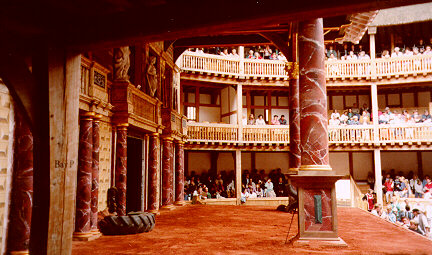
This is a photograph of the recreated Globe Theatre where William Shakespeare's plays were performed. For some reason there is a tractor tire on stage.
This photograph was taken by Rosalind Lee Tedford, the Information Literacy Librarian at the ZSR Library at Wake Forest University, who has an MA in English, specifically Shakespeare, and a Masters of Library Science, and is also a liaison between Wake Forest University and the Globe Theatre in London, England. Smart and generous.
www.wfu.edu/~tedforrl/shakespeare/globe.htm
www.wfu.edu/~tedforrl/shakespeare/index.html
Sophocles and Greek Drama
This excerpt, which I have included out of place chronologically (it is from the second chapter in the book), is about Homer and the (Greek) Mysteries, since the pagan religious rites of the Greeks and the Christian pageantry in England led to secular drama for both peoples. In the Odyssey Homer devotes an entire book to the Mysteries, the rites of celebrating it and the results (real or imagined) when the celebrant performs the required magic. Four types of Mysteries are named: Orphic, Plutonian, Proserpinean and Eleusinian. Whether there are more than these I do not know. Anyway, It was Ulysses who used one of these techniques that enabled him to confer with Tiresias (a deceased prophet) thereby communicating with the dead. [fairauthor does not recommend the performing of any pagan rituals except the paying of taxes.]
Milton the Conscience
Rascoe begins this chapter slamming John Milton�s poems Paradise Lost and Paradise Regained, saying that Milton, as an epic poet has only the make-up and costume of the grand style: he is lacking in the unpremeditated gestures, in the unconscious revelations of feeling, the soul of style. He goes on to say they have been given too much honor and that in trying to find an epic author in English to rank with the epic authors in Greek, Latin and Italian educators have given undue credit to Milton, who is a minor poet ranking below the Elizabethan poets. Many scholars know that Paradise Lost is a plagiarism of earlier authors, and the whole scheme was stolen from an Italian author named Serafino della Salandra, who wrote Adamo Canuto in 1647, the central theme is the Universe shattered by the disobedience of the First Man.
At age thirty-three Milton issued a pamphlet, The Reason of Church-government Urged Against Prelatry that through his labor and intent study he would compose a work that would rank with the greatest works of all time. He then condemned all English poetry and other authors and boasted of his talents and his writing ambitions.
Milton added some original contributions to the work. He offered the notion that Man is the highest of God�s creatures and that women should be subservient to him. He embellished the character of Satan to either the status of hero or progressively degrading villain. He also transliterated Salandra into austere and stately blank verse. Milton�s treatment of Eve stemmed from his attitude towards women, which grew progressively worse over time. Because of this his first wife left him a few months into their marriage and did not return for two years, and he was married three times.
Milton wrote only one love poem in English, To a Nightingale. He seemed to have regarded the English language as one of austerity and of vicious personal abuse. When writing pleasantly or lightly of love he used Italian. Two of his other love poems, L�Allegro and Il Penseroso are sophomoric compositions about conflicting desires of the flesh and the mind. He also wrote the Areopagitica, making a point that virtue is found when exercising it in a free choice in face of temptation. Other works were Lycidas and Samson Agonistes.
John Milton was born in London in December of 1608. His father was in the mortgage loan business. Milton went to St. Paul�s school in London and to Christ�s College, Cambridge. He is described as a prig, described then as: beautiful, of cleanly habits and daintiness. He also had a hysterical temperament, but was without a sense of humor. In Milton�s religious and sectarian pamphlets he wrote more about himself than the subject of his thesis, for example, his Apology Against a Pamphlet Called a Modest Confutation in which he writes of his chaste character and his superior upbringing and his virtue over all other poets. He also calls the people who disagree with him �vipers�, �scavengers�, �imbeciles�, �illiterates�, �dissolute heathens�, �frequentors of bordellos�, �obscene�, �drunken�, �fenborn serpents�, who write �vomit.� Milton did not pull punches when writing of Catholic hierarchy saying that they were mired in �a masse of slime and mud� and that they poisoned doctrine and discipline.
Milton graduated with two degrees after having written some sonnets in English, Latin and Italian, the L�Allegro and Il Penseroso the stately charade Comus. He left college at age twenty-four and lived with his mother at Horton at Buckinghamshire, during five years in which he studied and worked on his �self-improvement�, dedication himself to the quest of becoming a great poet. His letters to his friends reveal his �woefully inept literary judgments�, and he never praises the writers whom he is in debt to and praises those that he does not. He also turns against the writers that he praised in his youth.
Milton�s mother died ending his stay at Horton, then his father paying for his fifteen months of travel and study through Europe. He met and conversed with famous scholars and scientists on France and Italy, including Galileo. Milton wrote Latin verses for his hosts and Italian sonnets in their ladies� albums. He also purchased books and music. Milton sought to go to Sicily and Greece, but political, ecclesiastical and economical troubles in England force his return home. This was the civil war between Charles I and Cromwell in which Cromwell decimated a large portion of the population in England, Scotland and Ireland. He did not participate, but opened a boarding school for boys.
Milton did not become a pamphleteer until his domestic troubles brought him to write his famous pamphlet The Doctrine and Discipline of Divorce Restored to the Good of Both Sexes. His most famous prose work, the Areopagitica was written out of disappointment because the Round Heads* had closed the theatres as incitements to vice.
[*fairauthor's note: the Round Heads were members or supporters of the Parliamentary (or Puritan) party during the English cival war (1642-1652). A derisive term.]
At age thirty-five Milton married Mary Powell, who was seventeen. She left him in less than a month and returned to her parents. Milton thought that women should be submissive in all things and their greatest pleasure was to be found in pleasing men, and this probably ruined their relationship. While she was gone, Milton courted another young woman. When Mary returned more than two and a half years later she brought her family with her, the civil war probably ruined them financially. She and Milton had four daughters, and she died in childbirth at age twenty-six.
In 1645 Milton published his first collection of poems. The volume included the ode On the Morning of Christ�s Nativity, L�Allegro, Il Penseroso and some of his sonnets. Also that year was A Mask usually called the Comus.
In 1649 Milton released his famous pamphlet The Tenure of Kings and Magistrates which declared: �proving that it is lawful, and hath been held so through the ages, for any who have the power, to call to account a Tyrant or a wicked King, and after due conviction, to depose, and put him to death, if the ordinary Magistrates have neglected to do so.� He was also employed that year as Latin Secretary to Cromwell�s council of state, translating Latin and Italian dispatches into English. A European scholar named Salmasius disagreed with Milton�s Tenure and a feud began. Milton replied with three pamphlets including the two tracts on the Defense of the English People.
Three years after his first wife�s death in 1653 Milton married Catherine Woodstock who died in less than two years. He wrote a sonnet to her memory after her death. He married again to Elizabeth Minshull, who was a housekeeper more than anything else. Milton was blind for eleven years by this time and his daughters were required to wait on him, read to him and take his dictation.
Paradise Lost was finished in 1664 and published in 1667. In 1671 Milton wrote a poetical drama about his blindness, despair and courageous triumph in terms of the biblical story of the blind Samson. It was titled Samson Agonistes. During his final years Milton was busy with hack writing, a grammar and other textbooks, translating and editing. He died in November of 1674.
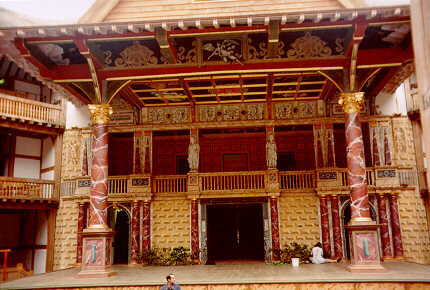
This is a photograph of the recreated Globe Theatre where William Shakespeare's plays were performed.
This photograph was also taken by Rosalind Lee Tedford.
www.wfu.edu/~tedforrl/shakespeare/globe.htm
www.wfu.edu/~tedforrl/shakespeare/index.html
