This literature page contains notes taken on the book Titans of Literature written by Burton Rascoe. The book I have was copyrighted in 1932.
Homer and Greek Legend
The following is a summary of how we obtained the copies of the Illiad and the Odyssey. Homer (circa 884 BC) was lost and forgotten throughout the centuries of the Middle Ages and only hearsay to a few Greeks. In the late Middle Ages monks had preserved, copied and hid many pagan Greek texts they were unable to read. Only Virgil from the pagan past was respected, because church leaders considered one of his Eclogues to contain a passage construed as the announcer of the end of paganism and the beginning of Christianity. But Greek literature was forgotten until the 14th century AD, when three men restored Homer: Leontius Pilatus, Giovanni Boccaccio and Francesco Petrarca (aka Petrarch).
In the mid 14th century Boccaccio brought Pilatus from Venice to Florence for three years. Petrarch was an old man was a poet and a Latin scholar leading the revival of the Greek language. Pilatus knew ancient Greek and could translate, and also knew where to obtain a manuscript of Homer. The translation (into crude Italian prose) would then be given to Petrarch, and the revival of the Humanities would begin. In 1488 the first printed edition of the Greek text of Homer reached Florence from Athens. By the early 16th century Homer was exceedingly popular.
Virgil and Latin Literature
The Greek language had greater vitality and longevity that Latin, being a medium for prose and poetry from Homer�s time until about the middle of the fifteenth century A.D. Latin ceased to be the literary language of Rome under Hadrian and ceased to be even the vulgar language of Rome in the seventh century A.D.
In a section of this chapter dedicated to the 15th century custom known as the Pasquinade, based on ancient obscene verses recited at festivals, Mr. Rascoe quotes from another author: �According to Mazocchi,� writes Edward Hutton in his biography of Pietro Aretino, �Pasquino was a schoolmaster with a bitter tongue and lived in Rome in the fifteenth century. But, at the end of that century, and especially in those early years of the beginning of the sixteenth, this name had been transferred to an antique and mutilated statue which had been recently excavated and set up at the corner of the Piazza Navonna. To his statue it had been the custom to affix learned squibs on the papal government and famous persons generally.
Pasquin had lately taken a partner in the form of another statue excavated in the Campus Martius, and popularly known as Marforio (A feor Martius). The regular form of �pasquinade� now became that of a dialogue of question and answer in which Marforio was usually the questioner. These pasquinades became famous all over Europe. Pasquin, indeed, is of the modern world and is a sign of the return of free satire, anonymous and violent and often as vulgar and salacious as anything in antiquity. He is not really of the people; he is the creation of the learned, of scholars and men of letters.�
Virgil�s Fourth Eclogue is a miniature epic of the Perusian Wars and the conflict between Antony and Octavius. In it he paraphrased the Sibylline oracles and in doing so paralleled the prophecies of Isaiah. The later Christian fathers conferred upon him a sort of pre-Christian sainthood.
Quoting Gibbons in his The Decline and Fall of the Roman Empire chapter XX: �Forty years before the birth of Christ the Mantuan bard, as if inspired by the celestial muse of Isaiah, had celebrated, with all the pomp of Oriental metaphor, the return of the virgin, the fall of the serpent, the approaching birth of a god-like child, the offspring of the great Jupiter, who should expiate the guilt of humankind, and govern the peaceful universe with the virtues of his father; the rise and appearance of a restoration of the innocence and felicity of the golden age. The poet was perhaps unconscious of the secret sense and object of these sublime predictions, which have been so unworthily applied to the infant son of a consul or triumvir; but, if a more splendid, and indeed specious, interpretation of the fourth eclogue contributed to the conversion of the first Christian emperor, Virgil may deserve to rank among the most successful missionaries of the gospel.�
Mr. Rascoe disagrees with the interpretation. The Virgo of Virgil does not refer to the Virgin Mary� The Virgo of the eclogue is the Virgo of the astronomical chart and so is the Saturnia� Saturn is beneficent only under certain combinations, but when Saturn is in Virgo, in the jargon of the astrologers, the good results of Virgil are supposed to ensue.
Virgil�s reputation was kept alive throughout the Middle Ages since he was regarded as the pagan poet who was appointed as the herald of the birth of the Savior. Others revered his as a sorcerer, because of the pharmacology of the Eighth Eclogue and because of the passage in the sixth book of the Aenid, which seemed to indicate his acquaintance with the nether world. This is why Dante chose Virgil as his guide through Hell.
Dante and the Medieval Mind
Mr. Rascoe is not fond of Dante�s Divine Comedy, which is divided into three books: Inferno, Purgatorio and Paradiso. The author uses words like juvenile, pedestrian, uninspired and dull to describe Dante�s work. Also says the author: �Therefore there is throughout the three books a false note and often a false tone; an unconscious hypocrisy, a lamentable failure at elementary self-understanding.� This work was originally called the Commedia until Giovanni Boccacio named it the Divine Comedy. Inferno is a petulant act of revenge where Dante, among other things, sends his political enemies to hell. Rascoe rates Purgatorio as the best of the three, though it lacks dignity, humanity, ethical appositeness and poetical grandeur. Parts of Paradiso are curious enough to repay the time spent in reading it.
Mr. Rascoe is not fond of Dante either, describing him as having an unhealthy state of mind, and comparing his spiritual experience to that of �derelicts of a Bowery mission who achieve grace every Sunday night and fall out of it again on Monday.� The author also states: �In Dante was the culmination of the medieval attitude in conflict with the rising spirit of the Renaissance. Part of his mind voiced the almost universal tendency of the Middle Ages to regard this life only as a preparation for the next, to renounce worldly thing that one might enter the Kingdom of Heaven; and another part of his mind was incessantly involved in worldly ambitions of the most impatient and sordid kind, ambitions which led him into political intrigue, party disloyalty and finally what was no less than downright treason.�
Commenting on the exiled Dante�s attempt to return to Florence: �� he connived with a German emperor to invade Italy and try to take Florence. It was his hope that his native city, which he professed to love, a city in which the nearest form in Italy to a republic had been established, would become a dependency, paying tribute to an alien government. And when patriotic Florentines repulsed the army of the Hapsburg, Henry VII, and prevented his subduing all Italy and crippling the power of the Pope, Dante went into a perfect fury of rage.�
Dante had written a �theological� treatise De Monarchia a specious argument intending to show that kings rule by divine right, and that in kings only (not the pope) the words and wishes of God are manifest. According to the author this document had a centuries long history of limiting the liberties of the people and hampered the spiritual work of the Roman Catholic Church. It emboldened upstart kings and helped precipitate wars over monarchs �divine rights� to possessions, trade routes and tax revenues.
It is said that Boccaccio wrote the best biography of Dante. Boccaccio knew Dante�s two sons and many of the Florentines who knew Dante and his family. Dante Aligheri is supposed to have come from the family of knights that founded Florence, the city in which he was born in 1265. His family had allied itself with the Guelf faction in the political party strife for the control of Florence (the other party being the Ghibelline). The Guelfs, in principle, believed that the superior authority belonged to the pope, while the Ghibellines thought that power should be with the emperor, also known as the Holy Roman Empire.
At the time of Dante�s birth, Florence was already emerging into an independent city-state, with a democratic form of government developing, in which there was to be no allegiance either to Roman pope or German emperor because neither had a stable existence. Florence was a walled city on a strategic trade route and took in revenue from commerce entering or passing through the city. It was developing into a wealthy manufacturing and commercial center, with a thriving trade in wool and a strong banking system. The political parties vied for the votes of the merchant class, tradesmen, guild workers and laborers.
Dante�s father was a politically active lawyer who encouraged his son to study the liberal arts. Dante studied Virgil, Horace, Ovid and Statius, and the Greek poets translated into Latin as well as the renowned poets of the Middle Ages: Bertran de Born, Arnaud Daniel, Guraud de Bornelh, Huon de Villeneuve, Colin Muset, Rutebeuf and Guillaume le Venier. As a nine-year-old, Dante met a girl Beatrice Potinari, a year younger than he. Beatrice�s beauty �� delicate and perfectly proportioned � full of such pure loveliness� wrote Boccaccio, influenced Dante�s ideas and poetry. Another influence was the poetry of the trouveres and the minstrel songs had begun to lose its inspiration before Dante�s birth, becoming formalized, sophisticated and in a state of decadence, losing its joyous quality. He also inherited the pessimism of the Middle Ages, with political and social life in a state of transition with barons and feudal castles giving way to the rule of the cities, the idea of empire was crumbling and the wretched peasant warriors of the crusades were introduced to other cultures and traditions.
In Medieval times it was the poetic fashion for young men to have an �unattainable� [female] object of devotion, real or imagined, to whom they should indite verses and whom they might admire from a distance. In the early feudal days the trouveres and troubadours, the wandering minstrels, were vagabond entertainers depending upon the alms and favor of the barons. Some lords had had their own minstrels among their retainers who ate and slept with the servants. They could not address the ladies of the castle directly or on terms of equality, but in order to please them the minstrels went from celebrating the lords of the manor in their poetry to verses celebrating the beauty of the wives and daughters of their masters.
From this literary convention arose the romantic convention of the cavaliere servente, the cavalier servant of a great lady, who was a devoted knight who dedicated his life to the lady of his heart, his reward being nothing more than an occasional glance or an even rarer smile. This �lady�s smile� was what Dante spoke of in the Paradiso. Beatrice died at age 24. Dante then began to obsess over her and his love for her, real or imagined became paramount. She became his spiritual love; one that he thought could make amends for his life of pleasure seeking. Dante and a friend would spend evenings carousing and then exchange bawdy sonnets. His Vita Nuova was written during this time.
Dante was obsessed with Beatrice who was married for three years when she died. Dante collapsed into sorrow, grief and tears. According to the Boccaccio: �He became almost a savage to look upon � lean, unshaven and almost utterly transformed from which he was wont to be formerly.� Shortly after her death Dante was married to Gemma Donati, sister to his best friend, at age 30. They had four children, but quarreled constantly and were separated. The author then says that Dante was probably involved in at least one adulterous relationship.
Along with Vita Nuova, Dante also wrote his treatise in Latin De Vulgaria Eloquentia (�On the Vulgar Tongue�) about the age of 30. The treatise explained why the vulgar tongue should become the literary language. At this time Dante also entered politics. He was an alderman, belonging to the guild of Physicians and Apothecaries. One of his first official acts was to concur in the banishing of a man who had been one of his best friends. The details of Dante�s political life are meager and conflicting, and intensely partisan. There seemed to be a struggle between church and state, between the pope and the city of Florence. Pope Boniface VII sought to unify Italy through the states of the church, electing Prince Charles of Valois (brother of King Philip IV of France) to mediate between the Neri and the Bianchi in Florence. The White party (Guelfs) did not want Florence to engage in a war that did not concern her. The Blacks were sided with the pope, and they convinced him that their rivals were secret Ghibellines who would strengthen the hands of Aragon and make Florence a refuge for the Colonna. So the White went into exile where they joined forces with their former enemies, the Ghibellines.
Elected to the aldermanic board as a Guelf, Dante�s partisanship was with the pope. He was still charged with corruption, however, by the Neri, who was allied to the Guelf party. Dante, already under trial for corruption when Prince Charles arrived, switched his allegiance to the Ghibellines. The Neri/Guelf faction was victorious over the Bianchi/Ghibellines and Dante was condemned to perpetual exile. He joined the Ghibellines and began his years of secret work trying to get alien princes and a German king to invade Florence. Dante�s property was confiscated, but he seems to have lived at the courts of princes and also studied at Paris. His family did not suffer either; his wife had considerable property of her own and was able to provide for their children.
After failing to unite the princes of Italy in a war for the conquest of Florence Dante addressed himself to Henry, Count of Luxembourg, who became King of the Romans in 1308. It was this king whom Dante addressed the De Monarchia. Henry was lord in an empire that had only nominal existence, who aspired for the crown of Rome. At this time the papacy had been transferred to Avignon and the French pope, Benedict XI. Henry sought to revive imperial power over the church and had Benedict on his side, but the exiled Guelfs and Ghibellines as well.
Henry and his supporters were broke, however, and democratic governments in Florence, Milan, Genoa and Venice were rising. To finance the war, Henry levied heavy taxation on Italian cities. This resulted in a revolution in Milan in 1311 and rebellion in Cremona let to the revenge murders of some of its citizens. Opposing Henry in Rome was John of Anjou, brother of King Robert of Naples. When Henry sent his army to Florence to exact tribute to the Holy Roman Empire, the citizens rose up and defeated the invaders.
Dante previously had an offered a release from exile, but that was withdrawn. In exile copies of the Divine Comedy were circulated in Florence, a large part of it seems to have been written in revenge. Dante died in the year 1321 at the age of 56. It took over fifty years before there was an interest in Dante and his writings.
In Florence during the summer of 1373 a petition was made before the Council of the Captain of the People than an expounder of Dante should be hired, with Boccaccio chosen for the post. But Dante was never an author read, loved, memorized and remembered like Ariosto, author of the Orlando Furioso, who was �the great epic genius of the Italian language.� Mr Rascoe rates Ariosto with Shakespeare and Corneille. Ariosto was neglected by English scholars, but not forgotten by Italian critics or Italians or Italian Americans (or at least up to the printing of this book). According to Mr. Rascoe in New York City in the Italian quarter (neighborhoods divided like this probably do not exist any longer, though I could be wrong) until the depression of 1930, the performance of the whole of the Orlando Furioso in cycles was an affair at a marionette theatre.
Dante, continues Mr. Racsoe, was a combination of all the unpleasant aspects of the Middle Ages, and none of its virtues. He was without kindness, charity, tolerance, gentleness, humility or (though he wrote much of it) love. And like those behind the Inquisition, Dante was cruel, delighting in tortures and revengeful.
Dante had talent; maybe even a certain genius. He is supposed to have invented the terza rima, the rhyme form in which the Divine Comedy is written. He will live on, however as the author of a curious, perverse and almost unreadable �epic�, an unread, but generally praised �classic.�
Boccaccio and the Renaissance
Giovanni Boccaccio was born in Paris in 1313. His father was a Florentine banker and merchant. The next year they returned to Florence when the elder Boccaccio took a second wife. Boccaccio�s father wanted him to learn merchandizing and banking and sent him to Naples as an apprentice in one of his enterprises. Boccaccio loathed business, but enjoyed the pleasures of Naples. He accomplished nothing in six years and he father relented and allowed him to prepare for the legal profession by studying canon law. He studied Greek and Latin and learned how to written in the Tuscan vernacular. In 1331 Boccaccio met a 17-year-old married girl and fell in love with her. Maria d�Aquino, referred to as Fiammetta in his writings. They had an adulterous relationship that lasted for a year, until she lost interest in him. He was hurt by this and never was with another woman. Ten years later, however, she perished in the Black Plague and there seems to be evidence that Boccaccio nursed her in illness and even helped bury her.
Shortly after this Boccaccio�s father was ruined by speculation and poverty engulfed the family. His friends abandoned him and he then sought to make a careen for himself by writing the poem Filostrato (about his relationship with d�Aquino), the Filocolo, the Teseide, the Ameto (his own history in allegory), the Amorosa Visione (again about d�Aquino), the Fiametta, and the Ninfale Fiesolo. Boccaccio�s Decameron deals with the plague and ten fugitives from it, who gather in the countryside and tell tales. One of theses fugitives is Fiametta. The Decameron was written during the years 1348-1353.
In 1350 Boccaccio went to Padua, as an ambassador of the Florentine republic, to recall Petrarch from exile. Petrarch, who revived the classical Latin and Greek, was to be known as the father of the Renaissance. He was a great influence on Boccaccio and turned him into a scholar. Boccaccio grew a distaste for Italian and regretted that he wrote the Decameron. Still, Boccaccio wrote, in Italian, the Vita Di Dante.
Boccaccio wrote, in Latin, treatises that became textbooks of the new Revival of Learning. He also restored Homer to the modern world. Petrach owned a copy of the Illiad in the original Greek. In 1358 Boccaccio met a Calabrian scribe named Leonitus Pilatus, who was allowed to live at Boccaccio�s house and translate it into Latin.
Boccaccio died in 1375, living in poverty, bitterness and melancholy. When Petrarch died earlier in that year, his student soon followed.
Contained in the Decameron are delightful and amusing tales of grave and farcical situations, romantic and lecherous situations, lusty women and satire directed towards the clergy. The stories of the Decameron throw a light upon almost every trait of human nature including modesty, chastity and piety.
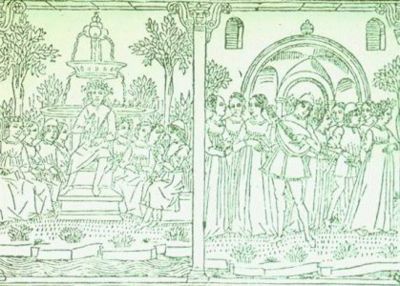
This is an illustration from a copy of The Decameron, ca. 1492. This image was taken from Wikipedia.
Rabelais and Medieval Gusto
Francois Rabelais did not pen many works. The histories of Gargantua and Pantagruel can be considered a masterpiece, but without admiration for the author the reader can be repelled by the stretches of dullness, long passages that are about nothing in particular.
The book is full of irreverent gusto; lusty, earthy and gross with peasant-like animalism, all written in protest of things like formalized literature and solemn pretences.
There are few consistencies in Rabelais and no certainties whatsoever, the books were never re-read, polished or corrected. Conversation, jocosities, parodies, anecdotes, jibes, word-exercises and inventions, stinging satire, pleasing pictures of peasant life, affectionate characterizations of friends, literary criticism, obfuscations � all pour out his mind.
In 1494 a book written by Sebastian Brant called Narrenschiff (The Ship of Fools) was printed. It was the beginning of the revolt against narrow ecclesiastical authority, inquisitorial methods, intolerance, and dead literature in dead languages. It inspired Praise of Folly by Erasmus and Gargantua and Pantagruel.
Erasmus was a learned Franciscan Monk. He sided with neither the Papists, the Protestants or with kings. Erasmus wrote his treatise The Christian Prince, in which he argued that the common rights of humanity were more sacred than the rights of kings and that the Gospels of Jesus Christ should not be kept in an obscure language and taught through �interpretations� but should be available in clear language to all. In Praise of Folly, Erasmus accuses the Pope and prelates of being grasping and avaricious, frivolous and extravagant, imitating the princes in their vices and luxury, deaf to the pleadings of the poor, careless of the instruction of the masses, putting money above Christ�s teachings.
Gargantua and Pantagruel is irreligious, blasphemous and salacious enough that the Faculty of Theology of the University of Paris convinced Rabelais to make revisions, but in doing so he added things damaging to the respect and authority of the Faculty. In 1543, 12 years after its publication, the Faculty put it on its list of proscribed books. The presses subject to ecclesiastical authority could not print it, and Catholics were expected not to read it.
Rabelais was born in the year 1495. His father was either an apothecary or innkeeper, or both, at Chinon in Touraine. He also owned a vineyard adjoining the Benedictine abbey of Seuilly and it was at the abbey�s school that Francois was instructed in the ways of the clergy. When Rabelais was 15 he enrolled at the monastery of la Baumette where he befriended Geoffrey d�Estissac who later became bishop of Maillezais, and the brothers du Bellay who later rose to power as papal ambassadors, cardinals and soldiers.
Students at that time would wander from one school to another as a means of augmenting their education. After this he entered the Franciscan monastery at Fontenoy-le-Comte. These friars, according to Rabelais (and Mr. Rascoe) took a vow of ignorance saying that knowledge was for heretics. It is suggested by some of Rabelais� biographers that his parents sent him to stay with this order because they did not have the money to send him elsewhere. Whether or not Rabelais was fit for the clergy he became an ordained priest. While he was with order for five years Rabelais sought knowledge, aided by a fellow monk named Pierre Amy (or Lamy) who smuggled books into the monastery. These books were in Greek, some textbooks in Hebrew; there were also books on Arabic and Roman law.
At Fontenay, Rabelais and Amy formed a group that discussed all things intellectual. Among their topics were the accomplishments of men like Columbus, Copernicus, Leonardo da Vinci, Michelangelo, Raphael, Titian, Durer, Erasmus, Cervantes and Lope de Vega. The Faculty of Theology at the University of Paris declared to study of Greek to be heretical. Some monks informed the University that Amy and Rabelais had books in Greek hidden in their cells and the books were confiscated and the two rebels were put in solitary confinement.
Amy escaped from the monastery and absconded to Switzerland where he renounced Catholicism and became a Lutheran. Rabelais appealed to his former schoolmate Geoffrey d�Estissac who had become Bishop of Maillezais and presided over the Benedictine Abbey. He enabled Rabelais to transfer to the Benedictine order, appointed him as a canon and made him his private secretary. Rabelais had also studied medicine and in 1530 he was admitted to the college of medicine at the University of Montpellier where he receive a degree of Bachelor of Medicine. He was then became a lecturer on anatomy. While at Montpellier Rabelais may have written a comedy called The Man Who Married a Dumb Wife.
By the time Rabelais was 35-years-old he was a practicing physician at Lyons. In 1532 He published his Latin translations of the medical works of Hippocrates and Galen. He had also edited a small book of folk tales called Les Grandes et Inestimables Chroniques du Grand et Enorme Geant Gargantua. From this an idea was born, which led to the first installment of Pantagruel. It was titled The Horrible and Dreadful Feats and Prowesses of the Most Renowned Pantagruel. It was signed with the pseudonym, Alcofribas Nasier, an anagram of Francois Rabelais. The book was a success. At this time Rabelais was appointed head physician on the staff of the city hospital of Lyons. This, not his authorship, provided him with financial security. The only other source of income came the last years of his life as the parish priest of Meudon in the diocese of Paris.
Shortly after the publication of Pantagruel Rabelais was summoned by Jean du Bellay to accompany him on a mission as his personal physician and private secretary. Du Bellay was sent in an attempt to reconcile Henry VIII of England and the Holy See, at the request of the French King Francis I. This would join England to Rome and check the power and encroachments of Charles V of Spain. The mission failed and Pope Clement VII excommunicated Henry (for divorcing his wife, Catherine of Aragon, an aunt of Charles V) and intensified the hostilities between Catholics and Protestants.
At this time Rabelais lost his job at Lyons city hospital after he made his two trips to Italy without notifying the hospital, finally being replaced in the year 1535. After this, Rabelais made one more trip to Italy as du Bellay�s physician. On his return to Montpellier he produced his second book of the History of Gargantua and Pantagruel. He also returned to practicing medicine. In 1551 at age 66 he received his appointment as cur� of Meudon and would also wrote the concluding adventure of Pantagruel, with bitterness replacing the gayety of his earlier writings. He then left Paris for Metz for the position of city physician.
Rabelais had an illegitimate son, and possibly a daughter as well.
He was dismissed from his position of city physician in 1547 after only one year. The reasons for this are unknown, but could have been due to political reasons, his irresponsibility, or possibly a drinking problem. Rabelais died in the year 1553. He last will stated: �I possess nothing; the rest I give to the poor.� His last words were: �Draw the curtain: the farce is ended.�
A summary of Gargantua and Pantagruel:
This story is vaguely about the life and adventures of Grandgousier, his son Gargantua, and his grandson Pantagruel. The three are adept at drinking, fighting and disputation. Grandgousier is coarse and brutish, Gargantua less so and Pantagruel is learned, dextrous and cultivated. The book begins with a burlesque genealogy and a burlesque poem. The record of Gargantua�s birth (after an eleven month pregnancy), his childhood and education follows this. Detailed next are Gargantua�s escapades in Paris, his war against Picrochele and the building of the Abbey at Theleme. The Thelemites, who resided at the abbey, had a motto: �Do what thou wilt.� They are an honorable community. The most favorite character of the book is Friar John of Entommeures, the abbot of the abbey and the wit of all discussions, whom Rabelais uses for satirical effects, directed against all religious practices and especially against monastical institutions. The author feels that Rabelais is a product of the middles ages, not of the Renaissance. He protests against refinement, filling the book with what the author thinks are intentional errors, so many that the corrections are so numerous that the notes bulk larger than the text.
Rabelais was anti-clerical. Another biographer, Joseph Spencer Kennard stated in his book The Friar in Fiction: �� Rabelais sought destruction � of Catholicism and Christianity ��
Villon and Medieval Music
Francois Villon was born Francois de Montcorbier of poor and uneducated parents across the river from the University of Paris. When Francois was an infant his father died and when his mother could no longer provide for him she sought help from a priest at the University who was not only affluent, but also a distant relative. After decades of wars, rivalries, excess and invasion by the English, France was suffering in poverty and ruin. Francois was five-years-old when Paris was struck by a brutal winter. The countryside was devastated, no sustenance was available and forty-five thousand inhabitants perished from famine and the plague within a few months. The survivors lived off offal and famished wolves prowled on the outskirts of the city. Those who had some wealth remaining ate fish from the Seine, ducks and wild geese from the moats and wine. The conditions of poverty and famine would plague Francois later on in his life.
Francois was taken to a priest named Guillaume de Villon, chaplain of the University church and professor of canon law. He probably introduced Francois to the Latin and French poets and gave him Eustace Deschamps� Art de dictier, which prescribed the rules for composing ballads. It was at the age of thirteen Francois became a candidate for the degree of Master of Arts, in ecclesiastical law in doctrine and the elementary humanities. When the degree would be obtained Francois would be eligible for benefices and open a career for him in the profession of religion. Francois also adopted his foster-father�s name, and would be known as Francois Villon.
Villon profited little from his studies and knew very little Latin and this may be from a lack of incentive, not a belligerent attitude. Other things that may have had an effect on Villon was church corruption and corruption at the University, the hopelessness of French citizens in comparison to the wealth of ecclesiastical authorities and the resentment of the poverty-stricken commoners towards those with ecclesiastical careers who lived at ease off of the tithes from peasants and tradesmen. Over time Villon aligned himself with the suffering poor and not with University students.
Villon was adept at writing verse, reciting ribald and topical songs in taverns where patrons would provide wine and food in return. He also found companionship in the taverns and deserted the cloisters at the University. And just as important was that the taverns were warmer than his room at the University and although his tavern buddies were of ill repute, they were better company and provided Villon with an abundance of subject matter for his songs, and learned to speak in their �language�. At age nineteen Villion became Bachelor of Arts and another three years of education he became Master of Arts. However, Villon put no great importance to this and chose a life of poet-artist and vagabond. And for a time he also was in the company of strolling players, jugglers, acrobats, musicians and reciters of verse and producers of miracle plays.
In 1455, a priest named Philip Chermoyne attacked Villon, who was twenty-four-years-old at the time. Villion was seated in the Rue St. Jacques outside the cloister he and his foster-father resided in. With him are a woman named Ysabeau and a priest named Gilles. Chermoyne, according to Mr. Rascoe, was not only holding a grudge against Villon, but was also drunk that evening. Accompanying Chermoyne was Master Jehan de Mardi [whom I assume was an authority figure at the University]. Regardless of who he was, he, and the others fled when Chermoyne laid a hand on Villon. Chermoyne then slashed Villon across the face with a dagger, doing serious damage to his lip. Villon then stabbed Chermoyne in the groin with a dagger of his own. They then wrestle and Villon flees with Chermoyne in hot pursuit. Villon then throws a stone at his attacker, hitting him in the face and sending him to the ground.
Villon went to a barber-surgeon to have his lip dressed and the barber asks for his name and an account of the altercation in case the police inquired. Villon gave a fictitious name along with the other details. Meanwhile, Chermoyne was found and taken to a hospital. But with a cracked skull and blood loss from the stabbing, Chermoyne died about a week later.
An order was out for Villon�s arrest. He is away from Paris for an entire year banished by royal edict under pain of hanging if he returns. His whereabouts are unknown although there are many conjectures. In the Grand Testament there is a �bequest� to Perrot Girart, barber of Bourg-la-Reine, a village not far to the south of Paris, �two basins and a pitcher, since he works so hard for his living. It is just half a dozen years ago since he fed me at his house for a whole week on fat pork � witness the Abbess of Pourras.�
The Abbess of Pourras may have been a real person. According to D.B. Wyndham Lewis she was a notorious actress named Huguette de Hamel: �She had taken the religious habit in 1439, had become Abbess of Port-Royal [popularly Pourrais or Pourras] in the Chevreuse valley near Paris in 1454, and then, by swift degrees had gone completely to the bad. In the year 1455 when Villon knew her or pretended to, her conduct was not the subject of more than local gossip; but by 1463 the scandal had become such that the Abbot of Chaalis, her superior, who had her placed under observation, degraded her from her office and thrust her into the prison of the abbey of Pont-aux-Dames, in the diocese of Mieux, to cool her hot blood and being her to penitence and obedience. Among the charges brought against he were that �she attended feasts and revels, disguising herself, with gallants, and behaved in such a manner that the men-at-arms put her into a ballad.� The author concludes that Villon is saying that he spent a week with the abbess in the boarding house of Girart.
How Villon earned a living that year is yet unknown. Some scholars claim that he joined the Coquillards of Burgundy, a gangster organization. They were originally mercenaries who fought for pay against the English and Burgundians, but the Peace of Arras ended that and they then, on a smaller scale lived by plundering the countryside. Villon was definitely a member of a branch of the Coquillards in Paris, because he wrote seven ballads in their jargon, and tells us repeatedly that he was.
Also written by Villon was the �Ballade of Francois Villon and the Grosse Margot� a work that had caused much dispute over its translation, due to a failure to read it carefully and the mistranslation of the word �paillard� to �pimp�. In this poem Villon says that he was the waiter in the �bourdel� and Margot�s lover.
Villon lusted after many women, one of them, Katherine de Vauselles, is known. Mentioned in a double ballade found in the Grand Testament (about one of his adulterous misadventures): �Take a poor fellow like me. I�ll give you an incident. Once I flayed the way laundresses flay shirts hen they are washing them in the river. I give you my word. And I was stark naked when I got the beating. �Now, who do you suppose got me into that jam? �Katherine de Vauselles, no less � Old Noah himself was the one who did the job.� If this was an actual event and this woman did exist, her name might not have been Katherine.
So Villon had been banished from Paris at age twenty-five and about a year later Charles VII, convinced that the killing was in self-defense, pardoned him and signed the Letter of Remission. The author then states that Villon may not have been absent from Paris that year, but just kept under surveillance by the undercover police. Villon whereabouts are recorded late 1456 in Guillaume de Villons house, leaving a note in the form of a poem since he is once again leaving town. This note is called the Lais or �Will�, known to English readers as �The Little Testament�, to distinguish it from his major work Le Grand Testament, written six years later. He has participated in a crime that will not be discovered until three months later. Included in this note is an alibi to the police, that he is leaving town due to a �broken� heart. He wishes his foster-father well, forgives the woman who betrayed him and with humor jokes about members of the underworld and the police force, except the chief of police. He finishes with �By God, Francois Villon is a poet and these other fellows who have money and good looks will soon be forgotten while Francois Villon will not.�
In March of 1457 his crime was discovered. As a burglar in a gang led by Guy Tabarie, Villon, Tabarie, Colin de Cayeux and someone known as �Shorty Jack� broke into the chapel of the College of Navarre, picked the lock of the treasure chest and stole five hundred gold crowns. The police suspected Villon and Colin since their whereabouts were unknown.
In July Tabarie was arrested for a different crime and offered immunity from prosecution for information on the burglary at the chapel. He named his accomplices, but since two were out of town only �Shorty Jack� would be punished. Villon and Colin were banished and �Shorty Jack� went to jail. The money was never recovered and within a year Tabarie is in jail again.
Villon made off with 125 gold florins. He was absent from Paris for five years; his whereabouts and activities can only be deduced by reading his Grand Testament. He wandered about Brittany and Poitou, went to Dijon and got as far south as the Dauphin�. He also spent time at the court of the Duke of Orleans, who was a patron of the arts. He also spent much time and money on women.
Unfortunately for Villon his banishment was from the Kingdom of France, not just Paris. So in Meung in 1461 Villon is in jail. Thibault d�Aussigny, bishop of Orleans saw to it that he was punished for his crimes. Villon was subjected to water torture, which made him confess to other crimes besides robbing the chapel. He was then put into a foul, underground dungeon of the castle Meung and for an entire summer ate nothing but stale bread and water. This ruined Villon�s health, reducing him to skin and bones and turning him into a hairless, toothless wreck with a hacking cough.
This caused Villon to hate Thibault, and he heaped execration upon him in the Grand Testament. What spared him from prison and death was a custom concerning the monarchy. When a new king passed through one of his subject cities for the first time the prisons were opened and the criminals were set free. When King Louis XI entered Meung, Villon and the other criminals were set free in October 1461. When Villon returned to Paris he is so ravaged from his imprisonment that no one recognizes him. He then writes his �Grand Testament�, a review of his life written at the age of thirty. Included in this work is macabre humor about a trip to the gallows and also mentioned are his numerous partners in crime and their fate. Villon bares his soul, but he appears to have also been an unregenerate one. The author describes Villon�s souls as being a fine soul, one of the most beautiful in all literature, tender humble, sensitive, frank and honest. Yet, Villon asks himself what crimes he has committed and concludes that he has not committed any! He also asks for forgiveness and forgives those who had wronged him. Shortly after finishing his work Villon is in jail again, over his owing 125 crowns to the College of Navarre. Villon says he will repay and is released. A few days later thugs beat a clerk, and Villon, who is near the scene is assumed to be guilty. His past criminal acts are brought against him and Villon is sentenced to hanging. Villon appeals and a review of his contributions to literature spares him. As a poet he had been a guest at the court of Charles, the Duke of New Orleans, written there and was honored by Charles. Villon also wrote patriotic verses, was freed from prison by Charles, wrote a poem celebrating Charles� daughter. These things help lessen the sentence to ten years banishment, on January 1463.
This is the last Villon is heard of and the date of his death is unknown. Fifty years later in Touraine, Rabelais head stories of Villon, who had become a legend. Rabelais used these stories of reckless bravado in creating the character of Panurge in The Horrible Deeds and Prowesses of the Well-Renowned Pantagruel, King of the Dipsodes, son of the Great Giant Gargantua.
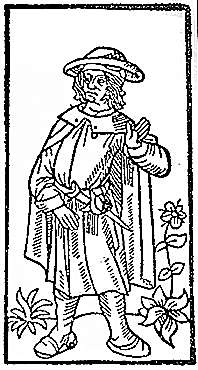
This is a stock woodcut image, used to represent Fran�ois Villon in the 1489 printing of the Grand Testament de Maistre Fran�ois Villon. This image was taken from Wikipedia.
