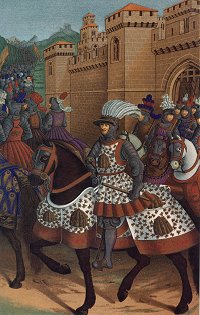
Becoming a Knight:
Feast held in his honor with singing and music. His attire laid out for guests to see: Spotless white shirt, costly robe of ermine, golden spurs. Bathes and dresses: white shirt, brown silk hose, white outer-girdle and crimson robe.
To chapel of parish church and prays all evening, stands or kneels for 10 hours. There is a lamp on the altar and large candles beside altar. The weapons and armor are also on altar. Mass the next morning. Knight put on sword and spurs.
Taken to his lord and kneels, and a knight dubs the new knight by tapping him on the shoulder with his sword, then delivers the accolade by saying something like: "In the Almighty's name, I dub you a knight. Be worthy, valiant and humble". Led out of church, hailed with cheers, and the new knight eats breakfast.
Later in the day the new knight goes to the courtyard, where the others await him. Two loud trumpets, singers, priests and monks greet him. The knight followed by all present to the grounds by the garden to a platform covered with carpets. Sponsor kisses knight, puts spurs on him. 2nd and 3rd sponsors put on his steel hauberk and helmet. 4th sponsor puts sword on the knight and says, "Use it worthily".
Moral instruction and encouragement offered and the new knight takes the oath of knighthood, declares his commitment to justice and faith.
Music begins. He leaves the platform, runs to his horse and leaps onto its saddle. Crowd applauds; his squire brings his lance and shield. There is a jousting tournament in his honor the next day.
The following is a list of things pertaining to medieval knighthood, warfare and weaponry:
arbalest��also known as a crossbow. It was a steel bow set crosswise in a shaft of grooved wood. Arrow placed in the groove, the bowstring pulled back by a crank windlass (a crank with a wooden handle). This pulled the string over a notch on the stock of wood and then set off by a trigger. Could also shoot iron balls or stones.
armiger��A squire who was a knight's armor bearer and companion.
armor��originally of chain mail, the heavy suit came in the 14th century.
ballista��a machine shaped like a crossbow, used to throw heavy stones.
battering ram��large beam with a head of iron shaped like the head of a ram. Used to beat down walls and gates.
basinet��a small, round steel helmet often with a visor. Attached to it would be the chain mail.
battle-axe��a heavy axe with a long blade.
camail��a neck guard attached to the helmet, made of chain mail.
caparison��ornamental covering, laid over the horse's saddle.
cat��a moveable shelter used for protection by soldiers involved in the siege of a castle.
coat of arms��heraldry worn on a knight's blouselike garment called a tunic. The emblem also painted on his shield. Also known as heraldry.
crossbow��a bow set on a wooden stock. Arrow placed in the groove of the stock, bowstring pulled back by a crank windlass over a notch and released with a trigger.
cuirass��armor to protect the chest and back.
cuir bouilli��boiled leather shaped for use as armor or helmet.
destrer��a knight's war horse.
dexter--in heraldry, the right side of the knight's shield (sinister is the left side).
greaves��leg armor from the ankles to the knees. Late middle ages.
gambeson��a quilted or leather tunic stuffed with wool, worn as armor.
gorget��armor to protect the neck.
halberd��a wooden pole with a steel point and a flat piece of sharpened steel at both sides or on one side and a point at the other.
helmet��originally a plain conical steel cap encircled with a band of metal and a nasal (a metal bar to protect the nose). Laced to the hauberk with leather straps. Visors were added in the early 13th century.
hauberk��hooded medieval coat of armor made of chain mail. Weighed 55 pounds.
heraldry��a design on a knight's blouse (or tunic) in the form of an animal, mythical creature, fleur-de-lis, swords, cross etc.
Hospitallers��knights who aided pilgrims in the Holy Land.
javelin��a light spear for throwing.
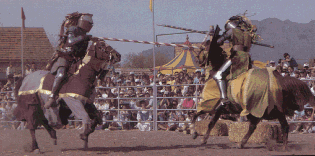
joust��competition between two knights who rode towards each other, trying to knock each other from their saddles with a lance for a monetary prize.
list��the field on which the jousts were held, surrounded by stands for the spectators (all "nobility", not peasants). Barrier added in the 15th century, a cloth-covered rope or wooden barrier that was used to separate the contestants.
lance��a ten foot long weapon made of wood with a sharp-pointed head made of steel. Used by knights on horseback.
Lances used in tournaments were made of softer wood to lessen the chance of injury.
longbow��a large bow for shooting arrows. Easier to explain than a crossbow.
melee��name of tournament between opposing knights who used lance, mace and sword.
mangonel��another device that threw large stones.
mace��iron headed war club with a long handle.
morning star��a wooden ball embedded with iron spikes at the end of a pole, or swung by a chain attached to the pole.
pennon��the brightly-colored feathers attached to a knight's helmet.
press gang��men who abduct others and force them into military service or slavery. Now known as community service for students.
sappers��mining engineers who weakened castle walls so troops can enter.
scutage��a knight's tax paid in lieu of military service.
shield��made of hide with wood behind it. Held together with a metal ring.
scabard��the leather sheath that held the sword.
sinister--in heraldry, the left side of the knight's shield (dexter is the right side).
spear��made of wood from 6-8 feet long with a metal point.
spetum��another thrusting device with a sharp point.
sword��Nearly three feet long, swords were adorned with gilt and set with pearls. The pommel (the knob at the held end of the sword) contained small saints relics behind a bit of crystal.
surcoat��loose, short cloak worn over armor.
tilting��another name for the joust.
tabard��a short-sleeved blazoned cloak worn over armor.
tournament��mock battle that began in France circa 850-1100. A climax for weddings and addubments. Two armies battled each other for several days. Captured knights paid ransom or gave horse and armor to their captives. If you're going to maim and kill people you might as well have fun doing it and win some nice prizes. Replaced by the joust in the 13th century.
Templars��the Templar Knights were a monastic order formed in the 12th century who protected pilgrims in the Holy Land.
visor��the moveable face shield of a helmet.
voulge��a sharp pointed knife at the end of a spear.