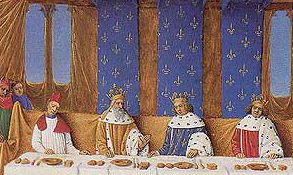
Painting from: godecokery.com
Key words to help define what a king was:
Feudal system: the king owned all the land in his kingdom. The land was divided among his barons who were allowed to build fortified places of residence in return for their loyalty.
Fealty: the pledge of loyalty from the barons. They could either support the king militarily or monetarily.
William the Conqueror:
Was king of England from 1066-1087.
1087: William's son William Rufus is king.
1100: After William Rufus died in a hunting accident his brother Henry becomes king. Henry's heir dies in the year 1120.
1128: Henry's daughter Matilda marries Geoffrey Plantagenet, the Duke of Anjou, France (he would also be the Duke of Normandy).
1135: Henry dies, his nephew Stephen (the son of William the Conqueror's daughter) is selected to replace him.
1136: Matilda seeks the throne, and civil war (1139-1148) is the result, until she is defeated.
1154: Stephen dies and Matilda's son Henry II becomes king.
King Henry II: Born 1133, died 1189. Family name: Plantagenet (the Angevin Empire). Married Eleanor of Aquitaine (France). King of England from 1154-1189. Was also lord of over half of France.
1154: Churchman Thomas � Becket becomes Henry's chancellor (the highest officer of the Crown).
1155: The pope bestows Ireland on Henry.
1163: Henry and Becket (now Archbishop of Canterbury) begin quarrel over Henry's power struggles with the church.
1169: Intervenes in the struggles between Irish kings, and his earls and soldiers start claiming land in Ireland.
1170: Four Norman knights murder Becket, but Henry claims innocence.
1171: Goes to Ireland and the Irish kings and the English earls in the east and southeast do homage.
1172: Eleanor and her sons rebel against Henry, who signs peace treaty with son Richard.
King Richard (a.k.a. Richard the Lionhearted): Born 1157, died 1199. Henry II's son. Spoke French, not English.
1191: Joined the Crusades, Prince John ruled in his absence. Richard was one of the few victorious Europeans to lead troops to the Holy Land, getting a peace treaty from Sultan Saladin that allowed pilgrims to travel to the Holy Land. Richard and his father drained England of most of its finances. On return from Holy Land, was held hostage by his enemy Duke Leopold of Austria, freed with ransom payment. Struck by arrow at Chateau Galliard, a castle in Les Andelys, France. He later died of gangrene.
King John: Born 1167, died 1216. Henry II's son. Lord of Ireland at age 19.
1185-1186: Could not suppress Irish rebellion, but returned 25 years later to victory. Tried to usurp kingdom from Richard, hid in France when the king returned from the Crusades.
1190: Relatives in France favored his nephew Arthur.
1193: John revolted.
1203: Ordered the execution of 16-year-old Arthur, and imprisoned niece Eleanor to secure his kingdom (they were children of John's deceased older brother Geoffrey). Eleanor was kept in confinement for 40 years until her death.
1210: Tore through eastern Ireland, punishing the rebellious Irish king and Norman barons. Money needed for war against France.
6-15-1215: Barons force him to sign the Magna Carta at Runnymede (political and civil liberties for barons, but not for peasants). John reneges and raises taxes.
1216: King Alexander of Scotland defeats John in battle. After John rejects the Magna Carta, the barons revolt. They want King Louis of France to be king. John rides northward to fight barons. Lost the baggage train in Wilestrem River that held his crown, jewels and other valuables. After a surfeit of peaches, wine and cider John died of dysentery. This ended the war.
King Henry III: Born 1207, died 1272. John's son. Became king at age 9.
1216: There were still French troops in England when Henry became king. Five prominent men in the dispersal: William Marshal and Ranulf de Blundeville led the army and the French mercenary Falkes de Breaut� commanded the archers. Hubert de Burgh and King John's illegitimate son Richard Fitz-John lead the naval defenses against French reinforcements.
(Willliam Marshal was a knight and the marshal of England, overseeing military affairs. Served Henry II, Richard, John and Henry III. Along with De Blundeville and De Breaut�, Marshal routed the French in the battle known as "The Fair of Lincoln", De Breaut�'s archers on the rooftops firing at the French soldiers below. Marshal was at one time the richest man in England with land in France, England, Wales and Ireland.
De Burgh was John's seneschal (chief justiciar) in Poitu, France and chamberlain (in charge of the royal household). Under orders for John, he oversaw the execution of Arthur, but spared him from torture. Was justiciar and constable, ruling the kingdom until Henry was 19-years-old.)
1217: Treaty of Kingston, French king departs. De Burgh in charge of England until Henry is an adult.
1227: Henry begins rule (age 19).
1228-1230: Failed attempt to regain French land.
1236: Married Eleanor of Province (France). Henry's in-laws enter England, the priesthood and his administration. They abuse their power over the barons.
1239: Son Edward is born.
1241: Henry's mother Isabella and Hugh le Mann plan a rebellion in France. Henry agrees without the baron's consent, and is defeated in Poitu.
1254: Wanted crown of Sicily for deformed son Edmund (nicknamed Crouchback). Pope fights for Henry against Germany in Sicily. When Henry won't pay full amount for war effort, Edmund loses his kingdom.
1259: After failed attempts to regain French land (1230, 1242 and 1253), Treaty of Paris signed with Louis IX to preserve Gascony land. Was lord and duke of Gascony (Bordeaux, Bayonne and other south lands also his. Henry becomes Louis' vassal while losing north territories (Normandy and counties of Poitu, and Plantagenet possessions of Anjou and Maine. Also lost Channel Islands. He was lord and duke of Aquitaine. The treasury was empty and Henry was in debt due to Church and wars with France.
1264: Simon de Montfort, Earl of Leicester and Henry's brother-in-law, leads disgruntled barons in a civil war, but is defeated.
King Edward: Born 1239, died 1307.
1265: Led loyal barons in the defeat of De Montfort. After the civil war Edward was active in the ruling of England even though Henry was still king.
1270: Joins the Crusades. When Henry died, Edward was in Acre, recovering from assassin's wound. As king, he tried to unite Britain into one kingdom.
1283: Defeated the Welsh and named his infant son Edward II the Prince of Wales.
1295: Keeping De Montfort and the civil war in mind he made reforms to Parliament.
1296: Declares himself the King of Scotland and takes the Stone of Scone (Scottish coronation-stone) to Westminster Abbey.
1297-1305: Second conquest of Scotland.
1307: After another rebellion, Edward dies during an expedition against Robert Bruce. Edward II lost Scotland in 1315 to Bruce. After a couple of failed attempts by the Scots over the following centuries, The Stone of Scone is returned to Scotland in 1993.
Edward II: Born 1284, died 1377.
1301: Was given the title "Prince of Wales", the first heir of the throne to be known as such.
1327: As king, after many disputes with English barons and with King Charles IV of France, his Queen Isabella and the barons revolted against him. He was deposed by parliament and finally murdered.
Edward III: Born 1312, died 1377.
1327: Led England in a battle against the invading Scots. This led to a treaty in which the entire independence of Scotland was recognized.
1346: Successful war in France against King Philip, gained land and a truce. His son Edward the Black Prince fought in that war.
He was the father of Richard II.
Richard II: Born 1367, died 1400.
1377: Replaced his grandfather as the King of England, a council of regency managed his kingdom until he was of age.
Had a tumultuous reign.
1399: Deposed and succeeded by his cousin, Henry of Bolingbroke and was murdered the following year.
The following is a list of the kings (and queens) of England, from William the Conqueror through the Renaissance:
(1066): The Normans conquer Anglo-Saxon England.
William I, the Conqueror (1066-87)
William II, Rufus (1087-1100)
Henry I (1100-35)
Stephen (1135-54)
Empress Matilda (1141)
The Plantagenet, Angevin Line, Henry II also coming from France.
Henry II (1154-89)
Richard I (1189-99)
John (1199-1216)
Henry III (1216-72)
Edward I (1272-1307)
Edward II (1307-27)
Edward III (1327-77)
Richard II (1377-99)
Plantagenet, Lancastrian Line
Henry IV (1399-1413)
Henry V (1413-22)
Henry VI (1422-61, 1470-1)
Plantagenet, Yorkist Line
Edward IV (1461-70, 1471-83)
Edward V (1483)
Richard III (1483-5)
House of Tudor
Henry VII (1485-1509)
Henry VIII (1509-47)
Edward VI (1547-53)
Lady Jane Grey (1553)
Mary I (1553-58)
Elizabeth I (1558-1603)
