
�Put your rear in a chair and read about Furniture of the World�!
�Put your rear in a chair and read about Furniture of the World�!
Well, what can I say? This page is about furniture, a subject that is not as amazing or exciting as human history. After all, a chair gets little action unless someone hurls it across the room at someone else. Be that as it may, I was still able to glean quite a bit of information from the book, which is profuse with photographs; many of them in color, and this makes the book worth buying especially if furniture interests you. So if you like to look at pretty things and are tired of looking at Julianne Hough (I know I am), you might be interested in getting a copy of Furniture of the World.
As always with this website I include some information concerning ancient history and recording mostly what pertains to the Medieval and Renaissance eras, drawing the line roughly at the mid 17th century.
Furniture of the World by Peter Philp � 1974
The Use of Materials
Wood
Wood has always been the most popular material used for making furniture. Many other products have been used as embellishments. The various types of wood used in furniture making varies from countries and regions.
Veneering: the application of a thin sheet of decorative wood to the outside of a piece of furniture goes all the way back to Egypt and revived in the 17th century. The thin slices of wood were cut parallel to each other and had nearly an identical figure in the grain. The pieces were used to make symmetrical patterns.
�Oyster� veneers popular in the late 17th century were cuts along the grain of small branches or small trees, such as laburnum, that utilized the annual rings as decoration.
�Burr� or �burl� veneers were obtained from cuts along the roots of walnut and elm trees. Mahogany and satinwood are cut at angles and oak has silver grain with pale, feathery markings when cut lengthwise.
Inlaying: different woods of contrasting color, a smaller piece being placed into the open space of a larger piece.
Marquetry: developed in the 17th century. The inlaying of a veneer ground with other veneers to make a pictorial design.
Parquetry: geometric patterns made from small squares of contrasted veneers. The varying colors and grains would give the effect of an optical illusion of a three-dimensional perspective.
Marquetry and parquetry designs were flower and plant forms. Delicate leafy scrolls, symmetrically arranged, are known as �seaweed� marquetry. The Italian tarsia designs combined pictorial and geometrical inlays for images of landscapes with buildings. Germans also has a similar technique.
Metal
An alternative to wood and also used as accessories; bronze chairs and tables in ancient Rome, wrought iron in Spain and cut steel of Russia.
Glass
According to this book the ancient Egyptians and Syrians invented glass [although I think I read somewhere else that the Phoenicians were involved], but it was not until circa 1507 that it was used as furniture. Mirror glass came from the island of Murano near Venice. One hundred years later it was still in limited supply, the sheets of glass were small and very expensive. In circa 1680 the improvements were made in French factories and larger sheets of glass could be made. �Toilet� or �swing� mirrors for dressing tables consisted of one plated of glass and were popular in the late 17th century. About this time a machine was invented that beveled the edges of the mirror for an easier fit into the frame. Bookcases with clear glass panes were made as far back as the 1660s, in wider use one hundred years later.
Porcelain
Used by the Chinese in the Ming dynasty (1368-1644) for headrests and from the 17th century onwards for tiles inserted into the backs of chairs and the tops of tables. The earlier form of decoration was painting in blue under the glaze.
Handles and other accessories
During the late Gothic and Renaissance periods in Northern Europe the most common type of handle was a small, turned wooden knob. A wrought iron ring, triangle or pendant drop suspended from a back-plate, probably originating in Spain, would replace these knobs. The popularity of brass began in 1650.
From 1600 to 1700 Holland and Britain favored brass pear-drop or acorn handles that were fixed by means of a �tang�, a thin strip of brass that passed through a small hole at the top of the drop and through the thickness of the drawer front and secured with small nails.
Hinges
The first hinges were made of leather, but the Egyptians made them out of brass, circa 1575 BC. In medieval Europe the lids of chests were hinged on the outside with straps of iron, which were often finely wrought. In Britain the �cock�s head� and �H� patterns were popular in the 16th and 17th centuries. The common �butt� and �backflap� in brass or iron were in fashion circa 1680.
Leather
The finest 16th century leatherwork in Europe was in Spain, from the region of Cordoba in particular. The work was elaborately tooled and colored, with a strong Islamic influence, due to the earlier Moorish occupation. The leatherwork was known as guadamecil. After the mid 17th century equally fine work was produced in the Low Countries. It was fastened to chair frames, chests and screens with brass or iron nails. In Northern Europe in the mid 17th century plain cowhide was also used for the seats and the backs of chairs.
Paper-m�ch�
Originated in the East, then to France and Britain in the 17th century. This material is made by: soaking sheets of paper in a mixture of glue and paste, pressing into moulds, drying and then dipping into oil.
Stone
Was used by ancient peoples for ceremonial seats and altars. In 16th century Florence, mosaic work or pietre dure, was either a design of tiny colored stones bonded to a marble base with plaster, or arrangements of semi-precious stones set in relief onto a wooden base.
Plaster
An Italian technique of the late 17th century, the overlaying of a wooden surface with a special type of plaster called gesso that could be carved and gilded. Scagliola was a substitute for pietre dure made by mixing small pieces of marble in a mixture of plaster and glue. Stucco lustro is plaster painted to simulate marble.
Varnishes and polishes
Oil varnish, resin dissolved in linseed and poppy oil, was used in Northern Europe until circa 1660, replaced by a version of lac and spirits of wine. Country-made pieces of furniture were usually oiled and polished with beeswax and turpentine.
Nails and Screws
Iron nails go back to ancient times, but as they rusted away the furniture fell apart. The furniture held together with wooden dowel pins, however, have been able to survive the ravages of time. After circa 1600 hand-made screw of steel or brass replaced iron nails and wooden dowels.
Textiles
Upholstered seat were rare until the 17th century, and even then, only for the affluent. During medieval times the hard wooden chairs were softened with cushions, often decorated with needlework by the lady of the house. Italy established a textile industry in the 16th century the expensive velvets of Genoa and the silks of Lucca commanded a world market. These crafts spread northwards, and weavers migrated to Britain in 1560 and produced wall hangings, drapes for beds and cushion covers. In the early 17th century carpets were imported from Asia Minor into Europe to be cut up and used to upholster the seats of chairs. Imitation carpet work came mainly from Britain and Holland. Both the original and copies became known as �Turkey work�.
Medieval Flemish weavers were renown for their skills as tapestry makers. In the 1660 some settled in England and helped to establish the famous factory at Mortlake in London. The Gobelins factory established by Louis XIV on the Parisian outskirts produced even more splendid tapestries and other upholstery fabrics along with the fine furniture for use in the royal palaces. The persecutions of the French Huguenots brought about the migration of many weavers to Holland and Britain between the years 1685 to 1690, greatly assisting the textile industries in those two countries.
The Furniture of the East
Chinese furniture is divided into three main categories: hardwoods � mostly types of rosewood sometimes inset with panels of porcelain, marble or woven grass; lacquer on a foundation of softwood, usually pine; bamboo � mainly for outdoor use in good weather.
Construction was mainly the mortise and tenon joint and the dovetail, with the corners carefully mitred. Nails and screws were normally used for affixing metal mounts. The Japanese were inspired by Chinese furniture design, though they developed their own unique style. The Japanese limit the number of pieces in a room, but frequently change the arrangement. Their walls are also ever changing, as they are made to slide. The kimono rail is adorned with lacquer and engraved metal mounts. The sword stand was decorated even more lavishly.
The Portuguese were the first to trade with Japan in the 16th century, but later the ports were closed to all foreigners, only the Dutch remaining until the United States arrived in the second half of the 19th century.
The Table
The Chinese use a low table, originally placed on a platform called a k�ang, for reading and writing. Very low versions of these tables had cabriole legs that ended in square feet were made in the 15th century. Over time these tables were used without the platform and were made higher with straight legs. There were also side tables constructed on the trestle principle. The Japanese sat on the floor to eat and also had low tables some modeled on the k�ang while others were eight-lobed trays that had cabriole feet. In Persia, Turkey, Arabia and Morocco small table were used to serve coffee. They were octagonal in shape and intricately inlaid with bone or carved with shallow crisp designs.
The Chair
Chinese hardwood chairs were square seats of solid wood or marble originally topped with cushions. The legs are usually straight and square with slightly rounded corners. They are connected near ground level by understretchers, with the front one projecting to provide a footrest. The square arms had subtle curves and the central splat of the back is often shaped to accommodate the spine. This feature was possibly copied in the West as early as 1700. Bamboo chairs had hooped backs, another comfort feature. Hardwood chairs were carved with symbols, with dragons as the favorite subject matter. Chairs were made with and without arms, the armchairs reserved for important people. Women usually sat on stools when men were present. Elaborate, throne-like chairs were made in lacquer.
In India, until the 17th century, the typical throne was very low and shaped like the lotus on which the Buddha traditionally sat on. After that it was raised a little bit and of an octagonal shape, pinched in at the waist and richly carved and often lacquered.
In Islamic countries chairs with X-shaped frames that could be folded flat and were inlaid with abstract designs or figures of birds were is use from ancient times. They were reserved for dignitaries, but little used since the tradition was to sit on rugs and cushions placed on the floor.
The Dutch colonies founded in 17th century Indonesia produced a class of furniture collectively known as Batavian. Although the chairs were in the European style their proportions were curiously distorted, the legs turned and the backs were carved in minute detail.
The Bed
Since the late 17th century the Ottoman Empire has given its name to various kinds of sofas based on Western concepts of the Turkish couch. The word �divan� � originally the name of the Turkish council of state, members of which sat on cushions raises on a low platform � has come to be applied to the modern divan bed in the West. Beds were for the wealthy in India. Like modern Western divans in appearance, they were on bell shaped feet and sometimes covered with canopies and posts of architectural form. Chinese beds also resembled European four-posters, solid platforms with posts at each corner nearly enclosed by trellis-like walls, surmounted by a canopy that supported hanging curtains. The Japanese slept on the floor on a tatami mat of woven rushes. Honored guests would be covered with brocades.
The Screen
Originating in China, the screen became essential to the Japanese. Used to block drafts of air, the screen also could vary the shape of a room. It would also present an opportunity for artistic expression, the panels either being lacquered and inlaid with shell or painted on paper to exhibit stylized landscapes.
Lacquer
Oriental lacquer is derived from the sap of a tree Rhus vernicifera. The wood was first coated with unrefined lacquer and dried. Additional layers were done with lacquer more refined than the previous coating, hardened in a moist atmosphere then rubbed down to a smooth finish. This was done sixteen to thirty times, the final coat providing a glossy finish that could be decorated with gold powder. Or the surface could be carved, being of one color or a complex of colors attained by the use of lacquers of different hues, the later producing multicolored and three-dimensional designs. The East India Companies of the 17th century referred to this type as �Coromandel� lacquer or �Bantam work�.
The Japanese refined lacquer technique even further and excelled in surface decoration by filtering gold and silver dust through a bamboo tube onto a carefully prepared surface. This was known as togidashi � rubbed-down gold and colored lacquer.
The Chest and the Cabinet
The lacquered cabinet, sporting a pair of doors enclosing many small drawers, was a very popular export to Europe during the 17th century. The Japanese version of the chest of drawers was intended as a safe place for manuscripts rather than clothing. The Chinese and Japanese kept their attire in cupboards and boxlike chests with lids. The Japanese display cabinet was usually of an asymmetrical arrangement, open shelves and small cupboards with hinged or sliding doors.
The storage cupboards of China were usually made of hardwood, with severe lines and no projecting mouldings. They could be placed alongside each other, or small cupboards atop larger ones. Face hinges of engraved brass attached the doors to the carcass [framework or the body (of the piece of furniture)].
From Korea came the medicine cabinet with many small drawers.
There was little use for furniture among the nomadic Arabs. They did have chests with decorative designs in the Islamic style studded with brass-headed nails. These chests were used for transporting valuables during medieval times or probably earlier.
The Sequence of Styles in the West
Classical Beginnings
Furniture styles are carried down through the ages, the newer civilization taking what it learns from the older, established civilization and adding details of their own, from Egypt to Greece and Rome.
After the Roman Empire crumbled in the 5th century crafts from the Western Empire fell into disuse. In the Eastern capital of Byzantium the culture survived, the classical Greek and Roman styles now were mixed with early Christian symbols and the abstract patterns of the Middle East. Saints were depicted within borders of foliage and animals, elaborately carved on boxes of ivory or painted on large wooden cupboards.
The cupboards are a link connecting the Byzantine style and the Romanesque style, which is according to the furniture timeline the style established in the West in the 13th century or possibly earlier and lasting until the 14th century. The typical Romanesque sacristy cupboard is painted inside and out with figures of saints in vivid colors and sometimes carved with �arcading� � rounded arches supported on classical columns. Similar arcading is found on boxlike chests � a vestige of Roman architectural grandeur surviving into the Middle Ages, when political insecurity made the accumulation of much household furniture hardly worth while.
Gothic
Gothic art, architecture and furniture had little to do with the Germanic peoples known as Goths. To call something Gothic was an insult, to demean the style of the Medieval Ages. A pupil of Michelangelo did this, advancing the style of the day, which became known as the Renaissance. The style referred to as Gothic was actually a product of 12th century France and flourished throughout Europe for four centuries. This splendid soaring style seen in the pointed arches and rose windows of cathedrals was also appointed to furniture as well as seen in the solid construction and elaborately carved foliage, and human and animal heads.
Panels were carved with �linenfold��originally meant to represent scrolls or parchment. These pieces of furniture were massive chests often fitted with elaborate ironwork, high-backed armchairs with boxlike seats, tables mounted on trestles that could be easily disassembled, and stools of the same pattern on with shaped slab ends. Much of this furniture was of oak and most of these items were probably painted in carnival colors. The Gothic style had revivals in the 18th and 19th centuries.
Renaissance
In 1453, when Byzantium fell to the Turks, the center of Christendom returned to Rome and the skills of the East went along with it, contributing to the growing revival of interest in the classical culture of Greece and Rome that began in 1400. Leading the revival were scholars, architects, artists and sculptors, in reality a reawakening of the classical tradition that lasted in Italy throughout the Romanesque and Gothic periods. Between 1500 and 1600 most European countries benefited from this and many contributed to furniture design.
In Italy, rich decoration in carving and painting were lavished on the most important piece of furniture, the chest of cassone. France produced some splendidly carved walnut cupboards and cabinets in which the classical column and pilaster appear, the panels of the doors being decorated with carved �strapwork� or formal inlaid designs. The chairs made during this period were high-backed with columnar legs. In Germany Gothic shapes were retained but decorated with carving in the Italian style, inspired by Greek and Roman mythology, a favorite subject being the nude figure surrounded by entwined foliage and grotesque monsters. This decorative style developed into a recognizable type known as Mannerism.
English Renaissance furniture also retained a Gothic flavor, but made much use of boldly turned legs on tables and bedposts. Carving was richer and more fluid than in the earlier, more austere Gothic. Renaissance furniture became secular and pagan in its embellishments, although there were still examples of religious motifs in its carved or painted decorations.
Baroque
The Mannerist style of the late Renaissance was followed by the Baroque style in the 17th century. It began in Italy then spread throughout Europe. It was a highly dramatic style that found its origins in the architecture and sculpture of the period. The human figure used in decoration now was set in more lively postures with its limbs intertwined with the foliage. Andrea Brustolon, and other Italian furniture master were sculptors.
Carving was in great detail with hook-like scrolls for the legs of the furniture and when the former straight legs were retained they were embellished with complex turning on the lathe. Some of the other masters of the Baroque style during the 17th and 18th centuries were: Charles le Brun and Jean B�rain of France; Daniel Marot of the Netherlands; Paul Decker of Germany; Johannes Indau of Austria, and William Kent of Britain.
Rococo
Baroque was followed by Rococo in the early 18th century France. Justin-Aur�le Meissonier (of Italian origins) and Charles Cressent are credited for its creation. It was a more feminine approach to furniture making than the Baroque using shells, rocks and chinoiseries for embellishments and delicate curving lines. Neoclassical (circa 1760), Romantic Revivals (circa 1830), the Arts and Crafts Movement (1860), Art Nouveau (1870), Art Deco (circa 1920), and the Modernists (early 20th century) followed Rococo.
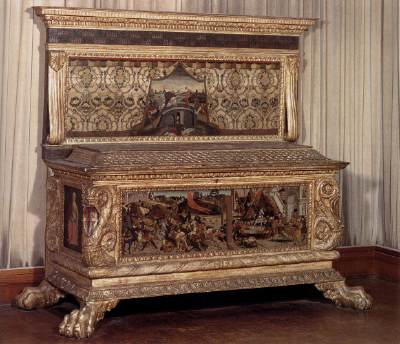
This photograph was taken from the Web Gallery of Art(www.wga.hu/index.html) To see this picture larger and more detailed please go to the Web Gallery. It is one of the best sites on the web and you can spend hours there.
JACOPO del SELLAIO
Cassone
1472
Tempera on wood, gold leaf
Courtald Gallery, London
This cassone (a Florentine wedding chest), one of a pair, was made for the wedding of Donna Vaggia di Tanai di Francesco di Nerli and Lorenzo di Matteo di Morello in 1472. The lower scene is Camillus Defeating the Gauls, the upper, Horatius Cocles Defending the Bridge against the Etruscans. The figures on the ends of the cassone represents virtues. The cassone was painted by Jacopo del Sellaio and Biagio d'Antonio, and the woodworker who built the chest was Zanobi di Domenico.
The Bed
Throughout history, in most countries, the bed was often decorated. On the footboard, headboard or both there were carvings, gildings or inlays. In 13th century Europe affluent people owned framed bedsteads of wood with carved and painted decorations were used as couches during the day and curtained off at night. During the later Middle Ages the hangings and their frames were taken on long trips for nightly use.
Along with the hangings were drawing curtains, an overhead canopy (or tester), and the �celure� which hung above the pillows before the introduction of the wooden headboard, and was frequently embroidered with the owner�s coat of arms. After the year 1500 the coat of arms was often carved on the headboard placed between two posts. When posts were at the foot of the bed also that particular type of bed became known as a �four-poster�. These posts supported the canopy above the bed. Later in the 16th century the headboards were substantial enough to support the canopy and often the head posts were omitted from the design. During Renaissance times the beds were boldly turned [on the lathe] and richly carved.
Drawing curtains were necessary because until the 18th century in most countries the bedroom was often the same room as the living room for the rich and poor alike. In late 16th century Holland, Germany and Sweden magnificent carved bedsteads were integral parts of living room architecture along with linenfold paneling at the foot and the head of the bed. In Brittany, Scotland and Wales the living room in farmhouses continued to feature cupboard beds, enclosed by doors, well into the 19th century. A half-tester or �angel� bed was a novelty introduced in France as early as 1672. It had no posts, but a canopy projecting from the wall above the head of the bed.
For the poor, the bed was, in most cases, a straw-filled mattress on the floor, or even the floor itself. Person servants of the wealthy might have slept on the truckle bed, which was a low frame mounted on wheels, which was kept underneath the master�s high four-poster in daytime. Sometimes the servant would sleep on the truckle bed while it was under the larger bed.
In better situations the peasants would have a wooden bedstead with a simple, paneled headboard and low turned posts at the foot. In Alpine countries the beds were often painted in lively colors, and in Scandinavia the beds were made of pine, sometimes relieved with shallow, carved decorations. In France the bed was seen as a status symbol and the king�s bed was given higher regard than the throne.
The Seat
The furniture known as a seat may have arisen from the ancient past when any item, a seat to raise one person over the others or a simply a mat placed on the ground for one particular person�s use was the sign of authority and this seat of honor led to the invention of the throne of monarchs.
During Gothic times the stool gave way to an object of solid wood, with slab ends splaying outward and joined below by a stretcher that passed through slots cut in them and secured by wedges. The seat was often a hinged lid over a boxlike compartment, making similar to a chest in appearance. By the 16th century�s end came the �joyned� stool with four turned legs joined to the seat frame and the understretchers by the mortise and tenon joint, secured by dowel pins. Dowel pins also fixed the seat to the frame.
The early Gothic chair of the mid 15th century very often had a box seat, possibly evolving from the chest. Slabs of wood enclosed the arms and later on panels within the framework became the new style. The back could be stiff and square or rise to a pointed arch. The shapes and carved decorations varied from one country to another. In Northern Europe chairs were scarce until the mid 16th century, the lord, his lady and possibly two honored guests had such seating arrangements while the rest sat on stools or on benches.
In Renaissance Italy, circa 1500, simple chairs were mass-produced. They were without arms, and were really back-stools, with slat (�ladder�) backs and rushed seats. They were soon regarded as humble objects; the affluent preferring chairs of a grander design with high backs and padded seats, mounted on X-shaped supports, turned columns or square legs relieved with fluting. This style made its way to France where the chair was designed in consideration to women wearing full skirts. The chair was known as caquetoire or �gossip� chair, which had a wide seat.
From 17th century Netherlands and England came the �farthingale� chair (as the English called it). The farthingale was the hoped metal frame over which the skirt was extended. This chair was a stool with a back as an addition; the seat and back were often padded. Armchairs of the late 16th and early 17th centuries were seldom padded; they served, however, as a sign of authority. The back panel and cresting rail were usually carved. The arms had a sloped downward to the front and the legs were turned to resemble columns or bobbins. There was also an item known as a �turned� chair, with a triangular seat, three turned legs and an assembly of turnings forming the back and arms.
The X-shaped frame that originated in ancient Greece and Rome made a comeback in the mid 16th century, this latest form of which was sometimes completely covered with leather, in velvet or in embroidered satin. This type of chair could be folded flat. During the Reformation it was known in Germany as a �Luther� chair, and in Italy a �Savonarola�. In early 17th century Italy, during the Baroque period, the affluent had their chairs covered with velvet and silk, and the legs were carved to resemble human figures and the arms of the chair were equally elaborately scrolled. Grotesque masks, entwined foliage and romping putti (cherubs) are used to form underframings and cresting rails. Chairs for family use were less garish, though still scrolled and upholstered.
Germany had their own approach to the Baroque, with straight-legged chairs that curved out abruptly at the feet, and with high backs carved in the �auricular� style, imitating the curves and crevices of the human ear. Paul van Vianen, a Dutch silversmith who studied anatomy, initiated this style early in the 17th century. The Swiss had a simplified version of this style with plain seat and legs and a low back, on which the grotesque carvings were concentrated.
While North America does not get much mention on this website there is some early 17th century furniture history to mention. William Brewster, who came to America on the Mayflower in 1620, was the elder and teacher at Plymouth, Massachusetts. John Carver was the governor of the colony. Two traditional types of American chair are named after them, both of simple design with solid seats and �stick� backs of turned spindles. The influence of design was both English and Dutch, since Brewster and many of the other Pilgrims lived in Leyden before venturing to New England.
England was late in accepting the Baroque style, slowly replacing Renaissance furniture in the first half of the 17th century. The Cromwellian chair had leather on back and seat, the leather sometimes tooled and colored in the Spanish style, similar to the Spanish �monk�s chair� of the late 16th and early 17th century.
Spain produced many elaborately ornate Baroque chairs that were probably influenced by Florentine and Venetian models, and the Portuguese produced their own furniture as well. France imported the Baroque look from Italy during the early 17th century, then over time made the chairs more comfortable without compromising the style.
The Chest
Chests made from hollowed-out logs were the first wooden receptacles made by ancient peoples. This was done with fire and flints. Dug-out chests made with steel tools were still being produced in some rural areas of Europe as late as the 17th century. As early as 1500 BC the Egyptians were constructing chests, some with domed lids and veneered with ivory and ebony or painted. The Greeks and Romans made elaborate chests shaped like sarcophagi. The Etruscans made small circular chests of wood and bronze. Byzantine craftsmen fashioned them with elaborate decorations in painting or inlay in ivory and precious metals.
During the early Middle Ages in Europe the chest was the most important piece of furniture in the house. It could contain the family valuables and could be loaded onto a cart it if was necessary to flee from enemies. In 13th century Southern Europe chests were carved in the Romanesque style, with rounded arches supported on columns. The horizontal boards forming the carcass being �housed� or slotted into the uprights or �stiles� at the four corners. This method of construction continued into the Gothic period in Northern Europe, though decoration differed per region. Westphalian adornment emphasized the very large strap hinges and strengthening bands of iron. The French displayed scrolled ironwork all over the lid and front, with the lockplate also of fine ironwork. The English preferred simple �chip� carving, a formal design chipped out of the surface with a chisel with little attempt at rendering it in relief. Linenfold patterns were carved on some, and a few had figures of knights.
In Italy the Gothic style was ignored and the classical tradition remained in fashion. During the Renaissance some of the really grand cassoni that were ordered by rich patrons as dower chests for their daughters were painted by fine artists using Christian saints or the gods and goddesses of Olympus as subject matter.
The cassone or chest often followed the outline of the Roman sarcophagus curving inward at the base and supported on lion�s-paw feet. Sometimes the decorations involved the Romanesque, Gothic and the classical styles all on a single piece of furniture.
16th century cassoni continued to be made in both curvilinear and rectilinear forms and both were used as the basis of the cassapanca with box seat, ornate back and arms, the forerunner of the sophisticated settee and the rustic settle. The cassapanca usually was placed in the entry hall of the palazzo, containing the owner�s wealth and watched by an armed guard.
During the early part of the 16th century important changes in the construction of the chest spread to Northern Europe. The Gothic chests were massive and were heavy to move. A lighter but crude alternative was the nailing of planks to a pair of slab ends, with no vertical stiles. Dovetailed joints in lieu of nails were a refinement. Early 17th century European adventures in Bermuda decorated their wooden chests with the varied cutting of the exposed dovetails to form an intricate pattern, and also utilized �scratch� carving, the design cut in continuous lines with a chisel, with no attempt at modeling in relief.
Paneled construction, an old method also was seen in Northern Europe in the 16th century, with the front, back and even the lid divided up to anywhere from two to four equal parts. Medieval Scandinavia had its own approach to woodworking, which was handed down from the Viking shipwrights, with turned posts at the corners instead of flat stiles, turned spindles set between the bottom of the box and the understretchers, and the top was often sloped and useable as a desk.
Another method of decorating the chest was with inlay or intarsia work, in woods of contrasting colors, metals and shells � a technique practiced with particular skill at Nuremberg in the 16th century, often on themes of landscapes with buildings. In Britain this type is known as a �Nonesuch� chest due to there being several examples which are supposed to depict the palace of that name, built by Henry VIII. They were probably imported from Germany or constructed by immigrant craftsmen. Light colored woods like box were inlaid into a darker ground of solid walnut in order to achieve brilliant effects.
In one example, a casket made in Augsburg circa 1570, the columns are of skillfully carved rock crystal with the elaborate inlaid decoration employing a variety of semi-precious stones. German craftsmen such as Peter Fl�tner and Lienhart Strohmeier adopted the Italian Renaissance style with enthusiasm. Augsburg and Nuremburg were the centers in Southern Germany for furniture decorated with inlay.
When the author speaks of �German� he is not refereeing to a sovereign state, but a cultural identity based on language common to Germany, Austria, Switzerland and the Low Countries. There was a difference in the furniture styles, however, the further south exhibited a stronger Italian influence, and the Renaissance idea was absorbed there earlier than the northern countries, where Gothic traditions were slower to be replaced. The wood used by these craftsmen had an effect on the type of ornamentation applied, pine from the alpine countries would be painted while oak and walnut found in the north would be carved or inlaid.
In the south, Islamic decoration of a formal kind introduced to Spain by the Moors, deliberately avoided portrayal of the human figure. Before the conquest of Sicily by the Normans, the Saracens for the Middle East brought the pointed arch of Gothic architecture. This mud�jar style of the Moors is seen in much Spanish furniture. One form of this style is seen in chest panels, in the inlaying of ivory arabesques into a walnut ground. Silver was also used, in 16th century Spanish furniture. Chests were modeled after the Italian cassone and embellished with classical columns, rounded arches and caryatids � architectural supports with their upper halves formed as human figures. The undersides of the chest lids were decorated with painting or carving. In peasant communities the Spanish Gothic version of the chest persisted into the 17th century and was decorated with chip carving.
The late 16th century iron box with elaborate locking devices known as the �Armada chest� was not Spanish, but German. Spanish influence, however, reached parts of the Netherlands, Portugal and to Spanish colonies in the Americas with Spanish-style furniture being produced in Mexico before 1600.
What little furniture that survives from Portugal before that date indicates that the Spanish and Italian types influenced it.
English carpenters also made use of paneled construction, although they blended certain Renaissance features with the Gothic. Traditional linenfold and chip-carved roundels appear on panels within a framework decorated with �strapwork� � the very flat carving of hook-like scrolls which was derived through the Netherlands from Spanish-Moorish sources.
While the term �coffer� is used to describe conventionally shaped chests, purists insist that is should be used exclusively for chests with a domed or arched lid � �coved� or �coffered� � also known as an �ark�, a shape familiar in Holland, Scandinavia and the North of England from very early times. In farming communities this lid was also hollowed out and used for carrying the grain that was stored in the chests.
In the Netherlands large chests of paneled construction were decorated with fluted columns superimposed on the stiles, and the panels were frequently carved with Romayne work � portrayals of classical gods and goddesses or profiles of the owner and his wife disguised as Greeks and Romans. Circa 1580, designs for furniture with Renaissance ornamentation were published by Hans Vredeman de Vries, providing patterns for Dutch, Flemish, German, Swedish and English craftsmen. He was most likely familiar with the French Mannerist designs of Jacques Androuet Ducerceau and Hughes Sambin, which appeared in 1550 and 1572, respectively, employing the human figure and grotesque animals as subjects for the woodcarver. Jacob Steiner and Veltin Redner also produced chests that featured romayne work.
During the 17th century in Italy the Mannerist habit of depicting figures in isolation was replaced by the Baroque style, which was more complex. The entire front of the cassone was enriched with inlaid designs of armorial bearings or by carving in depth of classical figures, foliage and scrollwork, framed in heavy mouldings. The use of mouldings as a means by which the surface was decorated became popular during this century, in the form of geometrical patterns based on Spanish-Moorish forms. This often appeared with split-baluster turning on the lathe � two lengths of wood either matching or contrasting in color glued together and turned on the lathe. Split open, the flat side of the wood could be glued to the surface of the furniture. This style spread across Europe and to America and also became an element of the �Jacobean� style.
The Bible box was a small chest, popular in Holland, Britain and America from circa 1650 to 1750. It was often placed on a stand and frequently carved with a date and the owner�s initials. Along with the Bible it also housed important documents.
Some late 17th century American chest-makers were: Joseph Brown, Edward Dear, Thomas Dennis and William Searle of Ipswich, Massachusetts; the Allis and Belding families, and Peter Blinn, in the Connecticut River valley.
Not all American chests were of simple box construction. Some were fitted, wholly or partly, with drawers. This started in late 16th century Europe, with small drawers placed inside dome-topped traveling chests. Early 17th century saw the placement of one long drawer or two small ones set at the base of the chest. This novelty became a minor status symbol; some chests had the drawers at the bottom and the front of the chest decorated with mouldings to give the appearance of more drawers. The chest with the box above and the lower drawers became known as a �mule chest�, a hybrid of two styles. Additional drawers were added until the entire carcass was occupied, this is known as a chest of drawers, which developed from the mule chest.
The chest of drawers
In the late 17th century the method of making the chest of drawers changed. The original method was adapted from the construction of the boxlike chest; a frame and set panels at the ends. The joiner would construct the carcase in solid wood (oak or pine), and when he was through the cabinetmaker would veneer the piece of furniture. Originating in the 1660�s was the French version of the chest of drawers, which was also known as a commode. In its most opulent form it was veneered with walnut and ebony decorated with marquetry. The master cabinetmaker was Andr�-Charles Boulle. He is known for the decorative technique known as �Boullework�, the inlaying of Arabesques and chinoiserie designs of great complexity that were cut out in sheet brass, into a ground of transparent tortoiseshell.
The Board and the Cupboard
The grand tables in Roman times were not available in the early Medieval Ages. Castle dwellers would gather around large tables that would be disassembled when the meal was over. The table was actually large boards resting on trestles that were shaped like pairs of triangles joined together at top and bottom. As time progressed to the Gothic period the supports became single posts resting on a crossbar and with a parallel crosspiece above on which the top rested. Another style, influence by church architecture, was also used. The base was shaped like a square cross and from it rose four buttressed verticals set at right angles to each other.
Some Italian Renaissance tables were inspired by the ancient Roman principle of resting the top on two or three slab-like supports, elaborately carved in stone or wood to represent animals or monsters. The tables made of stone, with inlaid marble tops, were closely modeled on Roman originals. These were only used by the wealthiest of peoples. The tables made of wood were less faithful to the classical prototypes, but more imaginative in their use of strange figures, which were half animal and half human.
This fanciful imagery of Mannerist designs was kept within bounds by a powerful architectural discipline, evident in the mid 16th century designs of Jacques Androuet Ducereau of Lyons and Hugues Sambin of Dijon. Some French Renaissance tables had mythological figures carved to form end supports, but between them ran a secondary support of rounded arches resting on turned pillars, while some of Ducereau�s designs for tables eliminated the sculptured figures entirely and concentrated instead on Corinthian columns.
The traditional Spanish table appeared before 1600. Also at this time in Germany the table with X-shaped end supports was developed and replaced the simpler trestle version. A table capable of extensions was invented in the Netherlands, also circa 1600. It featured a framed construction of four boldly turned legs, joined together by a frieze above and stretchers below. The top rested on this frame, but was not fixed. Concealed beneath it at each end was a leaf that could be drawn out, supported on sliding bearers. When both leaves were fully extended the main part of the top dropped automatically into position. This table became the popular style in Britain, where long narrow tables with four, six or eight bulbous-shaped legs were known as �refectory�.
Folding tables popular in Italy and South Germany in the 1600s had shaped slab ends connected by an understretcher, rounded drop leaves supported by swinging legs or iron brackets and a deep drawer at one end. The �fold-over� gateleg table was more usual in France, the Low Countries and Britain circa 1610 to 1650. This formed a half-round side table when closed, opening to a full circle with the leaf supported by a swinging �gate� [according to one of the pictures in the book, this �gateleg� was a leg attached to the frame beneath the table which could swing like a gate, inward when the table leaves were down and outward to support the raised leaves].
A similar table with an octagonal top was known as a �credence� table. It was replaced in popularity by the conventional gateleg with two drop leaves supported on legs turned to a bobbin, baluster or spiral shape. Exceptionally large examples had two gates supporting each leaf. The gateleg table was popular in the Netherlands, Britain and America. Made of oak, walnut or fruitwood this design lasted well into the 18th century with alterations in construction and design.
The console table
The console table or architectural side table in late 17th century Italy had a top of Florentine mosaic work � incredibly detailed designs being laid out with minute pieces of colored stone, set in plaster on a slab of stone, resting on a Baroque stand, probably a piece of sculpture in wood depicting the human figure, in the style of Brustolon. In France, slightly more restrained versions were designed by Jean le Pautre. In Germany, Augsburg and Nuremberg led in the production of this style, some of which were overlaid in solid silver, and the side table and center table were the sign of a family�s wealth.
The Dresser
Originally the French dressoir was a board placed at the side of the room on trestles � a sideboard on which drinking cups were placed. This was the �cup board�. Signifying wealth and rank, the dressoir (or buffet) was soon constructed in several stages or tiers, their number being decided according to social standing. They were elaborately carved, and had grotesque figures below and sometimes with doors enclosing the upper tier. The English version was the �court cupboard�. While the upper level was not enclosed, the English version allowed for three tiers. Few of these cupboards had the supports shaped like monsters, they featured bulbous turnings instead.
The American cupboards were styled the same. Early 17th century saw the open spaces of the English cupboards enclosed and what little exterior shelf space remained was allowed for with the ends of the shelf being canted [carved at an angle].
The Armoire
The French cupboard, like the English, gradually came to being fully enclosed, though it was produced in two sections and called an armoire � deux corps � a two-part cupboard. Prior to the 17th century the carving was usually rich, although disciplined and the upper stage was slightly smaller than the lower. After 1600 the carving tended to cover the entire surface and the upper section was a wide as the part beneath. This led to the construction of a one-piece wardrobe, the armoire. This single unit was actually present since the Middle Ages as the church sacristy cupboard. And in the North of Germany the one-piece wardrobe existed long before the French version. 16th century Germany also had enclosed two-stage cupboards, the upper stages having caryatid [a sculptured, fully-clothed female figure instead of columns] supports to the cornices and vivid inlaid decorations on the panels of the doors.
During the 17th century in Italy the cassone went out of style and was replaced by the armoire that was either two units or one massive piece of furniture. It had spiral columns or classical pilasters supporting the projecting cornice. The decorations were Renaissance-style carvings, and the inlays were known as intarsia, which was remarkable for the optical illusion of perspective created in the designs of buildings and landscapes.
Late 17th century the French armoire was decorated with brass inlay on a tortoiseshell ground in the manner of Boulle, and something that only the affluent could afford. More modest armoires were made in oak, walnut or fruitwood.
The Cabinet
The luxury item of furniture was the cabinet. Although it was use to house smaller valuables its main purpose was as an indication of wealth. Beginning as a large one-piece object the cabinet was downsized and set on a stand in the 17th century. The upper stage had many small drawers that were either in plain view or hidden behind doors. The drawers and doors were lavishly decorated as well as the legs of the stand. In Italy the drawer fronts were inlaid with Florentine mosaic or encrusted with pietre dure. In Spain the papeleira had drawers veneered in ivory or tortoiseshell. The contador of Portugal was fitted with heavily moulded, projecting drawer fronts. The stand on which it was set on had a deep apron that was fretted and carved, between boldly turned legs. In Holland and Britain, after the year 1660, the cabinet drawers were finely veneered in walnut and decorated with marquetry, and enclosed by doors treated in the same manner and the legs were spiral or turned into the converted cup shape. From France came very detailed work decorated with Boullework, mounted on elaborately carved legs. From Antwerp in the Netherlands came magnificent Baroque cabinets. The drawer fronts carefully painted on marble, the stands carved with the figures of Negroes, muses or caryatids.
During the 17th century trade with Japan and China was underway and one of the more popular items was the lacquer cabinet. Like the European article it had drawers within closed doors and the piece was richly decorated in lacquer. Usually without stands, the cabinets were mounted on Baroque supports. These supports were richly carved and gilded, but had little or no stylistic resemblance to the imported piece. The first of these cabinets arrived in 1600 and sixteen years later, William Smith, an Englishman, was in Rome copying them. This soon became a popular industry with centers in Venice, London, Spa, Berlin and at the Gobelins factory located outside Paris. The Portuguese did well in trading both the originals and the copies, as well as selling their own copies in Paris.
The Bookcase
Before the printing press books were composed by hand and being so rare they were locked inside chests or were displayed individually as works of art, on wall brackets or chained to reading stands. With the Renaissance came the increasing number of volumes and to accommodate them cupboards and shelves were built into the walls of the room that became the library. Freestanding bookcases arrived in quantity after the mid-17th century.
The Desk
During the Medieval era the desk had a sloping top on which manuscripts and books rested. It was sometimes mounted on a stand, but usually placed on a table or on the writer�s knee.
During the Renaissance in Germany small writing tables were made. They were often ornately carved, with a pendant turning below each corner of the frieze and some have cleverly concealed drawers. Some of the earlier forms of this table had rounded leaves that could be folded down.
In Spain, the vargueno (writing cabinet) first appeared in the 16th century and has lasted there since. The upper stage was of boxlike construction, fitted with many small drawers and a writing leaf that was hinged at the lower front edge, enabling it to be in the vertical position when closed. The stand was sometimes an architectural construction of turned legs, or a carcass fitted with doors or deep drawers. It was usually elaborately decorated. Designs of the Spanish-Moorish combination were inlaid in silver in the style known as �plasteresque�. Fine wrought iron was mounted on a background of tooled leather or rich velvet, while engraved or painted plaques of ivory were often used on the drawer fronts.
The French bureau Mazarin of the Louis XIV period was named after the monarch�s principal minister. It was a flat-topped writing table that stood on eight legs. During the 1660�s these legs were vertical, square and tapering with bold protrusions near the top, but towards the closing of the 17th century they were usually scroll shaped. The bureaus had three drawers of either side of the front, the fronts being bowed in the later versions. There was also another drawer located in the center of the bureau, above the kneehole. The usual decoration was Boullework. Other countries copied this style. Gerriet Jensen, a Dutch craftsman who immigrated to London late in the 17th century was one of the artists known for producing such furniture.
In Holland and Britain, simpler styles were produced. These writing tables had one drawer in the frieze and stood on spiral legs. The tops of these pieces were decorated in marquetry, vases of flowers being the preferred subject matter. Sometimes the owner�s coat of arms and monogram would also be displayed. Antwerp was an important center for marquetry work, Peter de Loose and Michel Verbiest known for their excellent artistry.
While the following is way beyond the Medieval period it was interesting and I decided to add it to this webpage: Oval and kidney-shaped desks became popular about 1800. Giovanni Socchi, a Florentine cabinetmaker working in the French Empire style made some ingenious desks with extending tops and concealed chairs that slid out when needed. The kind of mechanical conjuring trick is really more typical of German craftsmen of the period; one such craftsman, Peter Kinzing, produced some highly contrived furniture at the Neuweid workshops. A favorite device of his was a set of drawers, which rose from the flat top of a desk at the touch of a button.
The desk with a fall front that rests on the carcass at an angle when in the closed position � the English �bureau� � was made in many countries and was descended from the Medieval desk with sloping top. Originally, this sloping surface was hinged at its upper edge to give access to the interior. Late in the 17th century it began to be hinged on the lower edge, so that it could be lowered and rested on two supports that slid out, which were known as �lopers�. The interior was fitted with small drawers. There was often a small cupboard placed in the middle of the range of drawers, and on either side of the cupboard were columns that hid secret drawers. In the late 17th century this style of desk originally rested on a separate stand composed of turned legs. When a cupboard or cabinet sat on top of this particular piece of furniture it was to be known by several names: the �secretary cabinet�, �bureau bookcase�, or �bureau cabinet�. A bonnet top and the decorative use of a large shell often distinguish the earlier form of the American secretary desk.
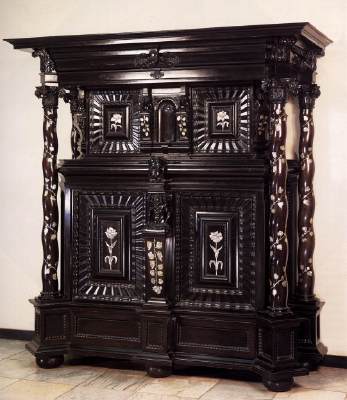
This photograph was taken from the Web Gallery of Art(www.wga.hu/index.html) To see this picture larger and more detailed please go to the Web Gallery. It is one of the best sites on the web and you can spend hours there.
DOOMER, Herman
Cupboard
1640s
Oak veneered with ebony, kingwood and rosewood, inlaid with mother-of-pearl and ivory
Rijksmuseum, Amsterdam
The cupboard is a work of supreme craftsmanship. The oak structure is entirely veneered with ebony and decorated with mother-of-pearl inlay in the shape of flowers and butterflies. The working of the ebony is skilful, particularly the sculpted work.