 ........................................
 ........................................
Christopher Columbus (1451-1506):
1484: Columbus asks King Joao II of Portugal to sponsor a western voyage to Japan (known to Europe as Cipangu).
1485-1486: The plan is rejected. While in Spain, Columbus seeks the help of Don Luis de la Cerda, the Count of Medina Celi, who arranges a meeting between Columbus and Queen Isabella. No deal is made.
1488: Returns to the Portugese king, rejected once again.
1490-92: Columbus rejected again in Spain, but due the efforts of Luis de Santangel, Marrano treasurer at Aragon, Spanish authorities finally approve of the voyage. Columbus was then appointed Admiral of the Ocean Sea, Viceroy and governor of whatever territory he might discover.
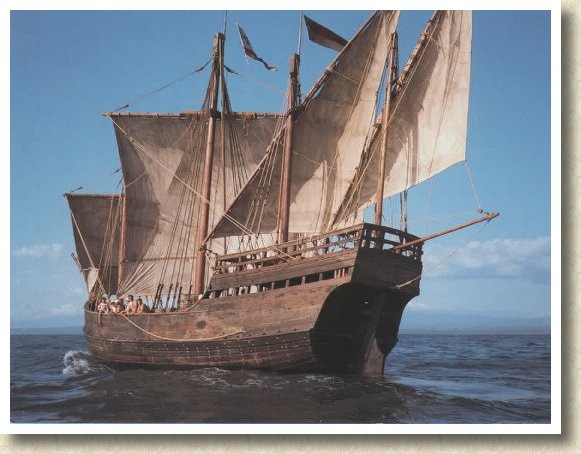
8-3-1492��3-15-1493: Columbus sets sail as commander of the Santa Maria. Vincente Yanez Pinzon commanded the Nina, and Martin Alonzo Pinzon commanded the Pinta. The crew totaled 90 men. (While exploring the Caribbeans, Columbus would meet the Caribs, who ate human flesh. Columbus called them Caribals. The word cannibal, now used to describe such people with this revolting, demented and unhealthy habit is quite similar.)

10-12-1493: With his crew threatening mutiny, Columbus sights land, an island in the Bahamas that he named San Salvador. He then explored the Bahamas, the northeastern Coast of Cuba and the northern coast of Hispaniola (Santo Domingo).
12-25-1493: The Santa Maria wrecks off the coast of Hispaniola, where Columbus establishes a colony (La Navidad).
9-25-1493��6-11-1496: Second voyage. This time with 17 ships and 1,200 men, his brother Diego among them. Explores the Leeward Islands and Puerto Rico. Returns to La Navidad to find the colony destroyed. Establishes another colony (Isabela) on Santo Domingo. He then explores the southern coast of Cuba, Jamaica and Hispaniola. The colony of Isabela is abandoned and the city of Santo Domingo is founded, Columbus leaves his brother Bartholomew in command.
5-30-1498��11-25-1500: Third voyage. With seven ships, Columbus explores Trinidad, and some of South America. When he returns to Santo Domingo to find the colony in a state of rebellion. The city gets a new governor; Francisco de Bobadilla, Columbus and his two brothers are sent home in chains.
5-11-1502��11-7-1504: Fourth voyage. Explores Martinique and Central America. Columbus' ship wrecks and he is marooned in Jamaica for a few days before returning home to Spain.
John Cabot (Giovanni Caboto) (1450-1498):
5-2-1497��8-6-1497: First voyage. After migrating to England and working as a mariner for 13 years, Cabot is hired by Henry VII to discover new regions for England. His son Sebastian joins him on the voyage to Newfoundland and down the eastern coast of North American to Maine.
(early)-5-1498: Second voyage. Looking for a route to Japan, Cabot journeys along the North American coast, as far south as Delaware or the Chesapeake Bay.
Amerigo Vespucci (1451-1512):
?-4-1499-�?-6-1500: On an expedition to South America, Vespucci's ship separated from the vessel commanded by Alonso de Hajeda and explored independently. (On board with Hajeda was Juan de la Cosa, who joined Columbus on his first and second expedition.) Vespucci's ship explored the South American coast, in particular the mouth of the Amazon River. With the other ship already on its return to Spain, Vespucci explored the Bahamas and Azores.
1501: Second voyage to South America, southward to Argentina.
Concludes that South America is a new continent, independent of Asia. There is some dispute over his letters to his former patron. While some are accounted as authentic, some are considered forgeries. According to the letters, Vespucci made four voyages, and in 1497 he explored the Atlantic coast of North America.
Vincente Yanez Pinzon:
?-11-1499��9-30-1500��The former captain of the Nina, Pinzon sailed to Brazil, and most likely explored the Amazon.
1508: Set sail from Hispanola and explored the coasts Central America, namely Honduras and Yucatan.
Pedro Alvarez Cabral:
1500: Brazilian coast.
Rodrigo de Bastidas:
1501��Northern coast of South America.
The "Company of Adventurers to the New Found Lands":
1502-1505: Anglo-Portugese expeditions possibly to the Middle Atlantic States.
Sebastian Cabot:
1509: Explores the Hudson River
1526-1530: Explores Argentine rivers
Juan Ponce de Leon:
3-13-1513��Setting sail from Puerto Rico, De Leon sought lands north of Cuba. Explored the entire eastern coast of Florida and a portion of its western shore. Also explored the Florida Keys and the Bahamas.
Vasco Nunez de Balboa
9-23-1513: From the colony Santa Maria de la Antigua, Balboa explores Panama, and discovers the Pacific Ocean.
1515-1519: Several Spanish explorers to Brazil, Mexico, Yucatan, the Gulf of Mexico and Florida.
Fernando Magellan
9-20-1519: Embarks from Spain in an attempt to circumnavigate the globe. With him were 241 men and five ships. Two of his captains were Juan de Cartagena and Sebastian Elcano. Antonio Pigafetta was a historian who kept a journal of the adventure. When low on supplies they had to eat worm-infested biscuits and rats. Cartegena led a mutiny, and Magellan marooned his foe on Patagonia. Though he survived mutiny, natives in the Philipines who were engaged in tribal warfare 4-27-1521 killed him. Only one ship remained and Del Cano, Pigafetta and 16 others completed the mission.
The following is from Pigafetta's journal:
Wednesday, the twenty-eighth of November, 1520, we came forth out of the said strait, and entered into the Pacific sea where we remained three months and twenty days without taking in provisions or other refreshments, and we only ate old biscuits reduced to powder, and full of grubs and stinking from the dirt which the rats had made on it when eating the good biscuit, and we drank water that was yellow and stinking. We also ate the ox hides which were under the main-yard so that the yard should not break from the rigging: they were very hard on account of the sun, rain, and wind and we left the for four or five days in the sea, and then we put them a little on the embers, and so ate them; also the sawdust of the wood, and rats which cost half-a-crown each, moreover enough of them were not to be got. Besides the above-named evils, this misfortune which I will mention was the worst, it was that the upper and lower gums of most of our men grew so much that they could not eat, and in this way so many suffered, that nineteen died, and the other giant, and an Indian from the country of Verzin. Besides those who died, twenty-five or thirty fell ill of divers sicknesses, both in the arms and legs, and other places, in such manner that very few remained healthy.
Hernando Cortes:
1519-1521��The conquest of Mexico: Cortes leads an expedition into the province of Tabasco, Mexico. Defeats the Tabascan and Tlascala "Indians". South America is dominated by the Aztecs. They are among the most fearsome savages of all time, practicing an as-pagan-as-you-can-get religion that called for the sacrifice of human captives, cutting out their hearts that are still beating as they are offered to the sun. Since they were also cannibals, they ate the limbs of their human sacrifices. Montezuma amicably received Cortes, but the Spaniards did not respect the Aztecs or their customs (even though they could be just as violent). While the Spaniards were outnumbered, they had horses and armor and the help of some of the natives who feared the Aztecs. The Spaniards crushed a revolt and defeated the Aztecs in 1521.
1519-1530: Spanish exploration of Atlantic coasts from Florida to South Carolina, and northward to Nova Scotia, also Mexico and Gulf of Mexico.
Giovanni da Verrazano:
?-12-1523��1524��South America and the Carolina coast to northward the Harbor Hudson River, Narragansett Bay and further to Nova Scotia. Verrazano was the first European to participate in a multi-cultural experience. The cannibals of Guadeloupe ate him.
Francisco Pizarro:
1531-1533--Conquered the Incan empire of Peru.
Jacques Cartier:
1534-1535��North American Coast and Canada's interior. May have be on the Verrazano expedition.
Don Garcia Lopez de Cardenas:
Discovered the Grand Canyon in Arizona in 1540.
Francisco Vasquez de Coronado:
Explored New Mexico, Texas, Oklahoma, Kansas in 1541.
Hernando de Soto:
Explored the Mississippi River in 1541.