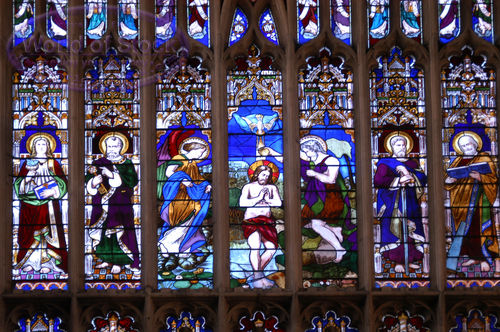
I have decided to add more to the study of medieval religion and in order to understand this subject you have to do a study of the Catholic Church and the Protestants. This information came from: The Pocket Bible Handbook by Henry H. Haley.
The History of Medieval Religion and the Catholic Church.
Long before the Taliban and Al Qaeda the popes and the Catholic Church made life miserable for millions. There is a dispute over the origins of the Catholic Church. The Catholics claim that they have their roots in Peter, the apostles and the teachings of the Messiah, while Protestants say this in not true. I personally do not believe that Peter was the founder of the Catholic Church. The Catholic Church did so many things anti-bible and anti-messiah, including torturing and murdering millions of people during the Inquisitions and forcing others to believe in their doctrines. It is impossible that something so vicious and corrupt would have its roots in the Truth.
Three Periods:
Roman Empire period: Persecution, Martyrs and the Christianizing of the Roman Empire
Medieval Period: Growth and power of papacy and the Inquisition
Modern Period: Protestant Reformation (availability of the bible for non-clergy, freedom of civil govt. from church control)
The notion that the Church at Rome should have vast powers began in the late 3rd century (circa 250-260). The Council of Sardicia (343) was first to recognize the authority of the Roman Bishop.
Even though Christians were severely persecuted by most of the Roman Emperors, Christianity was widespread in the Roman kingdom, about half the population in the early 4th century.
312: Emperor Constantine claimed that during a battle he saw a sign in the sky - a vision of the cross and the words "In this sign conquer."
The Edict of Toleration: In the year 313 Constantine granted to Christians and all others full liberty in following that religion which each may choose. He favored Christians, filling offices with them and gave exemption from taxes and military service for ministers. Christianity was the religion of his court and he encouraged and helped with the building of churches.
In 325 Constantine exhorted his subjects to convert. Had bibles made and made Sunday a day of worship. With Christianity virtually the state religion of the Roman Empire it had a powerful voice in world politics. Constantine thought himself to be head of the church. The other provinces were yet under Rome�s jurisdiction.
331: Since many Roman leaders clung to paganism Emperor Constantine moved the capital to Byzantium, renamed it Constantinople, the capital of the Roman Empire.
Late 4th century: Christianity was dominated by 5 centers: Rome, Constantinople, Antioch, Jerusalem and Alexander. All bishops (known as Patriarchs) had equal authority over his province. In 395 Antioch, Jerusalem and Alexandria leaned towards Constantinople, beginning the struggle between it and Rome.
Emperor Thesodosius (378-397) made Christianity the State Religion. He made church membership compulsory and this flooded the churches with non-believers. On the positive side the Empire became civilized; slavery, gladiatorial fighting, crucifixion and killing of unwelcome children (?) were abolished. Theodosius suppressed paganism, had temples destroyed and pagans killed. Worship, however, evolved into elaborate ceremonies. The Empire was divided (395) and there was the Roman church in the west, Greek in the east.
Leo I (440-461) is considered by some historians to be the first pope. On two separate occasions he convinced the invading Germans to spare Rome. This went to his head and he claimed to be, by divine appointment, the Primate of all bishops. In the year 445 he obtained Imperial Recognition from the Emperor Valentinian III. Leo proclaimed himself to be the lord of the whole church and the holder of universal papacy. According to Leo, resistance to his authority was a one-way ticket to hell and to make sure that you got there he advocated the death penalty for heresy (disagreeing with him on any issue).
The Council of Chanceldon: In the year 451 the bishops still gave the patriarch of Constantinople equal status with Patriarch of Rome.
When Rome fell in the year 476 the popes were freed from the rule of emperors and civil authority. They began dealing with the various Germanic kingdoms and their military might helped them to gain much power. This began the "Dark Ages", the beginning of Papal power. Meanwhile, the Germans, (Goths, Vandal and Huns), who destroyed Rome converted adding more paganism to Christianity.
Gregory I (590-604) is generally regarded as the first Pope. Controlled the churches of Italy, Spain, Gaul and England. He removed unworthy bishops, opposed simony (sale of office), sought justice for the oppressed and charities for the poor. Encouraged Bible reading. He did not consider himself to be "Universal Bishop" though he wielded the power of one.
632-638 Syria, Palestine and Egypt fell to Mohammedanism; Constantinople remained Christian.
Zacharias (741-752) declared Pepin to be the king of the Franks (a kingdom of West Germany and North France). (Pepin was the son of Charles Martel who in 732 spared Europe from the invading Turks.)
Stephen II (752-757) sought advantage from the political alliance that got Pepin to invade Italy and conquer the Lombards. In return, Pepin gave Lombard lands (much of Italy) to the Pope. This land grab was known as the Papal States or Temporal Dominion of the Popes, giving them civil control of Rome and Central Italy. This lasted for 1100 years until 1870 and the arrival of Napoleon, who eliminated the Papal States.
Leo III (795-816): In 774 Pepin�s son Charlemagne recognized the pope's temporal Power over the Papal States. In return, in 800, Leo gave the title of Roman Emperor to Charlemagne. Roman and Frankish real estate now made up the Holy Roman Empire.
The capital moved from Constantinople to Aix-la-Chapelle (in Western Germany). According to this popish plot the Western Empire was re-established and considered to be a continuation of the old Roman Empire. The Germanic kings were not only Emperors but given the title of "Caesars" as well.
Nicholas I (858-867): Based his claim of universal authority on a book of forgeries known as the Pseudo-Isidorian Decretals. This was a collection of forged letters and decrees of bishops from the 2nd and 3rd centuries that exalted the power of the pope. The claim of universal authority caused a final rift between the East and the West. This began in 869 and the separation was completed in the year 1054.
From the years 870-1050 the Roman church suffered from an abundance of corruption and immorality and the buying of the office of the pope. At the end of this period the Emperors were no longer allowed to appoint church officers or elect popes. Church Cardinals now chose the popes from the Roman clergy.
Henry IV, German Emperor waged war against the papal armies of Pope Gregory VII (1073-1085) over these restrictions, and Gregory died in exile. This war lasted 50 years and 5 other popes until 1122 when a compromise was reached in the Concordat of Worms. The emperors who defied the agreement still chose their popes, known as anti-popes.
Pope Innocent II 1130-1143 needed the protection of armed men to keep his office.
Pope Alexander III (1159-1181): His armies fought another war against German Emperor Frederick Barbarossa. Alexander died in exile.
Innocent III 1198-1216: This pope was anything but innocent. His claimed to be the: Vicar of Christ, Vicar of God and the Supreme Sovereign over the Church and the World. He also claimed the right to depose kings and princes, and that all things on earth and in heaven and in hell are subject to the Vicar of Christ. All kings of Europe obeyed Alexander and he controlled the Byzantine Empire. Began the tradition of auricular confession, insisted upon Papal infallibility and forbade the reading of the Bible in vernacular. Ordered the extermination of heretics and instituted the Inquisition. (Heresy: disagreeing with anything the pope says.)
Inquisition: called the Holy Office, the Church Court for detecting and punishing heretics. The Inquisition was placed into the hands of Dominican monks. The Inquisitor had the accused tortured then the accused was given to civil authorities for either life imprisonment or to be burned to death. The church and state divided the victim's property. The Inquisition lasted for 500 years.
Between 1540 and 1570 900,000 to 1,000,000 Protestants were murdered. At the beginning of the Inquisition was the extermination of the Albigenses of France by secular armies. The Spanish Inquisition ended in 1834.
1229: Bible reading by laymen is forbidden.
By 1254 the church had won the battle against the German Emperors. Boniface III (1294-1303) the Unam Sanctam declared that every human creature be subject to the Roman Pontiff.
Philip the Fair, who was king of France, took up the fight against the Catholic Church and defeated it. 1304 the Papal palace moved from Rome to Avignon and the Papacy was controlled for 70 years and a new round of immorality and corruption. This was called the Babylonian Captivity, but the Catholic Church was always Babylonish.
From 1377-1417 was the Papal Schism with popes in Rome and Avignon.
Nicholas V (1447-1455) authorized the king of Portugal to enslave the Africans (and agreed to by Protestants 100 or so years later).
Sixtus IV (1471-1484) Sanctioned the Spanish Inquisition. Collected money to free sinners from purgatory. Indulgence: the remission of sin for money
Innocent VIII (1484-1492): Had accumulated great wealth. Wanted the Waldenses exterminated. Appointed Thomas of Torquemada Inquisitor General in Spain.
Leo X (1513-1521) Pope when Luther started Protestant Reformation.
1481: The Inquisition, now led by Jesuits, took aim at the Protestants. This order founded by Ignatius Loyola (1491-1556) called for absolute and unconditional obedience to the pope. The Jesuits were behind the St. Bartholomew's Massacre in North France, religious wars, the persecution of the Huguenots and the revocation of the Toleration Edict of Nantes. They also were involved in the French revolution and murdered people all over Europe (and probably even in the Americas).
Paul IV 1555-1559 established the Roman Inquisition.
Gregory XIII 1572-1585 urged Phillip II France to war against England.
Since I am concerned with Medieval History I will end this study at the close of the 16th century. I will tell you that further popes called for inquisitions massacres and reigned over kings. They also condemned bible reading, translations, religious freedom, protestants and other non-Catholics to hell, freedom of speech and press, separation of church and state Americanism, religious toleration and liberty, and insisted in infallibility only true church pope holds upon the earth the place of the almighty, and obedience to them for salvation, submission to Rome.
Popes who were against the reading of the Bible: Hildebrand, Innocent III. Gregory IX was against Bible translations by Albigensus and Waldenses were burned them along with their Bibles. Paul IV.
Hildebrand "Overlord of kings and princes�.
Innocent III "Supreme Sovereign of the world�.
Clement VIII on the Toleration Edict of Nantes: "Liberty of conscience is granted to everybody is the most cursed thing in the world.
1700 Clement XI and his Jesuits, Leo XII, Pious VIII and Gregory XVI. Pious IX condemned Bible societies.
Pious Ix condemned separation of Church and state.
Leo XIII "head of all rulers�.
At coronation a crown is placed on the new pope�s head and the following words are recited: " Thou art Father of princes and kings, ruler of the world and Vicar of Christ.
